Author: William M. Peaster

Bankless author William M. Peaster mentions that he has been following a series of experimental projects by independent developer ross.wei. Previously, he had engaged in several Ethereum-oriented attempts, such as Wei Name Service, zFi, zOrg, zSwap, SLOW, Majeur, and recently seems to have entered a high-frequency "vibefi coding" state.
What particularly interests the author is that ross.wei has recently begun to delve into Bitcoin DeFi, attempting to build truly trustless financial building blocks with privacy on Bitcoin almost as a "one-person development" effort. From the technical possibilities demonstrated by his new project Tacit, this is being done quite well.
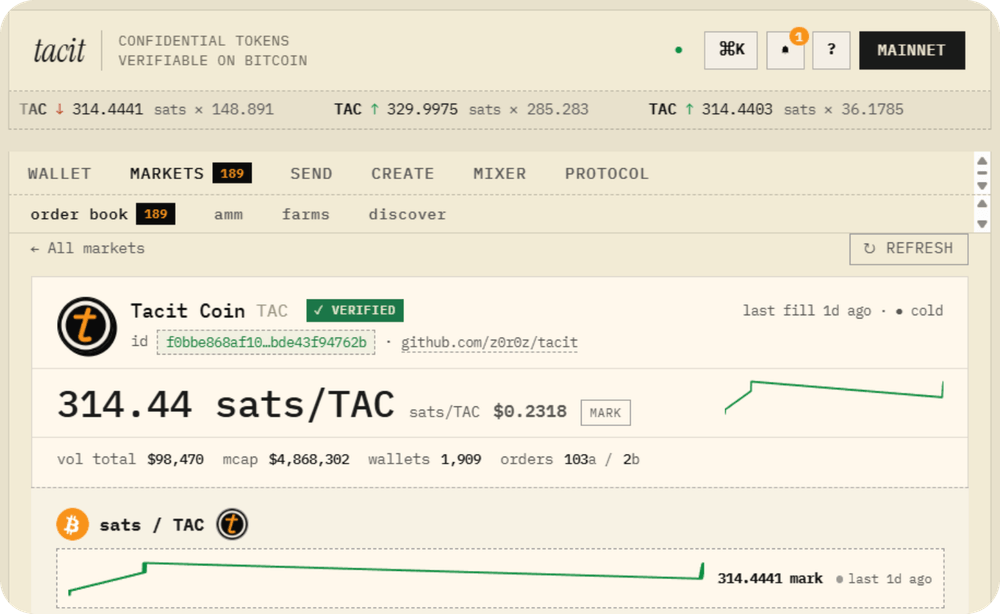
In short, Tacit is a meta-protocol built on Bitcoin, with a customized indexer verification system. Its trust model is similar to the patterns seen in Ordinals or Runes: the token rules are executed by an indexer that anyone can run, and everyone can independently arrive at the same results based solely on on-chain data.
However, Tacit has advanced this model from "ordinary tokens" to "privacy DeFi." You can directly check its live mainnet tacit.finance or read the complete specifications; the core idea is that it combines Zcash-style privacy capabilities with Runes-style token deployment infrastructure and then overlays DeFi functions on top. In other words, it attempts to use cryptography itself to replace what you typically think is an essential smart contract virtual machine.
A critical point is that, in Tacit, the number of tokens is hidden by default. Each balance is behind a Pedersen commitment. You can think of it as an encrypted "numerical commitment": it can hide specific numbers while allowing you to prove certain things, such as "no one is creating tokens out of thin air."
On top of that, Tacit also provides a shielded pool similar to Tornado Cash for anonymous spending. In this design, a deposit and its corresponding future withdrawal will not show a visible direct relationship on the chain.
Additionally, it introduces a native privacy AMM. This AMM will hide the specific exchange amounts of each trader while keeping the liquidity pool reserves public. More interestingly, since there is no actual UTXO to hold the funds of the entire pool, theoretically, it reduces the point where "the project team runs away with the funds."
The more complete piece of the current Tacit puzzle is trustless wrapped BTC and a trustless ETH→Bitcoin bridge implemented through tETH. It is worth noting that tETH also has mixer functionality.
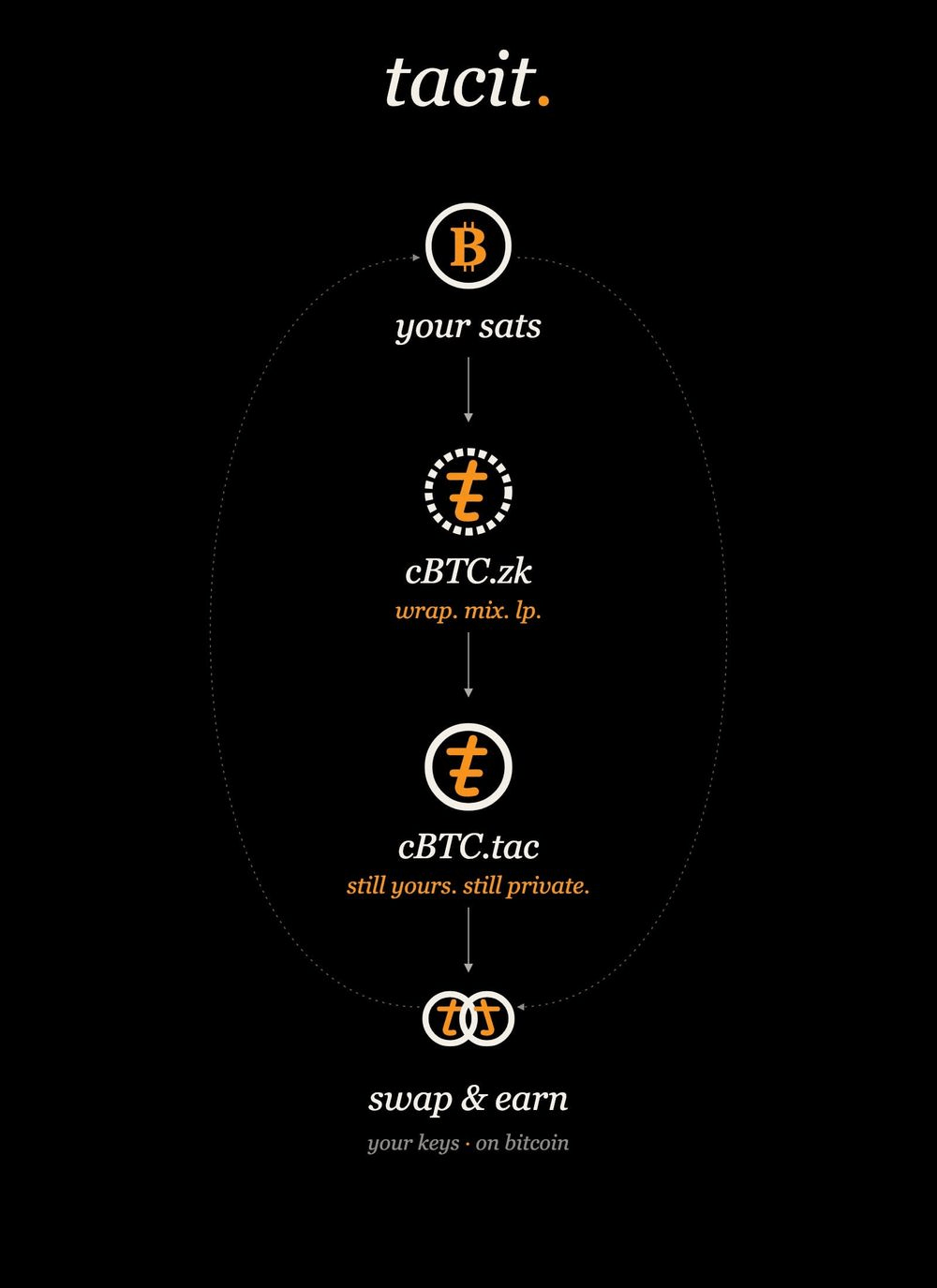
From the author's perspective, the most interesting part here is Tacit's design for wrapped BTC. Currently, most wrapped BTC still carry custodial attributes, such as WBTC being backed by BitGo. However, Tacit's cBTC.zk takes a completely different approach: it reuses the same secret value twice—this secret is used to prove you own a hidden mixer note, and at the same time, it can derive the Bitcoin private key that locks the underlying BTC.
In other words, it is "one leaf, two locks." There is no federated custodianship here, and it does not rely on oracles; rather, it re-engineers mixer technology into a trustless custodial mechanism. The author believes that even if you are not particularly interested in the Bitcoin narrative, this design remains highly impressive. If you really want to rebuild Bitcoin DeFi from the ground up, this seems to be a more promising path.
Of course, the author also acknowledges that the market for "privacy projects" has been quite hot lately, so it's natural to ask: Can Tacit withstand scrutiny?
The answer is that it does provide genuine privacy capabilities, but it is not "fully anonymous." Tacit hides amounts by default, but it does not automatically hide all other information, such as the relationship graphs formed between addresses and so on. If you want to achieve more complete unlinkability, you need to utilize several layers of capabilities it provides, such as: hiding amounts + shielding addresses + going through a mixer round trip, etc.
Therefore, the author's final judgment is: Tacit's privacy is not just a marketing statement but has real technical substance. It is an open privacy token platform built on Bitcoin, and it is also creating previously unseen components such as "private AMM on Bitcoin." It comes from a reliable developer and is paving a new privacy DeFi path between the two largest public chains.
The author finally stated that this project deserves continued attention.
Article link: https://www.hellobtc.com/kp/du/06/6335.html
Source: https://www.bankless.com/read/tacit-a-new-take-on-confidential-bitcoin-defi
免责声明:本文章仅代表作者个人观点,不代表本平台的立场和观点。本文章仅供信息分享,不构成对任何人的任何投资建议。用户与作者之间的任何争议,与本平台无关。如网页中刊载的文章或图片涉及侵权,请提供相关的权利证明和身份证明发送邮件到support@aicoin.com,本平台相关工作人员将会进行核查。


