On June 1st, Strategy submitted an 8-K filing to the SEC, disclosing that the company sold 32 Bitcoins from May 26 to May 31 at an average price of approximately $77,135, totaling about $2.5 million.

This marks the first sale of Bitcoin by the company since it began its Bitcoin accumulation strategy in 2020.Despite the fact that on that day, market attention was nearly fully captivated by the news of Binance listing on the US stock market, after the news was disclosed, the price of Bitcoin still experienced a significant decline.
This morning, a debate emerged in the Polymarket prediction market regarding whether Strategy sold Bitcoin in May, rekindling discussions about selling Bitcoin, and the price of Bitcoin consequently dropped below $70,000.
According to the filing information, as of May 31, 2026, Strategy held a total of 843,706 Bitcoins, with a total purchase cost of approximately $63.87 billion, an average price of about $75,699.

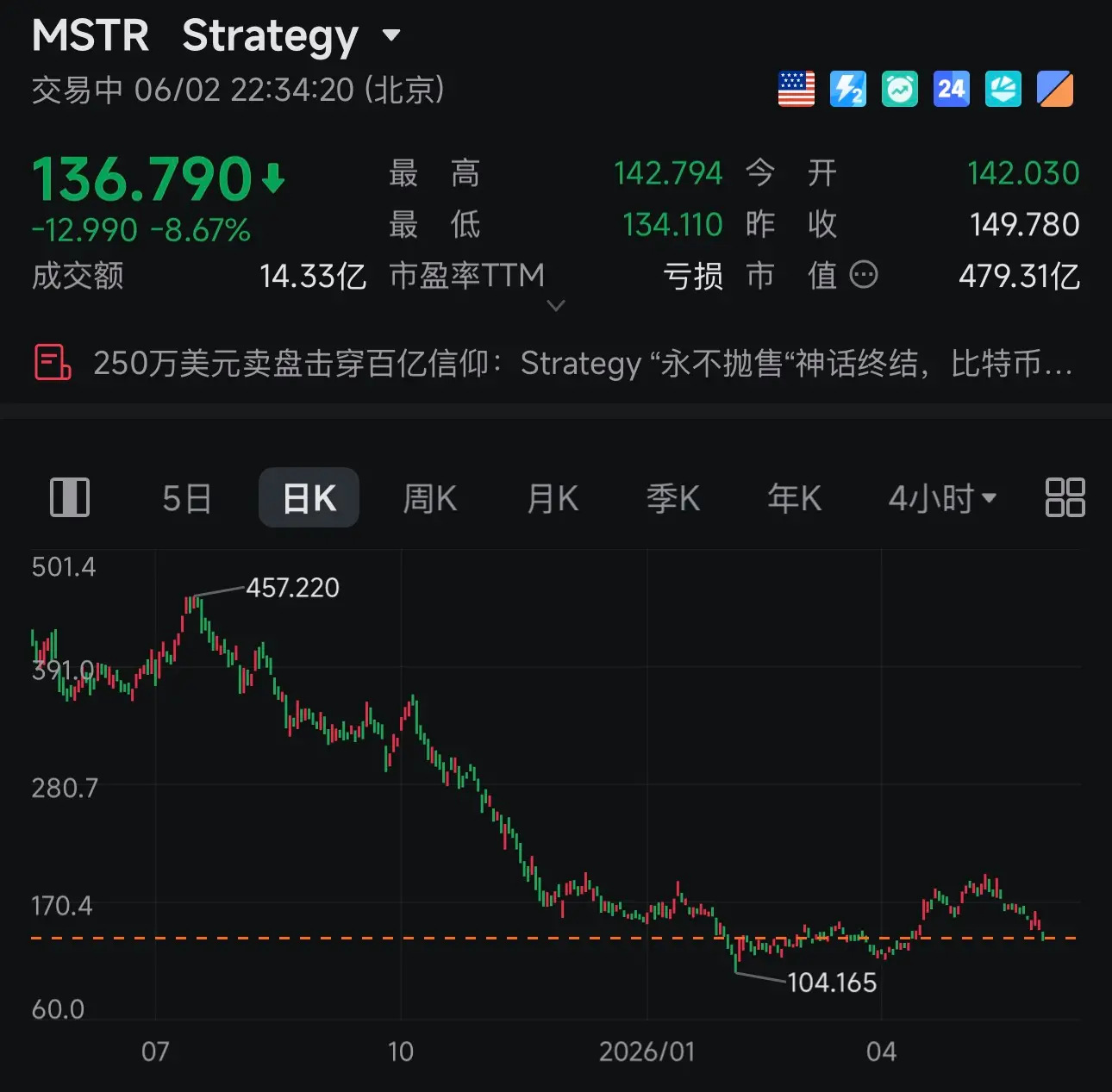
As of the time of this report, the BTC price fell below $68,000,Strategy is facing an unrealized loss of about 10%, with a paper loss exceeding $6 billion. Since the disclosure of the Bitcoin selling news, the market capitalization of Bitcoin has evaporated by over $800 billion. That night in the US stock market, MSTR fell over 10%.
During the same period, the company's cash reserve balance was $900 million. This fund was specifically allocated by Strategy in December 2025 as liquid funds to pay preferred stock dividends and unpaid debt interest.
Strategy currently has issued several series of perpetual preferred stocks, including STRC, STRF, STRK, STRE, STRD, with STRC maintaining an annual dividend yield of 11.50%. Based on the total scale of each series, the annual dividend obligation is estimated to be about $1.5 billion.
Software business revenue is negligible, and Bitcoin itself does not generate cash flow; this continuously growing dividend bill can only be covered by financing or liquidating assets.
Arca Chief Investment Officer Jeff Dorman bluntly stated that Strategy's current preferred stock financing structure has become "out of control," making it increasingly difficult to sustain amid the continued volatility in Bitcoin prices. He believes the company may ultimately have only two options: continue selling Bitcoin to pay dividends or directly announce a suspension of dividends.
In this context, the management's public statements have long laid the groundwork for this Bitcoin sale.
On May 28, CEO Phong Le stated in an interview with Fox Business that the company may flexibly decide whether to sell Bitcoin based on daily or weekly market dynamics; utilizing unrealized losses generated by price fluctuations for tax planning is also one of the reasonable considerations for selling. He also emphasized that the company’s long-term goal remains to continuously net increase its Bitcoin holdings and enhance the per-share Bitcoin content.
Michael Saylor, in an interview earlier last month, also clearly stated that he does not rule out the possibility of selling some Bitcoin before the end of the year, a clear public shift from his previous long-standing position of "never selling Bitcoin."
The actual sale was relatively restrained in scale.
From May 26 to May 31, Strategy sold 32 Bitcoins at an average price of $77,135, cashing out approximately $2.5 million. Meanwhile, the company sold about 800,000 shares of MSTR common stock through an ATM program, raising approximately $128.3 million.
In comparison, the proceeds from selling Bitcoin were merely a fraction of the overall financing actions, as the symbolic significance of selling Bitcoin far exceeds its actual financial contribution.
After the news was disclosed, market interpretations of this Bitcoin sale quickly showed divergence.
Crypto analyst Phyrex believes that, in terms of quantity, 32 Bitcoins are not significant, but it damaged the confidence of a considerable number of investors. Saylor’s initial promise was to never sell Bitcoins; once that commitment is broken, the quantity is no longer the most important aspect.
BITWU.ETH pointed out that the real reason for the market's short-term decline is not the actual selling pressure of these Bitcoins, but rather the repricing of expectations for 'perpetual one-way buying'. Over the past six years, Strategy has played the role of a permanent buyer in the market, one that only buys but never sells, and this image itself forms a considerable part of the bullish narrative. When this image shows the first crack, the market needs to reassess a variable that has never been seriously quantified before.
@Michael Liu93 raised doubts from a more fundamental perspective. He believes that MSTR selling Bitcoin to repay debts marks the beginning of the refutation of the STRC model. Once the market begins to view MSTR from the perspective of a fund manager, it will find that it has nearly all the disadvantages of a fund company: mediocre trading skills, wear and tear causing the buying price to always be at short-term highs, complete transparency that makes the market anticipate moves, and a size that is too large to escape at the cyclical peak.
However, there are also views suggesting that this sale is a proactive layout. Saylor is guiding a narrative transformation, transitioning from "Never sell" to "Never be a net seller". The difference between the two is that the latter allows for tactical sales as long as the overall position net increases. According to Saylor’s own words, as long as the annual issuance of STRC reaches 2.3% of the Bitcoin holdings, the company can maintain net purchases while continually selling, theoretically indefinitely covering dividend obligations.
Independent analyst Markus Thielen interpreted this sale as a market test, believing that Strategy is probing the market's acceptance of the behavior of selling Bitcoin while also verifying whether capital allocation strategies can operate more flexibly. He pointed out that the success and expansion of the STRC preferred stock financing tool has likely risen in priority over maintaining the narrative image of "never selling Bitcoin" in the current overall financial arrangement.
Therefore, this small-scale sale, to a large extent, isto let the market get used to the fact of "Strategy selling Bitcoin" in advance, so that using Bitcoin to pay dividends and repay debts in the future will no longer be viewed as a disaster signal.
Rather than letting this issue linger over the market, it is better to detach the fuse early. In this sense, Strategy is transitioning from a symbol of "never selling Bitcoin" to a more pragmatic capital operation entity. The market needs time to reprice this role.
Although 32 Bitcoins cannot change Strategy's holding logic, nor can they create significant market waves. However, this incident revealed something worth paying attention to: the market's reliance on this hoarding narrative is more fragile than many people think.
It is worth mentioning that the ongoing fermentation of the topic of selling Bitcoin has also affected the prediction markets. This disclosure simultaneously triggered a controversy on Polymarket over a prediction event with over $20 million in trading volume. The market is betting on whether Strategy will sell Bitcoin before May 31, with the focus of the controversy being: those supporting "yes" believe that the selling occurred before the deadline, while those supporting "no" argue that the information had not yet been disclosed when the market closed, and therefore should not be counted. Currently, the platform tends to support the "no" side on the grounds of "results confirmed outside the deadline will not be recognized," leading to a lot of criticism.
免责声明:本文章仅代表作者个人观点,不代表本平台的立场和观点。本文章仅供信息分享,不构成对任何人的任何投资建议。用户与作者之间的任何争议,与本平台无关。如网页中刊载的文章或图片涉及侵权,请提供相关的权利证明和身份证明发送邮件到support@aicoin.com,本平台相关工作人员将会进行核查。


