Original Title: The AI Bubble is Already Bursting
Original Author: Chengbei Xugong, Gelong
In recent days, the market has been highly volatile, and the "AI bubble theory" is rampant.
Ray Dalio, the founder of Bridgewater Associates, said: there is a bubble in the AI market, and the level is "relatively high".
NVIDIA CEO Jensen Huang said: there are huge opportunities in AI, and the demand for computing power is just beginning to explode.
Who should we believe?
Both of them are correct.
Is there a bubble in the AI industry? It undoubtedly exists.
However, bubbles in the tech field are often the only form of homage society can pay when facing disruptive advanced productive forces.
It is not merely a derogatory term.
In the long run, this is a phenomenon that inevitably occurs at the onset of advanced productive forces.

Many people are comparing the current situation to the internet bubble of 2000, feeling anxious.
The internet bubble back then did lead to a nearly 78% drop in the Nasdaq, with over $5 trillion in wealth evaporating.
But twenty years later, which industry can escape from the internet?
Today, the value of the internet industry has far exceeded the value during the bubble period.
The AI bubble, at least on the surface, appears to be a similar situation.
The bubble that exists in the capital market cannot block the active empowerment of AI in almost all industries of society.
AI+ is an unstoppable trend.
Just as all industries cannot do without the internet today, all industries in the future will not be able to do without AI.
01
In the era when companies could go public just by having a .com in their name, from 1995 to 2000, the Nasdaq skyrocketed nearly 600%. Then came a financial storm that lasted two and a half years.
Back then, some prominent names like software company MicroStrategy suffered a drop of 62% in a single day due to accounting scandals and overhyping; Pets.com (which sold dog food online) and Webvan (the pioneer of fresh e-commerce) went bankrupt on the spot.
…
In panic, almost everyone blamed the internet as a scam.
However, the physical infrastructure left behind by the excessive squandering of speculative capital often nurtures the next era's giants at very low costs.
The reason the bubble burst is not a problem with internet technology itself, but rather the pace of physical infrastructure development could not keep up with the market's rhythm.
For example, those once-thriving telecom companies (like WorldCom, Global Crossing) invested heavily in global submarine fiber optic cables and dense wavelength division multiplexing networks. Although they went bankrupt, these cheap "information highways" became the perfect breeding ground for the later rise of Netflix, Zoom, and the mobile internet.
If there had not been a frenzied pre-investment in telecom infrastructure around 2000, there would not have been the video streaming explosion of YouTube nor the later cloud computing infrastructure.
The most typical example is Amazon.
Its stock price fell from a peak of $107 in 1999 to $7 in 2001, a drop of over 90%.
But it survived because its underlying business logic, "restructuring retail with the internet," aligned with the direction of advanced productive forces.
This is the classic Amara's Law: to overestimate the short-term impact of a new technology while severely underestimating its long-term impact.
In the early stages of a technological revolution, the frenzy of speculative capital inevitably leads to overinvestment, forming a bubble.
This is the IQ tax that innovation must pay.
But when the bubble bursts, what remains will be a more unshakeable advanced productive force.
02
In 2026, the bubble in the AI industry appears to be even larger.
The capital expenditure of just five major cloud service providers like Amazon, Google, Meta, Microsoft, and Oracle is expected to reach $690 billion in 2026, with total AI infrastructure investment projected to reach $5.3 trillion by 2030.
Of that, only about 25% is spent on GPUs, while the remaining 75% is all sunk into physical infrastructure: liquid cooling systems, power transmission, network switches, optical modules, and land.
In terms of revenue, all leading pure AI companies like OpenAI, Anthropic, Cohere, Mistral, and Perplexity are expected to generate a combined total revenue of no more than $40 billion in 2026.
Almost $700 billion is dumped into the foundational layer, while the application layer brings back a few hundred billion.
Such severe asymmetry, what else can it be but a bubble?
One cannot simply jump to that conclusion.
There is a key point that cannot be overlooked.
In March 2023, when OpenAI released GPT-4, the mixed cost per million tokens was about $30.
By April 2025, with the optimization of model architecture and the improvement of inference computing power, the price for models of equal intelligence level per million tokens plummeted to $0.1 to $0.15.
According to Stanford University's "AI Index Report" and TokenCost data: the cost of AI inference has fallen by over 99.7% in the past two years.
According to traditional linear thinking, if costs plummet, companies' AI expenditures should naturally decrease.
But the reality is that corporate AI cloud spending triples between 2024 and 2025.
Why?
Because as the marginal cost of "intelligence" approaches zero, AI is no longer just a simple text summarizer or chatting machine, but has entered a new era of intelligent agents and multimodal enhanced search.
Companies began to have AI agents automatically run thousands of tasks, to write code, scan millions of legal contracts, or simulate biological experiments.
Cheap tokens unlock vast amounts of long-tail demand that were previously non-commercializable due to cost limitations.
This can be compared with NVIDIA in 2026 and Cisco, the dominant network hardware player in 2000, to see the clues.
The ecological niches of both are extremely similar, but their underlying financial health is worlds apart.
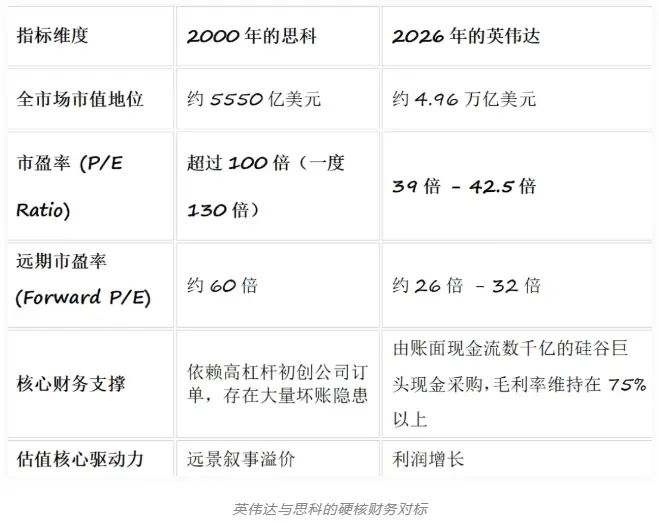
This perfectly corroborates the "Jevons Paradox" in economics: the progress of technology improves energy utilization efficiency, which does not decrease energy consumption, but rather leads to greater demand due to lower costs.
Even after experiencing the so-called "DeepSeek moment" early last year, the market quickly became sober in the following months: as algorithms become increasingly optimized, the barrier for enterprises to adopt AI becomes lower, ultimately resulting in an exponential increase in total computing power consumption.
Because of this, AI is gradually being embedded in almost all traditional industries.
Just as for the past twenty years, every industry has been involved in Internet+.
From SaaS software to biomedicine, to advanced manufacturing robots driven by embodied intelligence, by 2026, nearly all industries are embracing AI+.
No one will discuss "Should we use AI" but will instead worry whether "Is our data well cleaned? Do we have enough API call quotas? Is the RAG architecture optimal?"

Currently, there is indeed a bubble in the AI industry.
But for companies, if they do not embrace the bubble, they will be crushed by the times.
This has already been proved by nearly twenty years of the internet era.
03
Currently, we are undoubtedly at a critical node in the technology lifecycle: on the cusp of the "valley of disillusionment" in the Gartner Hype Cycle, or at the turning point in the theory of "Technological Revolutions and Financial Capital".
The AI bubble is actually already bursting, but many people are not aware of it.
In recent years, a large number of venture capitalists have developed a fear of taking measures.
A few newcomers can write dozens of pages of PowerPoints and package an OpenAI API layer to raise money. Now, as the tide recedes, these companies without a fortress and only concepts are dying in large numbers.
This is the market purifying itself and a reflection of the bubble bursting.
But this is just the surface.
Three profound evolutions are occurring in the underlying logic of the market:
First, the value transfer from CapEx to OpEx
Currently, most of the money is earned by those selling shovels, with NVIDIA, TSMC, and those selling optical modules and liquid cooling equipment capturing the most of the benefits.
However, as computing power gradually becomes "infrastructured," much like water or electricity, the real excess profits will gradually shift to the application layer.
That means AI-native companies that can use extremely low-cost tokens to genuinely solve pain points in vertical industries and reshape business processes (OpEx optimization).
Second, valuation compression and performance digestion
High valuations given to AI infrastructure do not necessarily mean an imminent collapse.
In many cases, high-speed growth in corporate profits will gradually digest the high valuations through a "time-for-space" approach.
As long as the income growth rate of cloud computing giants keeps pace with the depreciation rate of capital expenditures, this game of passing the parcel can evolve into an unprecedented industrial upgrade.
For example, global automotive manufacturing giants and chip giants have introduced end-to-end AI twin technology, shortening the development cycle of new products to production by 35% and improving the overall efficiency of equipment lines by 18%.
Also, in the financial industry, by 2026, quantitative trading, risk control, and credit assessment are fully dominated by multimodal agents. AI is not just processing macro expectations with microsecond timestamps, but is also deeply involved in every micro-level asset pricing.
In highly specialized industries like law, medicine, and auditing, AI has also completed the transformation from "junior assistant" to "partner-level expert."
ChatGPT, Gemini, Claude boasts over a billion active users, many of whom use it as a substitute for intense daily mental labor.
Including you and me.
All of the above are tangible occurrences that everyone can see.
04
Looking back at the grand history of technology, Schumpeter's concept of "creative destruction" is always in play.
The capital market is always impatient, hoping to convert $1 invested today into $10 tomorrow.
When nearly $700 billion in infrastructure investment cannot all be transformed into profits at the application end in the short term, the market will inevitably face a brutal reshuffle.
Wipe out those speculative shell companies that rely only on PPT presentations, and keep those with real technological foundations and practical scenarios.
After the reshuffle, the cheap and vast computing power centers and highly optimized model algorithms will serve thousands of industries at extremely low prices.
After 2000, humanity entered a digital age where no industry could do without the internet.
Today, we are also unavoidably heading towards an era of intelligence where all industries are vertically integrated and empowered by AI.
Amidst the clamor of the bubble, the underlying productive potential holds no exaggeration.
免责声明:本文章仅代表作者个人观点,不代表本平台的立场和观点。本文章仅供信息分享,不构成对任何人的任何投资建议。用户与作者之间的任何争议,与本平台无关。如网页中刊载的文章或图片涉及侵权,请提供相关的权利证明和身份证明发送邮件到support@aicoin.com,本平台相关工作人员将会进行核查。


