The ultimate winner of RWA is not the issuer, but the platform operator.
Written by: Bai Lu
Why write this? After a year and a half of consulting cases, I want to honestly say to everyone — "RWA is not about fundraising, but about reconstructing the growth model for enterprises going abroad, or starting to create your own RWA platform."
During this time, we have interacted with almost all RWA trading platforms and players in the Asia-Pacific region — licensed in Hong Kong HashKey, OSL, EX.IO, VDX, issuance + distribution of Asseto, offshore DEX PicWe, Dejoy, and stock RWA platform MyStonks, AiiN, consumer e-commerce rights token platform RWA.ltd, as well as on-chain e-commerce projects using token payments like ToMe, etc. — they are all building their own platforms, gaining capital valuation, and making themselves valuable. Figure, the world's "RWA first stock," demonstrated the same logic with a market value of $7.8 billion: it started by quickly lending to customers using institutional funds and then transformed into an RWA real estate lending infrastructure. The story of Figure is much larger than any single RWA project.
I will also analyze for you: there are three types of players in the RWA market — project parties, service providers, and platform operators, and the money earned by each is completely different: project parties earn financing amounts, service providers earn service fees, and platform operators earn capital valuations. The biggest opportunity is not in "moving traditional assets on-chain to raise some money," but in using RWA to reconstruct business models and create incremental value, evolving from project parties into service providers or even platforms. I will analyze real cases such as Langxin, Xiexin, Kyrgyzstan hydropower station, Ant Group, Standard Chartered, Binance, Figure, and HashKey within the structure of these three types of players to see the different pricing by capital markets for each type — ultimately answering a question: for traditional owners looking for opportunities to enter Web3, which type of player should you be?
1. First, let’s get to know Figure: A SoFi founder who moved mortgages onto the blockchain
In 2018, Mike Cagney made a surprising decision in Silicon Valley. He had just left SoFi, the fintech unicorn he had founded — a company that turned student loans into a multi-billion dollar business — and turned to the blockchain, then still scoffed at by mainstream finance.
What he saw was both simple and deadly — that the American home equity line of credit (HELOC) takes six weeks to process. Borrowers fill out forms, banks review them, lawyers check property rights, appraisal companies assess value; every step involves intermediaries, all charging fees and taking time. Cagney's judgment was: this isn’t a process issue but a trust structure issue. Traditional finance builds trust through "layers of intermediaries endorsing," and blockchain can directly replace this chain of intermediaries with "the immutability of distributed ledgers."
Seven years later, on September 11, 2025, the opening bell of Nasdaq provided an answer to this judgment — Figure Technology Solutions (ticker FIGR) went public, with Goldman Sachs and Bank of America Securities as lead underwriters, and its stock surged over 40% on the first day, becoming the world's first public platform with RWA as its core business and recognized as "the first stock in RWA."
Many people have the impression of Figure as "a blockchain concept company," but if you break down its numbers, you will see a highly sophisticated and rapidly growing credit machine.
① Fundamentals (Source: SEC prospectus, Figure 2025-2026 financial report, as of 2026.06)
- Team size | About 600 people (traditional banks require thousands of people for the same lending volume)
- Current market value | About $7.8 billion (2026.06 stock price around $33)
- Cumulative lending | Over $21 billion HELOC, serving over 250,000 households, expected to be the largest non-bank HELOC originator in the U.S. by 2024
- Cost per loan | Approximately $730, approval time reduced from an industry average of 42 days to a median of 10 days, and as fast as 5 minutes for approval
② Revenue and profit: completing the "from loss to explosion" in three years
- Net revenue | $210 million in 2023 → $341 million in 2024 → $507 million in 2025 (an annual increase of 49%)
- Net profit | Loss of $52 million in 2023 → $20 million profit in 2024 → $134 million in 2025 (year-on-year increase of 574%, net profit margin of 26.5%)
- Adjusted EBITDA | -$12 million in 2023 → $101 million in 2024 → $251 million in 2025 (profit margin approximately 49%)
- 2026 Q1 | Net revenue of $167 million (+97.6%), net profit of $45 million, EBITDA profit margin approximately 50%
- Consumer credit market lending volume | $8.4 billion for the full year 2025, $2.9 billion for Q1 2026 alone (+113%)
The key to this curve is that in 2023 it was still losing $52 million, turned profitable in 2024, and by 2025 net profit shot up to $134 million — profitability expands not linearly but with the increase of loan volume, which is characteristic of platform-based (rather than lending-based) businesses.
③ Core borrower profile: Who borrows money on Figure
- Who are they | Homeowners in the U.S. with property, equity, and good credit, typically looking for funds for renovations, paying off high-interest debt, or starting a business, but unwilling to refinance their low-interest old mortgage for cash out
- Credit threshold | Minimum FICO of about 640 (720 in some states), the better the credit, the lower the interest rate
- Borrowing rate | APR range of approximately 6.55%–15.54%, average rate of about 9%
- Loan amount | $15,000–$400,000 (average withdrawal of about $75,000), CLTV cap of about 80%
- Term and repayment | About 24–25 years, borrowers repay monthly with verifiable cash flow
- Risk control | 90 days plus overdue rate of about 1.7%
④ Returns and settlement mechanisms for investors (YLDS)
- Who provides funding | Nearly 200 institutional buyers + qualified investors entering through YLDS, almost no retail investors
- Investor yield | YLDS (SEC registered interest-bearing stablecoin) approximately 3.84% APY (tied to SOFR minus 50 basis points); funds waiting to enter the pool are priced through hourly Dutch auctions, and when liquidity is low the interest rate can spike to 30% to attract funds
- Settlement / payment | Borrowers repay monthly → cash flow goes on-chain → returns automatically distributed according to an agreed cycle, all executed through smart contracts without manual intervention
- YLDS circulation volume | About $598 million as of Q1 2026
Returns among three parties are three completely different things
On the Figure machine, three parties share the profits: borrowers pay an interest rate of about 9% (which is cost, not profit), investors earn about 3.84% through YLDS, and the platform achieves about 50% EBITDA profit margin from the interest spread + matching fees + tech fees. For owners looking to build a platform, the real focus should be on the third number — the platform makes stable earnings from the interest spread and service fees, not by promising high interest to funders.
2. Figure’s true identity: It didn't simply “issue an RWA,” it built an “RWA platform”
Many people misinterpret Figure, thinking it is just "tokenizing HELOC." If it were just that, it would amount to a lending institution and couldn’t achieve a $7.8 billion valuation. What Figure truly excels at is its model — shifting from heavy asset "self-lending" to light asset "platform fee-taking," supported by three pillars:
- Asset production: producing standardized HELOC, optimizing "asset production capacity," bringing per loan costs down to $730.
- Technical empowerment: licensing its lending system to over 240 banks, credit unions, and brokers, leveraging their existing customer base to scale up without burning money on customer acquisition.
- Market connections: operating Figure Connect secondary market, nearly 200 institutions buy and sell packaged loans; co-invested with Sixth Street to inject over $2 billion in liquidity and completed the first blockchain securitization rated by S&P across all six tranches.
Key transformation: from "credit institution" to "credit infrastructure platform"
CEO Tannenbaum candidly stated that this fee-based model "is more profitable and doesn't require using our equity." By Q1 2026, Figure Connect accounted for 56% of the total consumer credit market — Figure has transformed from "earning interest spreads through self-lending" to "providing lending + circulation infrastructure for the entire industry, collecting perpetual tolls." This is the true source of its high valuation.
Of course, Figure is also controversial — short-selling institution Morpheus Research has questioned that Figure Connect's touted "third-party market" is actually a significant buyer itself; DeFiLlama’s founder has also doubted its on-chain activity is relatively sparse; however, its GAAP statements have been audited and are genuine, these controversies serve more as reminders to the whole industry that "on-chain records and off-chain assets still have a disconnect."
3. Structure of three types of players in RWA
To understand RWA, one must first see the three types of players in the market. They are not a simple high-low distinction but three role positions — and project parties can evolve upward, transforming into service providers or platforms. Traditional owners need to first recognize where they currently are and where they should head in the future.
Player One · Project Parties (Asset Side)
Have assets and want to realize or appreciate them — internally divided into two types, following two completely different paths
Type A: Only fundraising, following the Hong Kong compliance route (high threshold, not easy)
In August 2024, Langxin Group issued RWA for rights to over 9,000 charging piles in Hong Kong, raising about 100 million, which the CEO of Ant Group called a "mini-IPO"; in December 2024, Xiexin Nengke tokenized rights to 3,000 household photovoltaic power stations, raising over 200 million. This path involves one-time financing and realizing existing stock; the ceiling is essentially the financing amount.
However, to explore this route, there are several hard thresholds: the underlying asset must be high-quality, sustainable cash flow assets, typically requiring over 7% annualized return, and the issuing entity should preferably be a mature and high-quality enterprise — even so, it may still fail to raise. Adding to that, the costs for legal, auditing, and licensing compliance in Hong Kong are high, while the upper limit for a single issuance's purchasing power in the market is about 300 million HKD, which makes it difficult for small private companies to navigate the Hong Kong compliant RWA route.
Type B: Traditional returns + on-chain DeFi return innovation, going the overseas asset + overseas user DEX route
No longer about "just completing the issuance," but embedding on-chain return mechanisms into assets, and not following the Hong Kong SFC compliance, instead going through overseas DEX regulatory exemption — overseas assets, overseas users, decentralized issuance. A typical case is the Isfayram hydropower station in Kyrgyzstan, through PicWe’s on-chain infrastructure completed million-dollar financing and exceeded a market value of ten million dollars, with an expected annualized return of about 20%, automatically redeemable every two weeks. The key design is continuing to inject operational transaction fees into the on-chain base pool, thus elevating the asset "floor price" with transaction frequency — the more frequent the transactions, the higher the minimum yield, turning static return rights tokens into dynamic appreciating on-chain financial products. This route is more realistic for owners without heavy assets but with overseas scenarios.
Player Two · Service Providers (Middle Layer)
Do not hold assets or engage in trading, providing technical / custody / compliance services to project parties
Those who truly enjoy the first wave of stable dividends are often not the issuing project parties but the service providers that empower them. Representing players:
- Ant Group — General RWA technical solutions ("two chains and one bridge" + Layer2 blockchain Jovay + AntChain Inside), serving several issuers including Langxin, Xiexin, and Xunying, connecting over 15 million new energy devices.
- Backed Finance — The issuer behind xStocks, focused on "Tokenization-as-a-Service."
- Standard Chartered (Zodia) — Provides institutional-level digital asset custody and infrastructure SaaS via Zodia Custody / Zodia Solutions, which is a paradigm of traditional large banks entering the RWA space.
Essentially: as a service provider, charging fees for technical / custody / compliance services. The income is certain and stable, but has an upper limit — without mastering trading, there is no imagination space for valuation.
Player Three · Platform Operators (Building Transaction Loops · Ultimate)
Benchmarking exchanges / DEX — the most profitable track in Web3
The criterion for determining whether it is a "platform" is a hard standard: can it complete a "issuance - trading - settlement" loop on its own platform. Once the loop is closed, the money earned is not from financing amounts or service fees but from capital valuation — this is precisely the logic of exchanges and DEX tracks (the most profitable track in Web3 history, from Coinbase and Binance to Uniswap). Figure converting credit into a transaction loop platform valued at $7.8 billion is the RWA version of this track. Platform operators can be divided into two tiers according to maturity:
- Mature tier (already has clear secondary market valuation): Figure (Nasdaq $7.8 billion), Hong Kong OSL / HashKey (already listed on Hong Kong stock market, receiving Hong Kong stock valuation), Coinbase / Robinhood (securities firm + on-chain securities firm), Binance (connecting over 7,000 U.S. stocks, promoting tokenized stocks bStocks), Ondo (building its own Ondo Chain public chain, the underlying for Binance's tokenized U.S. stocks), Securitize (the market leader in RWA issuance, issuer for BlackRock BUIDL), and DEX leader Uniswap.
- Emerging tier (platform is functional, valuation yet to be realized): PicWe (including decentralized stablecoin WEUSD), Wang Xin's Dejoy (one-stop DEX issuance + payment + private domain), Asseto (strategic investment from HashKey), new U.S. stock RWA platforms xStocks, Mystonks, AiiN. The only gap between them and the mature tier is in size and time, not in model.
A key variable for platform operators: whether to issue platform tokens
When building a platform, one must first think about whether to issue platform tokens. In the exchange track, platform tokens (like Binance's BNB) are core value-capturing tools — they directly convert the platform's trading growth into token demand and valuation. Issuing tokens means stronger value capture and user incentives but also immediately enters a gray area of securities regulations and must have compliance structures designed in advance. Whether or not to issue, how to issue, is a top-level strategy, not a technical detail.
The three types of players can evolve
These three categories are not fixed identities; project parties can completely transition upward — converting accumulated assets, customers, and technical knowledge into service capabilities for peers (becoming service providers), or simply building transaction loops (becoming platforms). Xiexin provides a living example: first issuing 200 million in photovoltaic RWA as a project party, then jointly with Ant Group to establish the "Ant Xineng" energy platform, upgrading from "selling electricity" to "energy asset operation platform."
4. How capital markets price these three types of players
Let’s compare the actual valuations of the three types of players.
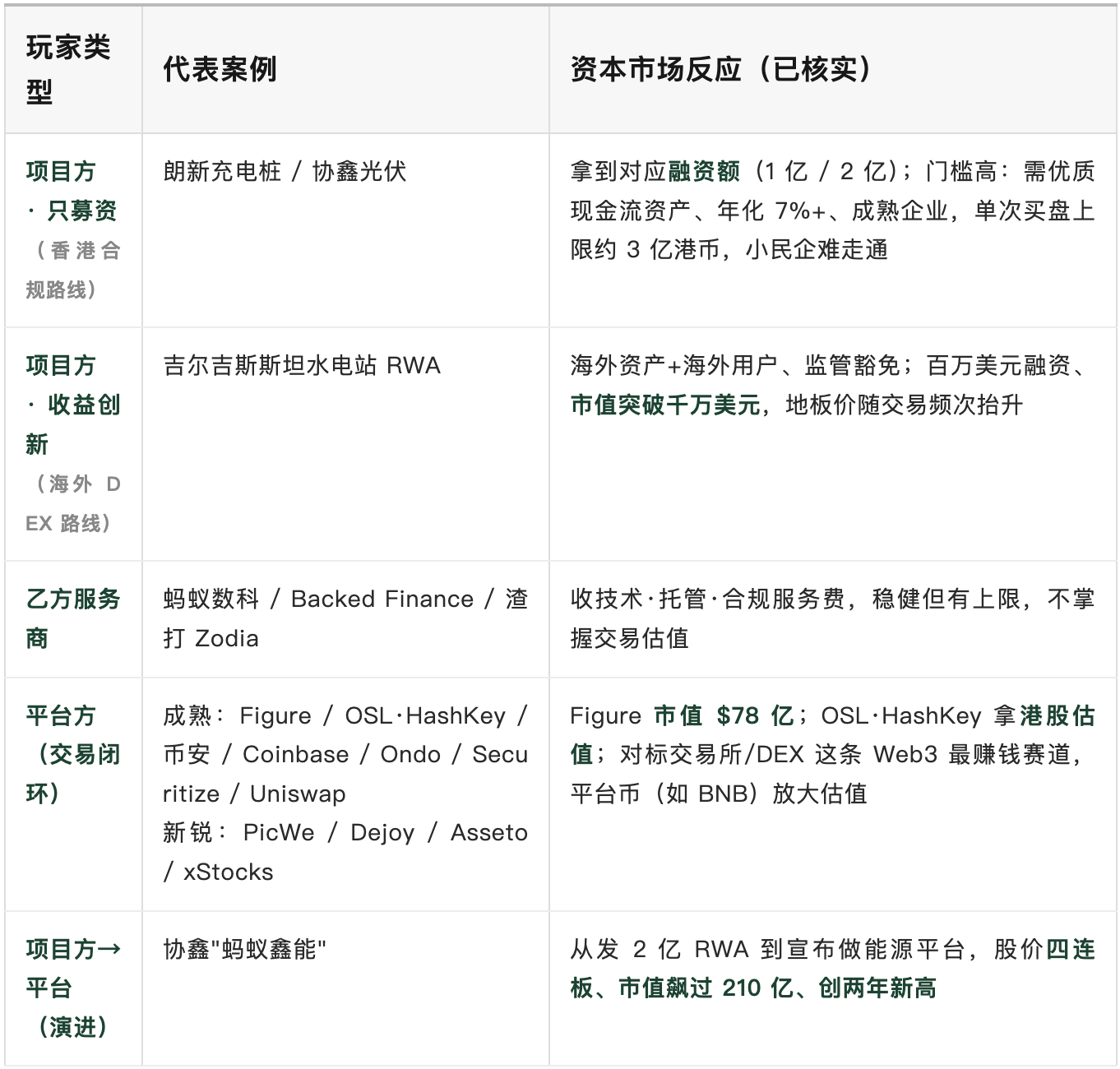
The same company, changing its identity, has its valuation differ by an order of magnitude
The most intriguing part of the table above is Xiexin — the same company was initially valued only based on "how much was raised" when issuing RWA, but after announcing it would become a platform, it was revalued as a "platform," gaining tens of billions in market value. Capital does not price you on how much you have raised, but on which type of player you are.
This trend is spreading to more industries. For example, in the medical field, Huajian Medical and Guofu Quantum, among others, have proposed tokenizing high-value medical assets like ADC drug patents, promoting "linking R&D capabilities on-chain," and aligning with the digital asset vault strategy. This is also about "reconstructing business models + building platforms using RWA." The directions may differ, but the logic is entirely consistent: the market rewards "reconstruction and platforms," not "transportation and fundraising."
5. The ecosystem for RWA landing in Hong Kong: A relay by eight types of participants
The three types of players are the top-level role divisions; landing specific RWA transactions in Hong Kong involves a complete industrial chain. Since the virtual asset regulatory framework was launched in Hong Kong in 2023, it has become a compliance high ground, but as of mid-2026, the truly established benchmarks remain a few projects like Taiji Capital’s Prince Real Estate STO and Delin Tower RWA — a project typically requires the relay of eight types of participants to go from asset rights confirmation to secondary circulation.
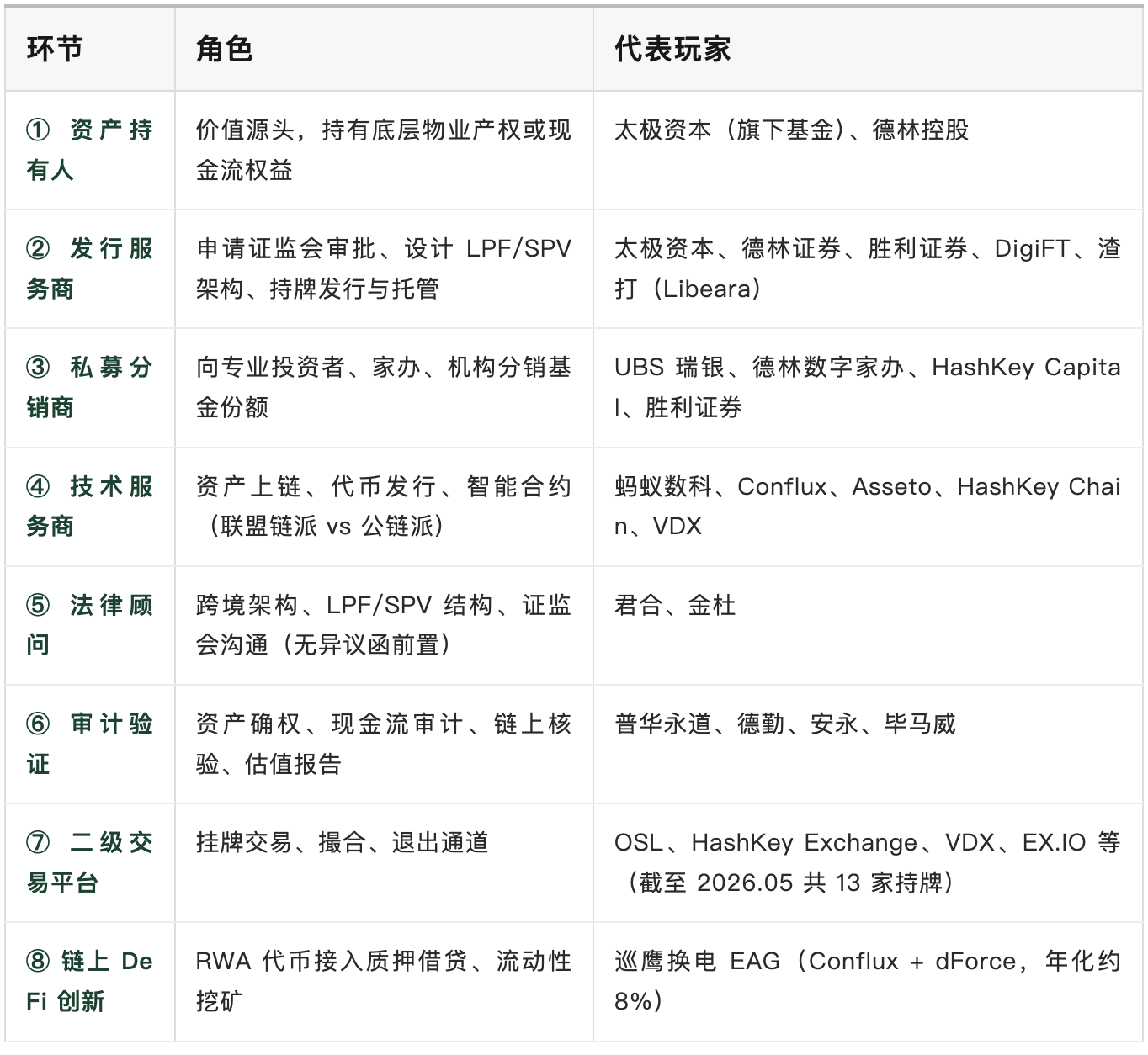
Hong Kong is a compliance financial high ground, but not yet a platform high ground
The entire industry presents a relay-style advancement where "asset equals compliance, compliance equals law firms, law firms equal audits, and trading equals liquidity" — slow, expensive, and limited depth in the secondary market. The yield on ordinary commercial real estate does not cover the high costs of going on-chain and ensuring compliance, which is precisely why Hong Kong currently only sees project-level exploration and has not yet seen true platform-level players emerge.
My judgment is: there is still about a year’s window for innovative platform models in vertical industry RWA, and I believe they will emerge in Hong Kong — pursuing routes such as non-securities dividends, consumer scenario closures + DEX issuance, like short drama RWA platforms or concert RWA platforms. We already have internally incubated landing cases in the first half of 2026.
6. For owners: first clarify the risks, then decide which type of player to be
Before stepping in, lay out the risks in this industry — this does not impact judgment but determines how you land.
- Compliance paths are divided into two: domestic assets going overseas typically involve issuing in places like Hong Kong, requiring pre-filing, with compliance as a prerequisite; while overseas projects and assets can be issued directly in overseas DEX, which is the path we most recommend — less regulatory friction, lighter loops.
- Off-chain operations are the foundation: tokenization cannot resolve off-chain asset operations, maintenance, and disputes. Whoever can manage off-chain cash flow can fulfill their on-chain promises — this is also the most critical factor when selecting assets.
- Narratives do not equal reality: there are many stories in the industry about "large-scale issuances" and "high annualized returns," yet there is a general disconnect between on-chain records and off-chain assets. When building platforms or selecting projects, always prioritize "verifiable real cash flow."
Once you understand the risks, the remaining task is to choose your position. Three questions to help you identify which type of player you should be:
- Realize existing assets or create incremental value?
If you only wish to exchange existing assets for cash, you are a "project party — only fundraising," with the ceiling being the financing amount; if you seek a second growth curve, you need to move towards becoming a service provider or platform.
- Can the assets produce continuously?
Figure's moat is not "having a batch of HELOC," but “being able to continuously standardize the production of HELOC.” One-off asset deals cannot support a platform.
- Are you the issuer or the platform operator?
Langxin issued tokens, Ant did the service, Figure created the platform, and capital's valuation logic for the three is completely different.
Bai Lu's Judgment
RWA is not a fundraising tool. Treating it as an ATM is the first pitfall for owners entering Web3 — single-time fundraising is stock realization, with the ceiling being that amount, especially given how high the compliance thresholds in Hong Kong are for small private enterprises.
What is truly worth investing in is evolving from being a project party to building a platform capable of continuously onboarding assets. Because project operations earn financing amounts, while platform operations earn capital valuations — the two differ by an order of magnitude. The ultimate winner of RWA is not the issuer, but the platform operator.
免责声明:本文章仅代表作者个人观点,不代表本平台的立场和观点。本文章仅供信息分享,不构成对任何人的任何投资建议。用户与作者之间的任何争议,与本平台无关。如网页中刊载的文章或图片涉及侵权,请提供相关的权利证明和身份证明发送邮件到support@aicoin.com,本平台相关工作人员将会进行核查。


