After the ETH mainnet market gradually quieted down, the degens have returned to being active on Solana. Nevertheless, it is hard to say there is a central theme in the market on Solana. If we were to summarize, perhaps it could be described as "pulled between returning to the community and attention PvP."
Attention PvP
Since Trump issued his coin, the meme coin market has long relied on celebrity endorsements, trending events, and speed contests as a way of play.
Everyone has gotten used to it, so even with poor liquidity, people will still look for opportunities based on this play style, creating an inertia for such gameplay.
$JOTCHUA, a dog meme that became popular in Spanish and English user circles in 2021. On January 24, 2021, Instagram user @_kingorange uploaded an inspirational poster featuring a rough dog image with the text "JOTCHUA," which received over 29,000 likes within three months.
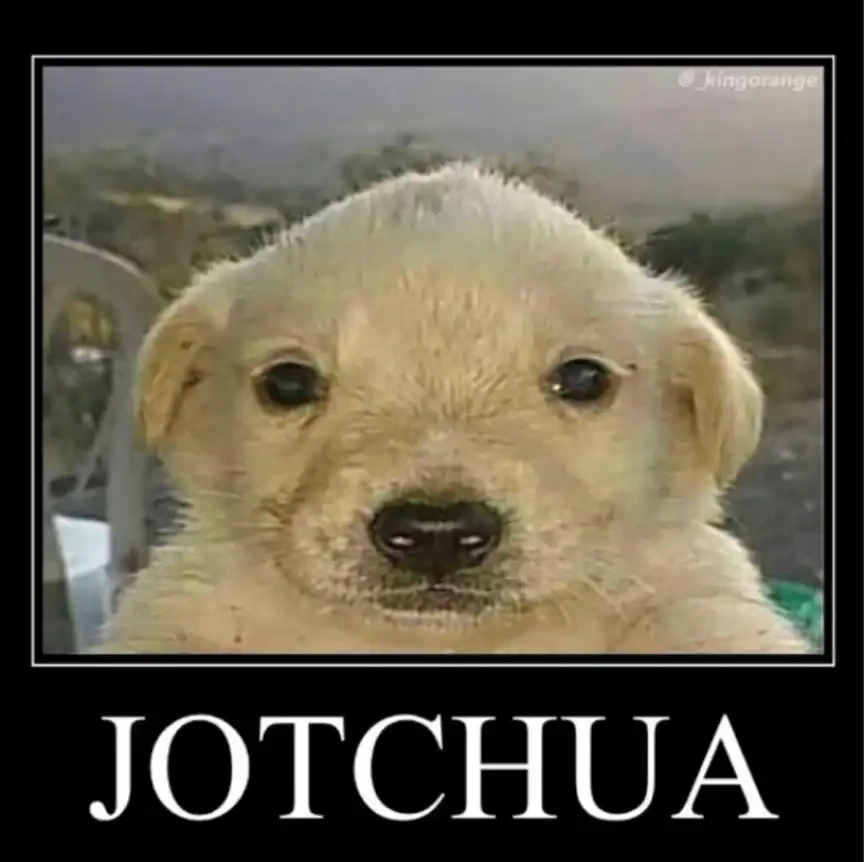
At its peak, this coin's market cap approached $9 million. There was significant controversy within the community over whether this coin was "organic," as its launch did not occur right after the meme’s creator @_kingorange claimed it, making it hard to argue that the "claim" was a direct cause of the coin's price surge.
Many players believe this coin is yet another "setup," or that market speculation regarding KOL Ansem's claim to have returned to purchase Solana meme coins on June 9 might have been related to this coin.
Similar concepts, even the same ticker, but your coin just doesn't rise. $JOTCHUA was deployed on the ETH mainnet as early as December 2023, and there is continuous content and community, but it cannot compare to creators quickly pushing buttons to claim it.
A similar situation occurred with the World Cup concept. On Solana, $WORLDCUP surged from a market cap of about $5 million to over $12 million due to the purchase by bonkguy and lengthy analyses. Meanwhile, the World Cup concept project $PITCH on Base has fallen from a peak market cap of about $7 million to nearly $700,000.
Although $PITCH does have its issues, primarily in communication, the project isn't inactive; it has been updating consistently, but the dev rarely speaks, and the account on X has repeatedly been banned without establishing a new one. But it must be admitted, without anyone advocating for it, similar concepts and gameplay lose out in the competition for attention.
The new feature recently updated on pump.fun, pump fun GO, allows anyone to post paid bounty tasks on pump.fun.
This has indeed attracted mainstream media attention but sadly, it has done so in a negative light.
$Bountywork, this coin briefly approached a market cap of $2.5 million at its peak. The dev behind it, @ayushquantt, focuses on continually posting new tasks on pump.fun to create buzz for this coin.
He did achieve this — by offering a bounty of 40 SOL for someone to tattoo $bountywork on their forehead.

An Indian man actually got the tattoo done, following the dev's slip-up in the description — missing an 'n' and incorrectly writing the ticker as $boutywork.
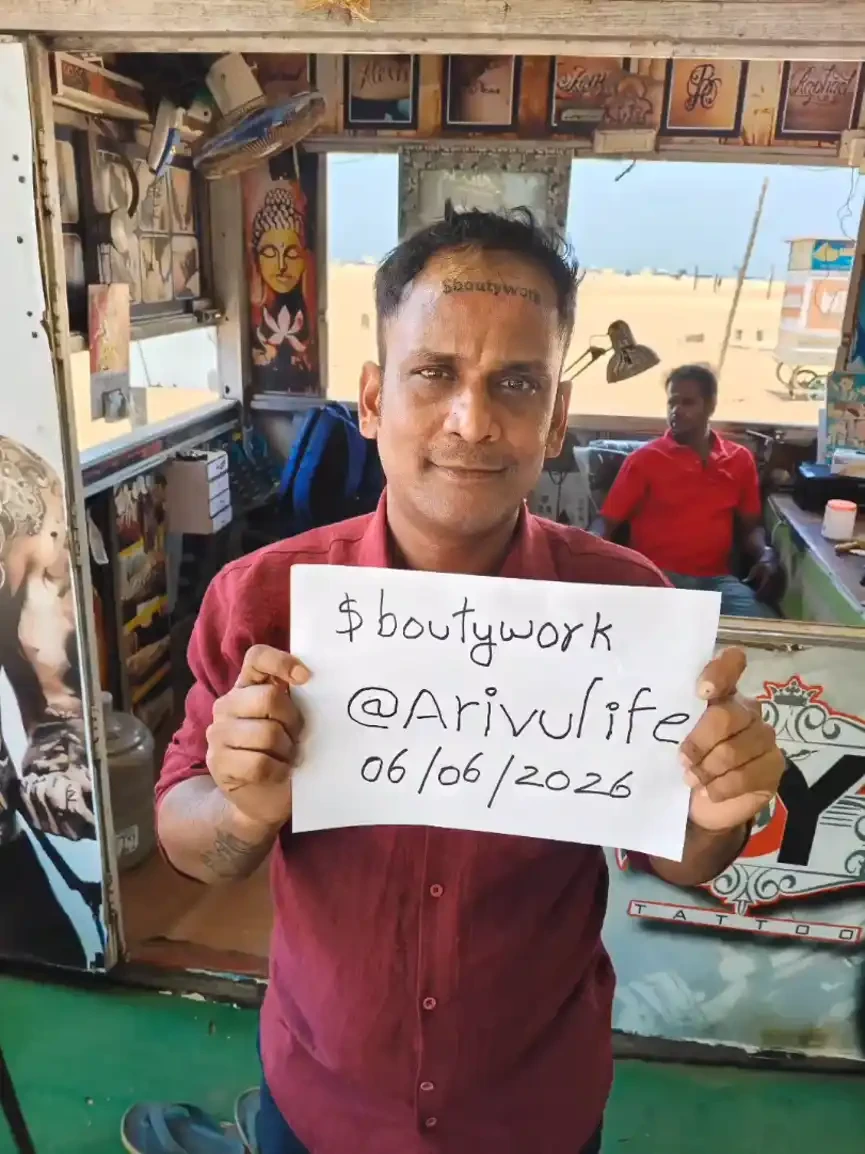
At first, his bounty request was denied, with the reason being that the tattoo missed a letter 'n', and the dev requested him to correct it. Then, someone sent him a $boutywork, treating the incorrect tattoo as the ticker for a new coin.
In the end, the bounty reward of 40 SOL was still given to him, and the income from the creator of the new coin was also awarded to him, totaling about $48,000 earned.
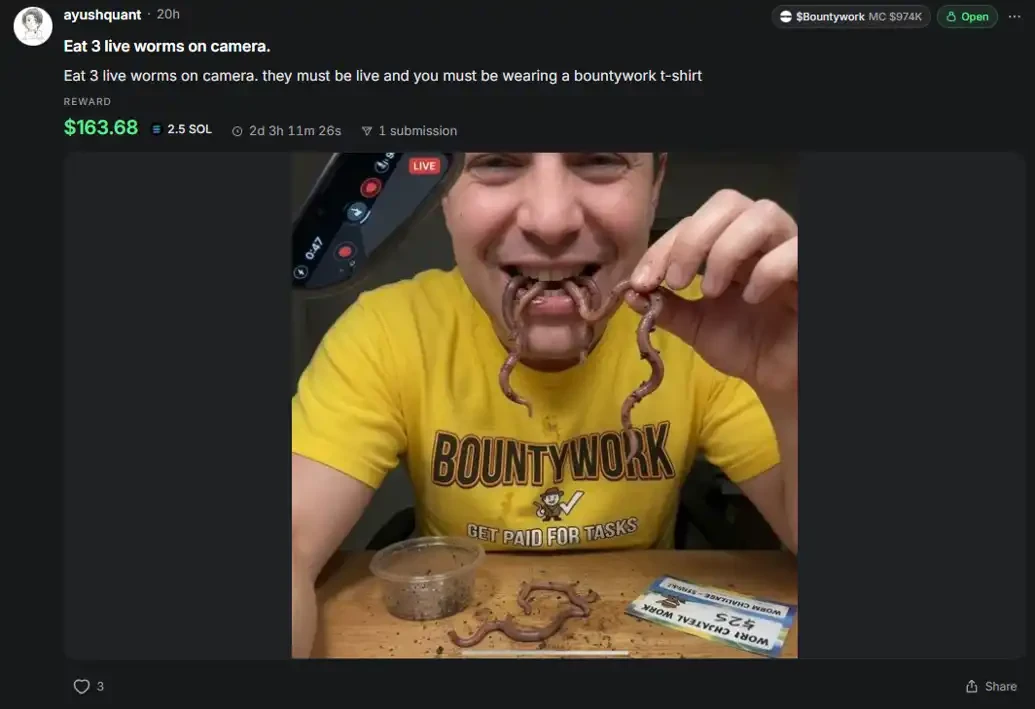
Then, as the event's heat faded, $boutywork has basically returned to zero, while the dev of $Bountywork continues to post new bounties in an attempt to replicate this "success," such as having someone wear clothing with $Bountywork printed on it and eat three bugs in front of the camera.
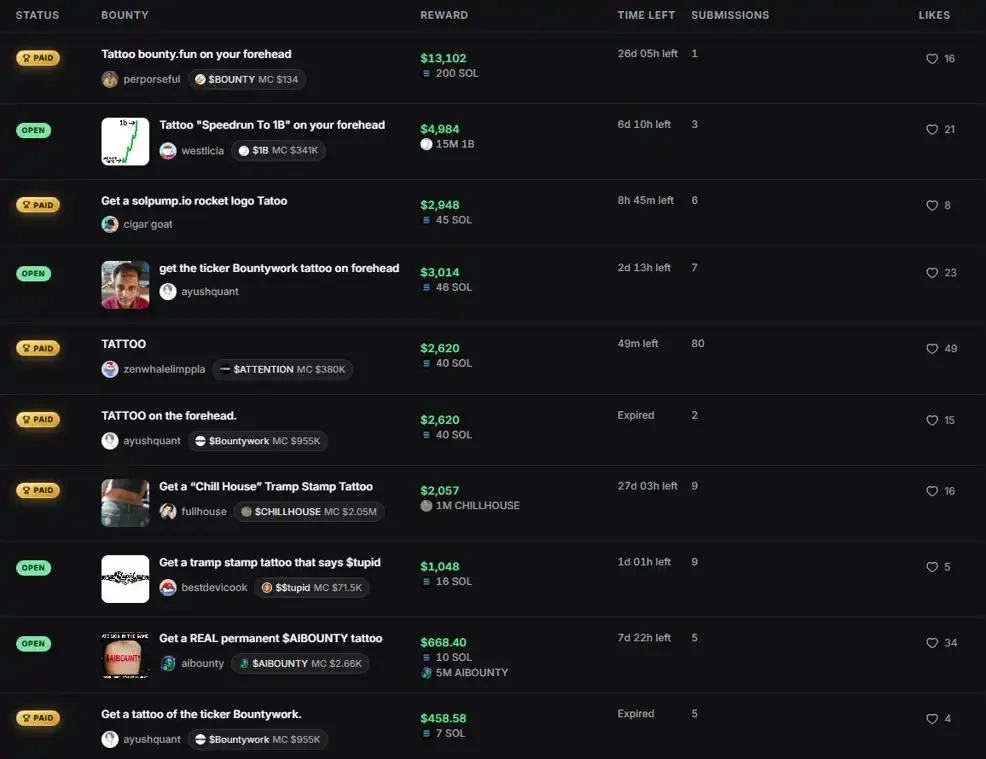
There are still many tattoo tasks on pump.fun, and some have earned a maximum of 200 SOL by tattooing their faces.
To be honest, this isn't much different from the days when big shots on Kuaishou would shower gifts while making people eat raw eggs or chugging strong liquor...
Return to Community
After discussing the new features of pump.fun, almost all bounty tasks are related to generating some attention hotspots for specific tokens, and the only one not viewed as a joke might be the bounty task for $neet — organizing a gathering in New York for those resisting work.
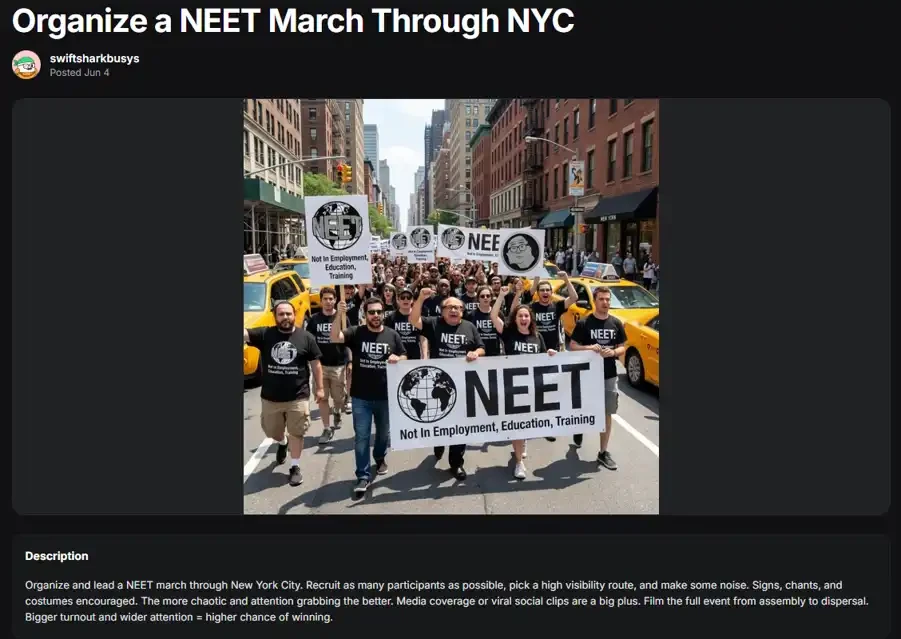
This bounty reward is paid in $neet, equivalent to over $15,000. The $neet community had already self-organized two offline "no work gatherings" in the United States, and if this bounty is fulfilled, it will be the third.
Although it's unclear what pump.fun's intentions are in supporting community-type meme coins, their official Twitter always features promotions for community tokens. While the performance of these tokens varies, such as $chillhouse's price being sluggish for a long time, the ones chosen by pump.fun generally do have community backing and are quite organic.
Currently, aside from $neet, other relatively stable in volume and price include $troll, $buttcoin, and $triplet. Here’s a brief overview of the survival status and themes of these community tokens:
- $neet: Deployed 410 days ago, peak market cap about $51 million, current market cap about $27 million, with the community's mission to raise awareness that spending most of one's life working results in losing one's life.
- $troll: Deployed 416 days ago, holds the copyright to the classic meme Troll, listed on Coinbase. Peak market cap about $290 million, current market cap about $65 million.
- $triplet: Deployed 107 days ago, an abbreviation of "Wood Stick Man Tung Tung Tung Sahur," which was the hottest character from last year's viral "Italian Mountains and Seas Classic." Peak market cap about $13.6 million, current market cap about $6.6 million.
- $buttcoin: Deployed 153 days ago, originated from a joke on a Bitcoin forum in 2011, where the homophone Bitcoin became Buttcoin. Peak market cap around $68.6 million, current market cap about $27 million.
When mentioning these coins and talking about the return of community-type tokens, we have to bring up Ansem. He mentioned that after he returned to buy Solana meme coins, someone suggested he directly issue a CA, and as soon as it was issued, he would angrily buy a 1% increase.
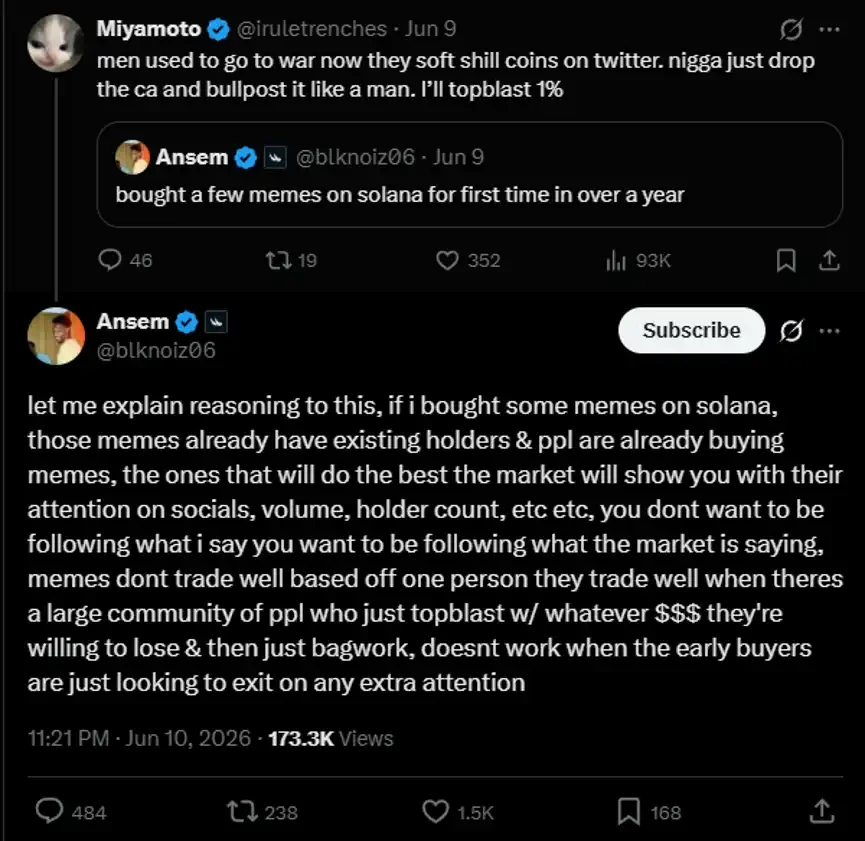
Ansem's response sparked much discussion among everyone:
"Let me explain why I won’t issue CA. If I buy some Solana meme coins, and these coins already have good holders, the market will indicate which are good coins through social media performance, trading volume, number of holders, etc. You shouldn't listen to me, you should listen to the market. Meme coins that rely on those quick on the trigger and waiting for a sell-off won't do well; only those that have a large community, with members willing to endure losses and daily promote the philosophy of their holdings, will thrive. Coins that depend on a single celebrity won't prosper."
In addition to the older coins that have survived longer and maintained a relatively stable price, there are indeed new coins emerging following Ansem's perspective, such as $KINS.
$KINS is a token for Kintara, which is a chain game. Interestingly, Kintara has not stimulated the chain gaming sector on Solana because its emergence relied not on how exquisite the games were but on building community trust step by step through action.
Let me briefly describe the mechanism of $KINS. It is an MMORPG game that can be played on a browser; to join, players need 1000 $KINS in their wallet, and then they can chop wood, mine, fish, buy houses, fight monsters, and engage in PvP.
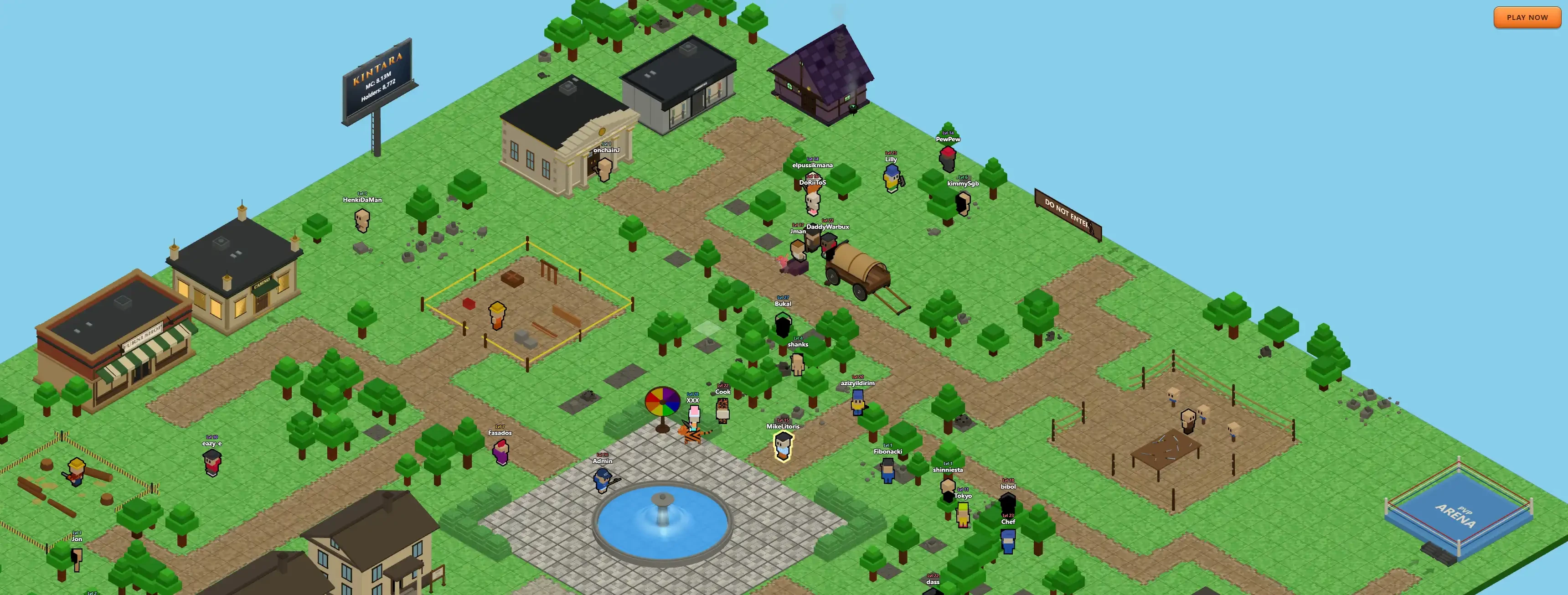
There are no other additional charging options in the game; there’s only a reward wheel, and if players want to spin more than once a day, they can spend $3 worth of $KINS to continue spinning. Of this revenue, 50% is used for token buyback and destruction, and 50% for project maintenance and development.
The core gameplay process is basically collecting resources -> crafting items -> challenging more difficult monsters. If players lack resources, they can use the in-game currency "Gold" to buy from other players. Players can sell "Gold" for $KINS, with 5% going to the treasury and 95% to the player.
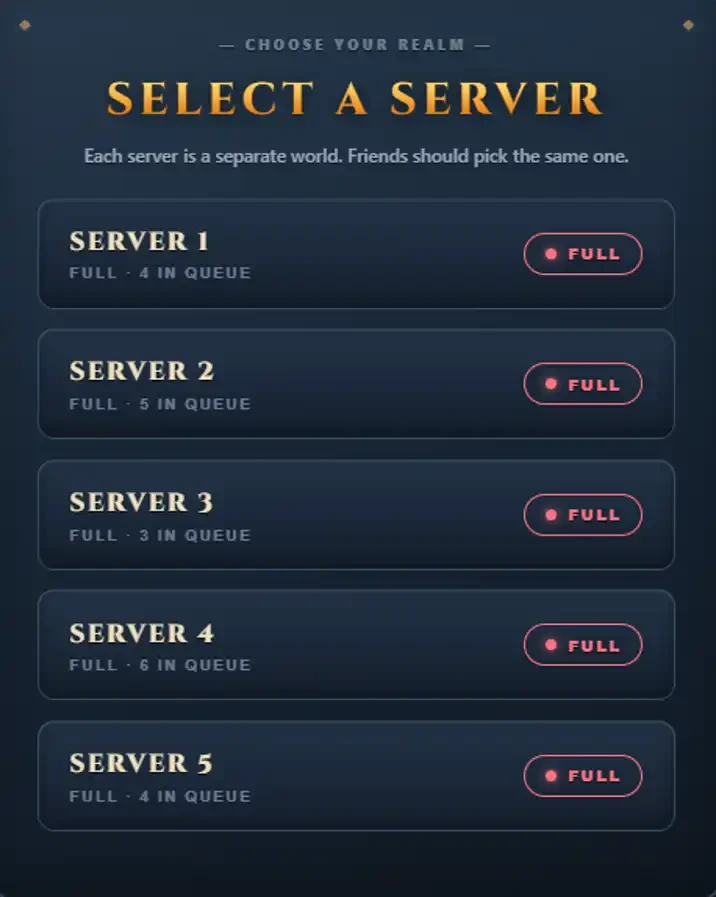
It sounds quite ordinary, and the data isn’t very impressive (so far, 0.5% of $KINS has been repurchased), but the project's consistent delivery has built good trust. Perhaps due to how disappointing the market has been, many players have actually gotten into the game, and daily fishing participants are increasing. The project team has already expanded the servers to five, but there’s still a waiting line...
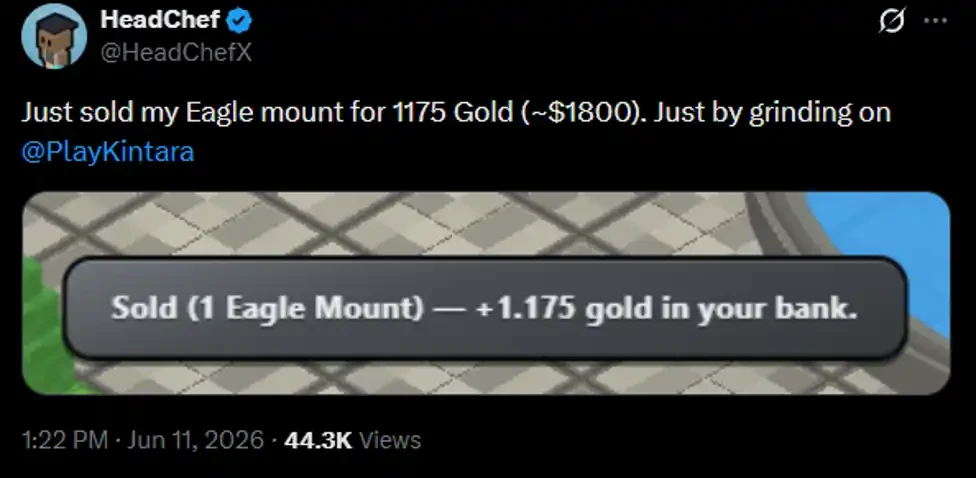
One player successfully sold a rare mount acquired from fishing and earned $1,800:
The project's team almost does "not promote gold farming" but instead places great emphasis on "how to establish a network effect and a sense of belonging among players." For example, integrating various community-type meme coins or new popular coins into game elements, like auctioning luxury houses in-game.
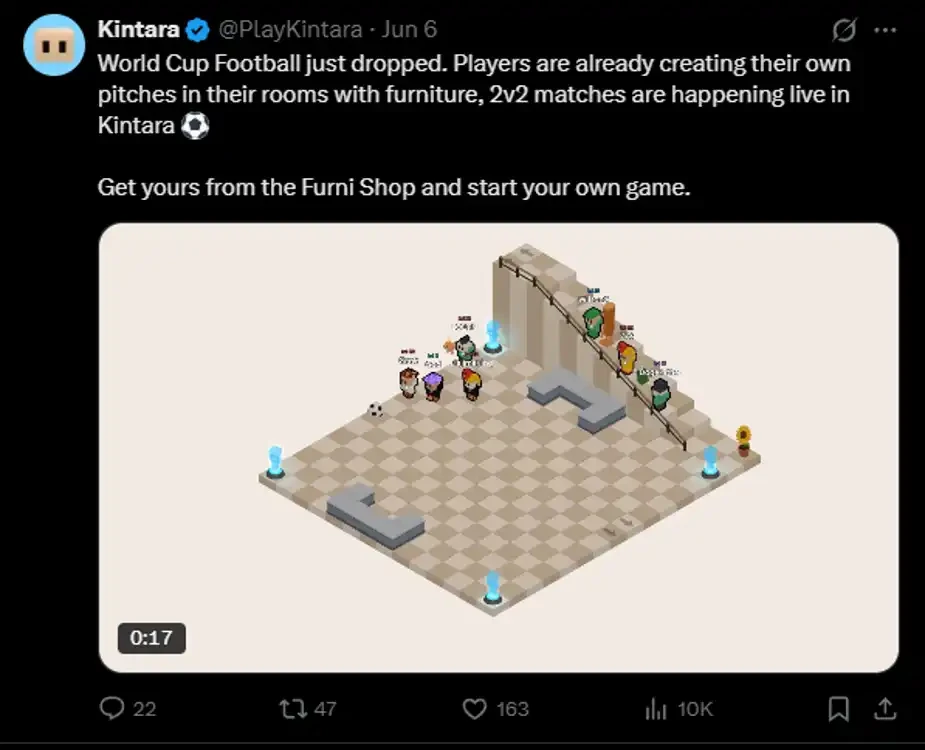
Or promoting players to organize special soccer competitions for the World Cup in their houses:
When it was still inconspicuous, with a market cap of less than $40,000 and 243 holders, this early "unnoticed and unknown" was already written on the statistics board of the game’s main map. Everyone watched Kintara persistently update the game content quickly, gradually gaining the trust of more and more people and attracting KOLs like Gake and Ansem to join as part of the player base.
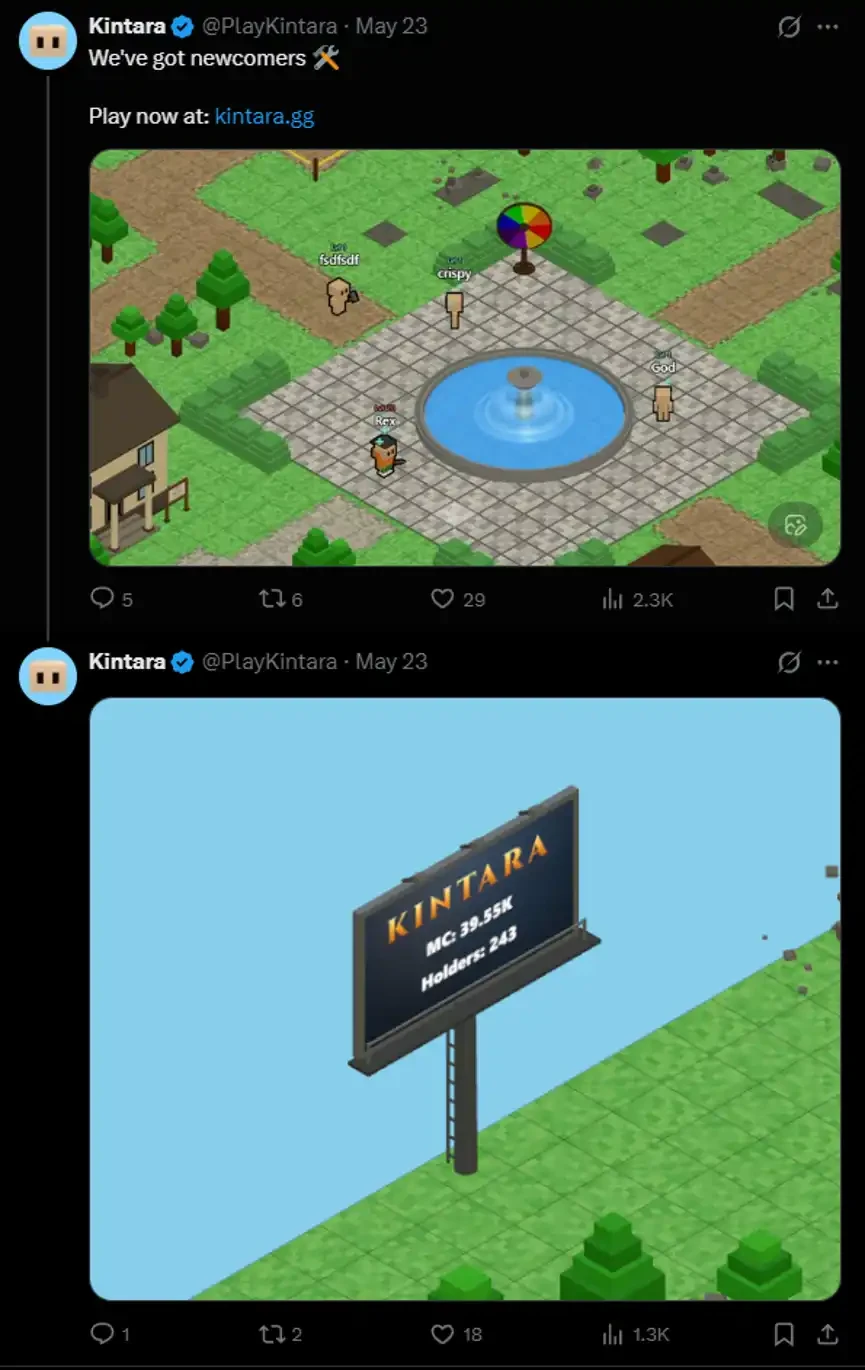
On May 23, Kintara looked like a newly born, silent, and deserted new world.
Thus, no one would say this project is a "setup."
"What we are continually pursuing is either a game of mutual trust or a game of mutual deception?"
This has been a recent introspection of the trenches.
May this questioning continue, ultimately guiding towards a more healthy market.
免责声明:本文章仅代表作者个人观点,不代表本平台的立场和观点。本文章仅供信息分享,不构成对任何人的任何投资建议。用户与作者之间的任何争议,与本平台无关。如网页中刊载的文章或图片涉及侵权,请提供相关的权利证明和身份证明发送邮件到support@aicoin.com,本平台相关工作人员将会进行核查。


