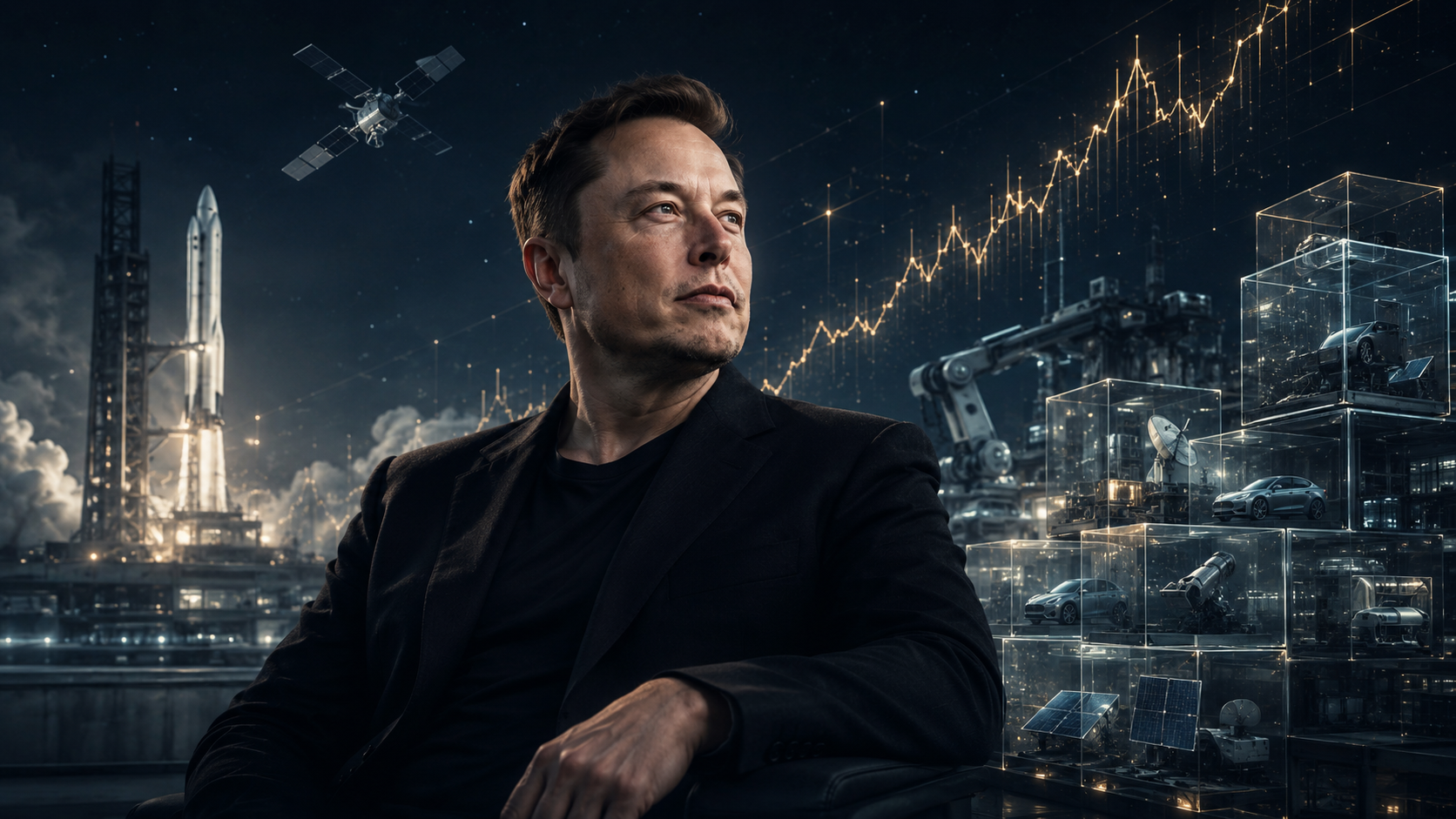
On June 12, SpaceX issued 555.6 million shares at $135 per share, raising $75 billion. The $29.4 billion IPO record set by Saudi Aramco in 2019 has been surpassed by two and a half times, with the company's overall valuation locked in at $1.77 trillion.
A number immediately comes to light: Founder Elon Musk's net worth surpasses $1 trillion. This is the first time in human history that a trillionaire has emerged.
However, the S-1 document simultaneously revealed another set of numbers: the company is projected to have a net loss of $4.9 billion in 2025, with cumulative losses exceeding $37 billion; the xAI department is losing $6.4 billion while annually collecting $26 billion in computing power leasing fees from Anthropic and Google. Only 4.2% of the stock will actually circulate in the secondary market; going forward, how much net buying will push the share price up? When will those holding unlocked stocks, including 4,400 employees about to become millionaires, be unable to hold back?
This is a mathematical problem.
How the trillion-dollar fortune is "calculated"
Musk becoming the first trillionaire is primarily driven by SpaceX's $1.77 trillion valuation. However, the specific composition of the "trillion" figure depends on a question that the S-1 document does not directly answer: How much economic interest does he actually hold?
According to TechCrunch citing the S-1 document, Musk holds approximately 85.1% of the voting rights and will still control over 50% of the voting rights post-IPO. Voting rights do not equate to economic interest. Musk controls the company through holding super-voting shares, which typically bestow voting power 10 to 20 times that of common stock, while the actual proportion of economic interest may be far below 85.1%.
Since the exact economic interest percentage of Musk is not disclosed in public reports, we can only make scenario projections. Assuming his economic interest is between 35% and 55%, the personal equity value corresponding to SpaceX's $1.77 trillion valuation is as follows:
If the economic interest is 35%, the SpaceX equity value is approximately $619.5 billion. Adding his approximately 13% stake in Tesla (equating to hundreds of billions at Tesla's current market value) and other unlisted assets (xAI, Neuralink, The Boring Company), his total net worth easily breaks the $1 trillion threshold.
If the economic interest is 45%, the SpaceX equity value is approximately $796.5 billion, and the total net worth falls in the range of $1.2 trillion to $1.3 trillion.
If the economic interest is 55%, the SpaceX equity value is approximately $973.5 billion, and the total net worth approaches $1.5 trillion.
In all three scenarios, the trillion-dollar threshold is surpassed. Musk's designation as the "first trillionaire" is thus valid on paper.
However, a trillion on paper and a trillion in disposable income are two different things. The 85.1% voting rights suggest that Musk likely holds super-voting shares, which have extremely poor liquidity. Three factors combine to lock up his liquidation ability: lock-up terms prohibit immediate sales post-IPO; large-scale divestitures would directly threaten his absolute control over the company; and if the founder significantly sells off shares, the resulting collapse in market confidence could lead to a price drop far exceeding the proportion of shares sold.
Let's do a comparative question. Bezos liquidated about $8.5 billion in Amazon stock in 2025 through gradual reductions, controlling his sale pace to no more than 2% to 3% of his holdings per year. If Musk were to reduce his SpaceX stake at the same pace, under the 45% economic interest scenario, the upper limit for annual cashable amounts would be about $16 billion to $24 billion. This figure seems enormous but only accounts for 1.6% to 2.4% of his trillion-dollar fortune. In Musk's trillion-dollar fortune, the amount that can realistically turn into cash each year may be less than 2%.
This is the core paradox of the title "trillionaire": the numbers are real, but the liquidity is illusory.
4,400 millionaires and a conditional stock plan
TechCrunch cites the S-1 document revealing that approximately 4,400 employees are expected to become millionaires due to the stock plan. Estimating at the lowest boundary, with each receiving $1 million, the total value of employee stock is at least $4.4 billion. If we assume the potentially implied median level in the S-1 (in the range of $1.5 million to $3 million), the total value is approximately between $6.6 billion to $13.2 billion.
The scale of 4,400 workers sets a record for wealth creation in tech company IPOs. Facebook created around 1,000 millionaires in its 2012 IPO, and Snowflake had around 3,000 employees with a market value of about $70 billion at its 2020 IPO. SpaceX's wealth creation has a broader coverage, which relates to its organizational structure: software companies often support comparable valuations with hundreds of employees, while SpaceX requires multiple times the workforce to maintain hardware manufacturing, launch operations, and satellite internet services. While the average wealth per person may be lower than that of pure software companies, the distribution is closer to the wealth allocation logic of manufacturing.
However, "millionaires" does not equal "million cash". Employee stocks are typically granted in the form of restricted stock units or stock options, and the journey from paper wealth to bank accounts must pass through three obstacles.
The first obstacle is the lock-up period. In the IPO practice of U.S. stocks, employee stocks are typically locked for 180 days, during which trading is prohibited. After Facebook's IPO in 2012, some early employees could not cash out when the stock price briefly fell below the offering price because sales were prohibited during the lock-up period. The second obstacle is the exercise price. If the stock format is options, employees need to pay out of their own pocket at the exercise price to purchase stocks, with the actual profit being the difference between the exercise price and the offering price. The third obstacle is the tax obligation. Exercising options generates a taxable event, with federal tax, state tax, and even alternative minimum tax (AMT) adding up, meaning the actual amount received may be far lower than the paper figure.
Snowflake's stock price doubled on the first day after its 2020 IPO, but employees could only start selling in batches after 180 days, during which the stock price fluctuated over 30%. The 4,400 millionaires at SpaceX face the same timing mismatch: the IPO pricing day is the peak of paper wealth, but real cash will have to wait until the lock-up period ends, and by then, the stock price will be determined by the market battles of the next six months.
The specific forms of employee stock, exercise price levels, and lock-up period details have not been fully disclosed in public reports. The fastest cash-out time window for the 4,400 employees and the actual after-tax amount received remains an unsolved number.
Total shares of 13.11 billion, only 4.2% traded in the secondary market
The chip structure of SpaceX is key to understanding its stock price fluctuations.
Issuing 555.6 million shares at $135 per share raised $75 billion, valuing the company at $1.77 trillion. Based on the valuation, the total share capital is approximately 13.11 billion shares ($1.77 trillion divided by $135). The newly issued 555.6 million shares account for about 4.2% of the total share capital of 13.11 billion shares.
What does a 4.2% circulation ratio mean? The price of any stock is ultimately determined by the buy and sell trades in the secondary market. When the tradable pool of shares represents only 4.2% of total share capital, even a small amount of net buying can significantly push the share price higher. Conversely, when the lock-up period ends and 96% of shares are gradually released, the selling pressure will also be amplified.
Let’s make a rough comparison. Apple's daily transaction amount is about $12 billion, corresponding to a turnover rate of 0.36% relative to a total market value of about $3.3 trillion. If SpaceX computes a daily turnover rate of 0.36% in a $75 billion tradable market, the daily trading volume would be about $270 million. At a daily turnover level of 0.36%, $270 million in net buying pressure theoretically could influence stock price movements, but in the actual market, the intervention of market makers, high-frequency traders, and arbitrage funds complicates this relationship.
One cannot directly assert that "a net purchase of $7.5 billion will make the stock price increase by 10%." However, it can be confirmed that SpaceX's chip structure gives its stock price a natural high elasticity while also rendering it vulnerable to substantial selling pressure after the lock-up period.
Here’s a hypothetical scenario depicting changes in market capitalization under price increases. If the stock price rises by 10% to $148.5, the market capitalization would rise from $75 billion to $82.5 billion, an increase of $7.5 billion. If the stock price increases by 20% to $162, the market capitalization would rise to $90 billion, an increase of $15 billion. If the stock price rises by 30% to $175.5, the market capitalization would reach $97.5 billion, an increase of $22.5 billion.
These incremental numbers are merely changes in market capitalization and do not equal the required net buying funds. The actual stock price is determined by the matching of buy and sell orders. The inventory adjustments of market makers, arbitrage strategies of high-frequency trading, and the distribution operations of institutional investors affect capital efficiency. However, the 4.2% circulation ratio provides a clear magnitude concept: SpaceX's stock price sensitivity to capital is far higher than that of ordinary large-cap stocks.
The real test comes after the lock-up period ends. When 96% of the 13.11 billion shares are gradually unlocked, including employee stock plans, early investors, and the large holdings held by Musk himself, will the secondary market be able to absorb such a flood? The S-1 document warns investors of potential further equity dilution risks after the listing, and this risk will be concentrated at the expiration of the lock-up period.
How many millionaires could Anthropic and OpenAI create if they go public?
The 4,400 millionaires at SpaceX provide a benchmark. In cross-comparison, if Anthropic and OpenAI were to go public at their current private valuation, how would the total value of their employee stock compare?
CNBC and Morningstar report confirm that Anthropic completed Series H financing with a valuation of $965 billion, reaching an ARR of $30 billion. Forbes and Sacra report show that OpenAI has a valuation of $852 billion, with an annualized revenue of about $25 billion. Neither company is publicly traded, and the proportion of employee option pools and the exact number of employees have not been disclosed.
Setting core assumptions: If both companies were to IPO at their current private valuations, and the employee option pool accounted for 10% to 15% of the total shares (as is common for Silicon Valley unicorn IPOs). Under this assumption:
For Anthropic, under the 10% option pool assumption, the total value of employee stock would be about $96.5 billion; under the 15% assumption, about $144.8 billion.
For OpenAI, under the 10% option pool assumption, the total value of employee stock would be about $85.2 billion; under the 15% assumption, about $127.8 billion.
Even under the most conservative 10% option pool assumption, the total value of employee stock at Anthropic and OpenAI is 22 times and 19 times the known minimum value at SpaceX ($4.4 billion). This gap arises from a structural reason: In SpaceX's $1.77 trillion valuation, Musk holds a very high percentage personally (his 85.1% voting rights mean that even if his economic interest percentage is lower, he still holds a massive share), limiting the portion of the cake available to employees. On the other hand, as AI-native companies, Anthropic and OpenAI have smaller employee counts (OpenAI approximately 1,200 people, Anthropic approximately 1,500 to 2,000 people, according to public estimates), allowing for a more distributed shareholding.
However, this is a paper-based horizontal comparison. Anthropic’s $965 billion valuation corresponds to an ARR of about $30 billion, giving a revenue multiple of about 32x; OpenAI's $852 billion valuation against $25 billion in annual revenue corresponds to a price-to-sales ratio of about 34x. This multiple is far above SpaceX’s approximately 9.8x (which is $1.77 trillion divided by $18 billion in revenue).
Whether the secondary market is willing to pay the same or even higher PS multiples for AI companies remains an unverified question. The IPO of CoreWeave provides a warning: when listing in 2025, its valuation was compressed to the range of $23 billion to $30 billion, far below the expectations of some investors. This was due to the heavy capital expenditures and low profit margins associated with the AI computing rental model being scrutinized.
Moreover, the financial data of the xAI division revealed in SpaceX's S-1 indicates that similar contradictions exist in SpaceX's AI computing power business. OmniTools previously reported that the xAI department projected revenue of $3.2 billion in 2025, with a loss of $6.4 billion, estimating annual capital expenditures of approximately $30.8 billion. This data means that the $26 billion annual income SpaceX collects from Anthropic and Google for computing power rentals comes from a unit that is still heavily losing money, with capital expenditures far exceeding income.
If Anthropic and OpenAI stand at the IPO threshold, the valuation multiplied by the ownership ratio will appear significant to employees. However, whether they can cash out on the secondary market depends on whether the post-IPO PS multiple can be maintained. The 4.2% circulation story of SpaceX will likely repeat itself in these AI companies, just with a shift in protagonism from rockets to large models.
The other side of computing revenue
The long-term support for SpaceX's stock price ultimately returns to one question: Can the AI computing rental income cover xAI's losses and capital expenditures?
The S-1 document discloses that xAI has secured computing power leasing contracts worth $1.25 billion from Anthropic and $920 million from Google per month, leading to an annualized income of about $26.04 billion. Yet, the xAI department is projected to generate revenue of $3.2 billion in 2025, with a loss of $6.4 billion. Just looking at this item, the $26 billion annual revenue comfortably covers the $6.4 billion loss, indicating that operational losses are not the main issue for xAI.
The problem lies in capital expenditures. OmniTools estimates annual capital expenditures at approximately $30.8 billion, far exceeding the $26 billion annual revenue, leaving a gap of about $4.8 billion that requires external financing or a cash infusion from SpaceX's parent company. More critically, the $26 billion annual revenue is based on a static calculation of "monthly $1.25 billion plus $920 million," while the contract duration, renewal terms, and conditions for early termination with Anthropic and Google have not been publicly disclosed in the S-1 document.
SpaceX lists water resources alongside chips and electricity as core risks in the S-1 document. The $30.8 billion capital expenditure means that xAI must continuously purchase GPUs, build data centers, and consume electricity and water resources. If the computing contracts with Anthropic and Google have clauses for shortened cycles or early termination, the $26 billion annual income may not be guaranteed.
For secondary market investors, this is a knot that must be untangled. SpaceX's stock price increase narrative relies on the high growth of AI computing rentals, but the scale of capital expenditures supporting that growth implies ongoing cash consumption. When 96% of the locked-up shares are released, if xAI is still in the financial state of "annual revenue $26 billion, annual loss $6.4 billion, annual expenditure $30.8 billion," will institutional investors continue to pay for this cycle?
SpaceX's IPO is a mathematical problem, and the answer does not lie on the pricing day, but in the first quarter following the end of the lock-up period.
免责声明:本文章仅代表作者个人观点,不代表本平台的立场和观点。本文章仅供信息分享,不构成对任何人的任何投资建议。用户与作者之间的任何争议,与本平台无关。如网页中刊载的文章或图片涉及侵权,请提供相关的权利证明和身份证明发送邮件到support@aicoin.com,本平台相关工作人员将会进行核查。


