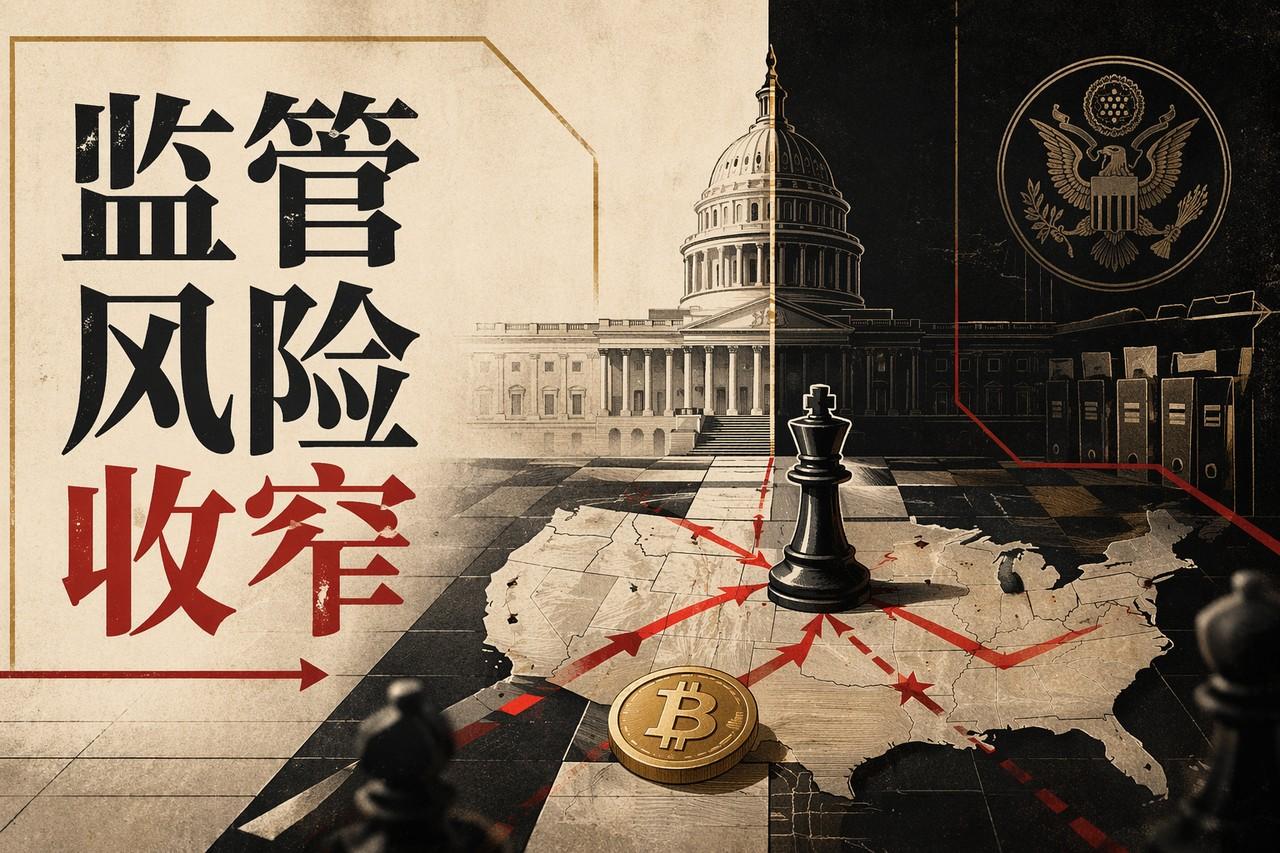
On June 17, 2026, two seemingly unrelated regulatory news events drew a hidden timeline: In Shanghai, at the Lujiazui Forum, which has consistently been viewed as a barometer of China's financial reform and regulatory environment, Wu Qing, chairman of the China Securities Regulatory Commission, openly stated that guidelines for the regulated development of artificial intelligence in capital markets would be released in due course, specifically targeting illegal stock recommendations, spreading rumors, illegal trading, and behaviors that manipulate the market under the guise of technology. Almost simultaneously, a joint announcement was made by the People's Bank of China and five other ministries, issuing the "Offshore Financial Action Plan for the Development of the Shanghai International Financial Center," which proposed building cross-border, offshore, and blockchain infrastructure based on the international operation center of the digital renminbi, promoting interconnectivity with overseas financial infrastructure, while leaving blank the specific stance on trading and issuing crypto assets. Across the ocean, the Office of the Comptroller of the Currency (OCC), a federal bank regulatory agency in the United States, was caught up in another game related to new technology: media reports cited two unnamed former OCC employees stating that World Liberty Financial, associated with the Trump family and described as a "crypto project supported by the Trump family," is expected to soon be approved to operate as a national trust bank, despite no formal approval documents being released by the OCC as of June 17, and this project had established a U.S. trust company and submitted relevant applications to the OCC earlier in January this year (according to a single source). As for financial technology, China is drawing increasingly detailed red lines for capital markets and digital renminbi infrastructure with AI guidelines and offshore financial action plans, while the U.S. may be opening the door to politically colored crypto banks for national trust licenses; the regulatory paths of China and the U.S. are bifurcating in two directions on the same day.
Lujiazui Forum Highlights AI Stock Recommendation Chaos
At the Lujiazui Forum on June 17, China Securities Regulatory Commission Chairman Wu Qing directly pointed his arrows at the rapidly spreading "AI stock recommendation business" in the capital market. On one hand, he released institutional signals, announcing that guidelines for the regulated development of artificial intelligence in capital markets would be "issued in due course"; on the other hand, he articulated a law enforcement stance—illegal use of artificial intelligence for stock recommendations, even spreading rumors, illegal trading, and other chaos must be "strictly dealt with according to the law," and "strictly investigate and punish activities that manipulate market concepts under the pretext of technology or even involve market manipulation and insider trading." In the long-standing platform recognized as an important venue for the release and discussion of China's financial reform and regulatory policies, these statements sounded more like a regulatory checklist about to be implemented rather than a principle-oriented reminder.
The targets directly aimed at by this checklist are a whole gray industrial chain revolving around "AI stock picking" and "intelligent quantitative signals": institutions and KOLs openly selling AI strategies, quantitative teams that heavily rely on algorithmic models while packaging themselves as "intelligent investment advisory narratives," and intermediary platforms facilitating traffic and products. These will be included in the strict crackdown scope of "borrowing technology to ride trends, conceptual speculation, and even market manipulation and insider trading." Wu Qing's linkage of "spreading rumors" and "illegal trading" with "AI" also signifies that the zero-tolerance attitude towards market manipulation and insider trading that has formed in China's capital market in recent years will be fully transferred to the artificial intelligence scenario: from now on, it will not be about whose technology is cooler, but rather about who uses AI to cross the red lines of manipulation, insider trading, or rumor-mongering will be held accountable under the strictest standards of securities violations.
What the Upcoming AI Guidelines Will Cover
By placing "artificial intelligence" directly in the same context as "illegal stock recommendations," "spreading rumors," and "illegal trading," it can be inferred that the "guidelines for the regulated development of artificial intelligence in capital markets" are aimed not at a type of flashy product, but at the entire AI application chain surrounding securities trading and information dissemination. Under the existing framework, investment advisory services and securities research have long been subject to licensing management and investor suitability constraints, and the regulators are more likely to transfer this logic to AI tools and algorithm service providers: when a model actually provides buy and sell suggestions to unspecified recipients, helps draft market-oriented analytical views, or directly participates in order decision-making, it is no longer viewed as "neutral technology" by regulators, but rather must be examined against the strictest standards of the three categories of investment advisory, research, and trading.
Corresponding to the specific boundary of roles, on one end are internally developed models for licensed institutions used to assist in research or risk control, and on the other end are publicly accessible AI stock recommendation robots, content generation tools, and "intelligent investment advisory" interfaces. In the middle are technology companies providing algorithm capabilities to brokerage firms and public funds. The guiding opinion will likely delineate responsibilities among these three categories: who is responsible for compliance with algorithmic recommendation logic, who bears joint liability for using models to spread rumors or manipulate markets, and in which scenarios must return to hard constraints of information disclosure and suitability management. The real uncertainty lies in how detailed these judgments will be written. The only anchor point currently available in the market is Wu Qing's statement of "issuing in due course" and the existing tone of strict law enforcement—before the formal text is published, all participants must first assume that a bottom line has been drawn: any use of AI to engage in activities already deemed illegal under securities law will not receive any exemptions just because it is wrapped in an "algorithm" exterior.
Digital Renminbi Offshore Infrastructure Begins
As the China Securities Regulatory Commission draws red lines on "AI + capital markets" at the Lujiazui Forum, a new framework for currency and payments is also taking shape. The "Offshore Financial Action Plan for the Development of the Shanghai International Financial Center," jointly issued by the People's Bank of China and six other ministries, places the "Digital Renminbi International Operation Center" squarely at the center of offshore development, requiring the construction of cross-border, offshore, and blockchain infrastructure based on this center, and explicitly stating "promoting interconnectivity with overseas financial infrastructure." In Shanghai, which has multiple times undertaken financial opening and pilot tasks, this means the digital renminbi is no longer just viewed as a domestic payment tool but is directly embedded into the narrative of a national offshore financial strategy.
For cross-border payment services and on-chain asset service providers, these seemingly abstract statements quietly rewrite compliance pathways. On one hand, the inclusion of "cross-border, offshore, and blockchain infrastructure" in the action plan itself sends out a signal: the technological base for future cross-border settlement and trading clearing will be prioritized for building around officially recognized blockchain facilities, rather than isolated technical islands. On the other hand, "promoting interconnectivity with overseas financial infrastructure" provides a boundary—only those overseas platforms that genuinely connect to the flow of funds and traffic from China must go through a pathway compatible with the digital renminbi international operation center and not bypass regulatory gray interfaces. Current public information has not disclosed the action plan's specific stance on cryptocurrency trading, issuance, etc., but what can be confirmed is that "blockchain infrastructure" has entered the policy planning vocabulary, which both gives compliance on-chain service providers some imaginative space and means that any attempts to evade regulation under the guise of cross-border and offshore must recalculate their risks and costs within this new infrastructure system.
WLFI Rushing for National Trust Bank License
Unlike China’s efforts to build "blockchain infrastructure" in Shanghai, on the other side of the Atlantic, a politically charged on-chain project is attempting to directly enter the sequence of federally licensed banks in the United States. World Liberty Financial has been repeatedly described by media as a "crypto project supported by the Trump family." According to a single source, it established a U.S. trust company in January this year and submitted an application for a national trust bank to the Office of the Comptroller of the Currency (OCC). Two unnamed former OCC employees informed the media that WLFI "is expected to be approved soon" and will operate in the form of a national trust bank; however, as of June 17, 2026, there have been no official records regarding the approval of this application on the OCC's official website and in public documents, meaning that all claims of "imminent approval" remain at the level of rumor rather than legal fact.
Nevertheless, the mere action of "rushing for a license" is already stirring the regulatory landscape of cryptocurrency and traditional finance in the United States. As a federal bank regulatory agency, the OCC is responsible for granting and regulating charters for national banks and federal savings associations. If it approves WLFI's application, the latter will no longer just be a high-risk innovation project tied to political figures but will have to fit into the licensed institutional sequence bound by federal bank regulatory frameworks: it would be able to reach a wider pool of USD funds and custodial services while also being subject to a complete set of "bank-level" requirements, including capital adequacy ratios, risk management, anti-money laundering, and compliance reviews. The truly sensitive aspect is the intersection of politics and licenses—if a project perceived to be "Trump-linked" obtains federal licensure, whether the regulatory standards can be maintained equally with other applicants, how competitors might question whether "political endorsement" has altered the entry thresholds, and how the OCC internally manages to firewall political pressure from professional judgment will all become stress tests for the credibility of U.S. financial regulation, and the direction of this test will significantly influence how the market prices the regulatory risk premium associated with politically connected projects.
Who is Being Rewritten Under Diverging Regulatory Paths
In the same time window, China is opting to "bring AI back into the old legal framework," while the U.S. might push politically tied crypto projects into the realm of licensed banks. Wu Qing has clearly stated that the chaos of using artificial intelligence for illegal stock recommendations, spreading rumors, illegal trading must be included in the existing securities law enforcement system along with market manipulation and insider trading; meanwhile, the "Action Plan" displays construction positions in offshore finance, the digital renminbi international operation center, and blockchain infrastructure. For crypto platforms and AI financial entrepreneurs, the short-term signals are direct: in China, any model that uses "AI investment advisory" or "intelligent quantitative" concepts touching on securities business must assume first that it is being treated as a high-risk object of traditional securities violations; cross-border funds and users must reassess their channel choices and compliance costs between the institutionalized digital renminbi infrastructure and the potentially OCC-licensed crypto trust banks in the U.S. On the other hand, the optimistic expectations regarding World Liberty Financial in the U.S. currently still derive only from the anonymous assessments of two former OCC employees, lacking the support of formal approval documents, and it remains unclear whether the regulatory thresholds have been lowered or maintained at traditional bank levels. Going forward, the official text of China’s AI guidelines, the implementation rules of the action plan, and the OCC's final decision on the WLFI application will jointly determine how far AI and crypto finance can move on both sides of China and the U.S. and what lines will be drawn, with the industry boundary quietly rewritten in these specific writings.
Join our community to discuss together and become stronger together!
AiCoin exclusive Hyperliquid benefits: https://app.hyperliquid.xyz/join/AICOIN88
AiCoin exclusive Aster benefits: https://www.asterdex.com/zh-CN/referral/9C50e2
On-chain Telegram community: https://t.me/AiCoinWhaleData
On-chain community: https://www.aicoin.com/link/chat?cid=N6OVMor5g
AiCoin on-chain Twitter: https://x.com/aicoinwhaledata
免责声明:本文章仅代表作者个人观点,不代表本平台的立场和观点。本文章仅供信息分享,不构成对任何人的任何投资建议。用户与作者之间的任何争议,与本平台无关。如网页中刊载的文章或图片涉及侵权,请提供相关的权利证明和身份证明发送邮件到support@aicoin.com,本平台相关工作人员将会进行核查。