Author: Zhou, ChainCatcher
Recently, Moomoo, a subsidiary of Futu, officially integrated Hyperliquid's on-chain US stock perpetual contract market data into the App, allowing nearly 30 million users worldwide to directly view on-chain derivatives pricing in the traditional brokerage interface.
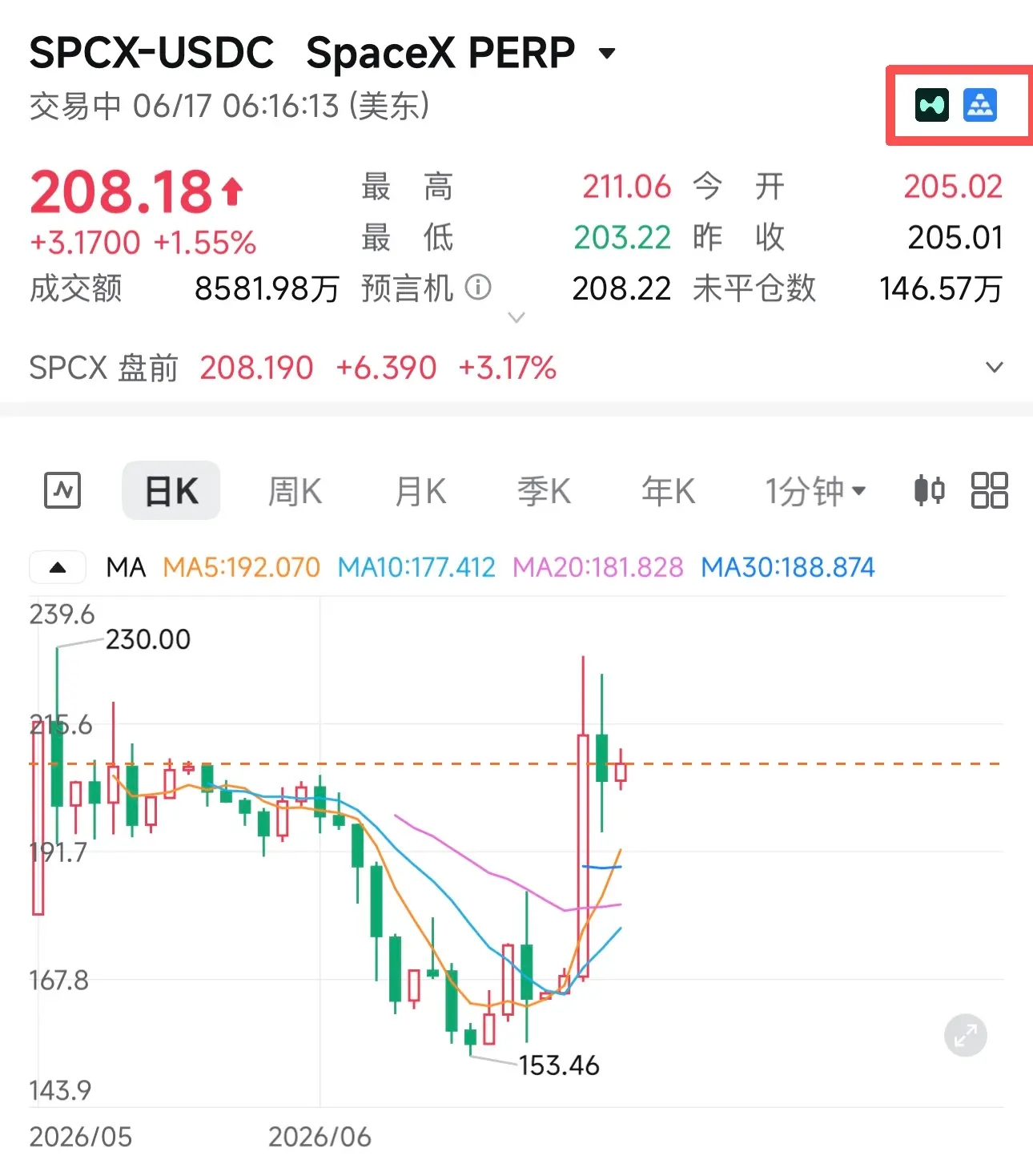
Prior to this, platforms like trade.xyz had already offered Pre-IPO perpetual contract pricing and trading for new stocks like Cerebras and SpaceX.
Discussions around "coin-stock linkage" have been ongoing for several years, initially describing the simultaneous rises and falls of BTC and the NASDAQ, later extending to miner stocks and treasury companies fluctuating with coin prices.
This article believes that "coin-stock linkage" has undergone three evolutionary stages: macro correlation (1.0), one-way penetration of sentiment and capital (2.0), and the new stage (3.0) where on-chain perpetual contracts provide 24/7 continuous trading as an all-weather sentiment signal for traditional assets.
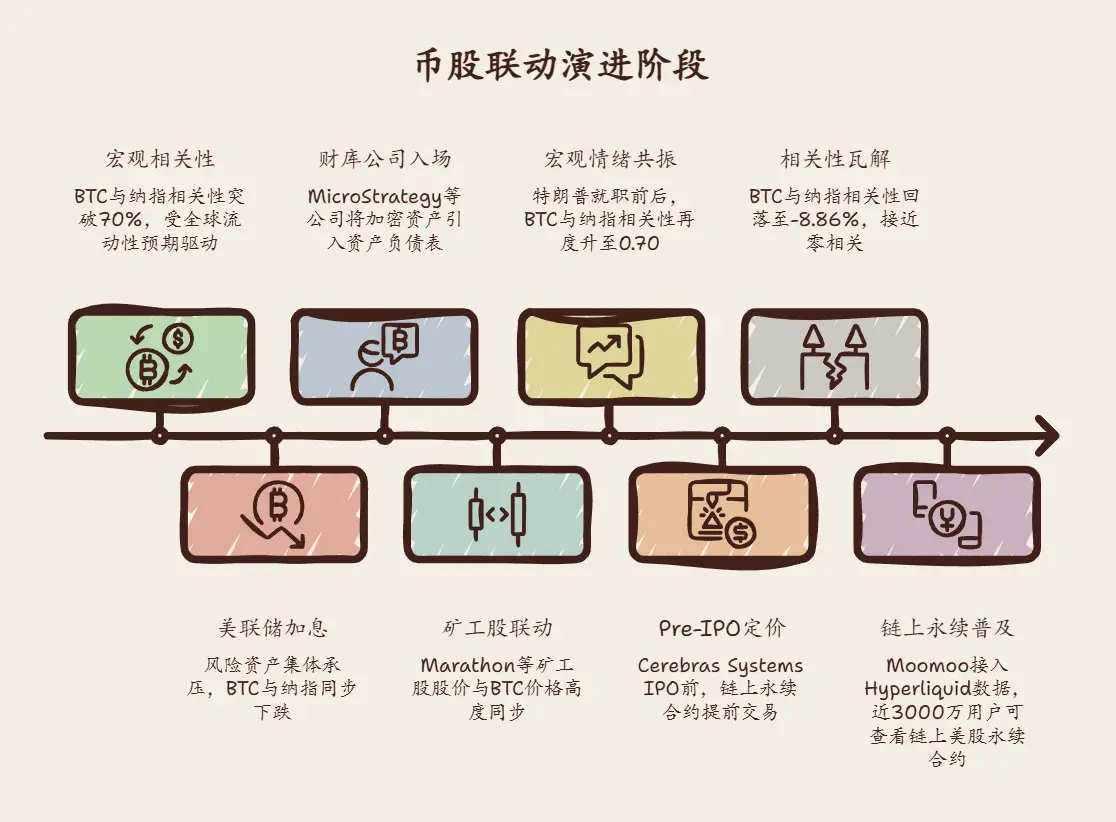
ImageSource:AI Generated
1.0: The Passive Follow of Macro Correlation
Before 2020, the correlation between BTC and the NASDAQ was generally low, mostly in a low correlation or even slightly negative correlation range, with both markets moving independently.
After the pandemic shock, the situation changed significantly. CryptoQuant data shows that from 2020 to 2022, the 30-day rolling correlation coefficient between BTC and the NASDAQ frequently broke above 70%.
During this period, global central banks implemented massive monetary easing, with a simultaneous influx of risk-seeking capital into technology stocks and the crypto market, both sharing the liquidity expectation in this macro denominator.
In 2022, the aggressive interest rate hikes by the Federal Reserve put significant pressure on risk assets, and BTC and the NASDAQ again fell sharply in unison.
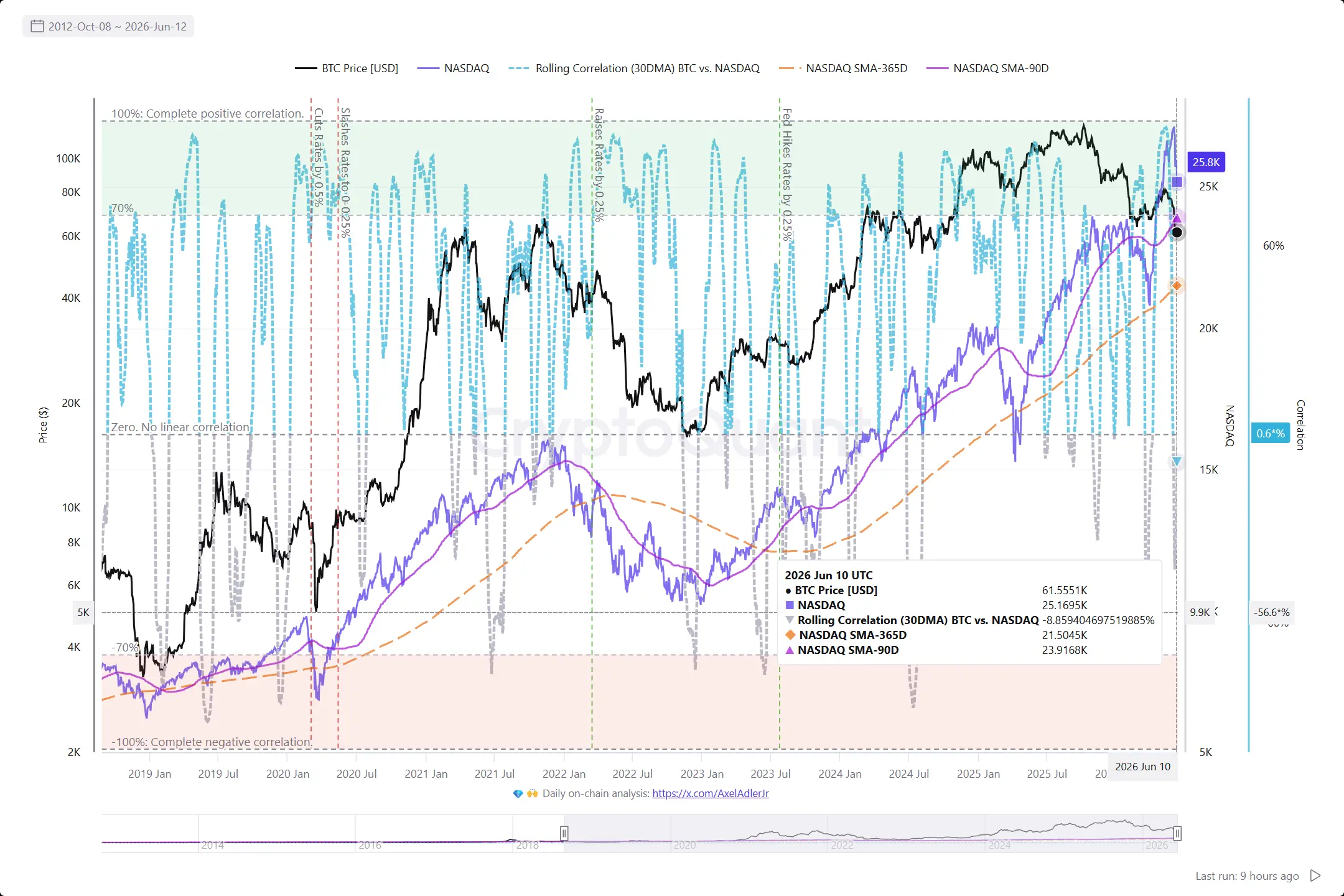
After 2022, the correlation declined somewhat, but the trend was not one-way downward. In January 2025, macro sentiment resonated again around Trump's inauguration, with the 30-day correlation coefficient rising to 0.70, marking a new two-year high.
However, as the event's intensity faded, the correlation again collapsed. As of June 2026, this figure had fallen to about -8.86%, essentially within the zero correlation range.
This change indicates that the correlation between Bitcoin and the NASDAQ is not fixed but adjusts with changes in the macro environment and market structure.
2.0: One-Way Penetration of Emotion and Capital
As the size of the crypto market continues to expand, the relationship between the two markets began to change anew. The sentiment and capital in the crypto market no longer just passively follow US stocks but begin to impact some sectors of US stocks in a one-way manner.
An increasing number of retail investors are becoming active in both markets, with resonance among hot topics becoming more frequent. The coin-stock linkage has entered version 2.0.
Mining stocks are the most typical example. Companies like Marathon and Riot have stock prices that move highly in sync with BTC prices, driven by direct business connections. When BTC rises, miner income expectations increase, driving up stock prices, and vice versa. This linkage does not depend on emotional transmission but on a fundamental hard connection.
Treasury companies represent another path. In 2024, MicroStrategy's stock price soared as the market gradually accepted its "BTC leverage exposure" pricing logic. After this model spread, more traditional public companies actively incorporated crypto assets into their balance sheets. Bitmine is one of the most aggressive treasury companies, having heavily bought ETH in 2025, and it is still at a loss of about 50%, with the rise and fall of the crypto market directly affecting these companies' asset valuations and stock price trends.
It is noteworthy that the stock price fluctuations of treasury companies often precede the cryptocurrencies themselves. The market's speculation over their holdings and financing expectations sometimes drives stock prices to react even before crypto prices start moving. This creates complexity in the direction of the 2.0 version of the linkage.
Overall, the linkage remains one-way. Capital and sentiment flow from the crypto market to the US stock concept sectors without forming a stable two-way loop. During times when the US stock market is closed, information gaps between the two markets still exist, which is a structural gap that version 2.0 has not resolved.
3.0: Extended Trading Duration and Emotional Signal Value
Filling the Trading Time Vacuum
The traditional stock market has fixed trading hour constraints, with weak liquidity before and after hours, and completely stopping on weekends. On-chain perpetual contracts break this limitation, allowing market sentiment to receive more continuous feedback through 24-hour trading.
On June 9, before the US stock market opened, perpetual contracts for Micron MU on trade.xyz had already reflected the upward trend of the day ahead of time, with prices breaking through $999.4, approaching the $1000 threshold, and a 24-hour trading volume reaching $243 million.
During the suspension of the Korean stock market, trade.xyz and Binance synchronized to provide continuous quotes for SK Hynix, with total positions on both platforms exceeding $170 million.
From the perspective of Hyperliquid's HIP-3 ecosystem, the cumulative trading volume of stock-linked perpetual contracts has surpassed $18.8 billion, exceeding the total of $7.66 billion for crude oil and Brent crude oil perpetual contracts.
This continuous pricing capability is the reason Moomoo is willing to integrate Hyperliquid's market data. As related platforms' trading volumes increase, on-chain stock perpetual contracts are becoming an important window to observe asset sentiment.
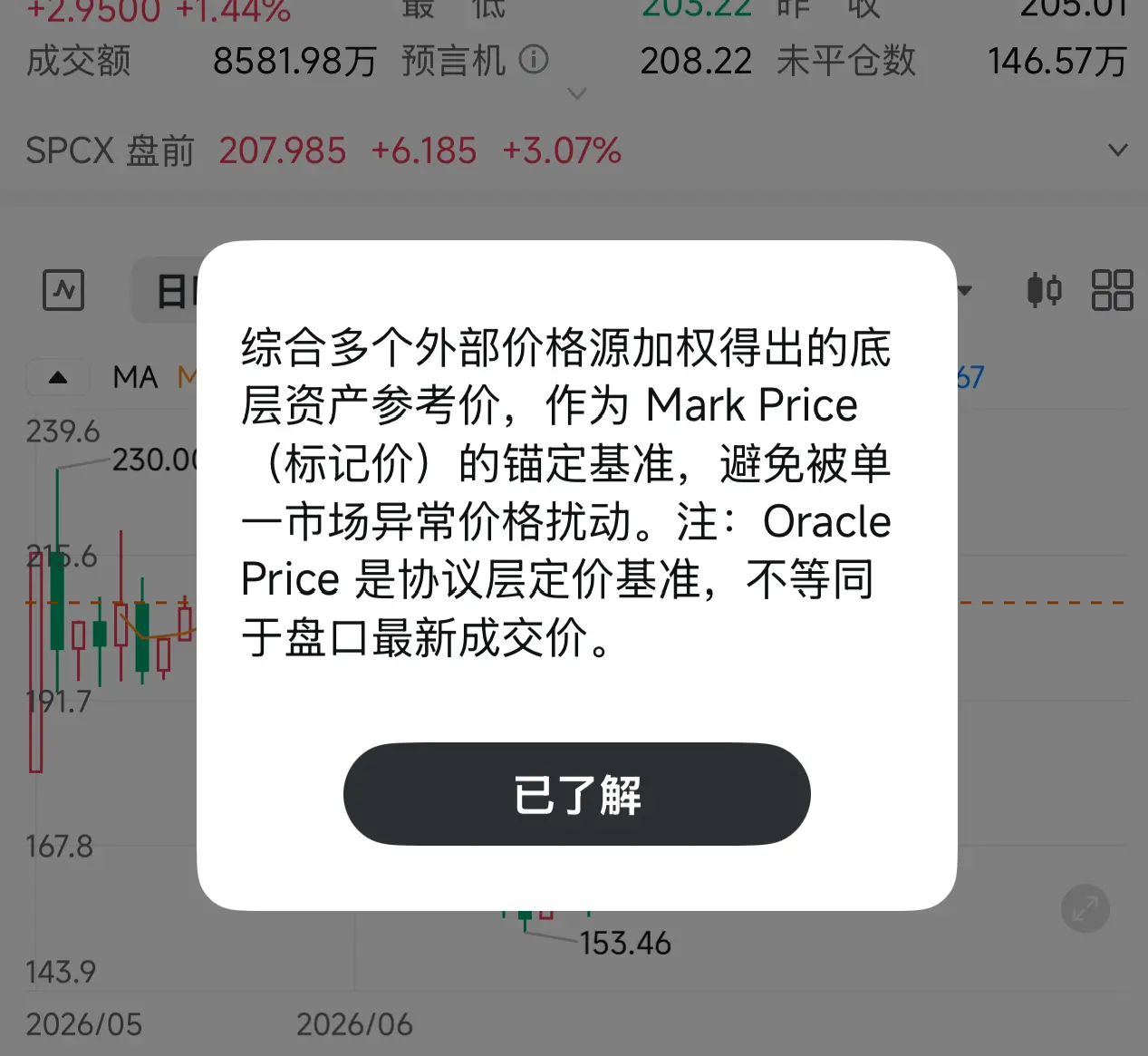
According toMoomoointerfacedisplaysthatitsoracle price is a weighted reference price derived from multiple external price sources, serving as the anchor benchmark for marked price, aiming to avoid being disturbed by anomalous quotes from a single market.
Products like perpetual contracts were considered a pseudo-demand track four years ago. Crypto KOL qinbafrank believes that US individual stocks lack futures tools, and on-chain perpetual contracts have a role similar to the linkage between altcoins' spot and contract, offering considerable operational space for some capital.
The Special Significance of Pre-IPO
For Pre-IPO assets, the significance of on-chain perpetual contracts is even more pronounced. In the traditional IPO process, it is difficult for ordinary investors to participate in pricing in advance, while on-chain perpetual contracts make this process continuous.
In May 2026, as Cerebras Systems landed on NASDAQ, Perpetual contracts for Pre-IPO on trade.xyz had already been trading weeks in advance. Before the opening, on-chain contracts quickly surged from the $290 range to $380, with single-hour trading volume nearing $100 million, while NASDAQ was still in the pricing stage, and ordinary investors could only officially participate by 1 AM.
The situation with SpaceX is similarly representative. In the three weeks before the IPO, the xyz:SPCX contracts on Hyperliquid had an average daily trading volume of only about $26 million. After SpaceX officially landed on NASDAQ last Friday, the trading volume of xyz:SPCX surged to $1.4 billion that day, accounting for 30% of the total trading volume on the HIP-3 platform. Similar contracts on Binance also saw a rapid increase in volume, with the 24-hour trading volume exceeding $5.6 billion by June 13, becoming the second largest trading variety on the platform, second only to BTC perpetual contracts.
Reality Boundaries and Mechanism Weaknesses
However, limitations in scale and mechanisms are also present.
On one hand, the growth of data on on-chain platforms remains concentrated on a few underlying assets, and its overall scale is still very small compared to traditional markets.
According to Hyperinsight monitoring, the overall trading volume on trade.xyz weekly is about $1.50 billion, equivalent to approximately 0.201% of the overall traditional market. Specifically, the on-chain corresponding contracts for MU and Marvell account for about 0.39% and 0.75% of the real trading of global traditional securities markets, respectively, making it difficult for on-chain perpetual contracts to form a substantial pricing impact.
On the other hand, there is also some vulnerability in the mechanism of the Pre-IPO track. The SpaceX pre-IPO contract faced pricing adjustments due to updates in share capital data, forcing many platforms to temporarily delist and reprice. Kraken's xStocks platform for SpaceX's IPO also encountered situations where allocation was far below expectations, with some users receiving allocation equivalent to only about $600 and receiving refund notices.
This process shows that while on-chain perpetual contracts provide continuous pricing, their issuance and distribution phases are still constrained by the supply constraints of traditional underwriting systems.
Overall, on-chain perpetual contracts currently provide emotion extension and signal supplementation during non-trading hours for traditional assets. They have not yet changed the underlying pricing logic but have demonstrated actual value in specific assets and contexts.
Conclusion
The coin-stock linkage has reached stage 3.0,with the core issue no longer being the strength or weakness of macro correlation, but rather that on-chain perpetual contracts provide the long-missing continuous emotional observation dimension in the traditional market.
Before hours, after hours, weekend suspensions, and gaps in new stock pricing—these information vacuums are now being filled by 24/7 uninterrupted on-chain prices.
Although the current on-chain trading volume is still far less than that of the traditional market, it cannot yet be considered a competitor for pricing power, but it has become another observation window beyond the prices of traditional assets.
Moreover, in areas where traditional pricing mechanisms like Pre-IPO are already weak, on-chain perpetual contracts have begun to play a real role in price discovery and emotional transmission, which is currently the clearest practical scenario in stage 3.0.
免责声明:本文章仅代表作者个人观点,不代表本平台的立场和观点。本文章仅供信息分享,不构成对任何人的任何投资建议。用户与作者之间的任何争议,与本平台无关。如网页中刊载的文章或图片涉及侵权,请提供相关的权利证明和身份证明发送邮件到support@aicoin.com,本平台相关工作人员将会进行核查。


