
Organized by: Felix, PANews
AI inference is gradually becoming one of the key layers of internet infrastructure. However, most current inference still relies on centralized architectures, which are expensive, have limited capacity, and layered complexities that pose certain security risks. Meanwhile, there are millions of powerful computers globally that remain idle for most of the day.
Eigen Labs recently launched the AI inference network Darkbloom, exploring distributed AI inference on idle Mac computers. By combining verified nodes, hardware-level privacy protection, and better economic benefits, it transforms idle Apple Silicon chips into a more efficient, privacy-first computing network.
The project was launched around April this year as a research preview, upgraded to a public alpha version in May, and is now live on the OpenRouter platform. In the alpha version, the available models are Google's Gemma 4 and OpenAI's GPT-OSS.
Core Architecture and Verifiable Privacy
The Darkbloom network consists of three parts: users, coordinators, and providers.
- Users can send inference requests through a chat interface or a compatible OpenAI API.
- The coordinator (operated by Eigen Labs) routes these requests to eligible Macs in the network.
- Providers (users who own these eligible Macs) run the models and return output results, but they cannot see the request content.
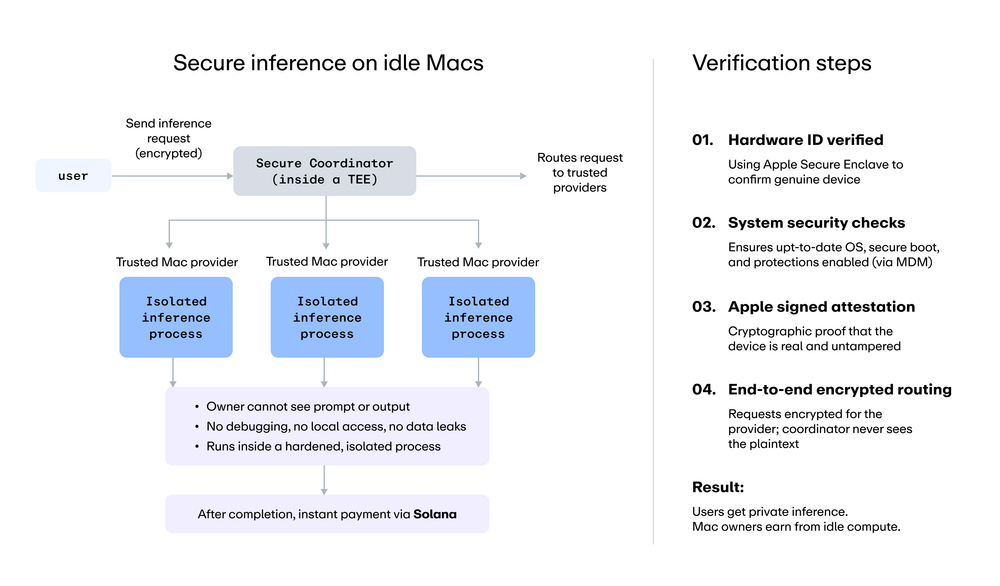
Darkbloom is built on a privacy-first distributed inference model. The provider process is fortified to withstand common local inspection paths, including debugger attachments and external memory checks. The integrity of the binary files is also part of the trust model, helping to ensure that the software serving requests aligns with network expectations.
The system also uses hardware-supported authentication based on Apple's security architecture. Secure enclave keys, authentication signals, and periodic challenge-response checks are used to verify whether participating nodes are operating with the expected protections and software states, truly achieving verifiable privacy.
Economic Model and Daily Earnings
Darkbloom's business model is fundamentally different from that of most projects. In traditional tech stacks, costs include hardware, facilities, cooling, networking, operational overhead, and multiple layers of profit. In Darkbloom's model, hardware already exists, and the marginal costs are mainly driven by electricity. Darkbloom's benchmark pricing is only about 50% of the current mainstream API aggregators. Providers (Mac hosts) can retain 100% of the inference revenue. Additionally, Darkbloom does not adopt token issuance to subsidize early participant pathways; node earnings come entirely from real AI inference demand.
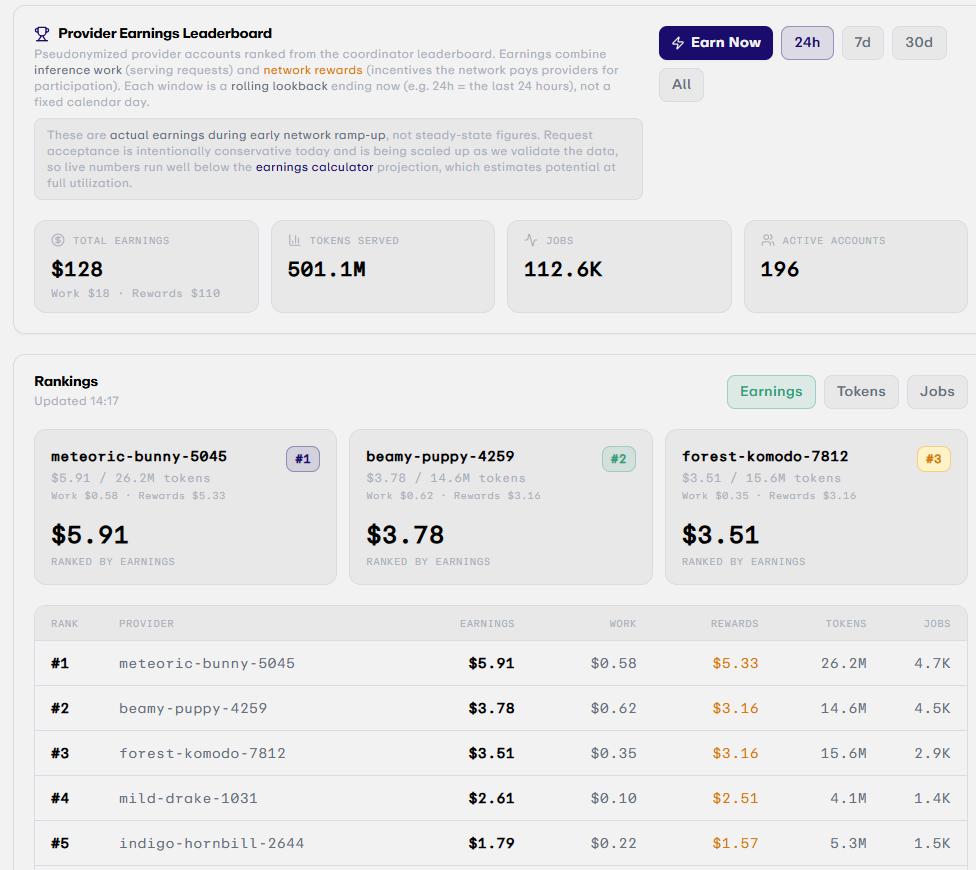
It is worth noting that, given the project is still in its early stages, earnings are relatively modest. Factors such as memory and hardware configurations, uptime, model demand, node health, and network demand will all affect earnings to some extent.
Currently, leaderboard data shows that the top provider earns less than $6 per day, while the fifth-ranked provider earns less than $2. However, with the network opening up to high-memory-demand large language models and real user usage increasing, this situation is expected to improve.
Here are the steps to set up an idle Mac:
- Obtain a Mac with an Apple Silicon chip
- Ensure it runs macOS 14 or higher
- Install Darkbloom provider
- Keep the Mac online and connected to a stable internet
- Allow AI tasks supported by network routing
Related reading: A roundup of recent notable US stocks and crypto assets: AI, RWA, and space stocks...
免责声明:本文章仅代表作者个人观点,不代表本平台的立场和观点。本文章仅供信息分享,不构成对任何人的任何投资建议。用户与作者之间的任何争议,与本平台无关。如网页中刊载的文章或图片涉及侵权,请提供相关的权利证明和身份证明发送邮件到support@aicoin.com,本平台相关工作人员将会进行核查。


