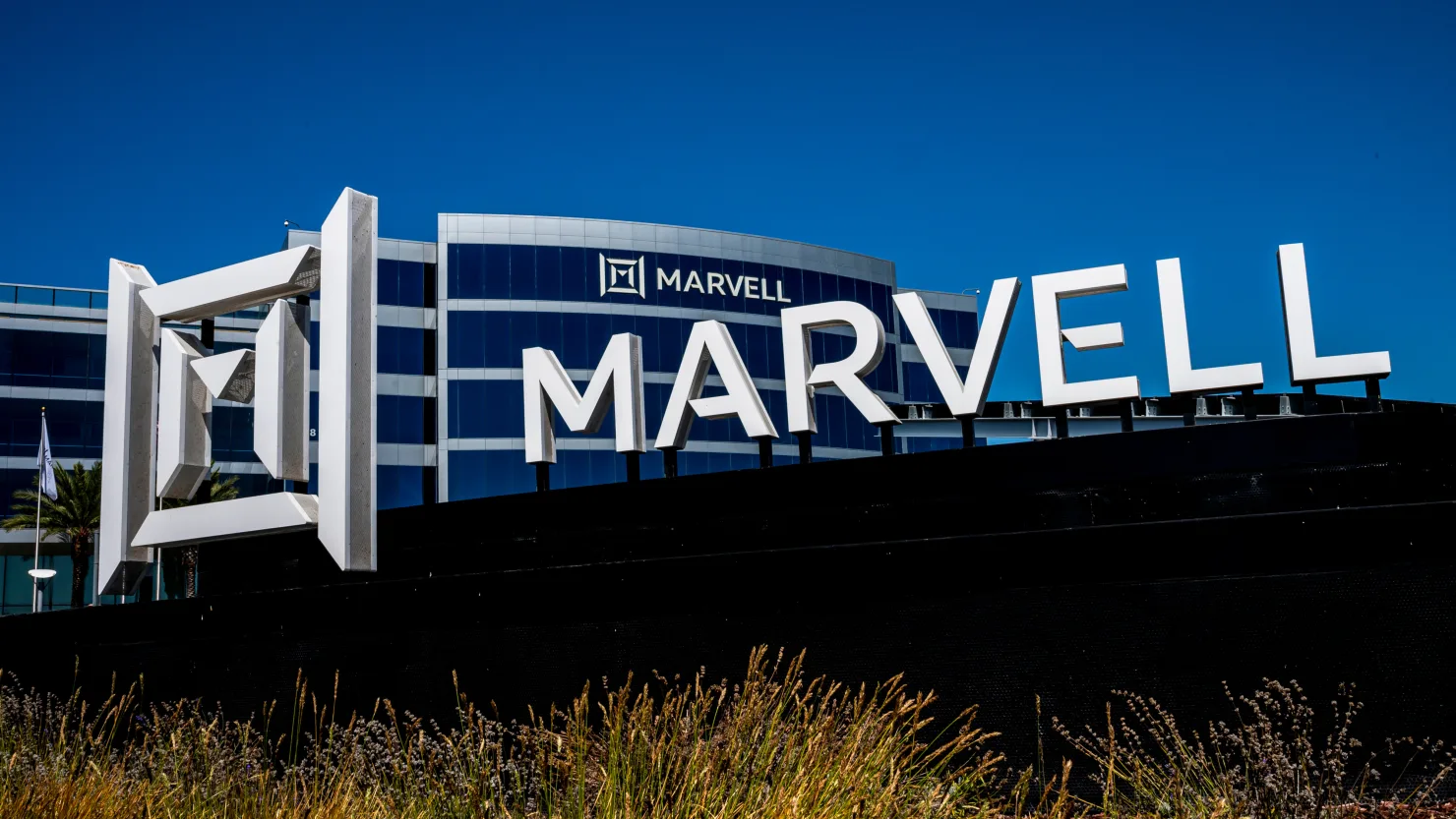
On June 22, 2026, Marvell Technology officially became a constituent of the S&P 500 index. At first glance, this event appears to be merely an adjustment of index constituents, but in the context of the AI infrastructure investment cycle, the reassessment of the US semiconductor industry, and the passive capital allocation mechanism of the capital markets, it seems more like a milestone confirmation of Marvell's transformation from a traditional communication chip company to a core supplier for AI data centers. For Marvell, entering the S&P 500 not only signifies the company's acquisition of a "blue chip identity" in the mainstream capital market of the United States, but also indicates that the demands of investors regarding its future growth, profitability stability, and industry position will significantly increase. Therefore, this event serves both as a milestone and a new pressure test.
From "Outsider" to New Member of the S&P 500
Marvell has not historically been a company lacking in market attention. It has long been active in the fields of storage, networking, communication, and data center chips, with its market capitalization at one time close to the threshold of S&P 500 candidates. However, the real obstacle to its entry into the index was not merely its scale, but rather the quality of its earnings and sustained profitability. The S&P 500 does not simply select stocks based on market capitalization; the index committee typically considers a combination of factors including market capitalization, liquidity, industry representation, listing location, and earnings standards. Therefore, even if a company has a high market valuation, if its profit performance is not stable enough, it may remain outside the candidate list for a long time.
Previously, Marvell found itself in an awkward position: the market recognized its technical accumulation and growth potential, but the company faced considerable financial pressure amid mergers, integrations, product transformations, and cyclical fluctuations, leading to a period of instability in GAAP earnings. This made it important in the semiconductor industry but prevented it from entering the S&P 500 for a long time. It wasn't until the full initiation of the AI infrastructure cycle that Marvell's revenue contributions in areas such as data center networking, optical interconnects, and custom ASICs gradually increased, and its profit structure began to improve, prompting the capital market to reassess its long-term value.
The formal inclusion in the S&P 500 essentially represents the S&P index committee’s acknowledgment of the results of Marvell's business transformation over the past few years. It was not simply chosen because of an increase in stock price; more importantly, the company has finally reached the balance required by the index in terms of profitability, market liquidity, and industry representation. In other words, Marvell has gradually transformed from a "promising but immature" growth chip company into an important publicly traded company representing the US AI infrastructure industry chain.
AI Becomes the Core Driving Force Behind Marvell's Rise
The core variable behind Marvell's entry into the S&P 500 is AI, rather than the traditional resurgence of the semiconductor cycle. In the past, when the market mentioned Marvell, it was more associated with enterprise networking, storage controllers, 5G communication chips, and traditional data center businesses. Today, the reason investors are willing to assign it a higher valuation is that it is viewed as one of the key beneficiaries in the process of expanding AI infrastructure.
The development of generative AI has altered the construction logic of data centers. Previously, data centers focused more on the number of servers, cloud computing resources, and general network throughput capacity. However, in the age of AI training and inference, data centers have raised demands for chip interconnects, low-latency transmission, high-bandwidth networks, optical communications, and customized computing. As the scale of large model parameters expands, a single GPU or server can no longer independently complete core tasks. Large-scale AI clusters must rely on efficient networks and high-speed interconnects to perform well, which suddenly places Marvell's years of accumulated networking and optical communication capabilities at the center of the industry chain.
Custom ASICs are one of the growth directions most closely watched by the capital market. Compared to general-purpose GPUs, ASIC chips can be optimized around specific customers, specific model architectures, and specific workloads, thus possessing potential advantages in terms of energy consumption, performance, and unit cost. Large cloud vendors and internet platforms are increasingly inclined to develop in-house AI chips to reduce dependency on a single GPU supplier while controlling long-term capital expenditures. Marvell offers a comprehensive suite of customization capabilities that range from chip design, interfacing, interconnects to mass production support. Once this type of business enters the supply chain of core customers, it usually has strong stickiness, as chip design cycles are long, switching costs are high, and customer validations are stringent. Therefore, the market is willing to view it as a key pillar for Marvell's revenue growth and valuation expansion in the coming years.
Data center network chips form the second layer of support for Marvell's AI narrative. AI clusters are not simply about stacking a large number of GPUs together but require those GPUs to work in synergy as a cohesive system. Data transmission bottlenecks can directly impact training efficiency and inference costs. In this context, the importance of Ethernet switch chips, network interface chips, and high-speed interconnect solutions has significantly increased. Marvell's long-standing technical capabilities in enterprise and data center networking enable it to participate in the upgrade process of AI data centers from "compute nodes" to "network systems," which is an inevitable direction as AI infrastructure investments transition from purely purchasing GPUs to system-level constructions.
Optical communications and interconnects represent the third key growth point. As the scale of AI clusters expands, the distances over which data flows between chips, servers, racks, and data centers continue to grow, causing traditional electrical signal transmission to face increasingly apparent bottlenecks in terms of power consumption, loss, and bandwidth. Optical modules, DSPs, and high-speed SerDes technologies thus become indispensable parts of the next generation of AI data center constructions. Marvell possesses strong competitiveness in the realm of optical communication chips, and if AI data centers continue to evolve towards higher bandwidth, lower power consumption, and greater scale, the company's revenues in the optical interconnect direction may see further elasticity.
Thus, AI's significance to Marvell is not simply bringing growth in a single product line but reshaping the value across multiple business sectors of the company. ASICs, network chips, and optical communications were originally relatively independent technical directions, but they are integrated into the same growth logic in the context of AI data centers. This is why the market has begun to reassess Marvell as an "AI infrastructure platform company."
What Does Inclusion in the S&P 500 Mean?
Entering the S&P 500 primarily means passive capital inflows. A large number of ETFs, index funds, and pension products worldwide benchmark against the S&P 500. Once Marvell officially becomes a constituent stock, these funds need to allocate MRVL shares according to index weights, creating a distinct technical buying surge in the short term. For a semiconductor stock that already possesses relatively high liquidity, passive funds may not permanently alter its value, but they can amplify transaction volume, enhance market attention, and strengthen investors' perception of the company as a "mainstream asset" during the index adjustment window.
More importantly, S&P 500 status will change Marvell's investor structure. Many institutional portfolios tend to prioritize S&P 500 constituents when allocating large-cap US stocks; certain active funds, while not fully replicating the index, will also use the S&P 500 as a core stock pool. Therefore, once a company enters the index, it often receives more stable institutional holdings, more frequent research coverage, and greater market visibility. For Marvell, this means it will no longer be just an object of interest for semiconductor growth stock investors but will also become an asset that must be assessed by more large-cap technology, AI-themed, quality growth, and enhanced index strategy investors.
However, inclusion in the S&P 500 does not automatically equate to an improvement in the company's fundamentals. Index fund buying is a allocation behavior, not an unconditional guarantee of future profitability. Short-term capital inflows can drive up stock prices, but long-term stock prices will still depend on fundamental factors such as revenue growth, profit margins, free cash flow, and customer concentration. For Marvell, the most significant change brought by S&P 500 status may not be the influx of funds themselves, but rather the lower margin for error the market will have for it, because once it becomes a member of the mainstream index, the company must continuously prove that its growth is not merely an emotional premium during the AI hype but represents real industrial opportunities that can be translated into long-term profits and cash flows.
Why Did the Stock Price Rise Significantly?
Marvell's stock price rose following the announcement of its inclusion in the S&P 500, which is not unexpected, as the market typically anticipates the passive buying and liquidity premium that come from index inclusion. However, extending the timeline reveals that this wave of increase is not solely driven by the index event but rather propelled by the AI narrative, improvements in earnings, capital reallocation, and market sentiment.
Firstly, the market is looking for beneficiaries of AI infrastructure beyond NVIDIA. While NVIDIA remains the most core company in the AI computing cycle, as its valuation rises, investors naturally seek other companies within the industry chain that possess high growth elasticity. Marvell happens to simultaneously hold the triple tags of custom ASICs, data center networking, and optical communication, and is thus viewed by the market as the "second-layer beneficiary" of AI capital expenditure expansion. Such companies may not possess the monopoly position of NVIDIA, but they can find growth opportunities as AI infrastructure transitions from single-point computing procurement to system-level construction.
Secondly, Marvell's rise also reflects the pricing of the trend of cloud companies developing their in-house chips. Large tech companies do not want to fully rely on external GPU suppliers in the long term, especially against the backdrop of high AI computing costs, supply chain tightness, and continuously rising model inference costs. Developing in-house AI chips has become a strategic choice. If Marvell can continue to secure large customer ASIC projects, it may enjoy a growth logic similar to "platform design services + high-barrier chip supply" in the coming years. The stronger the market's expectations for this business model, the higher the valuation multiples assigned to the company.
Thirdly, public recognition of Marvell by industry leaders like Jensen Huang also reinforces market sentiment. The capital market places great importance on the judgments of core figures in the AI theme, and when the CEO of NVIDIA expresses a positive view on a certain company, investors often interpret this as an indirect endorsement of its industry status and technological capabilities. Although this endorsement cannot replace financial data, it can significantly enhance market attention, especially during phases where AI investment remains strong.
However, a significant rise in stock price also brings new challenges: as the market has already reflected future AI growth expectations into valuations, Marvell will face higher requirements in every financial report going forward. Revenue growth rate, the pace of AI project implementation, changes in gross margins, customer concentration, and capital expenditure returns will all become key indicators for investors to assess valuation rationality.
Historical Experience: Does Inclusion in the S&P 500 Always Lead to a Rise?
Historically, entering the S&P 500 usually brings about a short-term positive response, but it does not guarantee long-term outperformance. Many companies experience noticeable increases before their inclusion is announced because funds will position ahead of potential candidates. Once officially in effect, although index funds must buy, active funds may already begin to take profits, creating a typical "buy the rumor, sell the news" scenario.
This is particularly important for Marvell, as it had already carried a considerable amount of optimistic expectations before its official inclusion. The market is not only trading the S&P 500 inclusion itself but also trading multiple narratives including the ramp-up of AI ASICs, upgrades in data center networking, growth in optical communications, and endorsements from industry leaders. When these factors collectively drive up stock prices, short-term stocks can more easily be influenced by deviations from expectations. If there are no new fundamental catalysts thereafter, or if any key indicators in earnings reports fall short of expectations, stock price fluctuations may be amplified.
Another issue to note is the performance pressure following the revaluation. Inclusion in the S&P 500 will cause the company to be included in more institutional comparative frameworks. Marvell will no longer only be compared with traditional communication chip companies but will also be compared with Broadcom, NVIDIA, AMD, and other AI infrastructure companies. Investors will ask: Can Marvell's ASIC business reach the customer depth of Broadcom? Can network chips continue to benefit from upgrades in AI clusters? Does the growth of the optical communications business have sufficient sustainability? These questions will all affect the market's willingness to assign it a valuation premium.
Therefore, S&P 500 inclusion is a double-edged sword. It enhances the company's market position and visibility while amplifying the scrutiny of its long-term growth potential. Short-term gains can be driven by funds, but long-term gains must be proven by performance.
What Truly Determines the Future is Not the S&P 500, but the AI Business
For Marvell, the most critical issue in the coming years is not that it has entered the S&P 500, but whether it can transform its AI business from a narrative into sustainable financial results. The capital market is already willing to believe that Marvell stands at the core of AI infrastructure, but what the market ultimately needs to see are order growth, revenue realization, margin improvement, and cash flow expansion.
The AI ASIC business is the most important observation variable. If Marvell can continuously secure custom chip projects from large cloud vendors, and if these projects smoothly enter production cycles, the company’s revenue structure will undergo a noticeable change. Once the ASIC business scales, it not only helps enhance revenue visibility but may also strengthen customer stickiness and profitability stability. However, this business also entails risks, as it is highly dependent on a few large customers, has long project cycles, and requires significant R&D investment. If customers adjust product roadmaps, delay projects, or volumes do not meet expectations, it can severely impact market confidence.
The data center networking business also needs to prove growth sustainability. AI training clusters have extremely high requirements for network bandwidth and low latency, which indeed provides an opportunity for Marvell, but the competition in this market is fierce, with strong competitors such as Broadcom and uncertainties from cloud vendors' in-house development and system changes. Marvell must prove not only that it can participate in this round of AI construction but also that it can maintain its share and margins through future generations of technology iteration.
The optical communications business depends on the pace of AI data center architecture evolution. If the scale of AI clusters continues to expand, the increase in optical interconnect penetration will become a major trend, and Marvell's capabilities in DSP and related chips will further manifest their value. However, if industry investment slows down or if customers take time to digest previous capital expenditures, related business growth rates may also experience fluctuations.
Therefore, Marvell's core contradiction in the future lies in: the market has already rewarded its AI potential with a high valuation, but the company still needs to deliver this potential through multiple quarters or even years of performance. Inclusion in the S&P 500 has merely brought more visibility to Marvell; what truly determines whether it can continue to rise is whether its AI business can transform high growth expectations into stable, verifiable, and sustainable revenue and profits.
Conclusion
Marvell's formal inclusion in the S&P 500 is an important milestone in the company’s development history and a typical case in the process of reassessing the AI infrastructure industry chain. It indicates that the capital market is gradually expanding its focus from purely GPU computing power to more comprehensive aspects of AI system construction, including networking, interconnects, custom chips, and optical communications—of which Marvell is precisely at the intersection.
However, index inclusion is not the end of investment logic but rather the beginning of higher demands. In the short term, passive capital inflows, increased institutional coverage, and heightened market sentiment may continue to support stock performance; but in the medium to long term, Marvell must prove that it is not only a beneficiary of the AI concept but also a core supplier capable of sustainably generating revenue, profits, and free cash flow amid the AI infrastructure cycle.
Thus, Marvell's entry into the S&P 500 is both an honor and a test. It has gained a ticket to the market, but whether it can truly grow into a long-term winner in the AI infrastructure field will depend on whether its custom ASICs, data center networking, and optical interconnect businesses can fulfill the high expectations currently assigned to it by the market.
免责声明:本文章仅代表作者个人观点,不代表本平台的立场和观点。本文章仅供信息分享,不构成对任何人的任何投资建议。用户与作者之间的任何争议,与本平台无关。如网页中刊载的文章或图片涉及侵权,请提供相关的权利证明和身份证明发送邮件到support@aicoin.com,本平台相关工作人员将会进行核查。


