Written by: Tide Research
Author: Rita
Tide Research Guide
Bernstein analyst Stacy A. Rasgan released a research report on Intel on June 18, assessing Trump's recent statements supporting Apple and Intel's cooperation in PC chip design and manufacturing in the United States. The report believes this is a turning signal in the chip manufacturing landscape, but the initial scale is limited and more of a concept verification rather than an immediate profit opportunity. Bernstein maintains Intel's “hold” rating and a target price of $100, signaling a positive direction but not sufficient to support further increases in stock price. This report is suitable for investors interested in the direction of US chip manufacturing policies, Intel's production capacity layout, and government subsidy policies to read.
Three Key Conclusions
① Apple entering Intel's foundry is a "small trial", with negligible short-term revenue contribution
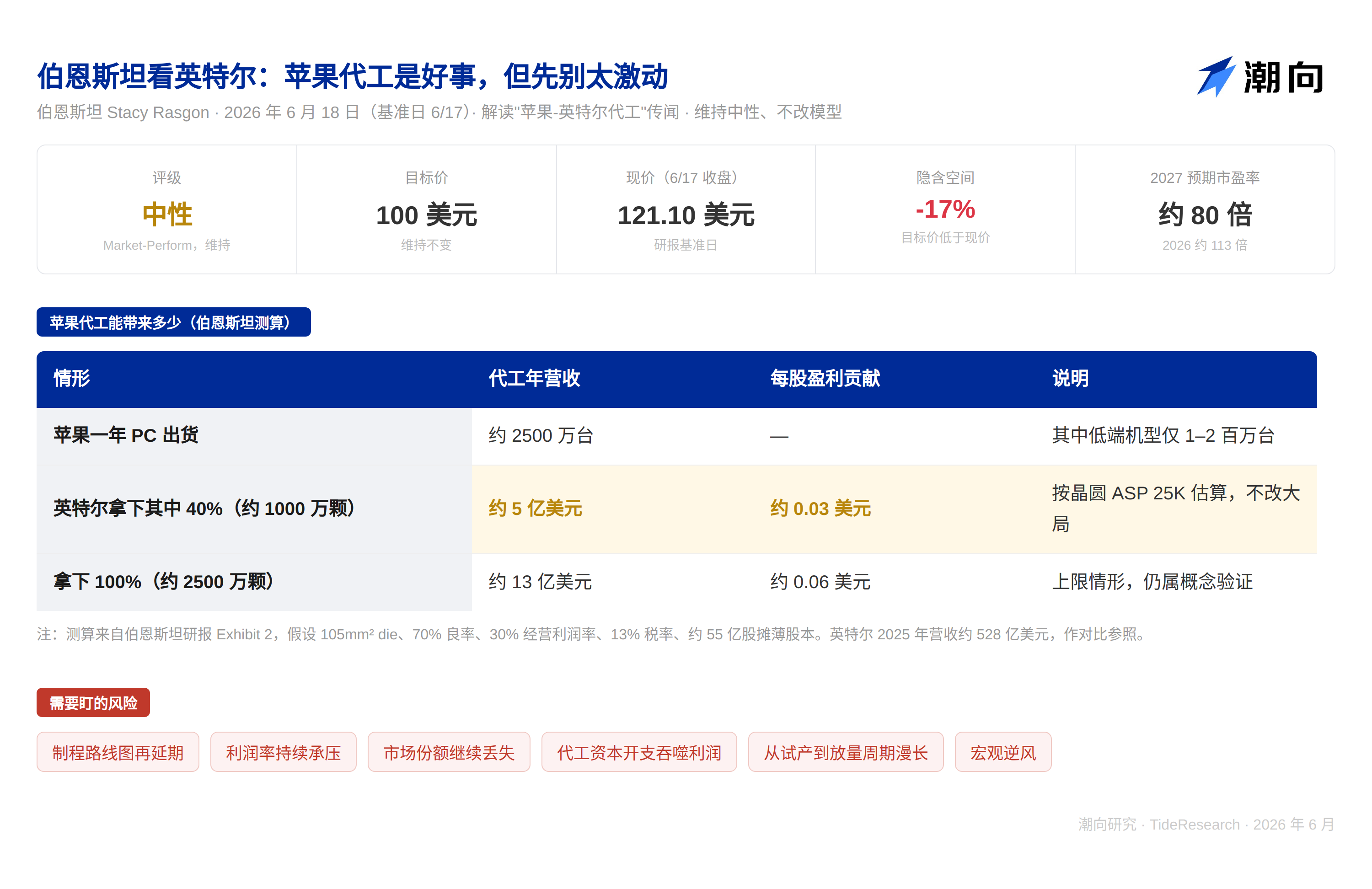
According to Bernstein's data, Apple shipped approximately 23.68 million laptops in the past 12 months, of which high-end models (priced above $700) accounted for about 22.15 million units. If Intel ultimately wins 40% of those orders as an initial goal, the corresponding annual PC chip foundry scale would be about 5 million units. According to Bernstein's hypothesis, if the average selling price for wafer foundry is $25,000, this part of the business could only bring in about $500 million in revenue annually, corresponding to an EPS contribution of about $0.03.
Compared to Intel's annual revenue of about $55 billion and an annual EPS of about $1.50, this potential contract is almost negligible in financial terms.
The report emphasizes that the value of this order is not due to the current revenue scale, but rather it represents the trust endorsement of American customers in Intel's manufacturing capability.
② The temperature of the policy promoted by Trump needs to be questioned
Trump recently publicly expressed encouragement for Apple and Intel to design and manufacture chips in the United States, but Bernstein points out that this encouragement is not "mandatory." The report analyzes that customers will not be "forced" to adopt a certain supplier unless that supplier can prove it meets three conditions: first, ability to produce according to specifications; second, a competitive cost structure; third, stable and reliable supply. Intel is currently in the risk trial production phase on the 18A process, proving that technological progress is credible, but mature capacity and cost competitiveness still need to be observed.
In other words, policy encouragement is a positive factor, but it is not a substitute for market competitiveness.
③ The "transitional dilemma" from concept verification to large-scale production still exists, and Bernstein has not raised its rating because of this
Bernstein's report repeatedly emphasizes “there is still a lot of wood to chop here”, meaning that transitioning from small-scale concept verification to large-scale production still requires a lot of work, significant time, and considerable capital investment.
In other words, for Intel to truly cross this phase, it must solve several issues simultaneously: invest billions of dollars to expand capacity, pass through a complex and stringent customer certification process, and prove its cost and yield advantages amidst fierce foundry price competition.
Based on this uncertainty, although Bernstein acknowledges the positive significance of this cooperation, it still maintains a Market-Perform (hold) rating and did not upgrade it to Outperform. The target price given is about $100, which implies a certain room for correction compared to the current price of about $121.10 (report benchmark date).
The Geopolitical Logic Behind Chip Supply Diversification
Apple has long implemented a supplier diversification strategy to reduce dependence on a single foundry. In the past, this diversification was mainly reflected in choices among different foundry systems and process nodes such as TSMC, Samsung, and Intel.
However, in recent years, geopolitical factors have begun to emerge as a new core variable. The US government has invested massive subsidies through the CHIPS and Science Act to promote the return of key chip manufacturing to domestic soil. Against this backdrop, Apple has allocated some orders in the high-end PC chip sector to be produced at Intel's US factories, which not only aligns with policy guidance but also helps enhance supply chain resilience, reducing risks associated with excessive reliance on a single region (especially Taiwan).
For Intel, this collaboration is more like a crucial market confidence verification. In the past, due to lagging process technology, Intel had lost Apple's trust in outsourcing. Now, being able to re-enter Apple's supply chain and participate in design collaboration and manufacturing itself indicates that its 18A process has a certain level of usability. This signal may also spill over to other potential customers (such as data center CPU or AI accelerator manufacturers).
Tension Between Short-Term Verification and Long-Term Imagination Space
Bernstein's analysis focuses on revealing a structural contradiction: the huge gap between short-term scale and long-term narrative.
In model assumptions, even if Intel captures about 40% of Apple's PC chip orders, the annual shipment volume would only be about 100,000 to 150,000 units. This remains within the “trial production verification” or “concept verification” phase in Intel's overall planning for its foundry business, contributing very limited revenue, only equivalent to a few million dollars in revenue, with an impact of just a few cents on EPS, making it hard to materially change the overall growth curve of the company.
However, from a long-term perspective, this “small-scale entry” has clear path dependency value. If Intel can use the Apple orders to prove its process stability and delivery capability, there would be further opportunities to compete for larger-scale foundry orders in cloud computing chips, AI accelerators, communication chips, etc. The total scale of these markets far exceeds that of PC chips and holds significant long-term expansion potential.
Bernstein did not quantify this “option-style long-term value” in the report but merely pointed out its existence, while the path to realization still heavily relies on subsequent customer expansion and continual process improvement.
Investment Logic: What to Bet On? What Not to Bet On? What to Watch?
What to Bet On:
- Intel's progression in the 18A process will not be significantly below market expectations
- The continuity of US policy support for semiconductor manufacturing localization
What Not to Bet On:
- The collaboration with Apple will significantly improve Intel's financial performance in the short term
- Government subsidies will directly and rapidly enhance Intel's overall profit margin
Key Observational Signals:
- The revenue recognition and gross margin changes in the foundry business in Intel's next quarterly report
- The improvement speed of yield rates and the cost reduction curve for the 18A process
- Whether there are other large clients officially introducing Intel foundry besides Apple
- The actual pace and scale of the implementation of subsidies related to the CHIPS Act

This article is a compilation and interpretation of third-party brokerage research reports by Tide Research. The ratings, target prices, profit forecasts, and related judgments quoted in the text are solely the views of the analysts from those brokerage firms and do not represent the views of Tide Research, nor do they constitute any investment advice.
Please pay attention to three points while reading: First, the target price is the analyst's expectation for the next 12 months; it is a prediction rather than a commitment and will be adjusted repeatedly along with performance and market environment. Second, sell-side research reports tend to be bullish, and some covered companies may have business relationships with those brokerages. Third, the value of research reports lies in their mainline logic and the underlying assumptions, rather than a singular target price. Focus on the logic, not just the price.
The market carries risks; decisions must be made independently. This article should not be used as a basis for buying or selling any securities.
Data sources: Bernstein Research Report (Stacy Rasgon, June 18, 2026) · Intel Historical Financial Data (SEC)
Tide Research · June 2026
免责声明:本文章仅代表作者个人观点,不代表本平台的立场和观点。本文章仅供信息分享,不构成对任何人的任何投资建议。用户与作者之间的任何争议,与本平台无关。如网页中刊载的文章或图片涉及侵权,请提供相关的权利证明和身份证明发送邮件到support@aicoin.com,本平台相关工作人员将会进行核查。


