Five former core researchers of the Ethereum Foundation officially established Ethlabs, transitioning Ethereum from a single institution-led to a multi-node collaboration.
Written by: Sanqing, Foresight News
On June 22, five former core researchers of the Ethereum Foundation (EF) — Ansgar Dietrichs, Barnabé Monnot, Caspar Schwarz-Schilling, Josh Rudolf, and Julian Ma — officially announced the establishment of Ethlabs, an independent nonprofit R&D (Research and Development) laboratory focused on Ethereum core protocol research and institutional-level infrastructure. The initial supporters include BitMine (BMNR), Sharplink (SBET), and over 50 community and ecosystem participants such as Ethereum co-founder Joseph Lubin, Uniswap founder Hayden Adams, and Base head Jesse Pollak.
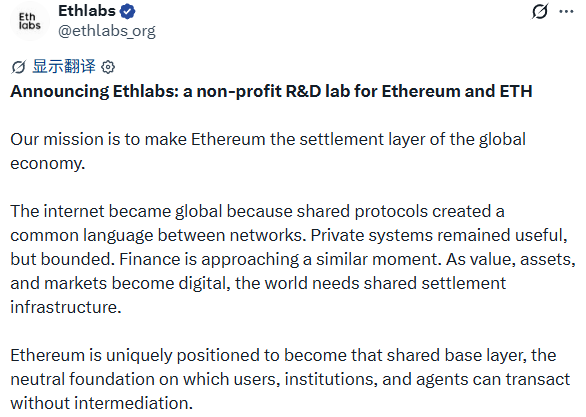
Ethlabs' mission is clear: "To make Ethereum the settlement layer of the global economy." The official statement outlines four beliefs: credible neutrality, ETH as programmable value storage, the open market value of DeFi, and converting the above principles into real adoption. The five founders have served in EF for many years and have been deeply involved in crucial protocol work such as the Dencun upgrade (EIP-4844), Proposer-Builder Separation (PBS), the anti-censorship mechanism FOCIL, and the ETH monetary economic framework.
EF Faced with Dual Pressure of Funds and Talent
Since early 2026, EF has undergone intense personnel adjustments. Co-executive director Tomasz Stańczak left at the end of February to pursue AI; co-executive director Hsiao-Wei Wang departed in mid-June citing "reflecting on priorities."
Core members such as Josh Stark, Trent Van Epps, and Alex Stokes have successively left, resulting in an overall loss of about 19 staff members. Currently, EF only has Bastian Aue in an executive role, with no succession structure and no public timeline.
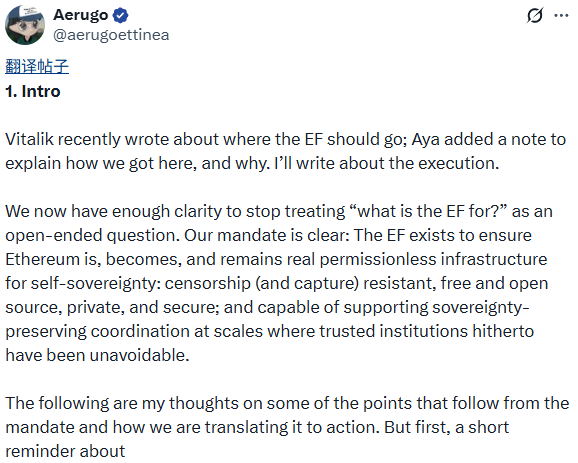
EF is aware of this situation and actively characterizes it as "returning to a more streamlined core mission." Its latest execution plan "EF Way" narrows its focus to core issues such as MEV mitigation, privacy protection, and ETH payments, clearly abandoning a comprehensive coordination role.
However, beyond proactive adjustments, there are also more pressing structural pressures.
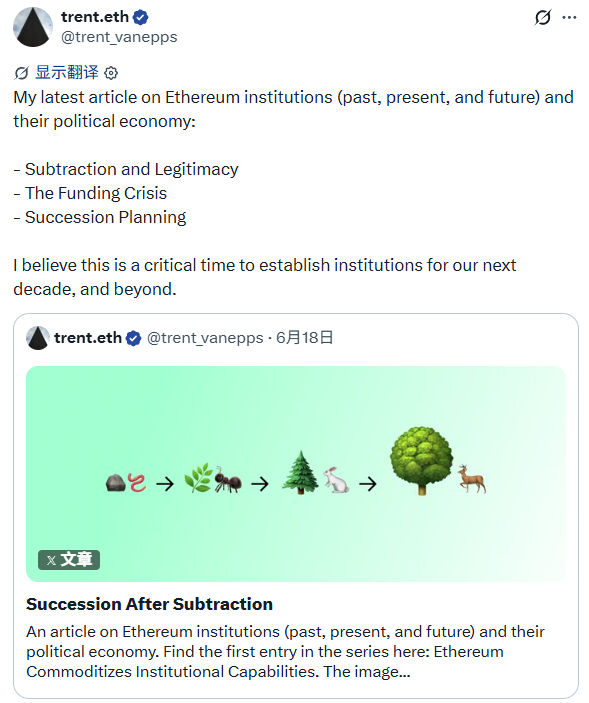
Former EF contributor Trent Van Epps issued a warning after leaving: the "client incentive program" supporting over 10 core client teams such as Geth, Erigon, and Lighthouse has expired as of April 2026, with no renewal plans in place. He estimated the annual operational cost of Ethereum core development to be around $30 million, and this funding gap, if not filled, will gradually manifest within 3 to 9 months.
EF's dilemma lies in that it has long undertaken functions that are generally not suitable for a single institution to monopolize in a decentralized protocol. EF serves as both a protocol researcher and a funder, as well as a spokesperson. When the network scales expands, any pressure on any level will be magnified by the community into an overall governance issue.
The Evolution of ETH Value Capture Narrative
In 2021, EIP-1559 introduced a burning mechanism, and in 2022, the Merge reduced issuance to a historical low point, where "ultrasound money" became the most compelling narrative for ETH: continuous deflation, anti-censorship, and programmable value storage. This narrative reinforced itself during the period of rising ETH prices, creating a closed loop.
In March 2024, the Dencun upgrade activated EIP-4844, introducing an independent blob fee market, reducing L2 data availability costs by 10 to 100 times. A large amount of activity migrated to L2, causing L1 base fees to plummet. The daily ETH burn volume dropped from thousands after the Merge, reportedly hitting a historic low of 53 coins in a single day in 2026, according to The Block.
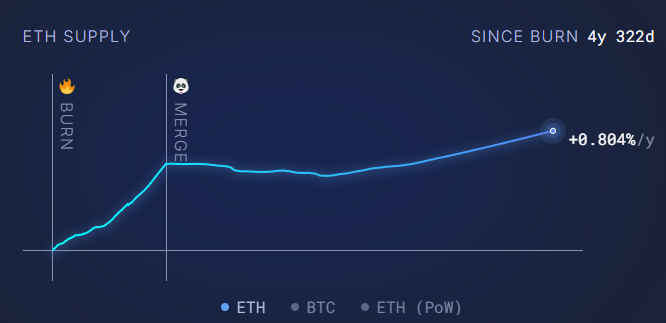
Meanwhile, staking issuance still maintained around 1,700 coins daily, with net issuance continuing to be positive. According to data from ultrasound.money, the annualized net issuance rate of Ethereum has risen to about 0.8%, with mainnet gas as low as 0.1 Gwei, and recent block burn amounts nearing zero. The "ultrasound money" narrative has temporarily lost its effect.
The fundamental contradiction is a familiar one: the more successful Ethereum's L2 expansion strategy is, the less fee capture there is for L1, and the weaker the direct benefits for ETH holders.
Controversy arose. Critics argue that L2 is "siphoning" from L1, with value flowing to L2 operators, dApp protocols, and stablecoin issuers rather than ETH holders. Supporters contend that ETH's structural status as the final settlement layer, security provider, and liquidity center is irreplaceable, and that value will eventually return, but this requires time and new mechanism designs.
In this context, Ethlabs has listed the "ETH monetary economic framework" as one of its initial research priorities. The five founders have been deeply involved in the design of EIP-4844 and PBS, and they understand better than anyone else where the boundaries of this mechanism lie.
Entry of Treasury Companies
BitMine, led by Fundstrat Chairman Tom Lee, is currently the most aggressive corporate ETH treasury company, openly declaring a goal to hold 5% of the circulating supply of Ethereum. As of June 21, 2026, BitMine holds about 5.67 million ETH, valued at approximately $10.7 billion (estimated at $1,733), with 4.719 million already staked, ranking second globally for cryptocurrency treasuries and first for Ethereum treasuries.
Sharplink transformed into an ETH treasury company after completing a $425 million private placement in 2025, with Joe Lubin serving as chairman. By May 2026, Sharplink held approximately 869,000 ETH, valued at about $1.5 billion, making it the second-largest publicly traded Ethereum treasury company, with nearly all holdings staked.
The core logic behind these companies' bets is that Ethereum will become the neutral foundational layer of global financial settlement, with ETH being the native reserve asset on this layer. Supporting Ethlabs is an extension of this logic.
The fundamental difference between these corporate treasury entities and traditional Ethereum donors (foundations, protocol treasuries) lies in their holding of a large amount of ETH; the health of the Ethereum protocol layer and institutional adoption may affect the ETH price, thereby impacting their asset value and stock performance.
Funding core R&D is a strategic support highly linked to their own asset values, rather than unconditional donations. Ethlabs' funding structure has been designed for isolation, with an independent funding management entity responsible for fund selection and allocation, granting supporters transparent reports and audits but not intervening in research directions and technical decisions.
Joe Lubin publicly stated at the Consensus 2026 conference that the tokenization of the global economy is "inevitable," and supported the corporate ETH treasury model as "Ethereum's long-term permanent capital." He also warned that imitation projects based on weak tokens pose systemic risks.
Specialization and Coordination Costs Coexist
Ethlabs stated in its official announcement: "Ethlabs is independent, but Ethereum is a shared project. We are just a node in a larger management network. This is a future of multi-node."
The governance structure of Ethereum is transitioning from a single centralized institution (EF) to multiple independent, focused, and specialized "management nodes" working in a distributed manner. EF itself is also actively promoting this transformation, repositioning itself as a high-level coordination and funding agency, encouraging external focused entities to take on specific research and construction work.
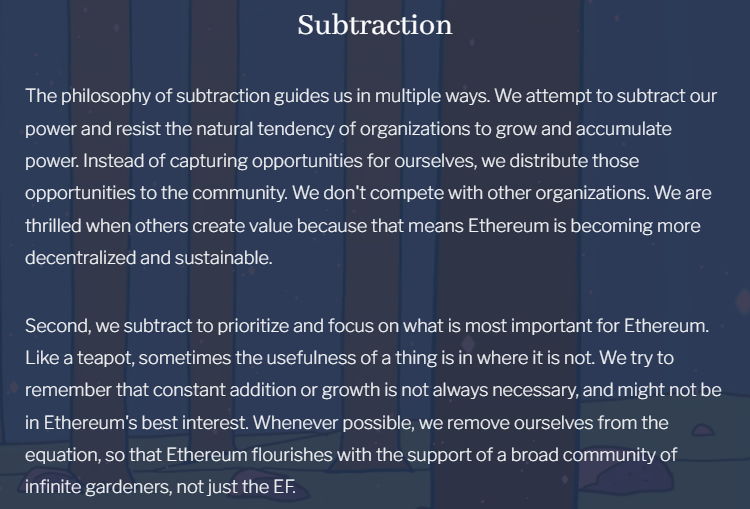
Protocol research, client development, institutional adoption, and standard setting are inherently different types of work. Each can be independently advanced by specialized institutions, both enhancing efficiency and reducing systemic risks caused by the failure of a single institution.
Ethlabs' funding isolation design comes at a timely moment, with an independent funding management entity responsible for fund selection and distribution, supporting parties receiving transparent reports and annual audits, but not interfering with any research directions or technical decisions.
However, distributed collaboration also brings new problems. Who will coordinate priority conflicts between multiple nodes? When Ethlabs' research direction diverges from EF's roadmap, can the Ethereum community's consensus mechanism effectively converge? Who will fill the $30 million funding gap for clients under a "multi-node" framework?
If the distributed structure lacks sufficient coordination layers, it may transform the complexity of protocol governance from "a single institution's execution problem" to "multi-institution's coordination cost problem."
The experiments of Ethereum continue.
免责声明:本文章仅代表作者个人观点,不代表本平台的立场和观点。本文章仅供信息分享,不构成对任何人的任何投资建议。用户与作者之间的任何争议,与本平台无关。如网页中刊载的文章或图片涉及侵权,请提供相关的权利证明和身份证明发送邮件到support@aicoin.com,本平台相关工作人员将会进行核查。


