Written by丨Boyang
Edited by丨Xu Qingyang
On June 25, local time in the United States, Qualcomm held its 2026 Investor Day event in New York.
Qualcomm announced a complete roadmap for AI infrastructure targeted at data centers, unveiling the Dragonfly C1000 CPU, AI300 inference accelerator, and high bandwidth computing (HBC) technology, while also announcing multi-generational collaboration with Meta, deepening cooperation with Hugging Face, and the acquisition of AI software company Modular.
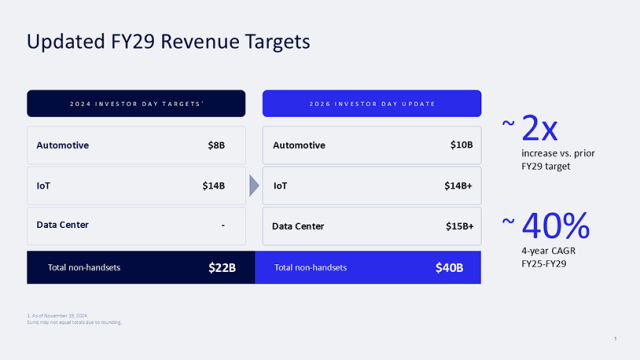
Qualcomm's announced revenue target for non-mobile business in fiscal year 2029
On the financial front, Qualcomm raised its revenue target for non-mobile business in fiscal year 2029 to $40 billion, nearly double the previous long-term target. Among these, the data center business is projected to exceed $15 billion in revenue for that fiscal year.
In after-hours trading, Qualcomm’s stock price rose by as much as 16%.
01 Data Center Revenue to Exceed $15 Billion
Qualcomm CFO Akash Palkhiwala predicted at the event that in fiscal year 2027, Qualcomm's data center business would generate “billions” in revenue. By fiscal year 2029, the annual revenue from this business will exceed $15 billion.
From the overall revenue structure of the company, by fiscal year 2029, the QCT (Qualcomm CDMA Technologies) non-mobile business revenue will reach $40 billion, while the long-term target set in 2024 for this figure was $22 billion.
In fiscal year 2029, Qualcomm's mobile business will account for only about one-third of QCT revenue.
The remaining share will be supported by several growth engines: automotive business revenue of $10 billion, and IoT business exceeding $14 billion. Among these, the IoT business includes industrial, networking, and robotics ($8 billion), as well as personal AI and computing ($6 billion).
The guidance on profits has also been raised.
Analysts' average expectation for Qualcomm's adjusted earnings per share for fiscal year 2029 is $15.26, while Qualcomm itself has set a target exceeding $18, a gap that is the direct reason for the stock price surge in after-hours trading.
CEO Cristiano Amon, explaining the growth logic, focused on the change in the usage of AI. He believes that AI is shifting from simple question-answering to intelligent agent applications, which are models capable of autonomously executing multi-step tasks. This type of workload demands more from low-power computing, and Qualcomm has accumulated capabilities in this area with its mobile chips.
Amon also stated that AI computing is entering automobiles, everyday electronics, and robotics, and the chip demand in these fields will continue to "open up."
02 Dragonfly C1000 Debuts, Meta Becomes First Customer
The highlight of the hardware announcement is the Dragonfly C1000, a CPU specifically designed by Qualcomm for data centers.
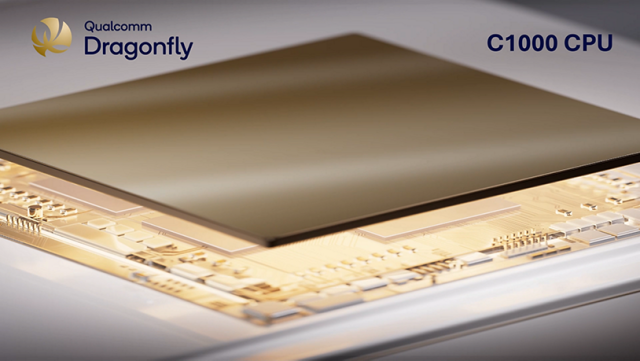
The Dragonfly C1000 is based on a custom-designed Oryon core, using a chiplet architecture and integrating over 250 cores, with a running frequency of over 5GHz. Qualcomm's performance testing shows that its performance per watt is more than twice that of existing server CPU competitors.
The Dragonfly C1000 supports PCIe Gen 7 and CXL connectivity, uses low-power memory technology in its memory system, and has built-in RAS features such as ECC, fault isolation, and error recovery. The cooling solution is compatible with both air and liquid cooling, and the rack complies with OCP ORv3 standards.
The rack configuration equipped with Dragonfly C1000 was also announced: featuring 43TB DRAM and expected to hit the market in fiscal year 2026.
Qualcomm has planned three sub-segments for this CPU:
The first type is the agent CPU, aimed at high-throughput agent orchestration and low-latency interactive AI tasks.
The second type is the general-purpose CPU, which balances two demands: optimizing total cost of ownership (TCO) performance when running first-party workloads, and optimizing vCPU (virtual central processing unit) performance for third-party elastic usage.
The third type is the AI head node CPU, designed to handle host processing with low overhead, allowing the XPU to be fully utilized in generative AI computations.
What truly gave weight to the Dragonfly C1000 was Meta's endorsement.
Qualcomm announced that the two parties have signed a "multi-year, multi-generational" agreement, under which Meta will use the Dragonfly C1000 for its next-generation server cluster, with the chips expected to enter mass production in the second half of 2028. Subsequent iterations of the CPU are also included in the scope of cooperation.
Qualcomm CFO Palkhiwala stated that through mobile chips and other existing products, Qualcomm has established business relationships with almost all large-scale companies, saying, “This is not a newly established relationship.” This remark implies that Meta is likely not the only negotiation partner, and more customers may still be in talks.
In response to external questions about whether Qualcomm is too late to enter the data center market, CEO Amon replied, “When people ask if it’s too late to enter the data center now, you should think about scale, execution capability, engineering capability, or operations and supply chain.”
He meant that the large-scale system engineering capabilities accumulated by Qualcomm during the mobile era are still effective in this market.
03 AI Accelerator Plus HBC to Break the "Memory Wall"
In addition to the CPU, Qualcomm has also updated the roadmap for its AI accelerators.
Following the previously released AI200 and AI250, the AI300 inference accelerator made its debut at this Investor Day, with the three products set to iterate annually.
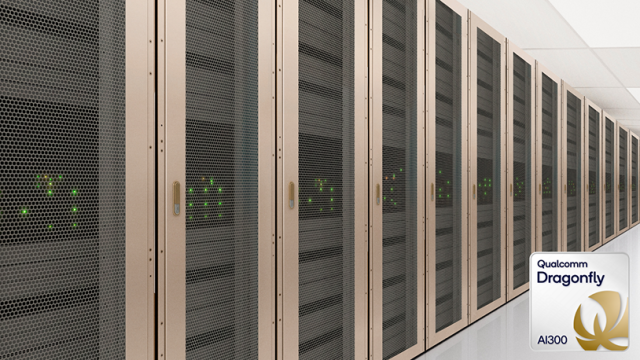
The core logic of this platform is "decoupled rack-level AI inference." Tony Pialis, Qualcomm's Executive Vice President and General Manager of data center business, explained that agent workloads require collaboration between CPU, AI accelerators, and connectivity technologies, rather than relying on a single chip. What Qualcomm is doing now is integrating computation, AI, memory, and connectivity into a unified rack-level platform.
In this platform, memory issues are inevitable, and Qualcomm's solution is high bandwidth computing (HBC).
This is a technology used to break the "memory wall." The so-called memory wall refers to the bandwidth bottlenecks of data transport between the processor and memory in AI computations. HBC's approach tightly integrates computing units and memory through 3D-stacked silicon technology, following the near-memory computing route.
Qualcomm provided several sets of data to illustrate the potential of HBC.
The AI250, equipped with HBC Gen 1, achieves an effective memory bandwidth of 133 TB/s per card, an 18-fold increase over the AI200 that uses LPDDR5X. The AI300, utilizing HBC Gen 2, will see bandwidth increase by 54 times over the AI200.
Compared to current mainstream HBM (High Bandwidth Memory), HBC offers six times the bandwidth at the same power consumption. In contrast with SRAM (Static Random-Access Memory), HBC offers 200 times the capacity at the same power consumption.
In other words, HBC significantly improves the data processing capacity per unit of power, directly impacting the total cost of ownership (TCO) for data centers. Commercial samples of the AI250 are expected to be available in mid-2027, while the AI300's commercial samples will have to wait until 2028.
Connectivity products are Qualcomm's traditional stronghold, and they did not miss out this time either. The company offers interconnection solutions from Die-to-Die, copper cables, and fiber optics to campus-level solutions, supporting 800G and 1.6T rates, covering scenarios from within data centers to as far as 20 kilometers.
Over 35 technology ecosystem companies publicly expressed their support for this roadmap, including AMD, Lenovo, SK Hynix, Micron, Samsung SDS, and Arista.
04 Acquisition of Modular and Cooperation with Hugging Face
Beyond hardware, Qualcomm has also made intensive moves in its software ecosystem.
First is the acquisition of AI software company Modular. The acquisition is valued at approximately $3.9 billion in Qualcomm stock, expected to be finalized in the second half of 2026, pending regulatory approval.
Modular's core product is an open, AI-native software stack that allows models to run on different chip architectures such as CPUs, GPUs, NPUs, and custom ASICs without requiring developers to rewrite code for each type of hardware. Modular was co-founded by Chris Lattner and others, and its platform is considered an open option beyond Nvidia's CUDA in the industry.
Amon commented on the acquisition, stating that as intelligent agents expand into data centers and edges, the industry needs a more open and modern software foundation. Qualcomm hopes to provide customers with real deployment choices in diverse computing environments through this acquisition.
Secondly, Qualcomm is expanding its collaboration with Hugging Face. The cooperation consists of three parts:
* Bringing Hugging Face's internal and developer workloads into data centers powered by Qualcomm Dragonfly;
* Over 3 million open models on the Hugging Face platform can be directly loaded onto devices and data center racks powered by Qualcomm, simplifying the developer's process from experimentation to deployment;
* Developing the "Hugging Face Agent" for orchestrating AI workloads in hybrid environments across devices and the cloud, dynamically allocating tasks based on performance, cost, and latency needs.
Clément Delangue, co-founder and CEO of Hugging Face, explained: “We are enabling our 16 million developers to easily run open models anywhere, from the device in your hands to full racks in data centers.”
There is also a specific arrangement in the cooperation. Hugging Face will provide customers using Qualcomm platform devices or cloud systems access to Hugging Face PRO, which includes advanced storage, computing, and collaboration features.
This step lowers the barriers for developers to apply open models.
05 Automotive, Robotics, China
Beyond the main line of data centers, Qualcomm has also updated the progress data of other businesses.
In the automotive sector, the "automotive design bid project reserve" has expanded to $65 billion, with Qualcomm raising its revenue target for fiscal year 2029 to $10 billion. The demand for automotive chips is driven by the continuous penetration of ADAS and autonomous driving.
The IoT business has been further detailed. Industrial, networking, and robotics are listed separately, aiming for $8 billion in revenue; personal AI and computing aim for $6 billion. Qualcomm judges that intelligent agents will trigger a new upgrade cycle for smart connected devices. The company estimates that by 2030, the overall scale of these businesses will reach $1.7 trillion.
Regarding the Chinese market, Amon provided a brief response during the event. Currently, the U.S. government has regulations on the export of AI-related hardware to China, but he stated that Qualcomm would have versions of data center chips that do not trigger export restrictions. He did not elaborate on the specific plan, but this statement indicates that opportunities in the Chinese market have not been sidelined.
Overall, the signals released by Qualcomm during this Investor Day are quite comprehensive. From C1000 to HBC, from the acquisition of Modular to the cooperation with Hugging Face, from the $15 billion data center target to the $18 earnings per share, all are verifiable milestones. Clients are in place, products have sample timelines, and financial models have been set.
The upcoming quarterly financial reports will be the first round of verification for these roadmaps from Qualcomm.
免责声明:本文章仅代表作者个人观点,不代表本平台的立场和观点。本文章仅供信息分享,不构成对任何人的任何投资建议。用户与作者之间的任何争议,与本平台无关。如网页中刊载的文章或图片涉及侵权,请提供相关的权利证明和身份证明发送邮件到support@aicoin.com,本平台相关工作人员将会进行核查。


