Author: The Economist
Translation: Deep Tide TechFlow
Deep Tide Introduction: The Economist conducted field visits to places like Ohio and documented an anti-data center movement sweeping across the United States. In the first three months of 2026, at least $42 billion and 3.5GW worth of projects were canceled due to resident protests. The opposition rate exceeds two-thirds among both Democratic and Republican voters. This is not just a "not in my backyard" effect, but a collective anger from the public regarding the "physical invasion" of AI infrastructure. For the AI industry, the computing power bottleneck already exists, and construction is being blocked by politics.
Looking out from the top of a backyard slide, just this April, the view still featured Ohio's farmlands, dense woods, and beautiful wooden houses. Now, this landscape has been consumed by six giant windbreak tents. These tents are typically used to park fighter jets or set up temporary facilities in disaster areas; soon, they will be filled with about $30 billion worth of cutting-edge semiconductors. Along with accompanying gas turbine generators, the entire site occupies an area equivalent to an airport terminal. If Meta's "Prometheus" data center launches as scheduled in 2026, it will dedicate a full 1 gigawatt (GW) of power to artificial intelligence, enough to power a million households, roughly equivalent to the output of a large nuclear reactor.
The Rise of the "Silicon Heartland": $3 Trillion Flooding into AI Data Centers
The future ultra-large data centers used to train cutting-edge AI models before 2030 will not be built in existing server clusters in Virginia or California, but will be located in the emerging "Silicon Heartland" formed by Michigan, Wisconsin, and Ohio, or in southern states like Louisiana, Mississippi, and Texas. Amazon, Google, Meta, Microsoft, and Oracle have collectively invested up to $750 billion; data center operators like CoreWeave and Wall Street-backed real estate developers are also following suit. According to Moody's, about $3 trillion will be invested in AI data centers globally from 2026 to 2030, with the majority in the United States.
This cash infusion will boost the total AI computing power in the U.S. from currently under 12GW to about five times that by the end of the decade. And in nearly every corner of the nation, people of all political stripes are angry about it.
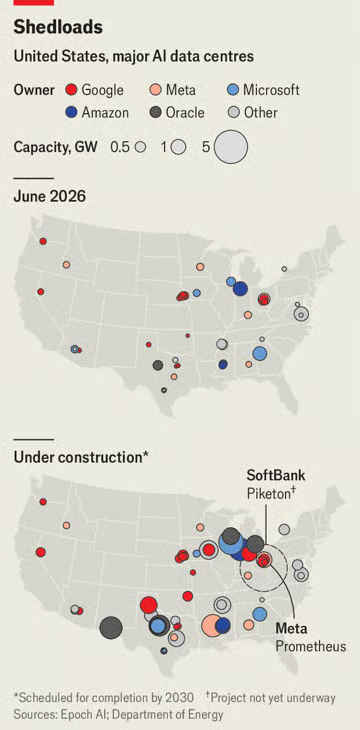
Image caption: Economist illustration, data center construction and expansion plans across the U.S.
$42 Billion in Projects "Killed" in Three Months
The reasons for the discontent are quite valid: ugly buildings; noise from generators and cooling systems; power transmission towers slicing through the skyline like a skeleton army; concerns about water source pollution. Polling shows that Americans would rather live next to a nuclear power station than a data center. The political heat around this issue is soaring, with gubernatorial candidates facing repeated questioning about their positions as elections approach in November.
Local activists have already achieved results. In the first three months of 2026, at least 20 data center projects were canceled, involving $42 billion in investments and 3.5GW of power; over the past three years, a total of $85 billion worth of projects have been cut, including small proposals from Amazon and Meta. Residents in Cedar Rapids, Iowa, are resisting Google's construction plans. Several townships in Michigan passed moratoriums after OpenAI broke ground in Saline despite local opposition.
Not Just a "Not in My Backyard" Effect
This resistance goes far beyond a simple "don’t build in my backyard" stance. A Pew Research survey conducted in April found that even among Americans who had merely "heard of data centers," their level of opposition was just as strong as those living within five miles of a data center.
Philosophers have long worried that an out-of-control AI would deplete all human resources for a singular goal, covering the earth with servers. Sam Altman and Dario Amodei have spent years warning that AI will leave most people unemployed or weaponized. Now, the infrastructure they need is appearing right at ordinary people's doorsteps, and it looks to them like something transported from a war zone. Residents across the country are pleading at town hall meetings to cut these projects, hoping to slow the advance of this technology. Will they succeed?
Energy Secretary: "We Must Stay Ahead of China"
This is not just an issue for the AI industry. U.S. Energy Secretary Chris Wright told The Economist, "We must maintain a distance ahead of China." Ensuring that the U.S. maintains a leading position in artificial intelligence is his "overarching goal" during his term. "We must get these data centers permitted, built, and powered."
Currently, approximately 1-2GW of data center capacity in the U.S. is used to train cutting-edge models, serving major providers like Anthropic, OpenAI, and Google, as well as followers like Meta and xAI. Based on this, around 10GW of capacity can be allocated for inference, allowing clients to query models, write code, or carry out other tasks. However, after the demand for AI tools surged in early 2026, the available computing power is severely insufficient. Anthropic has limited model usage, OpenAI has cut back on high power-consuming video tools, and Microsoft has raised the prices of programming assistants to the point where some programmers are reverting to writing code themselves.
New data centers were supposed to alleviate this pressure. Large projects under construction are expected to add nearly 30GW of capacity by the end of 2028. However, the computing power needed to train new models is also rising rapidly. Anthropic pointed out in a white paper last year that by 2028, training a cutting-edge model could require 5GW. Research firm Epoch AI estimates that this figure could rise to 16GW by 2030. If this is accurate, most of the newly added capacity coming online in the next few years will be consumed by training.
Can Technology Bridge the Supply-Demand Gap?
Several factors may temper the demand for more new projects. Chip energy efficiency improves over time, allowing the same power to produce more computing power. Crypto mining facilities are being repurposed for AI. Cerebras CEO Andrew Feldman pointed out that the massive facilities needed for inference, which are not required for training models, can utilize some of the existing data center capacity.
But that may not be enough. Currently, only the programming sector has truly been disrupted by AI. Other industries that AI might revolutionize, such as law, finance, and media, are still in the early adoption stages.
Even the "Data Center Capital" Has Turned
Most of the large projects currently under construction were approved before the wave of resistance reached its current intensity. Some projects narrowly passed approval. The OpenAI project in Saline, Michigan, was voted down by the city council and could only proceed by exploiting legal loopholes that violated the "exclusionary" zoning laws due to the lack of industrial land planning in the county.
Even areas that have long embraced data centers are reversing course. In March 2025, Loudoun County, Virginia, known as the "data center corridor," abolished rules favorable to data center development, meaning that new projects must now go through a "special exception" process that includes public hearings. Texas, which has the second-highest number of data centers in the U.S., has passed a moratorium in the city of San Marcos.
The Water Myth and the Reality of Electricity
Americans oppose data centers in part due to concerns about their impact on the community and the environment, some of which are valid, while others are misguided. For instance, the claim that "AI data centers consume large amounts of water" gained traction from a book published in 2025, but that book was based on a serious calculation error. A medium-sized data center's annual water consumption is approximately equivalent to that of two golf courses, and if water recycling technology (which many new projects use) is employed, consumption will decrease significantly.
The electricity issue is more tangible. According to SemiAnalysis data, there are currently about 1 terawatt (1000GW) of major load interconnection applications in U.S. states, almost all from data centers. This is equivalent to the total generation capacity of the U.S. power grid (which peaks at about 1250GW). While the average annual electricity use in the U.S. is about 470GW, peak summer demand can reach 750GW, and utility companies need to maintain a 15-20% buffer on top of that. The actual reliable dispatchable electricity is only about 975GW.
This has raised concerns about rising electricity prices for consumers and other businesses. Currently, there is not much credible evidence to suggest that this is already happening. The growth in demand allows utility companies to spread the costs of upgrades across more users. Data center operators always install backup power sources to guard against supply interruptions; in extreme cases (such as storms), they can cut back on their own electricity usage. Microsoft's data center construction head Alistair Speirs said, "We want to be good citizens of the power grid." He added that the batteries connected to large-scale data centers allow Microsoft "to choose when to sip slowly and when to gulp down."
However, the massive data center investments planned for the next few years do require the U.S. to increase its electricity generation significantly, and the infrastructure required will inevitably generate new waves of opposition. The Department of Energy predicts that by 2030, the U.S. will need an additional 50GW of generation capacity to support AI, with another 50GW needed for the government's expected manufacturing resurgence. Secretary Wright is skeptical of wind and solar projects that can only provide intermittent power. To that end, he has halted the closure of coal-fired power plants and supports restarting nuclear plants and building new gas plants. It is expected that by 2030, more than one-third of data centers will be fully self-powering, but this will make these projects even more conspicuous, while the rest will still rely on the grid.
Ohio's Experiment: Using Electricity Costs to Block Dissent
Ohio is now the fourth largest concentration of data centers in the U.S. and has been smarter in its response strategies than most states. In July last year, the state's utility commission passed a regulation requiring that data center operators of a certain scale must pay fees for reserving at least 85% of their requested electrical capacity each month, regardless of whether they actually use it, to allay local residents' concerns about footing the electricity investment bill. This innovative approach was later included in the "Rate Payer Protection Commitment" signed by tech companies in Washington, D.C. in March.
The Ohio provision is better than the White House commitment because it has legal binding force. Yet, even so, it has not assuaged the concerns of residents in the state. About three-quarters of Democrats and two-thirds of Republicans still oppose the construction of data centers locally. The opposition is so strong that even though Trump won the state by an 11-point margin in the 2024 election, AI advocate Vivek Ramaswamy is polling neck-and-neck with his Democratic opponent in the gubernatorial race.
Federal Government Bypasses Local Opposition
The Trump administration found ways to bypass local resistance. In March of this year, the Department of Energy announced a 10GW mega project on federal land in rural Ohio at Piketon, thereby avoiding conventional permitting processes. This project, funded by Masayoshi Son's SoftBank, will construct a gas power plant to supply the world's largest data center.
"Imagine, in a farmer's field in Appalachia, mud on our shoes, standing next to Secretary of Commerce Lutnick, Secretary of Energy Wright, Masayoshi Son, and me... and all the other hillfolks!" said Ohio Congress member Adam Holmes at the groundbreaking ceremony.
Residents of Piketon are not easily intimidated—this area was the site of the U.S. nuclear enrichment program in the 1950s. Even so, state senator Shane Wilkin, who represents the district, is not finding it easy either. He serves on Ohio's legislature's data center committee and shared an experience: "We had someone from the water authority testify, and I asked him how many data centers in Ohio received emissions permits. One. Then I asked a question I didn't know the answer to—always risky—whether they had any violations. He said twice: both due to late paperwork."
Wilkin said he explained to constituents that data centers would not drive up electricity prices because they have their own power sources; they would not pollute water sources because they do not discharge water. But residents' response is: "I just don't want them."
免责声明:本文章仅代表作者个人观点,不代表本平台的立场和观点。本文章仅供信息分享,不构成对任何人的任何投资建议。用户与作者之间的任何争议,与本平台无关。如网页中刊载的文章或图片涉及侵权,请提供相关的权利证明和身份证明发送邮件到support@aicoin.com,本平台相关工作人员将会进行核查。


