As early as 2016, SBI reached a collaboration with Ripple.
Written by: Eric, Foresight News
On June 25, 2026, Japan's SBI Group announced the acquisition of Japanese cryptocurrency exchange Bitbank for 46.7 billion yen (approximately 289 million USD). This acquisition, expected to be completed in October, will increase SBI Group's number of user accounts to approximately 2.92 million, with managed assets of about 1.1 trillion yen (approximately 6.8 billion USD), making it the largest cryptocurrency exchange group in Japan.
While crypto giants in other countries have emerged as a "new generation," SBI, one of the most active companies in the cryptocurrency field in Japan, was "born" in the same year as Alibaba.
SBI Group was founded in July 1999, initially named "SOFTBANK INVESTMENT CORPORATION," and was part of the SoftBank Group, primarily engaged in investment and incubation. Due to Japan's relaxation of financial regulation, it acquired E*TRADE Japan (the predecessor of SBI SECURITIES) in October of the same year, launching online securities trading services, becoming one of Japan's earliest online brokerages.
In 2005, the company changed its name from SOFTBANK INVESTMENT to SBI Holdings, transitioning to a holding company structure, and became fully independent in 2006. According to its official website, SBI has focused on "Internet + Financial Innovation" as its core direction since its inception, and is widely viewed as a pioneer in Japan's internet finance. The group later positioned itself as a "comprehensive internet finance group," emphasizing the provision of services such as securities, banking, and insurance through online platforms, forming a "financial supermarket" model.
This company, which ventured into internet finance 27 years ago, has also long been involved in blockchain.
In 2016, SBI entered the blockchain field through its cooperation with Ripple and has maintained this partnership to date. In January of that year, the two parties reached a preliminary cooperation agreement, with Ripple hoping to expand using SBI's financial network in Asia. Four months later, the partnership further escalated with the establishment of SBI Ripple Asia Co., Ltd. (SBI holds 60%, Ripple holds 40%). The goal was to introduce RippleNet to Japan, Korea, and Southeast Asia for cross-border payments.
In the 7 years that followed, SBI gradually promoted the Ripple-based cross-border payment network, starting from pilot projects to include regions such as Thailand, the Philippines, Vietnam, and Indonesia. Beginning in 2023, SBI's subsidiary started distributing XRP directly to shareholders as returns, which was a first among listed companies in Japan.
In June 2025, SBI and Ripple signed a memorandum of understanding, planning to distribute the dollar stablecoin Ripple USD (RLUSD) in Japan via SBI VC Trade. In March of this year, RLUSD was approved by Japan's Financial Services Agency for use as a new electronic payment tool, opening up to institutional and retail users through SBI VC Trade, supporting use cases such as payments, tokenization, and collateralization. Apart from RLUSD, just days ago, SBI also announced the issuance of Japan's first trust-based yen stablecoin JPYSC.
The SBI VC Trade mentioned here is the main cryptocurrency exchange under SBI, which has over 2.9 million accounts and manages approximately 6.8 billion USD in assets, having reached this scale after years of acquisitions.
In 2020, Binance negotiated with Z Fund, formerly Yahoo Japan, hoping to acquire the cryptocurrency exchange TaoTao to enter the Japanese market. After 9 months of back-and-forth negotiations, the talks fell through, but TaoTao quickly announced its incorporation into VC Trade as a subsidiary of SBI.
Starting with the acquisition of TaoTao, SBI entered a spree of acquisitions. By the end of 2024, DMM Bitcoin, which was facing operational difficulties due to attacks from a North Korean hacker group, integrated its customer resources and remaining managed assets into VC Trade. In April of this year, BITPoint Japan, which was acquired back in 2023, merged into VC Trade; combined with the recently acquired Bitbank, SBI has built a stronghold of exchanges.
In addition to exchanges, Web3 media company CoinPost, infrastructure company HashHub, and Singapore exchange Coinhako have all joined the "SBI family bucket" or are in discussion for acquisition. Alongside these acquisitions, SBI has also been proactive with its investments, including well-known Web3 companies such as Ripple, South Korean exchange Bithumb, RWA tokenization platform Securitize, Kraken, and Circle in its investment portfolio.
Japan's Web3 ecosystem is relatively closed, and SBI is one of the few groups with a higher level of internationalization across multiple businesses, somewhat akin to DCG, the parent company of Grayscale and mining pool Foundry. In addition to its positioning in payments and trading, SBI also has a market maker, B2C2; provides digital asset trading, management, and custody services through SBI Digital Asset Holdings / SBI Digital Markets; engages in cryptocurrency mining and mining pool operations (sbicrypto pool) through SBI Crypto; furthermore, SBI's securities and other departments are exploring businesses such as cryptocurrency investment trusts, issuing blockchain bonds, and cryptocurrency payment cards.
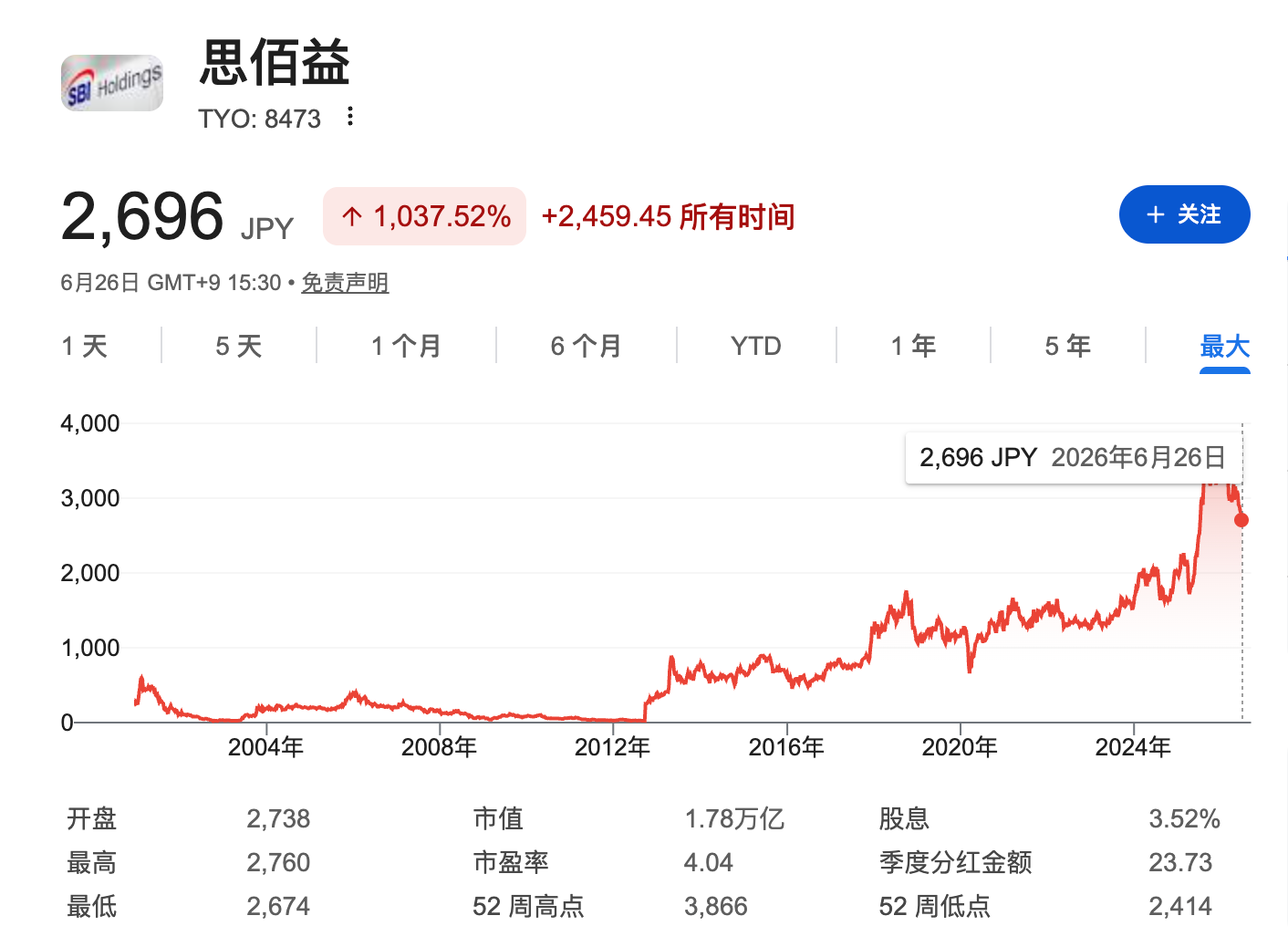
Apart from not undertaking specific Web3 projects, SBI almost encompasses all aspects of the cryptocurrency industry. As of the time of writing, SBI's market capitalization is 1.78 trillion yen, approximately 11 billion USD. This market capitalization of 10 billion USD includes not only cryptocurrency but also traditional banking and securities businesses. Although its fame may not be as prominent as Metaplanet, another listed company in Japan, this veteran that has been navigating the financial sector for nearly thirty years has successfully captured the benefits of Web3.
免责声明:本文章仅代表作者个人观点,不代表本平台的立场和观点。本文章仅供信息分享,不构成对任何人的任何投资建议。用户与作者之间的任何争议,与本平台无关。如网页中刊载的文章或图片涉及侵权,请提供相关的权利证明和身份证明发送邮件到support@aicoin.com,本平台相关工作人员将会进行核查。


