Author: Jessy
Walsh's Debut, the Fed's Direction Completely Reversed
On June 17, Kevin Walsh held his first interest rate meeting as the new chairman of the Federal Reserve.
In the minutes from the March meeting, most officials were still betting on one or two interest rate cuts within the year. Many crypto investors had high expectations for Walsh, as he was appointed by Trump and was likely to promote monetary easing after taking office.
After the meeting, the dot plot was released, and the results were unexpected: among the 18 officials who submitted predictions, 9 expected at least one rate hike within the year, with 6 expecting two or more hikes.
Just three months ago, the Fed was still discussing "how many cuts to make," but this time in Walsh's debut, they were discussing "how many hikes to make."
Walsh simply said, "Look at the data."
The three major U.S. stock indexes collectively plunged, with the Nasdaq dropping more than 1%; the crypto market reacted even more violently. Bitcoin, which had been rebounding above $65,000, fell directly to around $64,000 after the meeting results, a near 3% drop.
Looking through the interpretations from various financial media, some crypto investors sought an explanation for "look at the data," but instead, they stepped into a deeper "fog of jargon." Numerous technical terms bombarded them: CPI month-over-month hitting new highs, PPI production prices not fully transmitted; then it was about the non-farm payrolls in May far exceeding expectations, with the data from the previous two months needing "upward revisions"; what frustrated crypto investors the most was the Fed's own updated economic forecast (SEP), filled with PCE, core PCE, and the downward shift of the dot plot median...
Staring at the dense professional interpretations, instead of providing clarity, they instead felt a strong sense of helplessness. In the eyes of financial media, these data points are interwoven and causally clear. But for most people, these abbreviations and their impacting logic felt like a completely foreign language; every word was recognized, but together they made no sense.
To truly understand this meeting, it seems one must grasp a whole set of TradFi (traditional finance) concepts like inflation, interest rates, and the Federal Reserve's decision-making mechanisms. However, in today's landscape, a crypto investor has to monitor the Fed meetings, international situations, the dollar index, and the tightening or loosening of global liquidity, just like traditional financial market investors. After all, with the merging of crypto and traditional finance becoming closer than ever, crypto is no longer an island but part of the global asset map, rising and falling with the dollar, U.S. treasuries, and risk appetite.
In a Multi-Asset Era, Crypto Investors Need to Learn TradFi
In previous years, the rise and fall of the crypto market were not closely linked to the tides of the global economy. In recent years, with a boom in ICOs and the popularity of meme coins, crypto investors have become accustomed to observing on-chain capital trends and the buying and selling operations of whales, searching for investment targets following the current industry technological hotspots.
The information that traditional finance investors need to pay attention to, such as the Fed's interest rate meetings, non-farm data, and CPI, is not that important for crypto investors.
But starting in 2024, the rise and fall of cryptocurrencies are increasingly correlated with the macroeconomy. In January of this year, Bitcoin's spot ETF was officially approved for listing in the U.S., and half a year later, the Ethereum spot ETF followed suit. For the first time, Wall Street's money could legitimately and massively buy cryptocurrencies like Bitcoin. With traditional asset management giants like BlackRock and Fidelity entering the market, crypto assets have been included in the same balance sheet as stocks and bonds, rising and falling according to the same macro logic. The binding between crypto and macro finance is deepening, forcing everyone to start learning about TradFi-related knowledge.
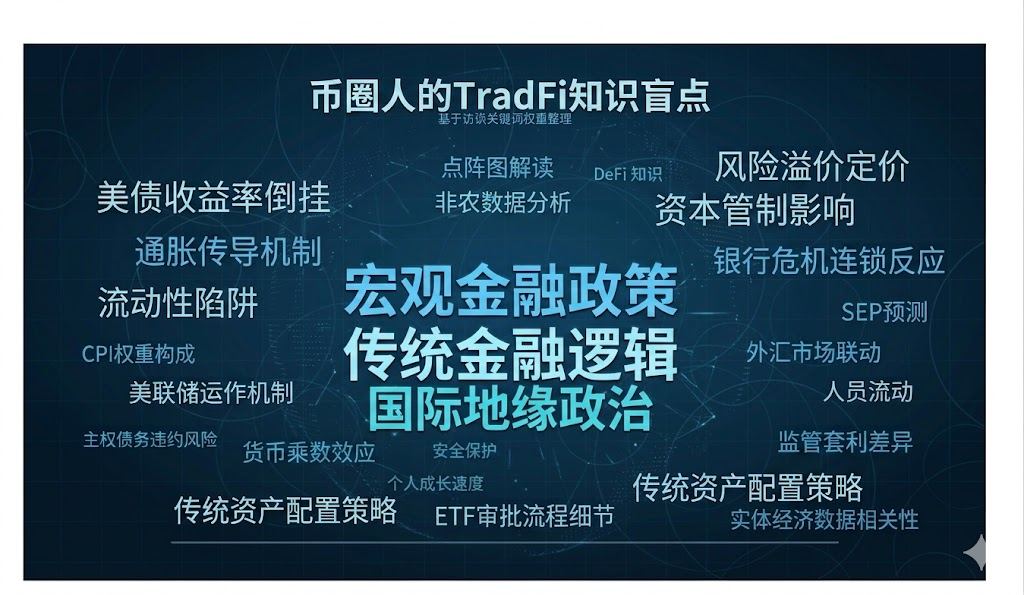
For most traders in the crypto space, this is not an easy task. For instance, before the meeting on June 17, many players in the crypto space misunderstood the terms "hawkish" and "dovish," assuming Walsh would be placed in the dovish camp—after all, he was nominated by Trump and should advocate for easing. But in reality, hawkish and dovish are not political stances, but rather the central bank officials' judgments on the current data: high inflation leans towards rate hikes to control prices (hawkish), while a weak economy leans towards rate cuts to stimulate (dovish). With inflation at 4.2% upon Walsh's arrival, he could not ignore the data. A misunderstanding of a single word's true meaning can lead to erroneous judgments.
Financial Education Should Be Simpler
If one wants to learn the true meanings of the concepts mentioned at the meeting after it ends, a simple search will yield either lengthy academic analyses or textbooks filled with a bunch of English abbreviations. However, what ordinary investors are looking for is actually quite simple: a clear explanation in layman's terms of what these things are and why they are important.
Traditional financial education has always had a high barrier to entry. The terminology is dense, and the expression is academic, as if the reader is presumed to have a certain financial foundation to be qualified to read further. However, for many who have transitioned from the on-chain world, what they lack is exactly the "foundation" shaped by traditional financial academic education.
But the best education often comes from the simplest questions, such as: What is a stock? Why do companies go public? Why does gold rise whenever there is a war? What does a rate cut really mean? What is an ETF? These questions may sound basic to the point of being "childish," but the process of learning new knowledge is inherently about understanding these "childish" questions before grasping more complex logic.
The author has noticed an investment education series—"One Hundred Questions on TradFi Science Popularization", initiated by Bitget together with industry partners, which aligns well with the kind of financial learning "foundation" I desire.
Currently, the integration between TradFi and Crypto is undeniably becoming tighter. Major mainstream exchanges have already launched traditional financial assets like U.S. stocks and gold; the barriers between crypto and traditional finance are quickly dissolving, and cross-asset trading is becoming a clear trend of development. However, most platforms in the industry focus only on expanding trading categories and enriching product tracks, rarely addressing the most core pain point for investors—that the vast majority of native crypto players lack a complete and approachable reserve of traditional financial knowledge. Launching systematic financial science popularization at this juncture may not quickly generate traffic and revenue, but it is a difficult yet correct endeavor.
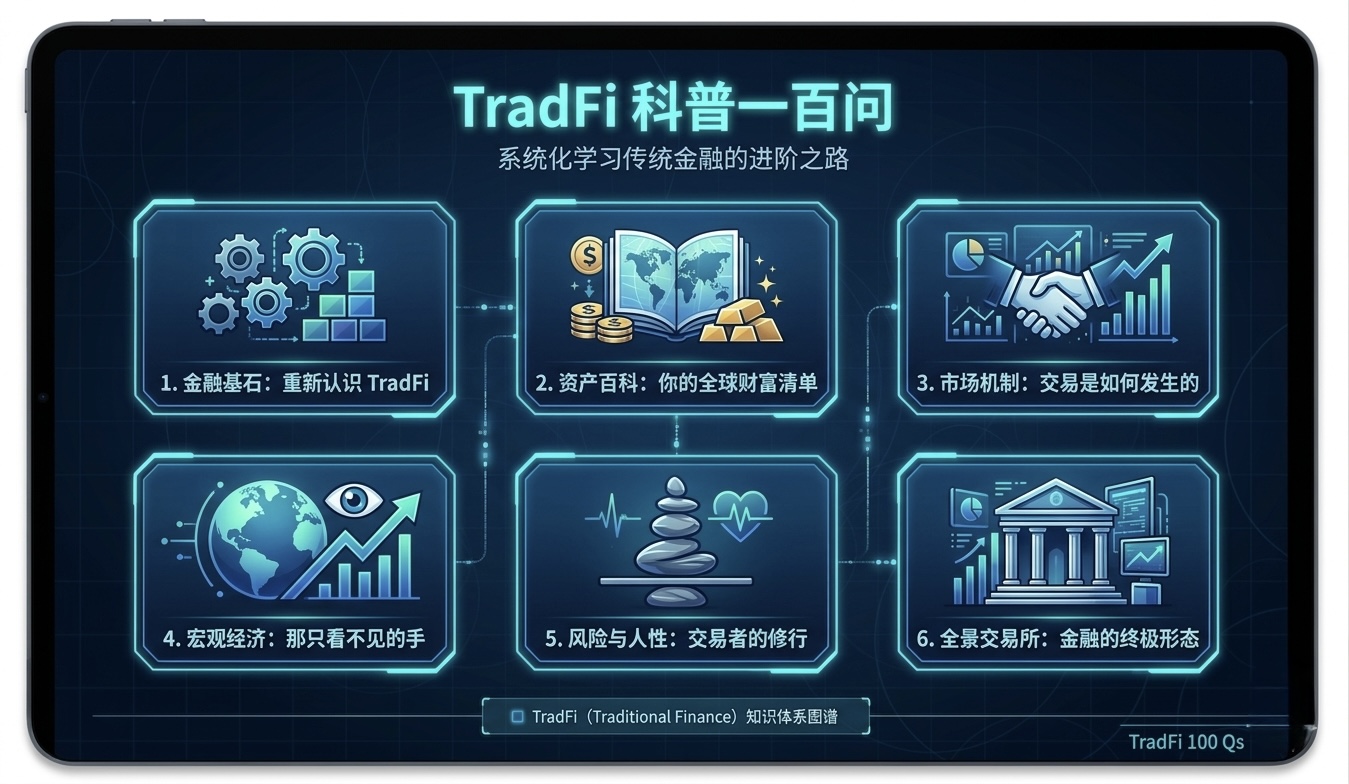
According to the official introduction, "One Hundred Questions on TradFi Science Popularization" breaks down traditional financial learning into 100 specific small questions, categorized into six modules: from the most basic "re-understanding money and markets," to "what assets like stocks and ETFs actually are," to "how order books, leverage, and market makers operate," followed by macroeconomics, trading psychology, and finally depicting what the deep integration of TradFi and Crypto looks like. Coupled with video effects, the content covered by a thick financial textbook is broken down into vibrant short videos.
The crypto industry has long since bid farewell to the primitive era of solely looking at on-chain data. The institutional funds brought in by ETFs and the real assets connected by RWAs have placed Crypto firmly in the global liquidity circulation. The future financial market will undoubtedly be mutually communicative: traditional financial assets will transition to on-chain, while crypto assets will be included in the global major asset allocation list.
Currently, the boundaries between TradFi and Crypto are becoming increasingly blurred. The ability to switch freely between them and understand each other's language will be a true advantage for the next generation of investors.
免责声明:本文章仅代表作者个人观点,不代表本平台的立场和观点。本文章仅供信息分享,不构成对任何人的任何投资建议。用户与作者之间的任何争议,与本平台无关。如网页中刊载的文章或图片涉及侵权,请提供相关的权利证明和身份证明发送邮件到support@aicoin.com,本平台相关工作人员将会进行核查。


