Author: Claude, Deep Tide TechFlow
Deep Tide Introduction: SpaceX was officially included in the NASDAQ 100 before the market opened on July 7, forcing over $800 billion in index-tracking funds to reposition, with QQQ alone expected to buy around $4.3 billion. However, this stock, which has been listed for less than a month, has already dropped 28% from its peak of $225, and starting in August, insiders will gradually be allowed to sell up to 44% of their shares. Whether this index inclusion is a buying point or a top signal has led to rare large disagreements on Wall Street.
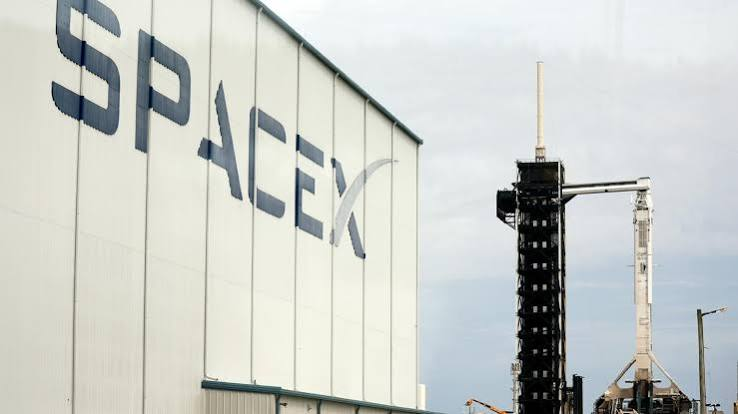
SpaceX officially joined the NASDAQ 100 index today. This technology and rocket launch company was included when the market opened on Tuesday, corresponding to about 1.3% of the index weight based on a threefold calculation of its original market cap of $75 billion. It is one of the fastest inclusions in NASDAQ 100 history, occurring less than a month after its IPO on June 12.
The mechanical buying from passive funds is the core of this story. However, there is virtually opposite judgment on the magnitude of this buying surge and the direction of the stock price from Wall Street.
Over $800 billion in index funds forced to reposition, but the actual buying scale varies
SpaceX's entry into the index after just 15 trading days relies on NASDAQ's newly established "fast lane" rules for large market cap IPOs. In contrast, the S&P 500 has refused to establish a similar fast track process, meaning SpaceX still cannot enter the S&P 500 due to separate profit and listing duration thresholds.
Over $800 billion in funds benchmarked against NASDAQ 100 must make room for Musk's rocket company. However, the specific amounts of forced buying vary among different calculations. Passive investors may have to buy up to $4.3 billion worth of stocks due to the NASDAQ 100 inclusion, and another approximately $3 billion may come from Russell index rebalancing. When adding up all mechanical buy orders from NASDAQ 100 and Russell tracking products, estimates land in the range of $22 billion to $27 billion.
These numbers sound substantial, but many analysts believe the actual impact on stock prices has been overestimated. A weight of 1.3% would position SpaceX around 21st in the index, below companies like NVIDIA, Walmart, Intel, and Tesla, indicating that the impact of passive buying on stock prices in the early stages of inclusion could be quite limited. A technology research director candidly stated that the significance of index inclusion is far less than people expect, as the rules are formulaic and everyone knows the formula. There are similar views in the derivatives strategy realm, suggesting that the actual buying volume required for inclusion is likely far lower than the market's initial speculations.
For those holding or considering positions, the implication is: do not treat "index passive buying" as an independent catalyst capable of moving stock prices higher; it is more like public information that has already been priced in by the market.
Small float amplifies volatility, expect a $20 swing in the next 11 days
The unique aspect of SpaceX's inclusion is its very small float. Only about 4% of shares were available for trading during the IPO, although the allocation to retail investors was higher than average. A small float combined with large passive demand will amplify price volatility rather than smooth it out.
ETFs and mutual funds will seek to buy a substantial portion of the tradeable shares; this dynamic may reinforce itself when prices rise but could become fragile if a reversal occurs. In other words, a thin float can amplify gains when demand is strong but can also exacerbate declines when sentiment reverses.
Risks have been placed on the table. An exchange executive warned that investors need to be prepared for a $20 price swing in this stock within the next week and a half. The market knows that volatility is high, and some believe that volatility may increase; investors should ask themselves if they can accept the expected $20 price swing over the next 11 days. People often only think about the stock price rising by $20, but it can just as easily drop by $20.
For short-term traders, this means position management is more important than direction judgment; for long-term holders, they need to endure the extreme daily volatility in the early stages of inclusion.
Historical samples vary: index inclusion is not a determining factor for stock price direction
If passive buying is a short-term positive, then the historical analogies commonly cited by the market actually point to a more complex conclusion: post-inclusion performance varies considerably among three high-profile stocks.
The stock most closely resembling "inclusion peaking" is Strategy (formerly MicroStrategy). This stock entered the NASDAQ 100 on December 23, 2024, but its intraday historical high of $543 was reached a month prior in November, and by the time of inclusion, its price was already on a decline, subsequently following Bitcoin's continued retreat, now hovering around $102, representing about an 81% drop from its peak.
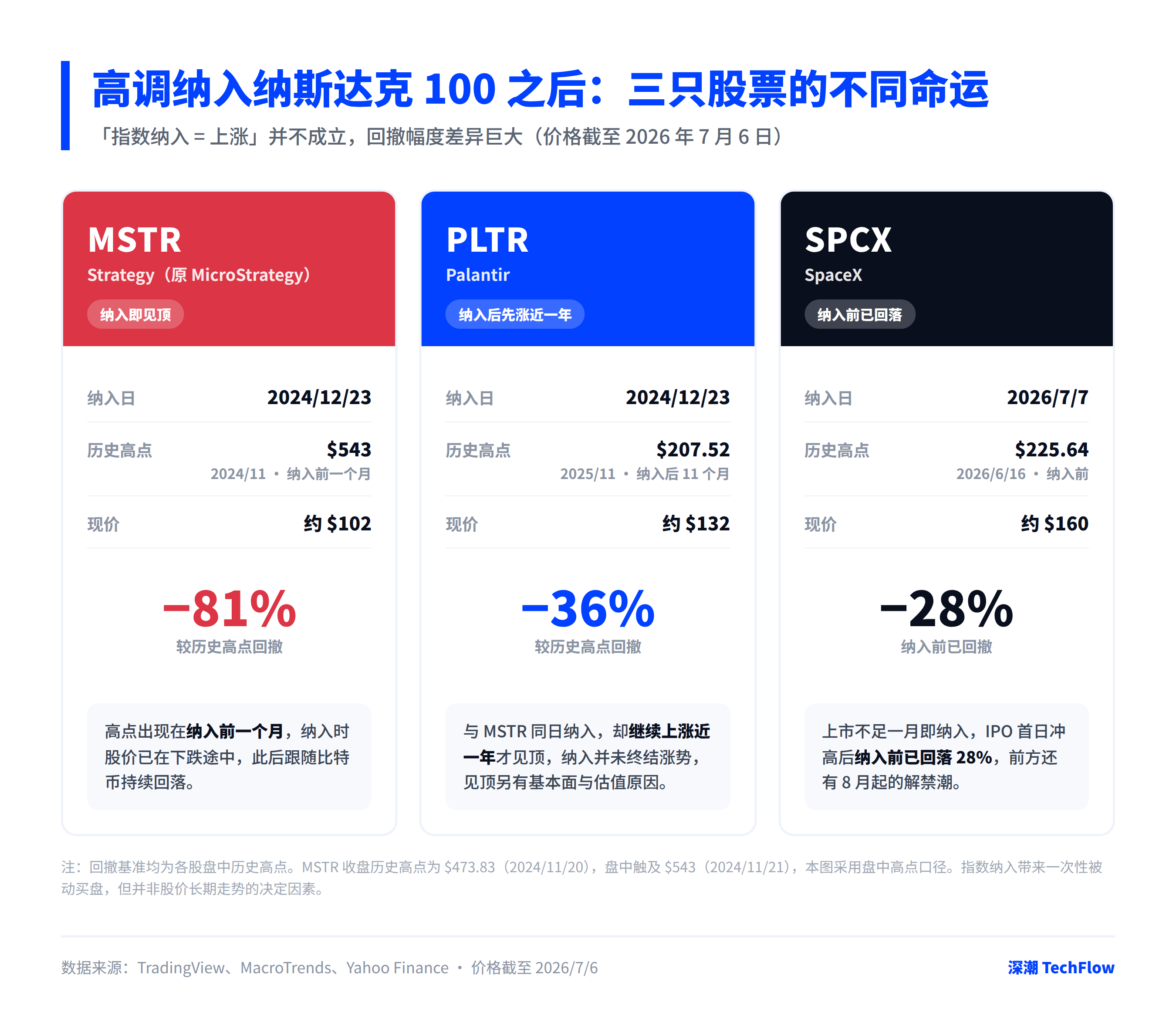
In contrast, Palantir, which was included on the same day as Strategy, took an opposite trajectory. It did not peak after inclusion; rather, it continued to rise, reaching a historical high of $207.52 on November 3, 2025, nearly 11 months after inclusion, and has now retreated to around $132, a drop of approximately 36% from its peak. Palantir's peak has other fundamental and valuation factors, having no direct causal relation to index inclusion itself.
SpaceX's position is different. After a 50% surge on its IPO day, it hit a historical high of $225.64 on June 16, having already declined approximately 28% before inclusion; at the moment of inclusion, its price was not at the starting point or peak, but in a pullback.
True short selling pressure lies ahead: a wave of unlocking starting in August
More noteworthy than the index inclusion is the subsequent wave of unlocking. The 180-day lockup period for SPCX will expire on December 8, 2026, with the first selling window opening after the Q2 earnings report (late July to August). Musk's 6.4 billion shares are locked until June 12, 2027.
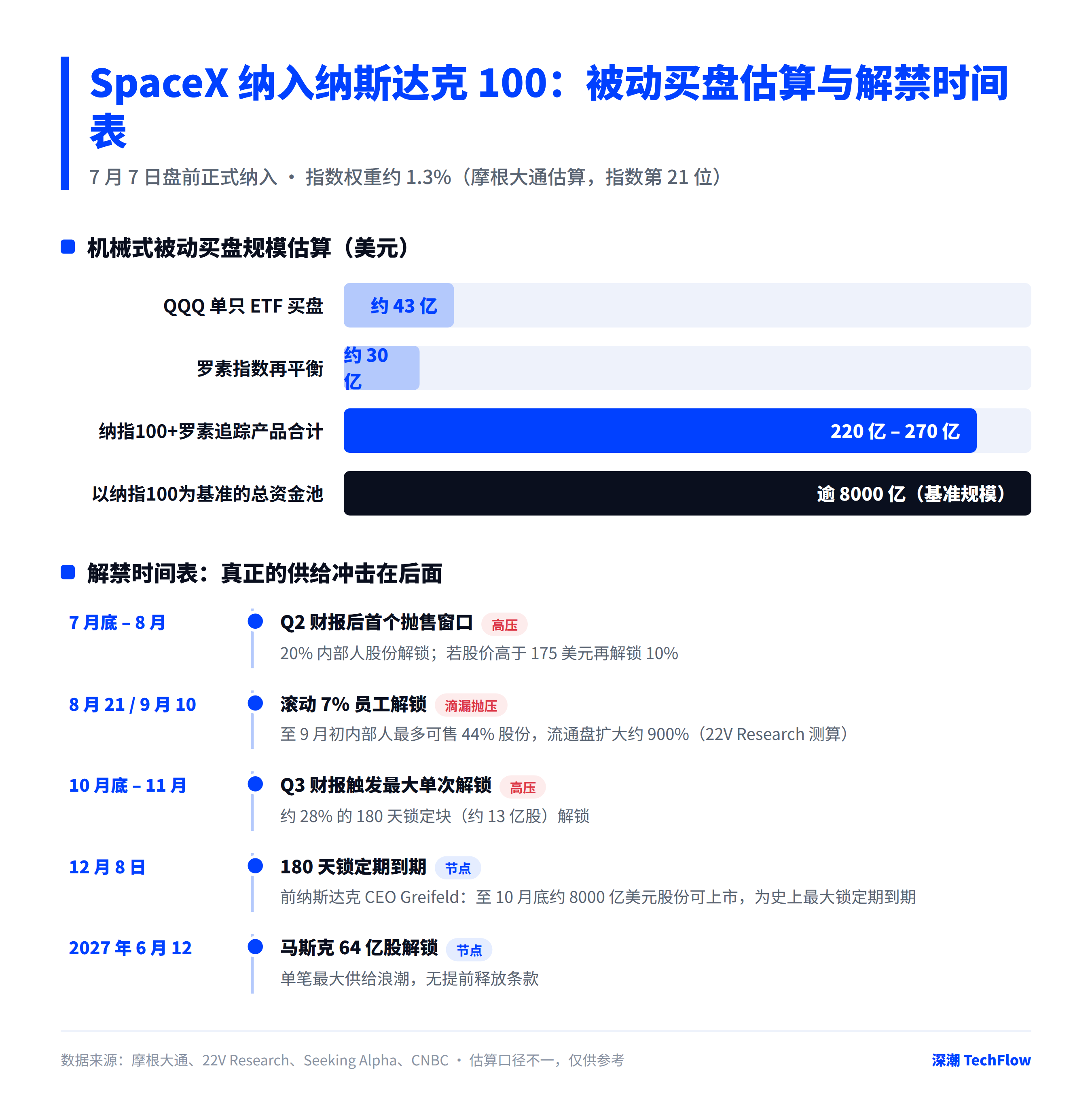
The unlocking is not a one-time release, but a gradual drip. After the earnings report in early to mid-August, 20% of insider shares will be unlocked. If the stock price increases 30% from the IPO price (above $175), another 10% will unlock; additionally, there will be 7% unlocking around August 21 and again around September 10. By early September, insiders could sell up to 44% of their shares, expanding the current float by about 900%.
Warnings from seasoned market professionals have been more severe: this is the largest lockup expiration in the history of the U.S. capital markets. While SpaceX is the largest IPO ever, it has been operational for 23 to 24 years, making this the largest lockup expiration in history. Approximately $800 billion worth of shares can enter the market from now until the end of October, which is unprecedented.
One balanced perspective worth noting is that while the unlocking increases selling pressure, it may also lower the extreme volatility of this stock. These large-scale unlockings could not only create substantial pressure on stock prices, but the newly added float might also reduce the overall daily volatility of the stock.
For holders, this means monitoring the Q2 earnings window from late July to August and the Q3 unlocking window from late October to November are the two supply shock nodes that require close attention.
Outlook: short-term noise is high, direction depends on fundamental realization
Putting various perspectives together reveals a relatively clear judgment: index inclusion itself is closer to a scheduled event that has been fully priced in rather than a catalyst capable of independently driving stock prices. Membership in the index supports liquidity and credibility, but it reflects past achievements rather than guarantees of future robust performance. Investors assessing SpaceX should pay more attention to the company's operational milestones and cash flow trajectory, rather than the temporary tailwind brought by index-driven fund inflows.
Supporting the long-term narrative are the fundamentals of SpaceX's three business sectors. Starlink is currently the largest source of revenue, contributing $11.4 billion out of the total $18 billion revenue of SpaceX last year, with subscribers exploding from 2.3 million three years ago to over 10 million now. The cost advantages of rocket launches and the AI layout of space data centers constitute a longer-term imaginative space.
In the short term, the forces of passive buying support, amplifying effects of a thin float, historical patterns' warning, and the upcoming wave of unlockings intertwine to push this stock toward a state of high volatility. Interest rates remain a ceiling; if yields rise dramatically, the stretched valuations of growth stocks will face duration pressure. SpaceX cannot offset this gravity, but a brand-new large-market cap story may maintain risk appetite amid a turbulent macro environment. The spillover effects into the crypto market are also worth noting, as when large tech funds dominate the market, Bitcoin and Ethereum often follow broader risk sentiment fluctuations.
The ultimate decision on direction does not lie in the index inclusion event itself but in the August Q2 earnings report and the subsequent unlocking window, where the fundamental analysis needs to withstand the supply shock.
免责声明:本文章仅代表作者个人观点,不代表本平台的立场和观点。本文章仅供信息分享,不构成对任何人的任何投资建议。用户与作者之间的任何争议,与本平台无关。如网页中刊载的文章或图片涉及侵权,请提供相关的权利证明和身份证明发送邮件到support@aicoin.com,本平台相关工作人员将会进行核查。


