Author: Xu Chao
The latest analysis from the research institution SemiAnalysis reveals that Anthropic is reshaping the AI commercialization landscape with a profitability and growth rate far exceeding its competitors. With a high-margin business model centered around APIs, Anthropic has become a leader in the B2B AI market.
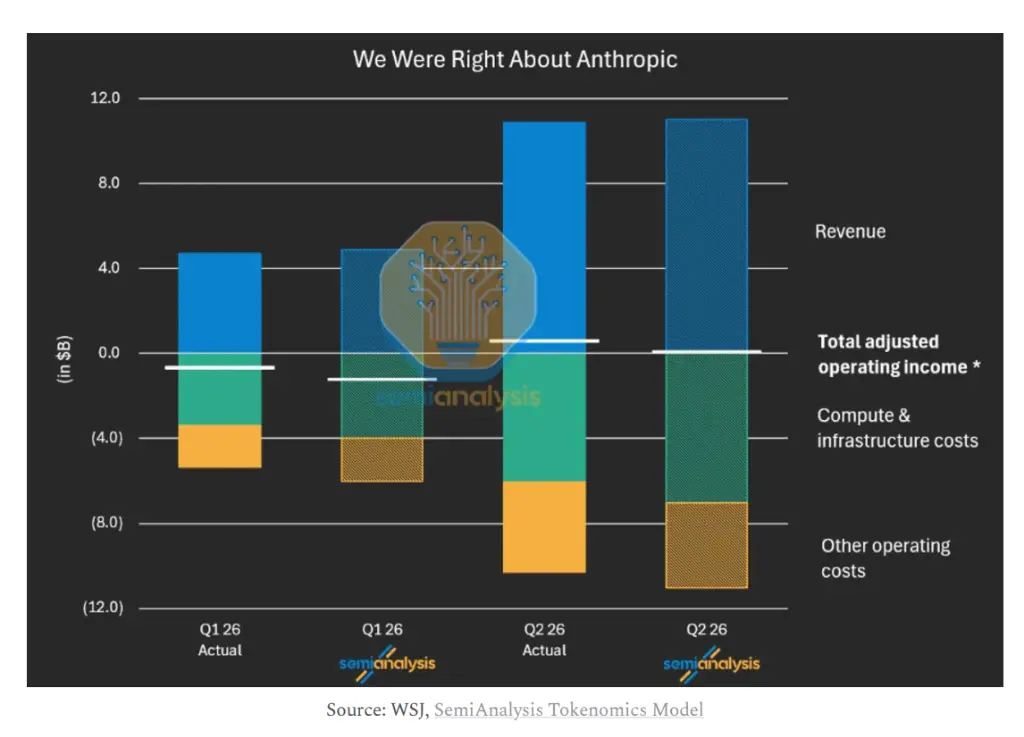
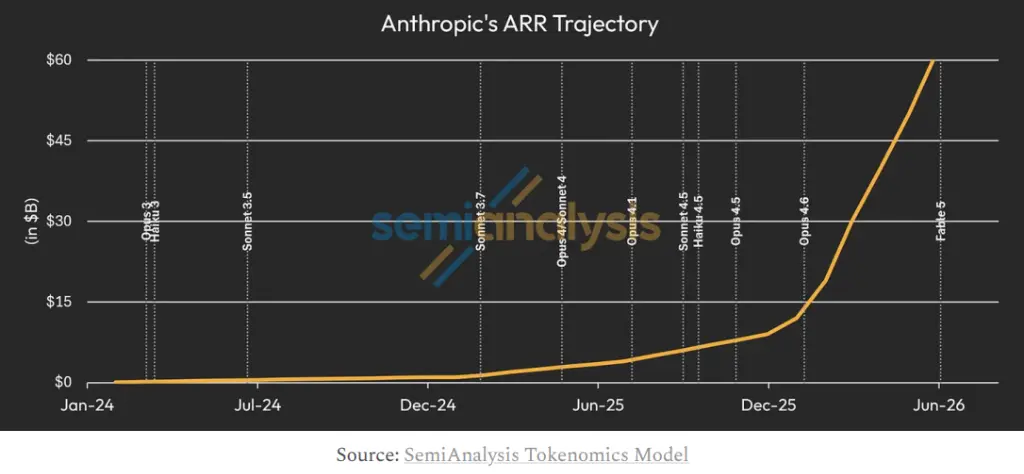
According to an in-depth report released by SemiAnalysis, Anthropic is expected to achieve $1 billion in GAAP earnings before interest and taxes by the third quarter of 2026, corresponding to a profit margin of about 6%. Meanwhile, its Annual Recurring Revenue (ARR) has skyrocketed from $9 billion at the end of 2025 to over $60 billion currently. The institution forecasts that if Anthropic maintains a net new ARR (NNARR) pace of about $15 billion per month, its ARR at the end of 2027 could reach $300 billion, corresponding to a $6 trillion enterprise value, making it the highest-valued company in the world.
Anthropic secretly submitted its IPO application on June 1. SemiAnalysis believes that going public at this time is of strategic urgency—Alphabet has completed $84.75 billion in equity financing, and Meta has also reportedly planned to raise hundreds of billions, with the capital market window narrowing. The report notes that Anthropic's superior financial data and business model mean it should go public ahead of OpenAI to seize the initiative in capital competition.
Claude Code ignites the B2B market, ARR growth more than doubles in a single quarter
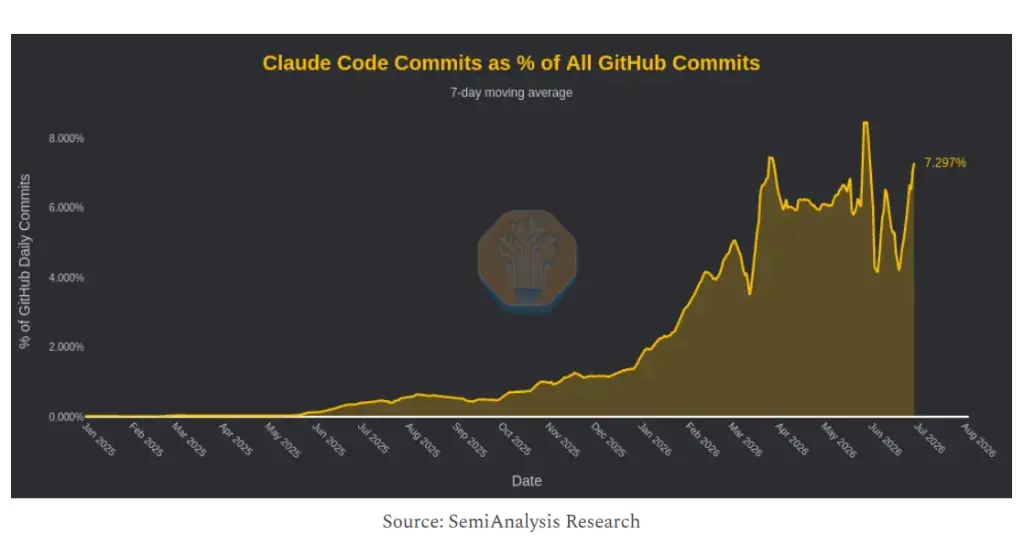
The performance inflection point for Anthropic comes from the explosive popularity of Claude Code. SemiAnalysis data shows that Claude Code currently accounts for over 7% of total code submissions on GitHub, directly driving the company's ARR from $3 billion monthly additions in January to $11 billion in March.
In terms of revenue structure, Anthropic and OpenAI show significant differentiation. About 75% to 85% of Anthropic’s ARR comes from usage-based API services, while consumer subscriptions account for only 5% of total ARR. In contrast, OpenAI still derives over 65% of its revenue from subscription models in the first quarter of 2026, with consumer ARR accounting for about 40%.
SemiAnalysis points out that the core advantage of the API model lies in the absence of revenue ceilings per single user— as the same client adopts more agentic workflows, their token consumption and corresponding revenue will continue to grow without needing to add new customers for expansion. Anthropic's CFO, Krishna Rao, disclosed in a podcast this May that the company's net revenue retention rate (NRR) is as high as 500%, meaning that among the customers contributing $30 billion in ARR in one quarter, they contributed only $2 billion a year ago.
Gross margin advantage forms a compounding flywheel, significant gap with OpenAI
The differences in business models are directly reflected in gross margins. SemiAnalysis estimates that Anthropic's current overall gross margin has risen to the mid-60% range, while in 2024 this figure was negative 94%. Notably, the gross margin for API services exceeds 80%.
The core driver of the significant improvement in gross margins is the increase in inference efficiency. Measured in ARR per megawatt of computing power, this metric for Anthropic is expected to reach $60 million later this year, up from only $16 million nine months ago. As the cost of inference computing power remains largely fixed, when the amount of tokens processed or token pricing increases per unit of computing power, the marginal profit margin approaches 100%.
The report estimates that if both Anthropic and OpenAI reach $100 billion in ARR, OpenAI will have approximately $25 billion less in gross profit due to the need to support over 900 million free users (SemiAnalysis estimates the monthly service cost at about $0.70 per person), which will directly affect both parties' ability to reinvest in the training of the next-generation models.
SemiAnalysis introduces "Earnings Before Tax and Interest Training" (EBTIT) as a core metric for assessing the reinvestment capability of labs, with Anthropic achieving an EBTIT profit margin of 36% in the second quarter of 2026. The report predicts that by 2028, Anthropic's cumulative EBTIT will exceed OpenAI's by $250 billion.
Beyond programming, cybersecurity may become the next growth engine
SemiAnalysis estimates that currently over 65% of the lab's ARR comes from programming-related use cases, with programming tools startups like Cursor, Cognition, Loveable, and Replit contributing a total of about $6 billion in ARR. Meta is the largest single customer of Anthropic, but its share remains between 3% to 5%.
The report believes that cybersecurity will be the next explosive vertical field following programming, and the release of the new Fable model is expected to further enhance token pricing and expand application scenarios, driving monthly NNARR in the second half of 2026 to surpass the current monthly level of $10 billion. Sectors such as healthcare, finance, and biotechnology are also identified as potential major directions for TAM expansion.
In terms of distribution channels, the "Token as a Service" (TaaS) model sold indirectly through large-scale cloud platforms like AWS Bedrock and Azure Foundry is rapidly growing, currently accounting for 15% to 20% of Anthropic's ARR, whereas this ratio was only 5% to 10% a quarter ago. SemiAnalysis believes that paying 20% to 30% of revenue to large-scale cloud platforms is still economically reasonable from the perspective of reach efficiency and compliance convenience for enterprise customers.
Compute power bottlenecks are the biggest variable, IPO provides a pathway for financing
The growth prospects for Anthropic face core constraints from computing power supply.
SemiAnalysis predicts that by 2030, the combined unconstrained computing power demand of Anthropic and OpenAI will exceed 100 gigawatts (GW), while the net additional computing power for 2025 and 2026 is only 2.5GW and 5GW respectively. Currently, the combined available computing power for both companies is just over 6GW.
It is this supply-demand gap that gives the IPO clear strategic significance. The report indicates that the funds raised from the public listing will primarily be used to bridge the increasingly expanding gap in computing power needs between inference operations and new model training, and to lock in computing power resources at more favorable financing costs in advance. The report also mentions that Meta is considering renting out computing power to external parties (information sourced from market rumors on July 1, 2026), and is expected that Anthropic will procure incremental computing power from such trusted suppliers.
SemiAnalysis also lists the main risk factors, including: OpenAI's rumored price reduction plans, competition pressure from Google's DeepMind and Meta in programming models, potential regulatory restrictions from the government on the release of cutting-edge models, and the dilution effect on overall gross margin due to the rising proportion of TaaS revenue. The report clearly states that if regulatory systems obstruct model releases and narrow the capability gap between open-source models and cutting-edge proprietary models, it will fundamentally weaken Anthropic's business moat.
免责声明:本文章仅代表作者个人观点,不代表本平台的立场和观点。本文章仅供信息分享,不构成对任何人的任何投资建议。用户与作者之间的任何争议,与本平台无关。如网页中刊载的文章或图片涉及侵权,请提供相关的权利证明和身份证明发送邮件到support@aicoin.com,本平台相关工作人员将会进行核查。


