Written by: Rita
Trends Guide
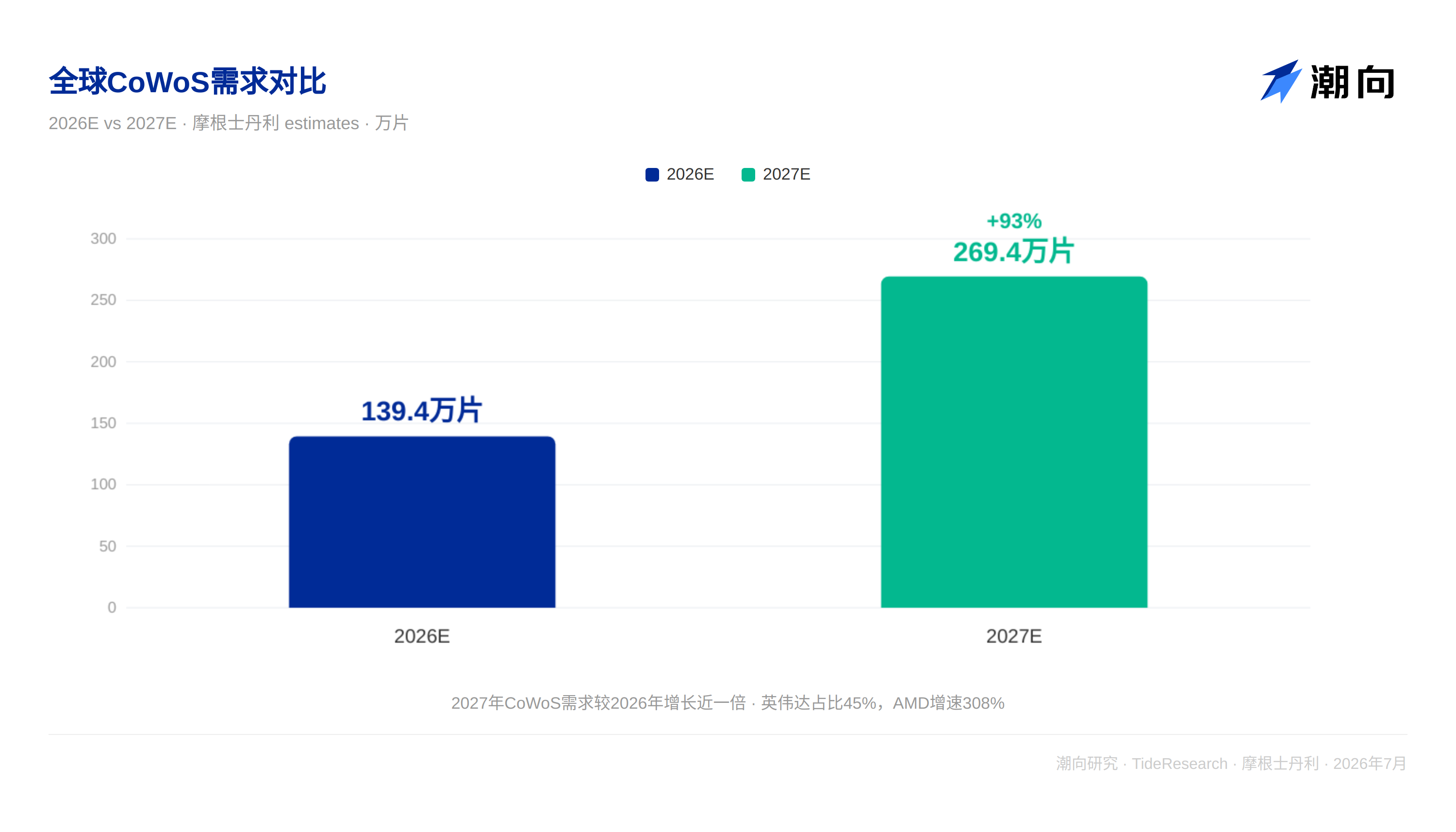
On July 8, Morgan Stanley released the latest report on the AI supply chain, providing a comprehensive update on the allocation of CoWoS advanced packaging and the dynamics of ASIC for 2027. The core judgment of the report is: global demand for CoWoS is expected to reach 2.694 million units in 2027, an increase of 93% compared to 1.394 million units in 2026. NVIDIA still holds the largest share (1.222 million units, accounting for 45%), but AMD is rapidly becoming the biggest variable with a growth rate of 308%. More importantly, CPUs are starting to adopt CoWoS packaging on a large scale, with AMD's Venice CPU expected to ship 6.75 million units in 2027, which is a key signal that AI computing demand is spreading from GPUs to a broader range of chip types. The so-called "inventory" issue of the Blackwell chip has been confirmed to be a supply chain buffer that will be completely consumed within 2026.
AMD's CoWoS Allocation: 240k units unchanged, but execution risks cannot be ignored
Morgan Stanley confirmed in the report that AMD's CoWoS allocation for 2027 remains at 240k units, an increase of about 85% compared to 130k units in 2026. The MI400 series will be divided into two versions: the MI455 is the standard version, equipped with 2 compute dies and 12 HBM4 12hi, along with the Helios rack (18 CPUs + 72 GPUs), primarily for customers like Microsoft, AWS, and Oracle; the MI450 is a Meta customized version, with the chip size halved, equipped with 1 compute die and 6 HBM4 12hi. Morgan Stanley expects 1 million MI455 units and 500k MI450 units to ship in 2027.
However, Morgan Stanley also cautions: AMD's execution risk cannot be ruled out, as AMD had previously cut CoWoS orders in 2026. This is a signal worth noting: even with clear demand, the matching of capacity and yield is still a variable.
CPUs join the CoWoS camp: Venice is a watershed
Venice is AMD's first CPU to adopt CoWoS packaging, with CoWoS production concentrated at ASE/SPIL, Amkor, and ChipMOS. Morgan Stanley estimates that the total shipment of CPU chips in 2027 could reach 5.7 million to 6 million units, far higher than the 1 million units in 2026. The packaging demand for 6.75 million Venice CPUs indicates that the application scenarios for CoWoS are significantly expanding from AI accelerators to mainstream server CPUs.
This is a clear incremental signal for the advanced packaging equipment supply chain. The ongoing tight supply of CoWoS capacity will accelerate the domestic substitution process for advanced packaging equipment. Leading packaging and testing players like Changdian Technology and Tongfu Microelectronics are expected to benefit from the overflow in OSAT capacity.
Google TPU: Sunfish delayed but not canceled, concentrated shipments in 4Q
Morgan Stanley's industry survey shows that revenue for King Yuan Electronics (KYEC) in 3Q26 may increase nearly 10% quarter-on-quarter, below the previous expectation of 15%, mainly due to slight delays in Rubin and Sunfish, as well as reductions in MediaTek smartphone SoC orders. However, the annual shipment volume for Sunfish remains at 960k units, concentrated in 4Q26 or 1Q27, with no order reductions. The shipping pace for Zebrafish in 4Q26 remains unchanged.
The delay of Google TPU means an extended window of opportunity for the domestic AI chip supply chain. Domestic AI chip manufacturers such as Cambrian and Haiguang Information still have space to catch up.
NVIDIA: Blackwell inventory is an illusion, Rubin is the real quantity
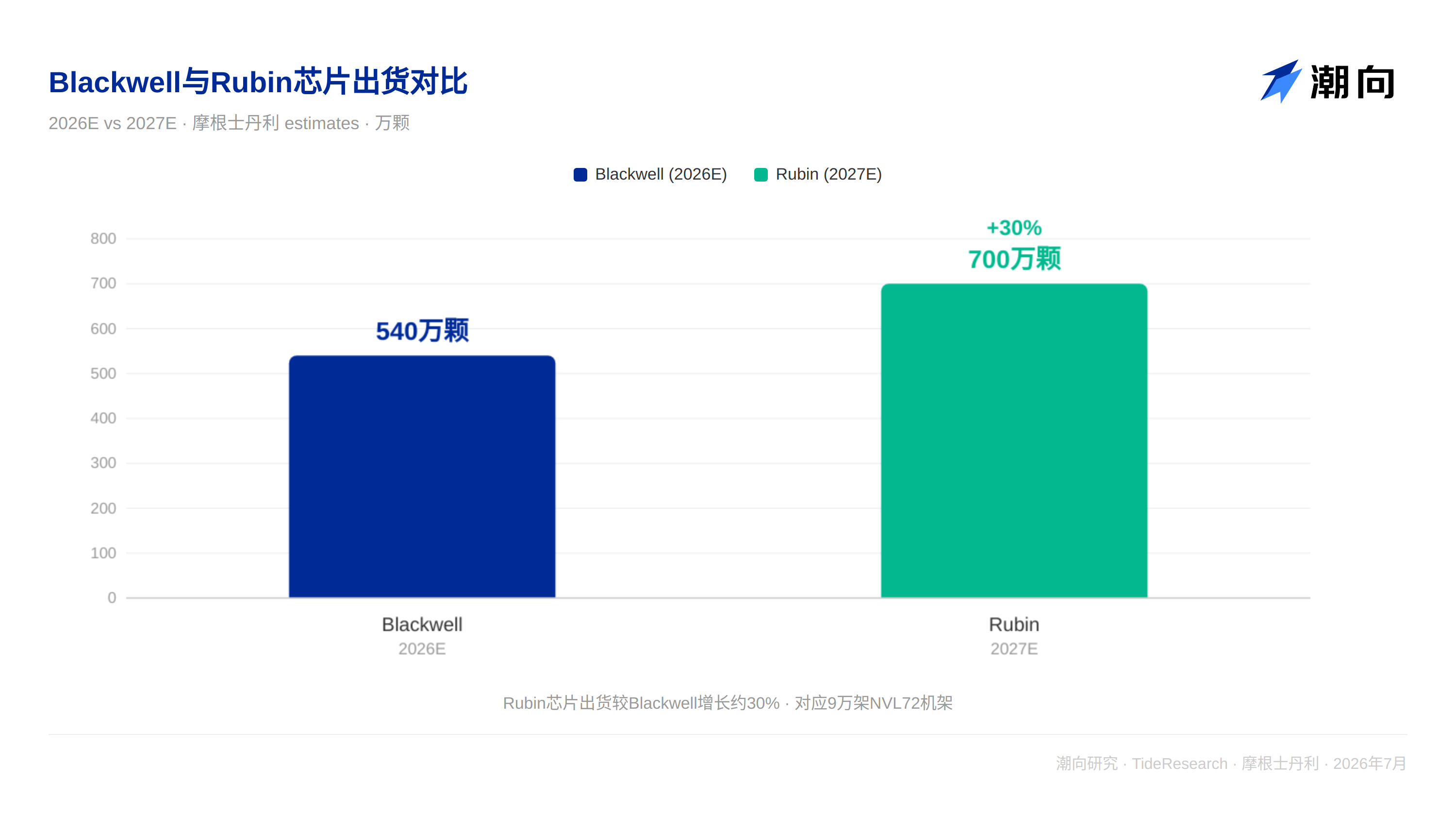
Morgan Stanley has given a clear conclusion on the Blackwell chip inventory issue: the so-called "inventory" is actually a supply chain buffer that will be completely consumed by 2026, so there is no need to worry about inventory issues. It is expected that 5.4 million Blackwell units will ship in 2026, with chip production sufficient to meet the demand for Grace Blackwell NVL72 in the second half of 2026.
Rubin is the true incremental addition. Morgan Stanley estimates that shipments of Rubin and Rubin Ultra chips will approach 7 million units in 2027, with up to 90,000 Rubin NVL72 server racks. Rubin will begin ramping up in 3Q26 and commence rack shipments in 4Q26.
For A-share investors, the increase in Rubin's volume means that domestic optical modules, PCBs, cooling, and other AI supply chain segments will welcome sustained orders. The performance visibility of targets such as Zhongji Xuchuang and Shenghong Technology will improve with the volume increase of Rubin.
Trend Perspective
The core logic of Morgan Stanley's report is: the competition in AI chips is shifting from "who can design the best chip" to "who can secure enough advanced packaging capacity." CoWoS is expected to grow from 1.394 million units in 2026 to 2.694 million units in 2027, more than doubling, but the growth rate on the demand side is even faster. NVIDIA, AMD, Google, Amazon, and Broadcom are all competing for CoWoS capacity.
The biggest structural change in this capacity scramble is that CPUs are beginning to adopt CoWoS on a large scale. The expected shipment of 6.75 million AMD Venice CPUs in 2027 signifies that the application scenarios for CoWoS have expanded from AI accelerators to server CPUs, which is a clear incremental signal for the advanced packaging equipment supply chain.
Three observation dimensions are worth continuous tracking: NVIDIA's Rubin is the largest single increment in 2027, AMD's Venice CPU is a structural increment in CoWoS demand, and the timeline for Google TPU leaves room for domestic AI chips to catch up. The overlap of these three dimensions suggests that the prosperity of the AI supply chain can at least be projected until 2028.
Disclaimer
This article is a整理与解读 of a third-party brokerage research report (Morgan Stanley, July 8, 2026) by Trends Research. The ratings, target prices, earnings forecasts, and related judgments quoted in the text are the views of the brokerage's analysts and only represent their institution's position, not the views of Trends Research, nor does it constitute any investment advice.
The market has risks, and decisions should be independent. This article should not be used as a basis for buying or selling any securities.
免责声明:本文章仅代表作者个人观点,不代表本平台的立场和观点。本文章仅供信息分享,不构成对任何人的任何投资建议。用户与作者之间的任何争议,与本平台无关。如网页中刊载的文章或图片涉及侵权,请提供相关的权利证明和身份证明发送邮件到support@aicoin.com,本平台相关工作人员将会进行核查。


