Author: Climber, CryptoPulse Labs
Recently, Nvidia announced a deepening collaboration with Hugging Face, the world's largest AI open-source community, to integrate capabilities such as Isaac GR00T, the Cosmos world model, and robot datasets into the LeRobot open-source ecosystem, jointly creating a platform for robot open-source model development. This may seem like just a technical collaboration, but it quickly garnered attention throughout the entire robotics industry.
The main reason behind this is that both parties represent two of the most important resources in robot AI: Nvidia possesses the world's strongest AI computing power, robotic foundational models, and simulation platforms, while Hugging Face has the largest AI developer community and open-source model ecosystem globally. The combination of the two indicates that the robotics field is beginning to experience a similar "open-source flywheel" as seen in the era of ChatGPT.
From a larger industrial perspective, the significance of this collaboration goes far beyond releasing a few models; it is about competing for one of the most important assets of the robotic era—the developer ecosystem.
1.Hugging FaceBrings a "GitHub Moment" for Robots
Many ordinary users may not have heard of Hugging Face, but for AI developers, it has almost become a website they visit every day.
 If we were to summarize Hugging Face's positioning in one sentence, it is the GitHub of the AI field.
In the era of software development, programmers would upload their code to GitHub, collaborating with developers worldwide to develop software. In the era of generative AI, developers need to share not just code, but also models, datasets, training processes, and inference tools. It is under this demand that Hugging Face has grown into the largest AI open-source platform in the world.
Today, from Meta's Llama to Alibaba's Qwen, and from Google's Gemma to Mistral AI, many well-known models are quickly released on Hugging Face.
For many AI companies, Hugging Face has already become the de facto model release platform; for developers, it is the primary entry point for finding models, downloading models, fine-tuning models, and deploying applications.
However, the robotics industry has always lacked such infrastructure.
For a long time, robot development has faced three pain points: expensive data, high algorithm thresholds, and high development redundancy. Different companies often need to start from scratch to collect data, train models, and build control systems, resulting in long development cycles and high costs, leading to a slow overall pace of industry development.
In this collaboration, Nvidia will gradually integrate Isaac GR00T, robotic datasets, remote control tools Isaac Teleop, and future Cosmos world models into Hugging Face's LeRobot open-source project, effectively standardizing and open-sourcing the underlying capabilities needed for robot development.
This means that in the future, companies will no longer need to reinvent the wheel in robot development but can quickly train and iterate based on existing models, just as they do today for developing large model applications.
For the entire industry, this is an infrastructure upgrade.
Moreover, it signifies that robots are beginning to replicate the development path of large language models. By attracting developers through open-source efforts, enriching the ecosystem through developers, and finally driving commercial applications through the ecosystem, it ultimately forms a network effect.
2.NvidiaSets the Stage for the Developer Ecosystem in the Robotic Era
Many may wonder why Nvidia, as the dominant player in AI chips, is increasingly enthusiastic about open source? The answer is not to sell models but to sell more GPUs.
 In recent years, Nvidia has demonstrated a business rule. The real profits do not come from any single AI application, but rather from the continuous growth of demand for computing power stemming from the entire AI ecosystem.
ChatGPT, Claude, Gemini, Llama… these models compete fiercely, but regardless of who wins, they all require large amounts of GPU for training and inference, with Nvidia remaining the biggest beneficiary.
This is equally true in the robotic era.
The humanoid robots, industrial robots, logistics robots, and even autonomous driving systems of the future will require continuous model training, simulation testing, and real-world fine-tuning. All of these processes rely on GPU computing power support.
Thus, for Nvidia, it is not about having the most robots but rather getting more and more people worldwide to start developing robots.
The more developers there are, the more models will be trained, and the greater the demand for simulations, which will naturally lead to a continued growth in demand for GPUs. This is precisely why Nvidia has been continuously improving the robotic ecosystem.
Currently, Nvidia has established a platform system covering the entire lifecycle of robots. Omniverse is used for digital twins, Isaac Sim for robotic simulation training, Cosmos provides world models, GR00T offers foundational robotic models, and CUDA continues to serve as the underlying AI computing platform.
Now, collaborating with Hugging Face completes the last piece of the puzzle—the global developer community.
In the past, Nvidia had the technology but relied on enterprise clients for gradual promotion; while Hugging Face possesses millions of developers and a mature open-source community culture that can help new technologies spread quickly.
This collaboration is essentially a combination of "technical platform + developer platform."
History has shown that companies capable of becoming industry standards often not only possess leading technology but also have the largest developer ecosystem.
Microsoft established its software ecosystem through Windows, Apple built mobile ecosystems through the App Store, and Google built a global developer network through Android.
Now, Nvidia hopes to replicate this successful model in the robotic era.
3.Ecological Competition is the Ultimate Battlefield in the Robotics Industry
If we segment the robotics industry into several layers, we can see that competition is undergoing fundamental changes.
The first layer is hardware, including the robot body, motors, gearboxes, sensors, etc. The second layer is AI capabilities, including vision, multimodal understanding, action planning, and reinforcement learning. The true determinant of the industry landscape is the third layer—the ecosystem.
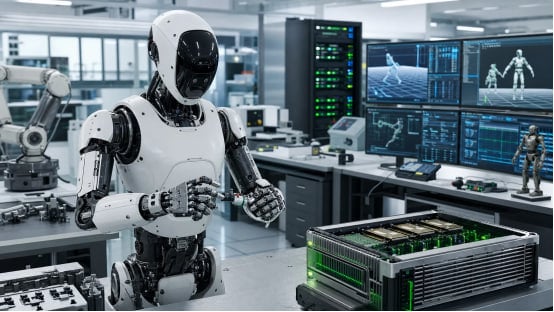 In the past, robotics companies relied more on closed development; each company had its algorithms and data, and there was a lack of sharing among companies, resulting in low innovation efficiency.
However, the development of generative AI has proven that open-source ecosystems can significantly accelerate the pace of technological evolution.
After Meta opened up Llama, numerous developers quickly completed optimizations, fine-tuning, and deployments, fostering the prosperity of the entire open-source large model ecosystem; the rapid rise of models like DeepSeek also benefited from collaborative innovation in the open-source community.
The robotics industry is experiencing a similar turning point.
As foundational models mature, the real competition in the future will shift from "who owns the model" to "who has more developers." More developers mean more application scenarios, more plugins, more training data, and faster model iteration speed.
Therefore, it is likely that the robotics industry will experience ecological competition similar to that of the smartphone era.
Different companies will no longer just sell the robot body but will build a complete platform system around robots, including development tools, model markets, data markets, application stores, and developer communities.
Nvidia clearly aims to become the underlying infrastructure for this platform.
At the same time, more and more tech giants are starting to plan for foundational models of robotics. Tesla is advancing end-to-end robotic intelligence based on FSD and Optimus; Google's DeepMind is continually reinforcing its research into embodied intelligence; OpenAI is also re-emphasizing the direction of robotics; domestic companies like Yushu Technology, Zhiyuan Robot, and Galaxy Universal are actively exploring the commercialization of humanoid robots.
It can be anticipated that in the future, the robotics industry will not just have one winner but will form a complete ecosystem similar to the PC era or mobile internet era.
In this ecosystem, whoever controls the development platform will possess the greatest long-term value.
Conclusion
Looking back, the collaboration between Nvidia and Hugging Face does not merely signify that several robotic models have been placed on the open-source platform; the real signal it releases is that the robotics industry is beginning to enter a new stage of open-source collaboration.
In the past, one important reason large models could make rapid breakthroughs within just a few years is that open-source communities continually lowered technical barriers, allowing developers worldwide to participate in innovation. Now, this model is being replicated in the field of robotics.
For Nvidia, the core goal of this collaboration is not to become a robot manufacturer but to become the most important infrastructure provider of the robotic era. From GPU, CUDA to Omniverse, Isaac, GR00T, and then to the Hugging Face developer ecosystem, Nvidia is constructing a complete value chain covering "computing power, models, simulation, development, and deployment."
免责声明:本文章仅代表作者个人观点,不代表本平台的立场和观点。本文章仅供信息分享,不构成对任何人的任何投资建议。用户与作者之间的任何争议,与本平台无关。如网页中刊载的文章或图片涉及侵权,请提供相关的权利证明和身份证明发送邮件到support@aicoin.com,本平台相关工作人员将会进行核查。


