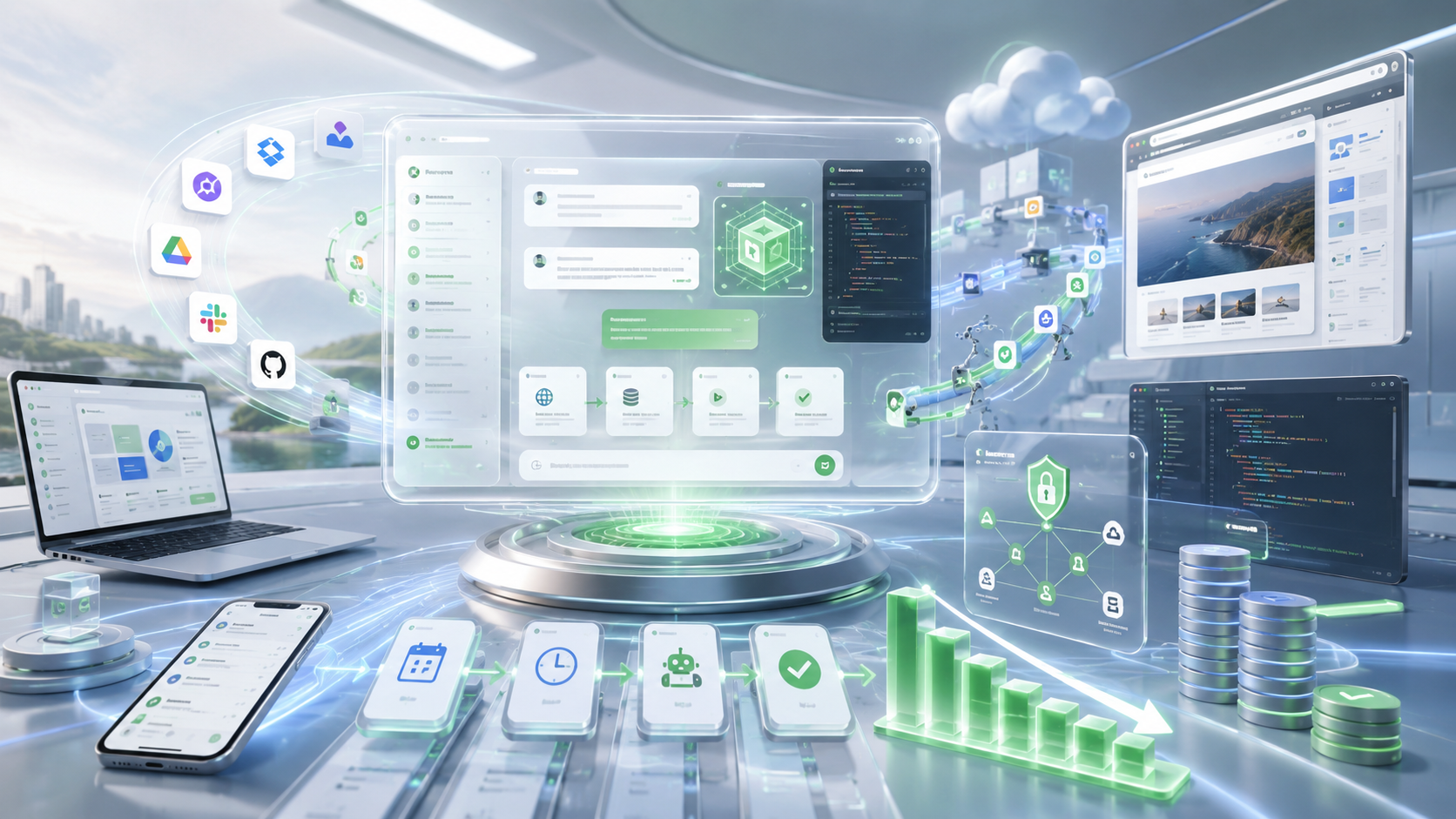
On July 9, OpenAI released the GPT-5.6 series models and officially announced the merger of the ChatGPT desktop application with Codex. In this update, the most noteworthy aspect is not just the parameter improvements, but the reshaping of boundaries in two dimensions: first, with model pricing, Terra offers near performance at half the price of GPT-5.5, while Luna significantly lowers API costs; second, in terms of tools, the merged application introduces the Work mode, supporting the execution of complex projects across platforms like Slack and Google Drive, along with scheduling capabilities. This marks a transition of AI tools from "human-triggered - machine responds" synchronous dialogue to "machine listens - machine executes" asynchronous workflows.
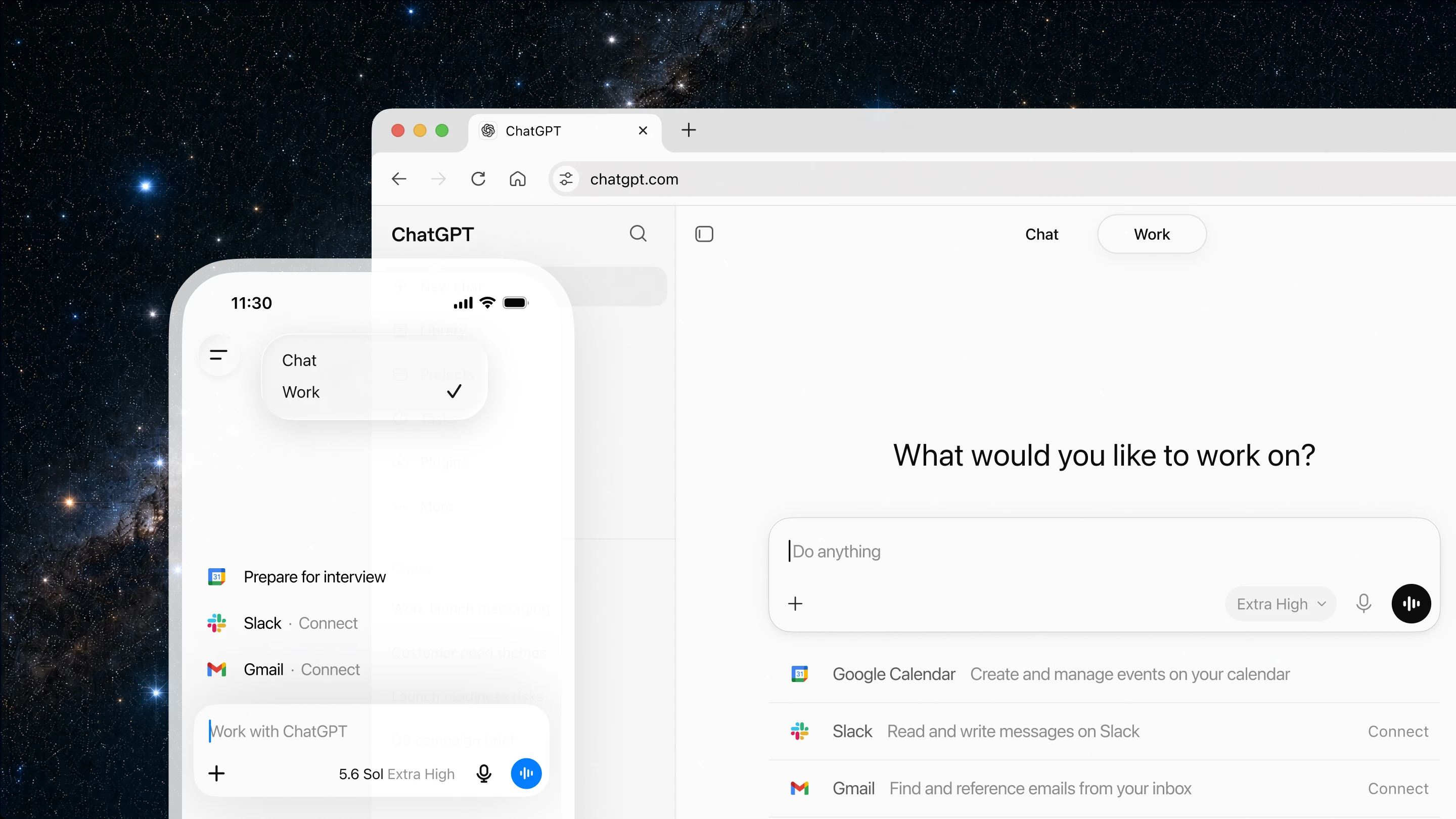
ChatGPT Work supports cross-platform execution and multi-device synchronization, image source: OpenAI official blog
The pricing strategy and execution cost reconstruction of GPT-5.6
OpenAI has implemented an aggressive "market segmentation by execution cost" strategy for the GPT-5.6 series. The new series includes the flagship Sol, cost-effective Terra, and lightweight Luna models, each targeting different execution scenarios and cost tolerances.
In terms of API pricing, Sol inputs at $5 per million tokens and outputs at $30 per million tokens, remaining consistent with the previous flagship GPT-5.5. Luna inputs at $1 per million tokens and outputs at $6 per million tokens, positioned as a lightweight model. The real game-changer for developers is Terra, which has an input price of $2.5 per million tokens and outputs at $15 per million tokens, delivering performance close to that of the previous flagship GPT-5.5 but at half the price.
For corporate procurement decision-makers and mid-level developers, Terra provides a clear path to cost reduction. When handling large-scale text analysis, code refactoring, and other non-extreme reasoning-intensive tasks, switching from GPT-5.5 to Terra can directly halve API expenses. Assuming a team consumes 1 million tokens input and 500,000 tokens output per month, migrating from GPT-5.5 to Terra would reduce monthly API costs from approximately $20 to about $10. This pricing strategy indicates that OpenAI no longer solely relies on Benchmark scores to differentiate models but instead allows enterprises to choose computing power based on the actual ROI of their tasks.
At the same time, Luna's extremely low pricing is not merely for penetrating the lower market but provides economic feasibility for asynchronous workflows. In backend tasks that require high-frequency calls and low-latency responses, such as data cleansing, log analysis, or scheduled inspections, the single-call cost of the model becomes crucial for large-scale deployment. Luna's input and output prices are only one-fifth of Sol’s, enabling developers to let AI continuously operate in the background without worrying about soaring costs. This "cheap labor" positioning naturally complements the scheduled task features in the subsequent Work mode—using Luna for background scheduled aggregation and Sol for handling foreground complex reasoning.
Sol, on the other hand, raises the upper limits with the addition of max and ultra reasoning tiers. The max tier is aimed at deep reasoning needs, while the ultra tier supports multi-agent parallel processing, targeted at high-end and enterprise-class workflows. In scenarios involving complex codebase restructuring or cross-system data integration, the ultra tier can schedule multiple sub-agents to process different sub-tasks simultaneously before compiling the results. This stratification not only covers all needs from low-end to high-end but also deeply binds model capabilities to specific execution scenarios, establishing a computational foundation for subsequent tool mergers.
From synchronous dialogue to asynchronous cross-platform execution
If model stratification provides different cost execution engines, the merger of the ChatGPT desktop application and Codex provides the physical carrier for executing these engines. The merged application uniformly provides Chat, Work, and Codex modes, constructing a complete productivity spectrum from daily Q&A to cross-platform project execution to sandbox-level code engineering.
The Chat mode still undertakes the role of daily synchronous dialogue, used for lightweight creation and quick Q&A, with interaction methods consistent with previous versions of the ChatGPT desktop app. The Codex mode focuses on heavy code engineering, adding file editing, Pull Request review, and Ultra mode to provide developers with a sandbox-level programming environment. In the Codex mode, the browser side has upgraded support for CDP (Chrome DevTools Protocol), allowing AI to inspect network traffic, perform multi-tab analysis, and interact with logged-in state operations, further expanding the scope of code debugging and Web application testing.
The feature that truly breaks the traditional boundaries of AI tools is Work mode. ChatGPT Work supports the execution of complex projects across platforms like Google Drive and Slack and includes scheduled tasks functionality. This means AI is no longer merely a passive responding dialogue box but an automated terminal that can actively listen, schedule, and execute.
Specifically, Work mode connects to external platforms through the Plugins mechanism. Users can describe task objectives in natural language, and AI will automatically decompose these into multiple steps, retrieving discussion records from Slack and project documents from Google Drive, then synthesizing an analysis report. More critically, the scheduled task functionality allows users to set up a background asynchronous execution plan similar to Cron, for example, "Summarize the key discussions in the Slack channel every Monday at 9 AM and generate a progress report based on the project documents in Google Drive." At the designated time, AI will automatically execute the entire process without manual triggering.
This capability signifies that AI tools are beginning to penetrate the territory of traditional RPA (Robotic Process Automation) and automation workflow platforms. Compared to traditional RPA, which requires complex rule scripts to be written, Work mode drastically lowers the barrier for building automation workflows through natural language understanding. The productivity boundary of AI tools expands from "human-triggered - machine responds" synchronous interactions to "machine listens - machine executes - human approves" asynchronous workflows. ChatGPT is transforming into a combination of an AI-powered Zapier and an automated terminal.
The ecological digging behind one-click website creation and code migration
In reshaping the workflow, OpenAI is also accelerating ecological binding through functional loops and reducing conversion costs.
The Sites feature allows users to publish visual content as a website with one click, and the browser-side upgrade supports logged-in state operations and multiple tabs. This means that analysis results or code applications generated in Work or Codex mode can be directly deployed as web apps with a login state. After completing data analysis in Work mode, users can publish interactive dashboards as accessible web pages via Sites, and team members can log in to view them using Sign in with ChatGPT. For internal corporate purposes, the Sites feature secures the distribution channels for lightweight applications. In the past, developers generated code with AI but had to find servers and configure deployment environments for team use. Now, this process has been compressed into a one-click operation, significantly shortening the delivery cycle from ideas to applications.
In the developer tools market, OpenAI has revealed a more direct competitive strategy. Codex has added the ability to migrate from Claude Code. The official GitHub repository provides a specialized migration script that can accurately scan Claude Code's configuration directory and convert configurations such as agents, MCP servers, and hooks into Codex format with one click.
Claude Code, as a strong competitor in the AI programming assistant space, has a configuration system that reflects user habits and project accumulation. An agent and MCP connection defined by a developer in Claude Code is often related to specific project workflows and external toolchains. OpenAI’s proactive provision of official migration tools serves as a "digging" weapon to lower competitor user conversion costs in the AI programming assistant red ocean. This indicates that as the gap in fundamental model capabilities narrows, the competition focus has shifted from pure model performance to ecological binding and user migration costs. Whoever can more smoothly take over existing assets from competitor users is poised to capture a larger share of the developer market.
The bulge and permission risks brought by the merger
Despite the ambitious ambition shown by GPT-5.6's layered pricing and tool integration to reshape productivity boundaries, this strategy also comes with considerable limitations and risks.
The first issue is the application bloat and cognitive burden. Merging a heavy code sandbox like Codex with ChatGPT's daily office terminal into a single desktop application has raised concerns among some developers. Whether the switching between different modes is smooth and whether the functional stacking will lead to software becoming overly bulky are practical issues that need to be addressed in actual use. For developers who only need simple code completion, confronting a super application that includes various complex modes such as Work and Codex may increase unnecessary cognitive burden. How to achieve seamless yet non-intrusive switching between different modes will test OpenAI’s product design capabilities.
The second challenge is corporate data privacy and permission control. Work mode deeply integrates with core data sources such as enterprise Slack and Google Drive, and Sites supports one-click publishing of public applications. This requires corporate procurement decision-makers to establish strict permission management systems while enjoying the convenience of automation. Although OpenAI emphasizes default settings and access controls for enterprise-level data not being trained, how to prevent AI from accidentally leaking sensitive information during cross-platform execution remains a risk that corporate compliance departments need to evaluate closely. Especially when AI needs to schedule data across platforms and generate publicly accessible Sites, auditing data flow becomes exceptionally complex.
More critically is the risk of open permissions at the browser level. The upgrade of Codex on the browser side introduced CDP (Chrome DevTools Protocol) permissions, allowing AI to inspect network traffic, perform multi-tab analysis, and interact with logged-in state operations. This deep browser control, while greatly expanding AI's execution capability, also opens potential security vulnerabilities. If AI's Prompt is maliciously injected, an AI with CDP permissions could be induced to steal user login credentials or intercept sensitive network traffic. Although the official requires users to explicitly approve and administrators can globally disable this permission, this leap from "read-only" to "low-level control" poses higher demands on terminal security protection.
Through the GPT-5.6 series and tool integration, OpenAI clearly sketches out the path of productivity reshaping from conversation to execution. However, behind the cost advantages brought by model stratification and the execution boundary expansion from tool integration, how to balance functionality richness with software lightweight design and how to maintain a security baseline while opening permissions will determine how far this strategy can go.
免责声明:本文章仅代表作者个人观点,不代表本平台的立场和观点。本文章仅供信息分享,不构成对任何人的任何投资建议。用户与作者之间的任何争议,与本平台无关。如网页中刊载的文章或图片涉及侵权,请提供相关的权利证明和身份证明发送邮件到support@aicoin.com,本平台相关工作人员将会进行核查。


