
Author: Pantera Capital
Translation: Jiahua, ChainCatcher
Perpetual futures (also known as "perpetual contracts") are gradually becoming one of the dominant trading tools in global financial markets. It is evolving from a crypto-native phenomenon into a fundamental shift in market structure that traditional investors can no longer ignore.
This concept is not new. Today, the infrastructure supporting it has caught up, especially in the on-chain space of decentralized finance. Just last week, as the U.S. Commodity Futures Trading Commission (CFTC) took a series of actions, the U.S. regulatory framework has begun to formally accept it.
Advantages of Perpetual Contracts
The first formal futures market was established in 1730 in the Dojima rice market, aimed at helping Japanese rice farmers hedge against crop price risks. External speculators realized they could make directional bets on rice prices through margin and leveraged trading of these contracts without the need for physical rice delivery (cash settlement).
As always, capitalism played a role. To this day, futures cover all major asset classes (commodities, forex, equities), and most futures trading is related to leveraging and directional betting.
Perpetual contracts are futures contracts that never expire. They do not set an expiration date but instead use a funding rate: a small fee that is periodically exchanged between longs and shorts (for example, every hour or, as most commonly seen on crypto exchanges, every 8 hours).
When perpetual contracts are priced too high relative to spot prices, longs pay fees to shorts; when priced too low, shorts pay fees to longs. Basis arbitrageurs step in to anchor the contract prices to the spot prices.
The absence of an expiration date sounds like a simple design choice, but it offers significant advantages over existing derivatives (e.g., fixed-term futures and options): it is easier to manage from a practical execution perspective, more understandable from a risk perspective, and natively supports 24/7 trading.
From a practical execution perspective, perpetual contracts require less management than traditional futures. Traditional futures have expiration dates (e.g., monthly), which is why they are often referred to as "fixed-term futures."
To hold a position for a longer time, traders must continuously roll over from one contract to the next and sometimes manage a series of contracts with different expiration dates, each with its basis between futures and spot.
Perpetual contracts simplify this complexity into a continuous position with no expiration date, eliminating the need for rollover. Traders can hold for seconds or, theoretically, indefinitely, without the concern of trading management issues.
From a risk management perspective, perpetual contracts are also easier to understand than other derivatives. Fixed-term futures require a viewpoint for a specific time frame. For options with specific expiration dates, traders might correctly judge the direction but could still incur losses due to time decay or changes in implied volatility.
Perpetual contracts strip away these complexities, enabling traders to express beliefs more directly and almost completely (though not entirely) based on price.
Perpetual contracts also trade continuously, 24/7, with no market time restrictions and no weekend closures. This cohort of internet-native users lives in a globally connected, always-online economy. For them, continuous access is not an added feature but a default expectation.
Driven by these market demands, traditional exchanges have been evolving in this direction. If the current trend continues, perpetual contracts will become a natural choice.
Given their origins, fixed-term futures feel somewhat outdated. For the directional leveraged exposure most participants desire, perpetual contracts are a more natural tool and possess all the advantages mentioned above.
Digital Assets Provide the Foundation for Perpetual Contracts
The design of perpetual contracts is not new and can be traced back to a paper published by Nobel laureate Robert Shiller in 1993. However, the existing market structure of traditional exchanges created too much resistance, preventing them from gaining popularity.
The digital assets industry lacks the baggage of traditional systems and has created an environment conducive to the flourishing of perpetual contracts in a crypto-native way. The specific mechanisms that enable perpetual contracts to function were first massively addressed by BitMEX in 2016 for trading Bitcoin, and BitMEX experienced tremendous growth due to this innovation.
Perpetual contracts subsequently gained immense appeal. By 2025, the total trading volume of perpetual contracts on centralized exchanges reached $62 trillion. This is many multiples of the approximately $19 trillion spot trading volume and constitutes a large portion of the $86 trillion total derivatives trading volume, indicating that market preference for perpetual contracts surpasses that for options.
For most of the past time, perpetual contracts have been traded on centralized exchanges (CEX). A more interesting story recently is their migration to decentralized exchanges (DEX) on-chain.
There were many early attempts that achieved some degree of success, the most notable being GMX and Synthetix using pool-based trading models, and DYDX using a central limit order book and dedicated blockchain. However, they struggled to match centralized platforms in terms of latency, liquidity, and user experience.
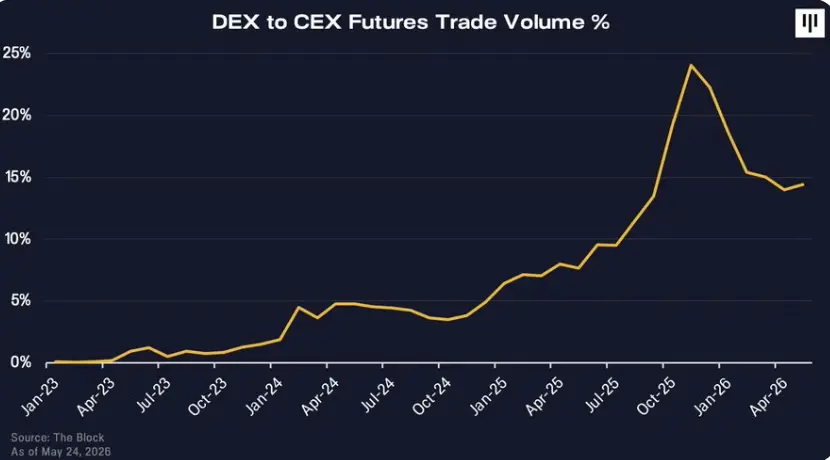
Hyperliquid has elevated DEX perpetual contracts to a new level, significantly increasing the market share of on-chain perpetual contracts. The trading volume of DEX perpetual contracts has reached 14% of CEX perpetual contract trading volume, while at the beginning of 2023 when Hyperliquid first launched, this figure was less than 1%.
The Rise of Hyperliquid
Hyperliquid is the largest decentralized perpetual contract exchange, accounting for about 40% of the trading volume for on-chain perpetual contracts. It was conceived by Jeff Yan, an alumnus of Harvard's Math 55 course and a former high-frequency trader who ran a low-profile market-making firm called Chameleon Trading for several years.
The collapse of FTX was the catalyst for building Hyperliquid. Yan redirected his trading team's focus to create a decentralized alternative to replace the centralized exchanges that had just failed their users, all while realizing that existing blockchains were too slow for professional on-chain trading.
The team built its own Layer 1 blockchain designed specifically for trading, which was globally launched at the end of February 2023. One change included the addition of a speed bump-like feature to prevent the most aggressive high-frequency trading firms from exploiting market makers, sacrificing short-term trading volume for healthier growth.
To address the cold start problem faced by all exchanges, the team guided liquidity by opening their proprietary trading algorithms, allowing anyone to participate through an on-chain treasury called HLP (Hyperliquidity Provider).
Providing this high-performance strategy to the public for free brought the added benefit of winning community favor, and community members became consistent advocates, further driving the growth of Hyperliquid.
Due to concerns about regulatory uncertainty regarding decentralized finance and perpetual contracts in the U.S., they also moved to Singapore in the spring of 2024. This move is one of many significant losses suffered by the U.S. due to its previous regulatory stance, which is now being corrected.
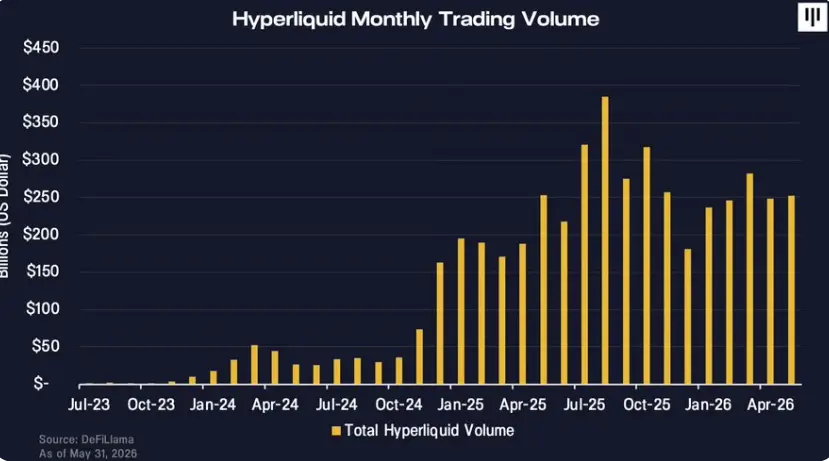
With a core team of high talent density, stakeholder consistency representing the best ideals of cryptocurrency, and incredible execution capacity, Hyperliquid has surpassed its competitors to become the largest and most profitable decentralized perpetual contract exchange, with monthly trading volume exceeding $250 billion and annualized revenue reaching $800 million.
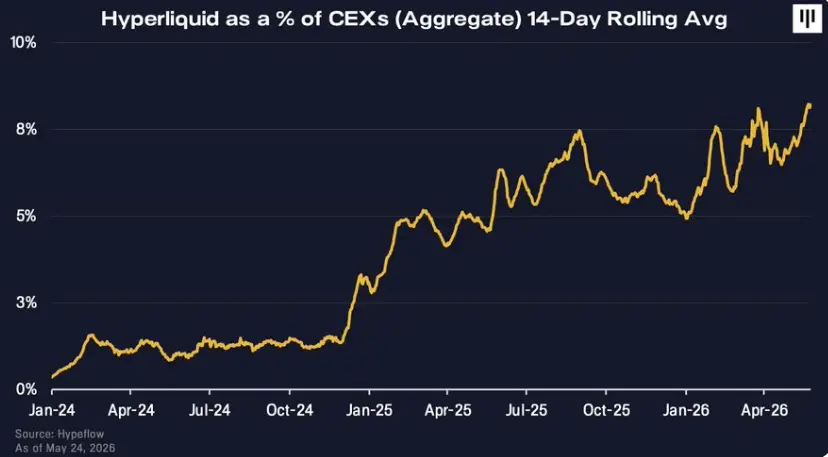
Hyperliquid's trading volume has continued to grow, and over time, its share of trading volume relative to centralized exchanges is also increasing.
From Digital Assets to "All Financials Included"
As Hyperliquid expands beyond crypto-native assets into stocks, commodities, indices, and private companies, its growth has accelerated this year. Jeff Yan describes this vision as encompassing "all financials" on a single platform.
Hyperliquid possesses two blockchain-native attributes that help it successfully expand its vision to traditional assets typically traded on traditional exchanges. First, as a decentralized exchange, Hyperliquid is automatically open 24/7, including weekends and holidays. In contrast, traditional exchanges like the New York Stock Exchange (NYSE) or the Chicago Mercantile Exchange (CME) are only open for five business days each week.
The second attribute is that Hyperliquid is permissionless, meaning any third party can quickly list the assets people most want to trade. The listing market is not limited to the initial imagination of Hyperliquid's core team.
Permissionless listing is unlocked by Hyperliquid Improvement Proposal 3 (HIP-3), which allows any third party to list new perpetual contract markets without permission and incentivizes them with a portion of the trading fees. An independent group operating under the brand trade.xyz is the most active deployer.
Thus, Hyperliquid's platform can quickly adapt and attract trading volume on any currently hottest assets, even when traditional markets are closed, resulting in remarkable outcomes. On-chain perpetual contracts are becoming a parallel, always-online derivatives platform that begins to meaningfully compete with traditional infrastructure.
The most obvious evidence appears during pressure moments outside traditional trading hours. When gold and silver prices took off at the end of 2025, Hyperliquid was the only platform trading these assets over the weekend, including the moment China announced changes to the collateral requirements for silver trading. Silver briefly reached 2% of global derivatives trading volume at its peak.
When the Iran conflict began on a Saturday morning at the end of February, Hyperliquid was the only platform for trading oil that weekend, with daily crude oil trading volume surging (noted by the editor: the original text has missing numbers here).
When oil futures opened on Sunday evening, the opening price was precisely the price at which oil perpetual contracts had already been traded on Hyperliquid. Oil trading peaked at 2% of global oil derivatives trading volume.
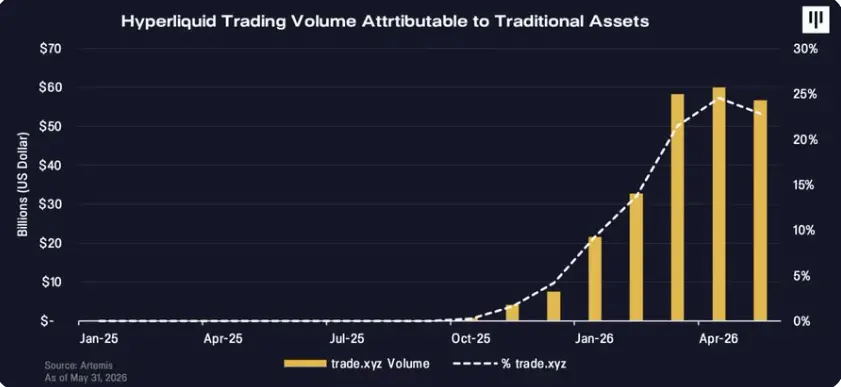
A month later, a fully licensed S&P 500 index perpetual contract surpassed $100 million in trading volume on its first day. Traditional assets sometimes accounted for up to 40% of trading volume on Hyperliquid, a number that was essentially zero at the end of 2025.
Mainstream Attention Emerges
The appeal of Hyperliquid has gained mainstream attention this year. We are hearing an increasing number of traditional asset hedge funds referencing Hyperliquid prices and even considering trading on the platform to respond more timely to global events.
Hyperliquid is becoming a trading venue for price discovery when all other markets are closed. This not only means over the weekends, but increasingly applies to private companies ahead of IPOs.
On the day of Cerebras's IPO (the largest IPO to date this year), the banks underwriting the IPO were monitoring prices on Hyperliquid. A circulated photo showed a banker’s screen displaying Hyperliquid's trading interface before the opening.
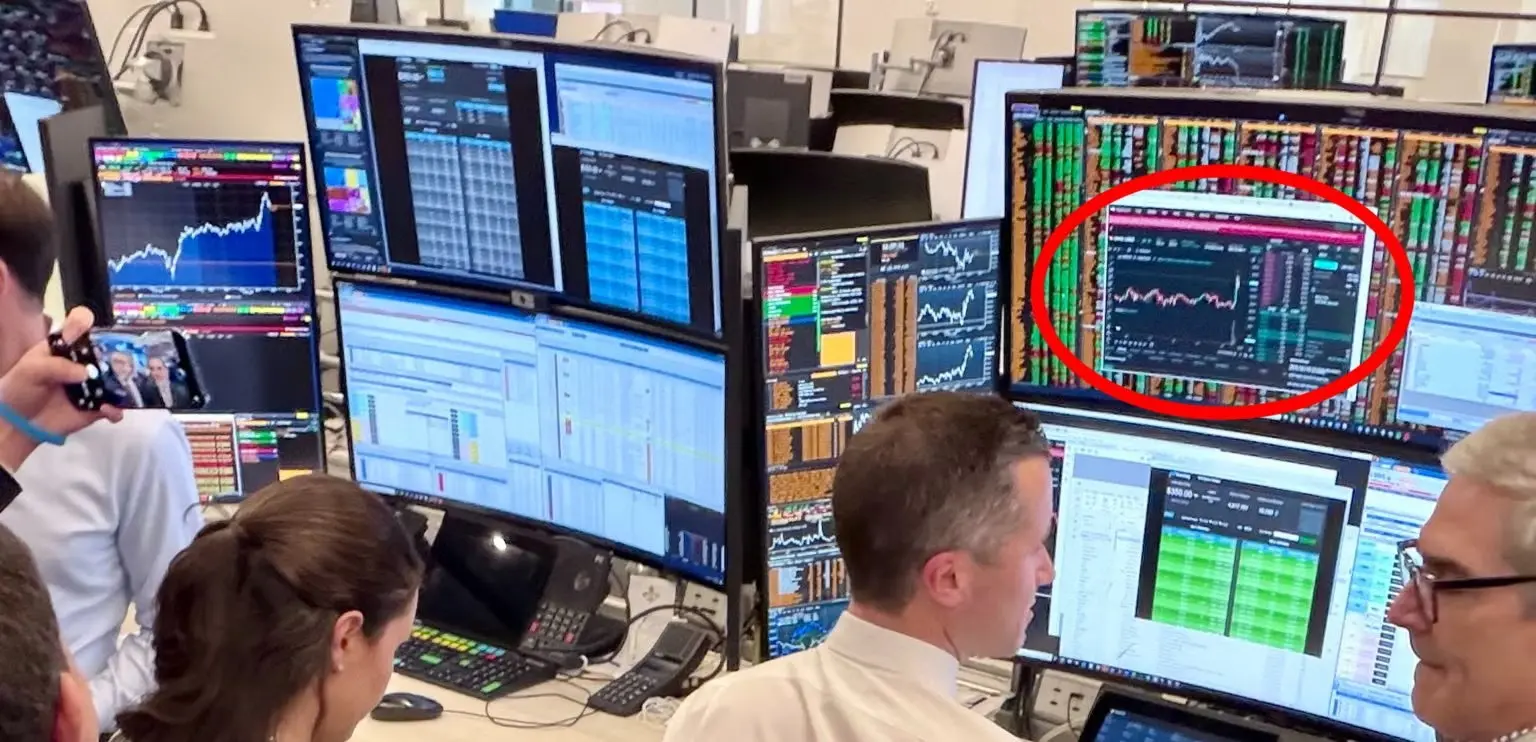
Traditional exchanges on Wall Street are also taking notice. On May 27, at Bernstein's strategic decision-making meeting, Intercontinental Exchange (ICE) founder and CEO Jeffrey Sprecher called Hyperliquid "bigger than Nasdaq," noting that ICE has met with its founders several times.
Just two weeks ago, reports emerged that ICE and CME pressured regulators to restrict Hyperliquid, suggesting that they view it as a genuine competitive threat. The significance lies in the fact that one of the world's major exchange operators is now publicly acknowledging Hyperliquid as a serious competitive challenge rather than a fringe experiment.
The public equity market has also shown interest. Hyperliquid Strategies Inc. (NASDAQ: PURR) is dedicated to Hyperliquid's digital asset treasury ("DAT"), with Pantera as its cornerstone investor. The company holds HYPE on its balance sheet, chaired by former Barclays CEO Bob Diamond and led by CEO David Shamis.
Both have directly pushed the case for HYPE into mainstream U.S. financial media, including CNBC's Squawk Box and Bloomberg, bringing traditional financial pedigree and credibility to this crypto-native asset, thus increasing its visibility.
As of June 1, 2026, PURR's trading price has risen over 200% year-to-date and is one of the few DATs that continues to trade at a premium to net asset value, indicating strong demand.
The next catalyst to watch is the IPO of SpaceX, reportedly scheduled for later this month. There is a SpaceX perpetual contract on Hyperliquid, providing traders a way to express pricing expectations for the company before its public equity investors in Nasdaq.
As of June 1, 2026, SpaceX is currently trading on Hyperliquid at approximately $200 per share, higher than the level rumored that bankers hope to price the stock.
Every market participant is watching this IPO, and it is reasonable to expect that Elon Musk, the well-known "heavy internet user" and crypto-supporting CEO of SpaceX, may prompt bankers and potential investors to consider the trading situation of SpaceX on Hyperliquid, significantly enhancing the platform's visibility.
How Far Can This Develop
Hyperliquid is an on-chain protocol with a capital structure based on tokens. HYPE is the native token, and Hyperliquid's protocol economics accumulate value through it, most notably through a programmatic buyback mechanism that utilizes 99% of platform revenue, a capital allocation strategy similar to many stocks with fundamental value.
Hyperliquid's investment case is based on several pillars:
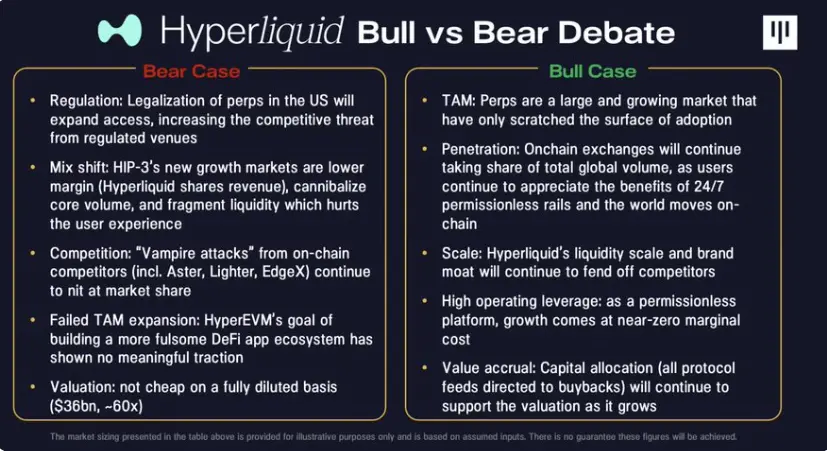
A large and continuously growing target market: Hyperliquid is a disruptive platform targeting an attractive and ever-expanding terminal market. Perpetual contracts are an innovative product that better serve a large number of investors compared to traditional derivatives, historically monetizing through extremely attractive trading fees. As Hyperliquid expands from the crypto-native market toward its goal of "housing all finance," its total available market multiplies.
Strong execution and scale flywheel: The protocol expands quicker and more successfully than previous decentralized perpetual exchanges, capturing a massive market share. In this market, scale creates a flywheel advantage: higher trading volume drives order book liquidity, which continuously improves user experience and attracts more capital.
Exceptional product experience: Hyperliquid delivers a high-quality user experience by operating on a custom Layer 1 blockchain built specifically for derivatives trading. User feedback consistently emphasizes that the platform far exceeds other decentralized exchanges and directly competes with major centralized exchanges in speed and user experience.
Direct and robust value accumulation for token holders: Crucially, these strong fundamentals directly translate into the protocol's profitability and token value. Hyperliquid generates $800 million in annualized revenue, almost all of which is invested back into its programmatic token buyback mechanism. This creates an exceptionally tight consistency between protocol growth and token holder value.
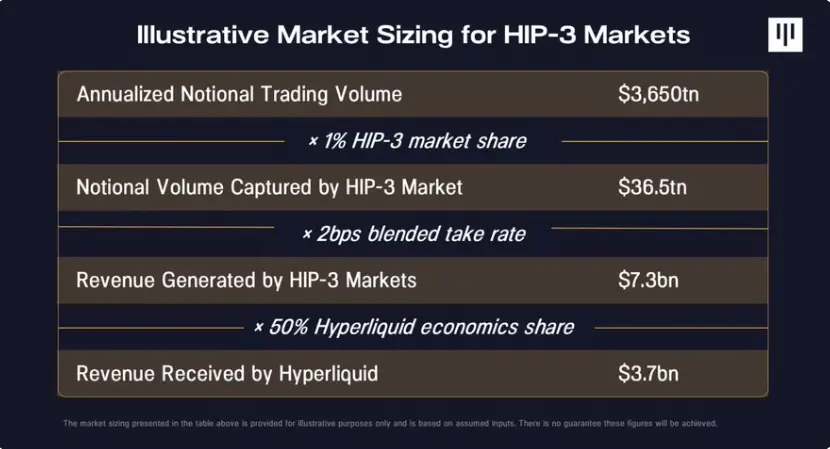
Looking globally, Hyperliquid's total available market (TAM) is approximately $100 trillion in nominal daily trading volume. Currently, investors use simple high-leverage directional exposure tools, with the daily trading volume of 0DTE options and leveraged ETFs around $200 billion.
Commodity derivatives have a daily trading volume of $2 trillion, while Hyperliquid has proven it can make progress, especially over holidays and weekends. Forex derivatives see a daily trading volume of about $8 trillion and remain nearly completely undeveloped on-chain, presenting a massive blue ocean opportunity.
As long as a sustainable capture of a very small single-digit percentage of this comprehensive trading volume occurs, the potential revenue would be five times what it is today, with a similar expansion potential for valuations.
That said, Hyperliquid also faces real risks, making it essential to acknowledge this. The biggest risk facing Hyperliquid is regulatory. Currently, perpetual contracts cannot be freely traded in the U.S., although there is a trend toward legalizing and listing them.
Hyperliquid is a decentralized exchange, meaning it has no KYC requirements. While it has geographical restrictions for U.S. users, it is not impossible to assume methods of bypassing them.
If perpetual contracts become legalized in the U.S., Hyperliquid will face a more severe competitive landscape and may lose trading volume shares as U.S. users shift to regulated platforms. One mitigation measure is that Hyperliquid may also launch a regulated exchange version in the U.S., like other platforms.
Opening the Door for Regulatory Developments
The greatest single constraint on the growth of perpetual contracts in the U.S. has always been regulation; this uncertainty pushed Hyperliquid's team toward offshore Singapore. Americans cannot access true perpetual futures, as both centralized and decentralized platforms have geographic restrictions for U.S. users.
This situation began to change last week. The CFTC approved a blockchain-based perpetual futures contract submitted by Kalshi, a U.S.-registered exchange, and it has also paved the way for Coinbase to provide certain crypto perpetual contracts via a foreign affiliate, treating them as foreign futures.
The main point is that the CFTC has opened a path for regulated crypto perpetual contracts under the existing futures framework rather than requiring the creation of entirely new rules.
Some policy advocates believe that the past absence of perpetual contracts in the U.S. was less of a well-thought-out regulatory choice and more of a business accident concerning which products existing companies choose to list, and there has never been a fundamental reason indicating that the CFTC cannot approve them. If and when exchanges apply to list more perpetual contracts, the CFTC now simply needs to act to clarify this.
The more complex question is what conditions are needed to bring decentralized perpetual contracts to U.S. users, and the pathway here remains unclear. A centralized participant can register as a U.S. exchange today, and we've already seen other companies like Coinbase and Kalshi seeking to list true perpetual contracts.
For a permissionless on-chain protocol, the Commission needs to expand exemptions to include waivers from requirements that derivatives must trade on registered exchanges and waivers regarding who can access certain contracts.
The U.S. Securities and Exchange Commission (SEC) and CFTC hold supportive positions on innovation and have previously issued statements endorsing the view that "nothing in the core stack of chain protocols needs to be registered." However, balancing permissionlessness and KYC exemption with reasonable concerns about sanctions and market integrity will require some effort to resolve.
Perpetual contracts began in the margins of cryptocurrency, where market structure evolved the fastest. They are now moving to the center of global finance. Recent actions by the CFTC do not resolve all regulatory issues, particularly for permissionless on-chain platforms, but they do mark an important shift.
The U.S. is beginning to embrace this product rather than rejecting it. Hyperliquid is at the center of this transformation. It combines the best properties of DeFi (open access, round-the-clock markets, transparent settlements, and high stakeholder alignment) with a product that increasingly appears better suited for modern trading than its competing tools.
The question is no longer whether perpetual contracts are important outside of cryptocurrency; the market has answered this question.
The question is whether the infrastructure that the blockchain industry first built can become a place for more and more areas of finance to price risk, trade, and discover prices.
免责声明:本文章仅代表作者个人观点,不代表本平台的立场和观点。本文章仅供信息分享,不构成对任何人的任何投资建议。用户与作者之间的任何争议,与本平台无关。如网页中刊载的文章或图片涉及侵权,请提供相关的权利证明和身份证明发送邮件到support@aicoin.com,本平台相关工作人员将会进行核查。


