On July 20, Andy Liu, the head and chief analyst of HTX Research, participated in the fifth session of Huobi's expert lecture series, discussing "Q3 2026 Outlook: A New Order in the Crypto Market Under Global Liquidity Repricing." He provided analysis on global liquidity repricing, changes in the crypto market structure, core asset dynamics, and future investment opportunities.
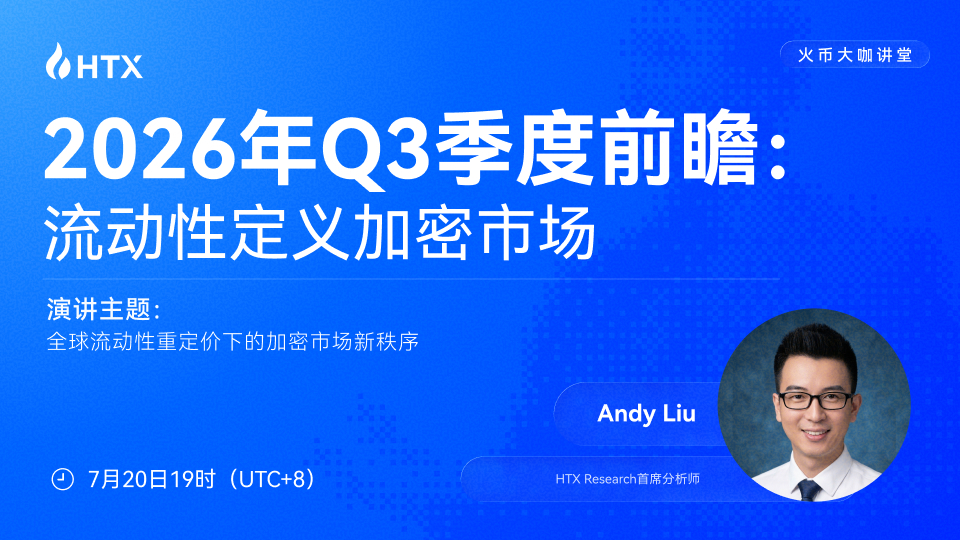
As a guest speaker for this session, Andy Liu has been deeply engaged in the crypto industry for a long time, possessing a composite background in investment management, institutional services, on-chain data analysis, and industry research. Currently, he is responsible for building the overall research system of HTX Research, covering various dimensions, including macro market interconnections, industry trends, and CEX asset strategy research.
Q2 Market Adjustment: Repricing Under Changing Global Capital Costs
Reflecting on the market performance in Q2 of 2026, Andy stated that the price of Bitcoin fell from a high of around $82,000 in mid-May to a phase low near $59,000 in June, with a maximum drawdown of nearly 24%. However, this does not mark "the end of the crypto industry cycle," but rather a concentrated repricing under the contraction of global dollar liquidity.
For the crypto market in Q3, Andy put forth three core judgments:
- Liquidity is more important than geopolitics: Short-term events may affect market sentiment, but what truly determines the trend are energy prices, inflation, Federal Reserve policies, and the dollar's trajectory.
- Cash flow is more important than narrative: The market no longer pays for grand narratives and piled-up TVL; protocols must have real revenue, value destruction, and value capture mechanisms.
- Infrastructure is more important than price: Price corrections have not hindered infrastructure expansion. RWA, stablecoins, on-chain securities, AI Agent payments, and institutional compliance channels are still advancing. The long-term direction of crypto is shifting from a native asset trading market to a part of global financial infrastructure.
Comprehensive Analysis of Hot Assets: Where is Institutional Capital Flowing?
In analyzing the performance of core crypto assets that the market is focused on, Andy Liu combined the liquidity environment, institutional capital allocation, and asset value capture capabilities to analyze key sectors such as BTC, ETH, DeFi, and RWA one by one.
BTC (overweight) has become a global liquidity proxy variable: BTC is no longer just a crypto-native asset but a core expression tool for global liquidity. The key variable in Q3 relies on whether spot ETF capital flows return to normal and the direction of the Federal Reserve's policy and the Treasury's bond issuance rhythm. BTC remains the primary entry point for institutional allocations, displaying strong defensiveness and elasticity.
ETH (neutral/tactically long) faces value capture challenges: Layer 2 has improved network efficiency but weakened mainnet fee income. The current pain point for ETH is that ecological growth has not effectively supplemented token value. In Q3, the valuation recovery of ETH needs to closely watch three catalysts: a rebound in L1 fees and destruction volume, net inflows of ETF capital, and favorable stimulus from regulatory implementation. DeFi (selective overweight on leaders) is entering a cash flow era: The era of looking solely at TVL (Total Value Locked) valuations is over. "High-quality DeFi," with real income return mechanisms, strong risk isolation capabilities, and deep integration with compliant capital, will welcome reevaluation.
RWA (continuously overweight) stands as a structural mainline across cycles: In a high-interest-rate environment, the tokenization of US debt and other RWA assets provides a natural yield outlet for on-chain funds. Its growth does not depend on bullish market sentiment but is based on real institutional compliance allocation demand, making it one of the most certain sectors currently.
Long-tail Altcoins (underweight): Against the backdrop of insufficient stablecoin expansion, significant unlocking pressures, and limited liquidity, long-tail altcoins lack a fundamental basis for a breakout.
In summary, Andy stated that the Crypto market in Q3 will not be driven by a single narrative but will be jointly determined by two main lines: whether global liquidity marginally improves and whether regulatory certainty is sufficient to reopen institutional risk budgets.
Regulation Shifts from Risk Discount to Market Catalyst
Regarding regulatory trends, Andy believes that, in the past few years, regulation has been viewed more as a risk factor by the market, affecting asset valuations through risk discounting. However, as the industry matures, regulatory certainty is becoming a new market catalyst.
He emphasized that the market is not concerned that "the more lenient the regulation, the better," but whether the rules are clear. "The clearer the rules, the easier it is for institutions to judge which assets and business can enter their balance sheets."
In the Q3 market outlook, Andy believes that regulatory progress holds greater importance for assets like Ethereum, DeFi, stablecoins, and RWA. Compared to Bitcoin, which already has ETF and mature institutional entry points, these areas may have greater potential for regulatory improvement in the future.
At the end of the live broadcast, Andy concluded with a statement: "The Q3 market will not reward all risks; it will only reward risks supported by liquidity, with real cash flow and a clear regulatory path."
Direct Insights into Hot Q&A: ETFs, Four-Year Cycle Theory, and "Altcoin Predicament"
During the interactive segment of the live broadcast, Andy provided in-depth answers to several market phenomena that the audience was most concerned about:
- On "Success or Failure is Dependent on ETF": In response to Bitcoin's recent significant volatility caused by ETF capital outflows, Andy believes that ETFs are not the sole determining factor for market trends but rather "amplifiers." The addition of ETFs has amplified Bitcoin's sensitivity to macro liquidity, allowing traditional institutions to quickly adjust positions. The real driving force of the market remains the improvement of global liquidity. Moreover, the inflow of ETF capital does not mean blind bullishness; it includes a large amount of basis trading and hedging actions.
- On whether the "Four-Year Cycle Theory" has Lost Its Validity: Andy believes that the "halving cycle" occurring once every four years has not lost its efficacy, but it has shifted from an "iron law" to a "reference for supply rhythm." Now that Bitcoin's supply is substantial and deeply integrated into the global asset allocation system, a super bull market will only erupt when "the supply contraction of the halving cycle" resonates with "the liquidity cycle of dollar expansion."
- Uncovering the Truth behind "Altcoin Liquidity Drain": Why has the market capitalization of stablecoins recently reached new highs, while the vast majority of altcoins continue to decline? Andy pointed out four reasons: Firstly, institutional funds are entering BTC through ETFs and are no longer flowing down to altcoins as they did in the past; secondly, the use cases for stablecoins have greatly expanded (e.g., cross-border payments, RWA), and the increased issuance of stablecoins does not equate to "lining up to buy altcoins"; thirdly, the supply volume of altcoins is high, facing huge unlocking pressures and early investor exits; finally, the market has become immune to "narrative coins" that do not capture real value.
The Huobi Expert Lecture Series is a long-term educational program created by the Huobi Growth Academy, aimed at inviting top scholars, industry leaders, and experienced practitioners worldwide to engage in in-depth discussions on cutting-edge fields such as the crypto industry, artificial intelligence, and Web3, helping users understand the underlying logic behind market trends and establish independent thinking frameworks.
免责声明:本文章仅代表作者个人观点,不代表本平台的立场和观点。本文章仅供信息分享,不构成对任何人的任何投资建议。用户与作者之间的任何争议,与本平台无关。如网页中刊载的文章或图片涉及侵权,请提供相关的权利证明和身份证明发送邮件到support@aicoin.com,本平台相关工作人员将会进行核查。


