"Is L2 eating away at the value of L1?" "Is Ethereum losing its global composability?" This kind of anxiety filled the entire Ethereum community during the two most popular years of L2.
At that time, in the Ethereum scaling framework, L1 was a stable but expensive settlement layer, while L2, as a cheap and efficient execution layer, indeed allowed Ethereum to gain more block space, but gradually lost the complete experience of being "one chain".
Therefore, over the past two years, these questions have driven Ethereum to re-examine the relationship between L1 and L2.
On one hand, Ethereum L1 continued to raise the Gas Limit, promoted statelessness, and zkEVM verification, no longer satisfied with just being a low-throughput settlement foundation; on the other hand, discussions in the community became increasingly intense. Earlier this year, Vitalik bluntly stated that with the enhancement of Ethereum mainnet's own scaling capabilities, some of the premises established five years ago in the roadmap regarding L2 as the primary means of scaling have changed (see further reading in "Understanding Vitalik’s Reflection on L2: Goodbye Fragmentation, Transitioning to Native Rollups").
Recently, Ethereum researcher Barnabé Monnot even stated that it is necessary to re-examine the long-term relationship between L1 and L2, including how L2 should create value in the future, why finality needs to be significantly shortened, and whether L1 could also become a kind of "self Rollup" as proof systems gradually enter the mainnet verification process.
Although these views do not yet equate to a confirmed protocol roadmap, they provide a very valuable observational angle.
Ultimately, the issues Ethereum faces today are no longer just about how to continue increasing block space, but rather how to re-divide the roles between L1, L2, the execution layer, and the settlement layer when transactions, assets, and user states are dispersed across an increasing number of execution environments.
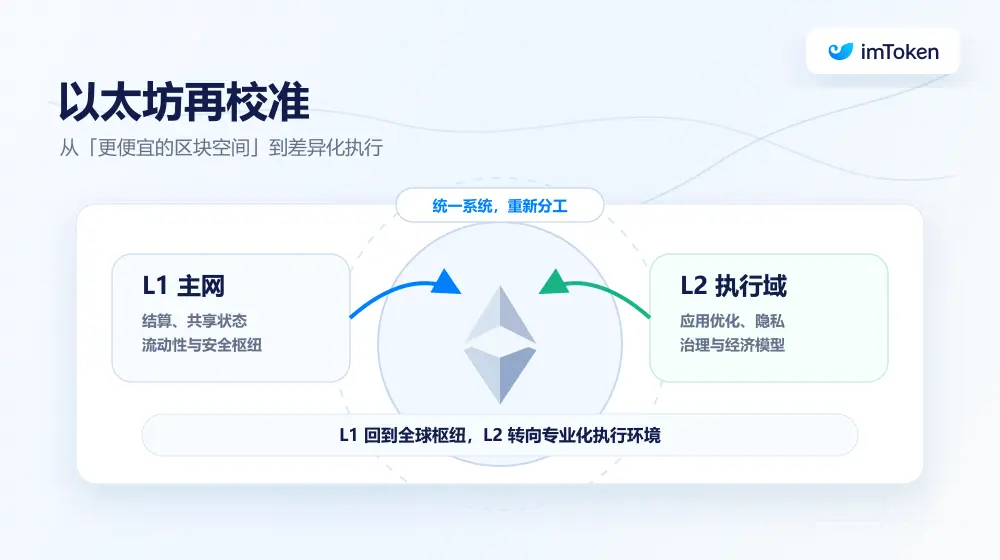
1. Ethereum has not "abandoned" L2, but must find a new position
To be realistic, when the Ethereum scaling route centered around Rollups was formed, L2's most important task was relatively singular: to provide Ethereum with more and cheaper transaction space.
Given the technological conditions at that time, this division of labor was very reasonable.
Since Ethereum validators need to re-execute L1 transactions and the mainnet’s throughput cannot be drastically increased in the short term, Rollups can execute transactions off-chain in bulk, submitting only compressed data or state proofs back to the mainnet, significantly reducing the unit transaction cost while retaining certain Ethereum security attributes.
Thus, scaling gradually formed two parallel paths, with L1 remaining restrained, prioritizing decentralization and security, while L2 took on new transactions, continuously reducing costs through Blob, data compression, and proof technologies.
However, now the premise of this division of labor has changed.
The Ethereum Foundation, in 2026, re-integrated protocol work, merging the relatively independent "Scaled L1" and "Scaled Blob" into a unified Scale roadmap, where raising the Gas Limit, expanding data availability, optimizing execution clients, promoting statelessness, and zkEVM attester clients were all incorporated into the same scaling framework.
In other words, Ethereum no longer views the scaling of L1 and L2 as two separate tasks but has started to reallocate execution, consensus, and data capacity from the perspective of the entire system.
This change does not mean that Ethereum is preparing to abandon L2 or pull all activities back to the mainnet. On the contrary, it means that L2 will find it difficult to prove its long-term value solely based on "faster transactions and lower gas fees."
After all, if L1 itself can enhance execution capacity by several orders of magnitude while maintaining security and decentralization, then normal EVM execution and low-cost block space are no longer unique to L2; what L2 needs to provide will more shift towards differentiated needs that L1 is difficult to satisfy uniformly, such as specific application optimization, privacy features, and more flexible governance and economic models.
The Ethereum Foundation, in its latest clarification of the relationship between L1 and L2 this year, also emphasized this point. In the past, L2's primary goal was to expand Ethereum, with differentiation and customization being secondary values; now it is to provide differentiated functions while continuing to contribute additional expansion capabilities.
Correspondingly, L1 needs to become a sufficiently powerful, permissionless, and highly resilient global hub, carrying settlement, shared state, liquidity, and DeFi.
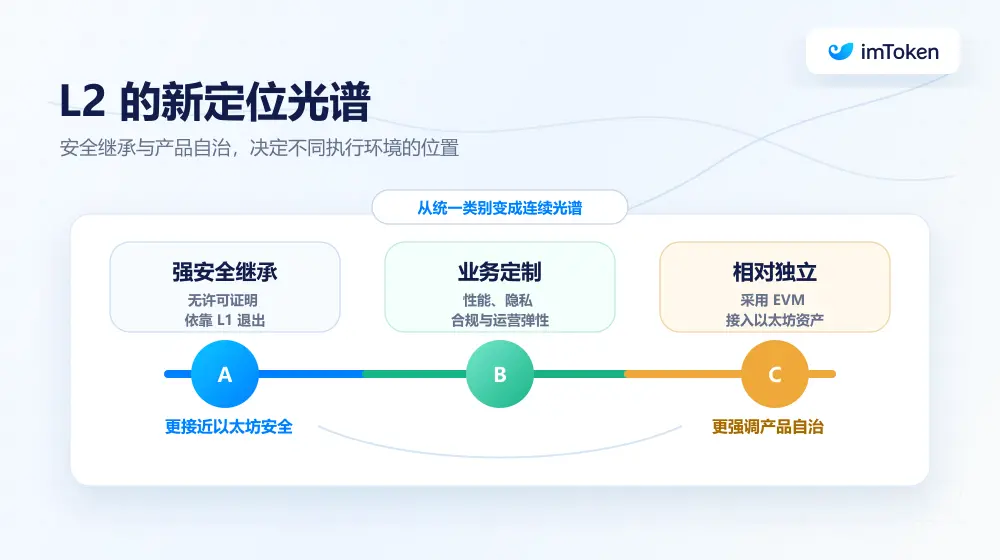
This actually pushes L2 from a unified technical category towards a more complex continuous spectrum:
- At one end of the spectrum are Rollups that strive to inherit as much of Ethereum’s security properties as possible, aiming to reduce multi-signature security councils, open non-permissioned proof mechanisms, and ensure that even if operators stop running, users can still rely on L1 to exit;
- In the middle position, there are execution environments that inherit some Ethereum properties based on business needs, which may have stronger management permissions, independent orderers, or specific compliance designs in exchange for performance, privacy, and operational flexibility;
- At the other end, there are chains that may simply utilize the EVM, use Ethereum assets, or access some cross-chain facilities but are relatively independent regarding security and settlement;
This is also why it is said that Ethereum is not abandoning L2, but rather re-clarifying the division of labor. Ultimately, in the past 3-5 years, L2 primarily represented a scaling technology, but in the future, it is more likely to represent a set of execution environments that establish different security, settlement, and liquidity relationships with Ethereum.
2. Interoperability is not just cross-chain, but how states mutually trust
However, as Ethereum expands into a system composed of numerous L2s, another longstanding issue gradually surfaces: the increasing number of L2s will undoubtedly fragment liquidity, account states, and application experiences.
This has been vividly reflected in actual usage over the past few years. For instance, a user may hold assets on one chain, use an application on another chain, and need to go to a third chain to complete transactions, resulting in the same stablecoin having different versions across different networks, and the same account needing to handle different Gas Tokens, cross-chain bridges, and asset entrances.
Consequently, interoperability has begun to become an increasingly important part of the Ethereum roadmap.
The Ethereum protocol team has focused the 2026 Improve UX roadmap on two directions: native account abstraction and interoperability, believing that the core solution to L2 fragmentation lies in making Ethereum "feel like one chain again," with this vision relying on the maturity of intent architecture.
- Among them, the Open Intents Framework allows users to declare their desired outcomes, such as "convert a certain asset from chain A to USDC on chain B," with the underlying solver completing path calculations, fronting payments, executing, and rebalancing funds (see further reading in "When 'Intent' Becomes the Standard: How OIF Ends Cross-Chain Fragmentation and Returns Web3 to User Intuition?");
- The further Ethereum Interoperability Layer (EIL) attempts to build a trustless transport layer, aiming to make cross-L2 transactions have the same experience as single-chain transactions (see further reading in "Ethereum Interop Roadmap: How to Unlock the 'Last Mile' for Mass Adoption");
On the account side, the EIP-7702 in the Pectra upgrade has already allowed traditional EOAs to temporarily execute smart contract code, supporting transaction batching, Gas payment, and recovery mechanisms; subsequently, the native account abstraction scheme represented by EIP-8141 aims to further embed smart account logic into the protocol, gradually making smart contract wallets the default account form and reducing reliance on additional bundlers, relayers, and intermediary services.
L1 rapid confirmation rules attempt to provide a stronger confirmation signal within a few seconds to tens of seconds before full finality, which can shorten the application wait time in most normal scenarios. This will directly benefit all cross-chain applications that rely on L1 finality, which is significant for cross-chain bridges, stablecoin settlements, and RWA asset transactions.
Because the real bottleneck in many cross-chain interactions is not whether messages can be sent, but when the target chain can be sufficiently certain that the state on the source chain will not be reverted.
A commonly overlooked point is that having a transaction packed into a block does not mean it has achieved finality — from the user's perspective, the transaction might show success within seconds, but for bridges, exchanges, lending protocols, and cross-chain solvers, they still need to assess the possibility of block reorganization and whether they can subsequently release assets or execute the next operation on another chain.
This is also why many cross-chain services that seem close to "instant arrival" are not truly waiting for the source chain to complete final settlement but are upfront financed by solvers or liquidity providers; this mechanism optimizes user experience, but does not eliminate the underlying waiting time out of thin air.
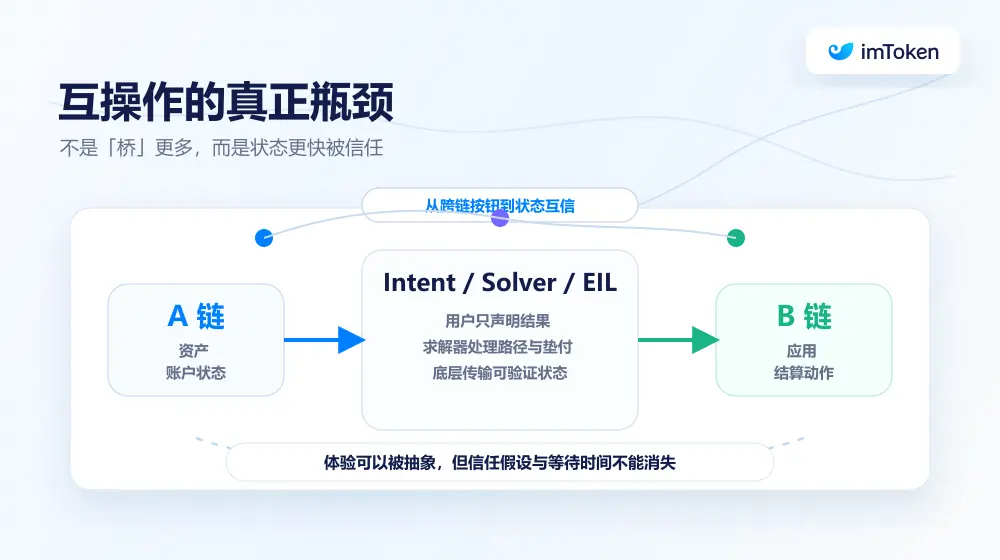
Therefore, Ethereum's long-term goal is to gradually shorten finality itself from minute-level to second-level. However, this is not a single upgrade scheduled for release; rather, it involves a series of phased research tasks, including decoupling finality voting from fork choice, optimizing validator sets, voting aggregation, and network dissemination, and then gradually changing consensus protocols.
Overall, a good interoperability experience, is not letting dozens of chains have the same cross-chain button, but enabling different execution environments to trust each other's states faster and at lower costs.
3. When L1 also becomes a Rollup, do layered boundaries still exist?
If the change in L2 positioning and the shortening of finality are still about readjusting the existing layered architecture, then another judgment mentioned by Barnabé further touches on the definitions of L1 and L2: As proof systems enter the Ethereum mainnet, L1 may ultimately also become some sort of "self Rollup."
This statement sounds somewhat counterintuitive.
After all, Rollups are typically understood as scaling networks built on top of L1, executing transactions externally and having L1 verify the state outcomes; how could Ethereum itself, being the underlying consensus and settlement network, become its own L2?
Understanding this viewpoint requires separating "Rollup" from hierarchical relationships. In today's Ethereum, when a node receives a block, it needs to re-execute all transactions within it, independently calculate state changes, and determine whether the block complies with protocol rules.
This mode ensures that nodes can self-verify, but also means that the overall execution capability of the network must be constrained by the hardware conditions of ordinary nodes. The larger the computational load in the block, the more hardware and time are needed for validators to complete execution.
In the future, as real-time proofs and L1 zkEVM gradually mature, transactions can still be computed by high-performance execution nodes, but ordinary validators may not need to re-execute every single transaction personally. For example, after execution nodes complete calculations and generate validity proofs, other validators only need to verify smaller and cheaper proofs to confirm whether the state transition is correct.
From the perspective of execution and verification relationships, this indeed has similarities with Rollups, where some participants are responsible for high-performance execution, and execution results are compressed into cryptographic proofs, while a broader set of consensus participants do not repeat all calculations but verify proofs and confirm the final state.
Therefore, Barnabé's statement about "L1 becoming its own Rollup" is more appropriately seen as a summary of this verification model, rather than suggesting that the Ethereum mainnet will be placed on another underlying chain or "downgraded" to its own L2.
His key point is that as proofs gradually replace the redundant execution across all nodes, Rollups may no longer just be a hierarchical name existing above L1 but will become a more general execution and verification architecture.
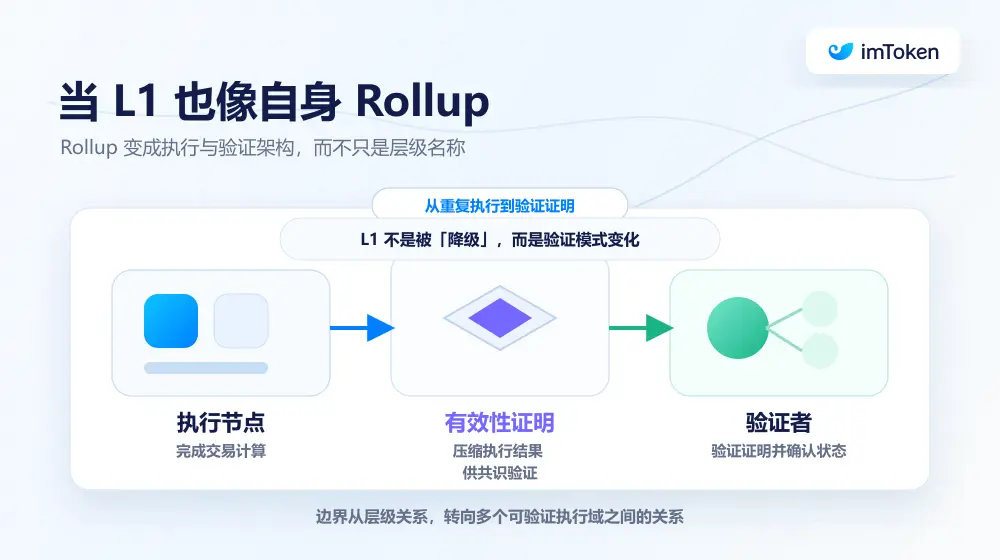
This will further blur the traditional boundaries between L1 and L2.
On one hand, L1 can leverage zkEVM proofs to expand its execution ability; on the other hand, Native Rollups aim to allow L2 to directly access the verification capabilities within the Ethereum protocol, enabling L1 to verify L2 state transitions in a more native and unified manner.
Today, different Rollups typically need to build their own proof systems, verification contracts, upgrade mechanisms, and security councils. Once a proof system fails, or a protocol needs emergency upgrades or operators become inactive, users often still need to rely on additional governance and trust structures; the long-term direction of Native Rollups seeks to transform some Rollup verification logic into Ethereum’s native capabilities, allowing L2 to reduce the need for self-established security structures and inherit L1’s state transition rules more completely, potentially freeing themselves from security councils.
If we take it a step further, when multiple L2s are able to rely on faster L1 confirmations, unified proof mechanisms, and synchronous composability to access each other's states, their relationship with the mainnet may no longer be connected by cross-chain bridges as it is today.
They may more resemble multiple execution domains under the same Ethereum consensus, some responsible for general financial activities, some oriented toward gaming, social, or payments, and some providing privacy or special compliance capabilities. They have different execution logics and product forms, yet jointly rely on a verifiable state, security foundation, and asset settlement system.
Of course, this remains a long-term direction.
But regardless of how these technologies eventually take shape, they have already shifted the boundary between L1 and L2 from a clearly defined architectural boundary to varying degrees of security inheritance relationships.
Final Thoughts
The world’s trend is that separation must lead to union, and union must lead to separation.
Ethereum once relied on shared states to gain global composability; later it split execution out through Rollups for greater capacity. Now, what it needs to accomplish is to reconnect the disassembled assets, accounts, and applications without undoing the scaling achievements.
For ordinary users, the ideal Ethereum should never be a network map consisting of dozens of chains, different Gas tokens, and cross-chain bridges. Where transactions are executed, where liquidity originates, and who ultimately settles can gradually be handled by wallets, applications, and underlying protocols, but the trust assumptions, security boundaries, and exit paths involved cannot be hidden along with the operational experience.
Thus, the endgame for L2 may neither be to replace L1 nor to be eliminated by an continuously expanding L1, but to become a group of execution environments with different functions and performances that can share security, liquidity, and state relationships.
In the past, Ethereum gained greater capacity by splitting execution.
In the next phase, let us see if it can still recompose an Ethereum after being disassembled.
免责声明:本文章仅代表作者个人观点,不代表本平台的立场和观点。本文章仅供信息分享,不构成对任何人的任何投资建议。用户与作者之间的任何争议,与本平台无关。如网页中刊载的文章或图片涉及侵权,请提供相关的权利证明和身份证明发送邮件到support@aicoin.com,本平台相关工作人员将会进行核查。


