Jack Mallers' multiple business goals during his term at Twenty One have completely failed, yet he received over $2.2 million in total compensation.
Written by: Protos
Translated by: Chopper, Foresight News
Jack Mallers claims he voluntarily resigned as CEO of Twenty One and did not receive severance pay. However, data shows that upon leaving, he received approximately $1.6 million in cash, bringing his total compensation to over $2.2 million. He also claims to have voluntarily waived his options.
Hours after resigning as CEO of the publicly listed company controlled by Tether, which focuses on Bitcoin reserve assets, Mallers issued a statement emphasizing that his departure was voluntary and repeatedly mentioning that he did not receive severance pay or his options, attempting to summarize the entire situation.
However, he deliberately avoided a key piece of information in his social media updates: a lucrative severance agreement worth seven figures, and cashing out several million dollars while the assets of ordinary shareholders significantly shrank.
The following will outline the various business goals that Mallers completely failed to achieve during his tenure at Twenty One. First, it is necessary to clarify the details of his high compensation, which he intentionally omitted from his social media posts.
Jack Mallers received over $2.2 million from Twenty One
According to the severance agreement, Twenty One paid Mallers a final salary of $50,000, which is clearly "too little" and does not meet the criteria for severance pay.
The company also paid $420,455 to cash out his vested restricted stock; simultaneously, it spent $1,151,046 in cash to repurchase 226,860 shares at $5.23 per share.
For Mallers, this cash exceeding $1.6 million was enough for him to "voluntarily" resign, yet he claims he did not receive any severance pay and waived his options.
The company also paid him stock benefits above the current market price, whereas these stocks are currently trading below $5.
The text of the agreement does not mention "severance pay," which is also the basis for Mallers' claim that he did not receive any severance compensation.
Although this seven-figure cash gain was not mentioned in his social media accounts, he indeed waived part of his entitlements:
The company canceled his unvested options and restricted stock; while he retained 1,522,407 vested options with an exercise price of $14.43. Currently, Twenty One's stock price is below $5, putting these options in a state of out-of-the-money.
This is also the part he refers to as "worthless." In fact, long before he claimed to "waive" them, these options had already lost their exercise value.
Profit goals completely failed
Twenty One went public in 2025 through a reverse merger with Cantor Equity Partners, a special purpose acquisition company affiliated with Cantor Fitzgerald and associated with the sons of U.S. Commerce Secretary Howard Lutnick.
Tether and Bitfinex provide Bitcoin assets and control voting rights; Jack Mallers serves as the public-facing brand ambassador.
Through his public influence and so-called "leadership," he garnered substantial compensation.
In 2025, his total compensation exceeded $667,898, and he was granted 12 million options. As the stock price fell below the exercise price of $14.43, most options ultimately became worthless.
Despite this, in 2025 he still recorded $667,898, including a bonus of $236,250 and consulting fees of $431,648, with funds distributed through entities under Twenty One. The company even paid $165,000 in legal fees for negotiating his personal labor contract.
Mallers had planned several business lines for Twenty One, but almost all announced failures or never officially took off.
In numerous interviews throughout 2025, the many business blueprints he described remained in the conceptual stage.
When asked what substantive achievements he had accomplished at Twenty One, he could only list fundraising, completing a listing, and achieving high valuations, without mentioning any profitable business at all.
Goals benchmarked against Coinbase turned to vapor
At the Bitcoin conference in April 2026, Mallers painted a vision: Twenty One would create a stable cash flow and achieve profitable operations.
He set a goal for Twenty One to match Coinbase's revenue scale, user base, and operating profit. He repeatedly refused to simply define the company as a passive Bitcoin reserve entity.
But reality proved that Mallers' expectations were severely detached from the truth. Twenty One consistently failed to generate the expected cash flow and had not implemented any profitable business. Ultimately, the company remained the version he vehemently denied: a publicly listed company with almost no net income, purely holding Bitcoin assets.
Earlier reports from Protos mentioned that Mallers quietly ceased disclosing the metric of "Bitcoin per share," which was originally a core standard for shareholders to evaluate his performance. The reason is simple: the per-share Bitcoin holdings had not increased.
Return to Strike, three-party merger plan declared bankrupt
The company's initial plan was to link three parties to create revenue: Twenty One, Mallers' payment company Strike, and the Bitcoin mining company Elektron.
On July 21, the official confirmation stated that Strike would remain independently operated and would no longer pursue a merger with Twenty One.
The merger plan, initially hoped to create operational earnings, collapsed before the terms were officially finalized.
Termination of the merger means that Mallers did not sell his holdings in Strike to Twenty One. No matter how high the private company's book valuation, he could not realize his earnings from it.
The board transferred management control of the company to Tether-aligned executive Raphael Zagury. Zagury operates Elektron and has served as a director of Twenty One since last December.
The company also adjusted its new strategy, focusing on "cash flow creation," indirectly admitting that significant cash flow was never established during Mallers' tenure.
Regulatory disclosure document 8-K shows that Mallers' departure "was not due to any disagreements with the company."
He had promised to lead Twenty One to achieve a user scale and operating profit comparable to Coinbase, but after about a year in office, he left quietly: all goals failed, personal total compensation exceeded $2.2 million, and the previous business narrative was completely shattered.
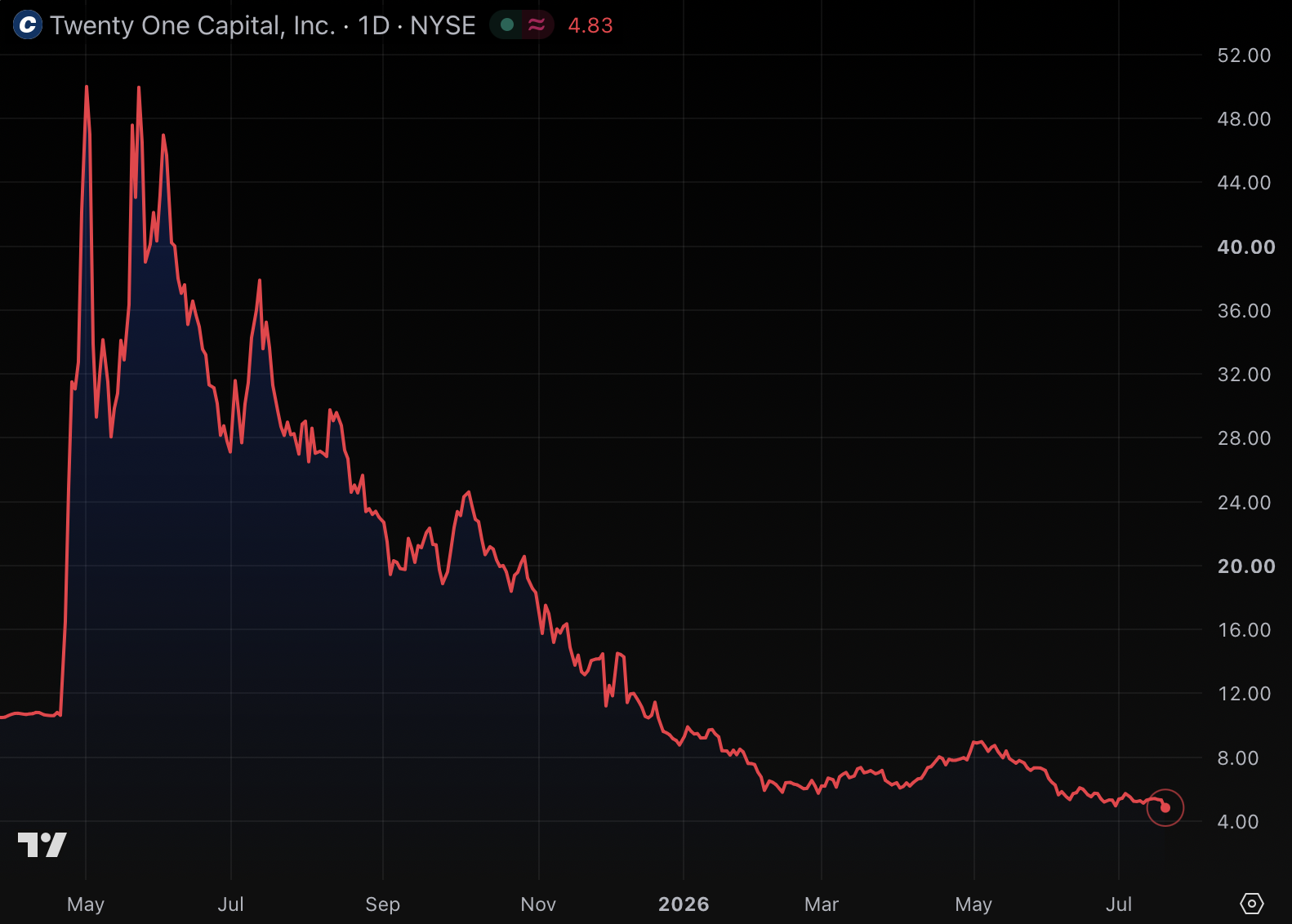
As of the time of publication, Twenty One's stock price has retraced 84% from its peak and has plummeted 91% from its 2025 highs.
What is more concerning is that on the day Mallers joined, the stock price peak was $17.83; now the stock price has dropped two-thirds from that point.
免责声明:本文章仅代表作者个人观点,不代表本平台的立场和观点。本文章仅供信息分享,不构成对任何人的任何投资建议。用户与作者之间的任何争议,与本平台无关。如网页中刊载的文章或图片涉及侵权,请提供相关的权利证明和身份证明发送邮件到support@aicoin.com,本平台相关工作人员将会进行核查。


