Geopolitical risk premium is becoming the new pricing core in the global energy market.
Author: Bu Shuqing, Wall Street Watch
The conflict between the U.S. and Iran continues to escalate, and the global energy market is repricing for a prolonged supply shock.
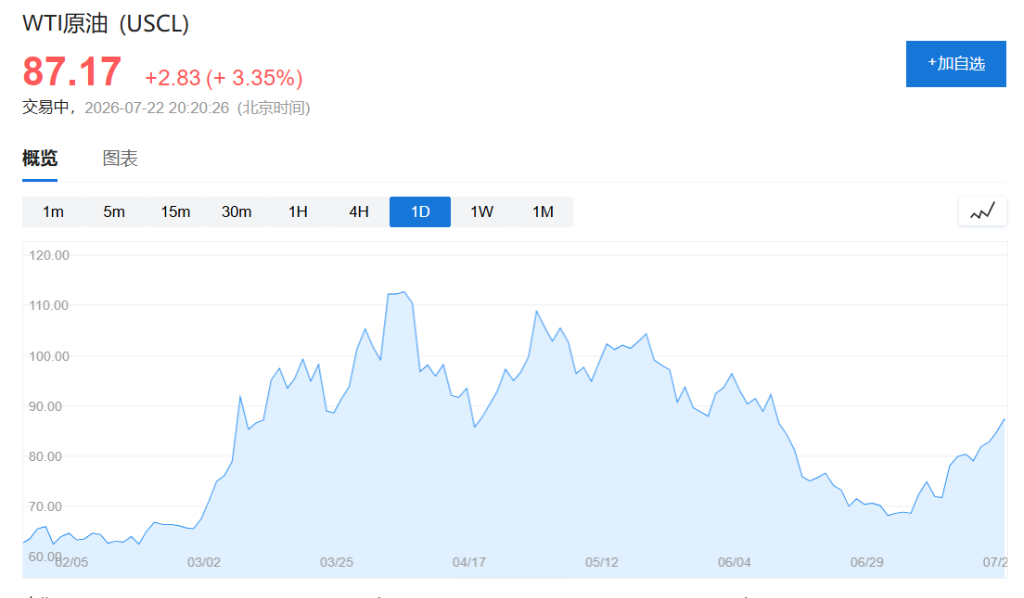
Brent crude oil surged past $95 per barrel during trading on Wednesday, reaching a six-week high with a daily increase of nearly 5%. At the same time, both the U.S. and Iran have clearly sent signals rejecting negotiations, causing market expectations for a short-term ceasefire to nearly drop to zero. The rise in oil prices is no longer solely driven by supply and demand logic; the geopolitical risk premium is becoming a structural anchor point in the pricing system.
According to CCTV News, on July 22 local time, U.S. President Trump stated on social media that from now on, if Iran fires on ships in the Strait of Hormuz, whether with missiles, rockets, drones, or other devices or weapons, the U.S. will bomb and destroy a bridge or power plant in Iran. Trump mentioned that relevant strike targets also include bridges and power plants located near or in Tehran, the capital of Iran.
CCTV earlier reported that on the evening of July 21 local time, the U.S. military stated that it has begun a new round of airstrikes against Iran, marking the 11th consecutive night of U.S. attacks on Iran. The strike range has now extended for the first time to military targets near the northwestern city of Tabriz, as well as strikes on Abadan and Jowar, close to the western border with Iraq.
The spokesperson for Iran’s Ministry of Interior clearly stated, "There are currently no negotiations, only possible information transfer," and Iranian MP Qashqavi also denied Trump’s claim that Iran is seeking negotiations. The spike in oil prices has transferred to the bond market, with U.S. 10-year and 30-year Treasury yields rising to about a two-month high, leading to an increase in market bets on Fed interest rate hikes.
Conflict Escalation, Increased Risk of Blocking the Strait of Hormuz
The U.S.-Iran military confrontation has entered its 11th consecutive night of exchanges, with the front lines continuing to expand.
This time, the U.S. military has extended its strike range to Tabriz, marking the first strike in the area since the conflict intensified two weeks ago, indicating that the geographical boundaries of U.S. bombing operations are pushing further into the Iranian hinterland.
The U.S. Central Command (CENTCOM) stated that this round of strikes targeted Iranian military command centers, naval combat capabilities, aircraft hangars, drone storage facilities, and military logistics infrastructure, aiming to further weaken Iran's ability to threaten commercial shipping in the Strait of Hormuz. CENTCOM also claimed that since early May, U.S. forces have assisted around 900 vessels, totaling 450 million barrels of crude oil, through the Strait of Hormuz.
However, Iranian Army Chief Amir Hatami clearly stated that Iran controls the Strait of Hormuz and will fire on U.S. forces. According to Kpler data, only three cargo ships passed through the Strait of Hormuz that day, indicating that the actual disruption to shipping is far greater than official statements. Meanwhile, Iran-backed Houthi forces announced that they have deployed forces near the southern end of the Red Sea near the Bab el Mandeb Strait, preparing to launch maritime attacks on ships attempting to dock at Saudi ports, posing a dual blockade risk for global shipping. The world's third-largest container shipping company, CMA CGM, announced that it will impose an emergency fuel surcharge starting August 1.
Diplomatic Stalemate, Substantial Closure of Negotiation Window
Diplomatic mediation efforts have not yielded any substantial progress. Iranian Interior Minister Eskandar Momeni visited Pakistan on Tuesday—one of the main mediators of this conflict—but after the visit, tensions did not ease. The Iranian side subsequently stated that the current situation is limited to "information transfer" and accused the U.S. of violating the temporary ceasefire agreement signed on June 17, claiming that the agreement "has essentially become worthless."
In response to reporters' questions, Trump downplayed the prospects for negotiations, stating, "They are eager to meet, but we have no interest until they are ready to meet in a meaningful way." He also hinted that U.S. forces might strike Iran’s suspected nuclear facility "Hercules Tooth Mountain" and reiterated that military operations would continue. U.S. Secretary of State Rubio on Wednesday accused Iran of failing to comply with the Strait of Hormuz agreement, stating that Iran's insistence on control over the Strait is a core obstacle to negotiations, but also asserted that the U.S. is "committed to diplomatic avenues."
The Iranian side warned that if the U.S. strikes its nuclear facilities or other sensitive infrastructure, it would respond with "strong retaliation," and stated that if U.S. forces set foot on Iranian territory, they will face "full resistance from millions of people."
Energy Prices Soar, Inflationary Pressures Resurge
The surge in oil prices is spreading to broader energy and financial markets.
Brent crude oil hit a high of $95.24 per barrel during the day, while WTI crude also rose to around $88.25 per barrel, with daily increases exceeding 4% for both. European refined fuel prices rose in tandem, with wholesale diesel prices rising significantly.
The natural gas market is also under pressure. The European benchmark natural gas price for the Dutch TTF front-month contract rose above €62 per megawatt-hour, higher than the previous day's level of less than €60. Goldman Sachs has raised its forecasts for TTF's third and fourth quarter to €60 and €53 per megawatt-hour, respectively, up from previous forecasts of €41 and €40, due to expectations that the recovery of liquefied natural gas exports from the Persian Gulf will be delayed until October 2026.
Rising inflation expectations are directly impacting the bond market. The yield on U.S. 10-year Treasuries rose to 4.63%, reaching about a two-month high; the real yield on 30-year bonds rose to 2.93%, the highest level since 2008. Market expectations for a Fed rate hike in July briefly rose to 26%. Gold prices surpassed $4,100 per ounce, while silver and copper prices also increased, with short-term inflation swap rates rising across the board.
免责声明:本文章仅代表作者个人观点,不代表本平台的立场和观点。本文章仅供信息分享,不构成对任何人的任何投资建议。用户与作者之间的任何争议,与本平台无关。如网页中刊载的文章或图片涉及侵权,请提供相关的权利证明和身份证明发送邮件到support@aicoin.com,本平台相关工作人员将会进行核查。


