Organized & Compiled: Deep Tide TechFlow
Guests: Josh Kale (AI Analyst, Anthropic Contractor), Ejaaz Ahamadeen (Co-host of Limitless Podcast)
Hosts: A conversation between Josh Kale & Ejaaz Ahamadeen
Podcast Source: Limitless Podcast
Original Title: Elon's $1 Billion Bet Reveals the Next AI Trade
Broadcast Date: July 22, 2026
Disclosure: Josh Kale is a contractor at Anthropic; his views in this episode are personal and do not represent Anthropic. Both individuals state that the content of this episode does not constitute investment advice.
Summary of Key Points
Musk spent about $1 billion of personal funds to quietly acquire a company called APR Energy. This company doesn't manufacture chips, rockets, or AI models; it does one thing: installs gas turbines on trailers, transports them to your data center campus, and connects them to power your GPUs in a matter of days. A person who has advocated solar energy for 20 years turned around and purchased fossil fuel power generation equipment, which itself illustrates the real bottleneck in the AI arms race.
This episode starts with this acquisition and unpacks two rotations happening: one is that memory stocks (DRAM, HBM, NAND) have seen a spike followed by a correction, yet underlying demand remains unchanged; the other is that funding is beginning to flow into power infrastructure. The two hosts mapped out the complete power technology stack from mobile gas turbines (APR Energy), solid oxide fuel cells (Bloom Energy), gas turbine + grid equipment (GE Vernova) to small modular nuclear power plants (Valor), believing that power is the next frontier for AI investments in the second half of 2026.
Highlights of Insights
On Musk's Acquisition Logic
"1 gigawatt of electricity is sufficient for 750,000 households, and is equivalent to the output of one nuclear reactor. This amount of power can run about 600,000 H100 level GPUs."
"We know about this deal because an investor in APR Energy had to disclose a personal return of $50 million. That's the only clue."
"He chose to buy with personal funds instead of putting it under xAI or Tesla, possibly due to tax and structural considerations."
On Power Bottlenecks
"Power demand for data centers in 2023 was about 23 gigawatts, and by 2026 it has doubled to 46.5 gigawatts. However, only 12 gigawatts were planned to be added this year, and only 5 gigawatts were actually completed."
"Connecting power to the grid requires high voltage transformers, grid infrastructure, various permits, and regulatory approvals. The entire process takes 5 to 7 years; I am not exaggerating."
"New York State has just banned a number of data centers, which will delay local data center construction by 5 years."
On the Correction of Memory Stocks
"In July, the average price of DRAM increased by nearly 20%, but memory stocks fell by 20%. Prices continue to rise while stocks are falling."
"SK Hynix has already signed contracts for the entirety of 2027's supply. 13 to 15 customers have locked in 40% of next year's expected profits. The demand is overwhelming."
"Micron fell 24% in one month, but the forward P/E ratio is only 7 times, with revenue growth of 350% and a gross margin of 85%. It is rare to see such high profit margins in hardware."
"Korean investors have over-leveraged about $1 billion, leading to the evaporation of $15 trillion in market value. The fundamentals are still there; this is just overselling."
On Power as the Next Trade Clue
"Electrons are more valuable than dollars. The only trend throughout human history has been: more energy equals more productivity equals more innovation equals more prosperity."
"This reminds me of how memory trading was before it became 'memory trading.' History does not repeat itself, but it does rhyme."
"GE Vernova is the TSMC of the power industry. Orders are booked until 2031."
"Microsoft signed a 20-year power supply agreement with Three Mile Island Nuclear Power Plant, taking 100% of the output. Locking in 20 years of electricity is much more imaginative than issuing a 20-year treasury bond at a 3% yield."
On the Model Independence of Energy Demand
"No matter whether your model is open-source or closed-source, expensive or cheap, cutting-edge or non-cutting-edge, you need energy and GPUs."
"China just released Kimi K3, an open-source model with 2.8 trillion parameters. 56% of token consumption on OpenRouter has already been spent on Chinese open-source models. But Jensen Huang is not worried because whoever makes the models has to buy his GPUs. The same goes for power."
Body
What Musk Spent $1 Billion On
Ejaaz: Musk just spent over $1 billion of personal funds to buy a company that nobody has heard of called APR Energy. The strangest thing about this company is that it doesn't make AI chips, rockets, or any AI models. What it does is gas turbines, installing them on trailers, taking them to data center campuses, and within days, powering your GPUs. A person who has spent 20 years talking about solar energy made this acquisition. When you break down why he bought it, it reveals a new trade clue in the AI sector and explains why memory stocks have been falling lately. The U.S. energy is abundant, but connecting this energy to the upcoming multi-billion dollar GPU clusters this year is an extremely challenging task.
Josh: APR Energy has an interesting history. It was founded in Jacksonville in 2004, went public on the London Stock Exchange in 2011, and acquired GE's energy leasing business in 2013, becoming the world's largest mobile gas turbine rental company. It has since traded between private equity firms. We found through regulatory filings that Musk spent about $1 billion to buy it. What does $1 billion buy? About 1 gigawatt of power. For reference, 1 gigawatt is enough to power 750,000 households and is equivalent to the output of one nuclear reactor. This power can run about 600,000 H100 level GPUs, which for now is the largest coherent cluster available.
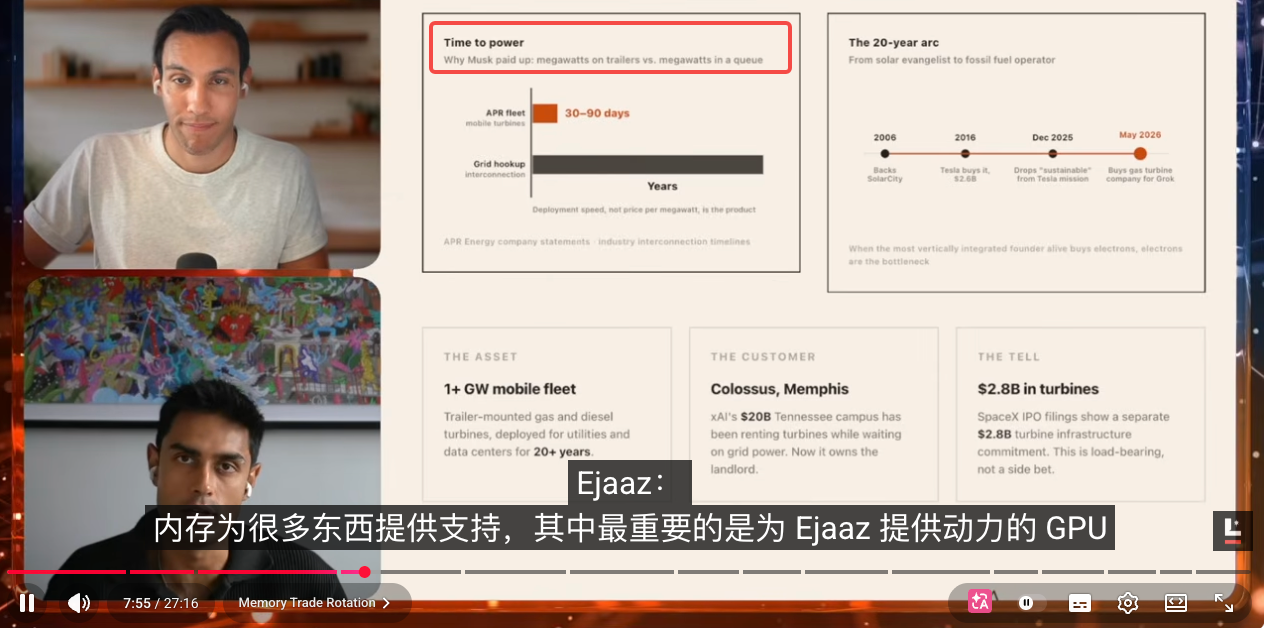
Ejaaz: My question is, why is this under Musk's name instead of xAI or Tesla?
Josh: I have a few guesses. One obvious possibility is that he wants this company to serve multiple entities, primarily Tesla. Tesla is supposed to be independent from xAI, although there have been rumors of a merger. So I believe it's more about tax and structural reasons. In fact, we know about this deal because an investor in APR Energy had to disclose a $50 million return. That's the only clue.
How Severe is the Power Bottleneck for AI
Josh: If we take a step back, everyone says energy and power are the next bottleneck for AI, but I think many people do not truly understand this issue. In 2023, power demand for data centers was about 23 gigawatts, which was already an astronomical figure, and we did not have enough supply to meet it. By 2026, this number has doubled to 46.5 gigawatts. But the problem is that this year we planned to add only 12 gigawatts of capacity, far below the target of 46.5. Worse yet, more than half the year has passed, and only 5 gigawatts have actually been completed. The bottleneck is extremely severe, and the speed of integrating energy into the grid is very slow.
Some may ask, isn't the western U.S. rich in energy? Yes, but connecting this energy to the grid is extremely difficult. We need high voltage transformers, grid infrastructure, various permits, and regulatory approvals. The entire process takes 5 to 7 years; I am not exaggerating; it exceeds a six-month time frame. Musk's acquisition, in a sense, operates in a gray area. The Clean Air Act states that you cannot move gas turbines to a data center to power GPUs; while not illegal, it is not entirely legitimate. After he buys this company, he can power GPUs with the already approved gas turbines under the framework of the Clean Air Act, without triggering any alarms. Musk is very clever; he's looking for ways to be the fastest to get GPUs online so that he can train the best models. Meta is doing the same thing; they are using Grok 4.5 and subsequent models to do the same.
Ejaaz: This is a race to power GPUs. The issue lies in infrastructure, not the energy itself. We have oil, we have natural gas, but integrating them requires very challenging infrastructure. If we imagine the U.S. as a vascular system, all the power lines are the blood vessels, and the grid is under immense pressure. I remember discussing electric vehicles ten years ago, where just charging all the Teslas would put a huge strain on the grid. Back then, we could barely keep up, and now we can still barely keep up. Adding city-sized power requirements on top of that poses a great challenge.
The solution is a modular approach, not integrated into the grid, with its own power supply. There are three routes: the first is solar energy, which requires the most land; it relies on absorbing sunlight to store in batteries to supply power, but the density is not high enough, and getting permits is also very difficult. The second is nuclear energy, but it is still far from being usable at data centers. The third is having gas turbines that connect to gas pipelines to generate power directly on-site. Data centers are effectively building their own power grids. Maybe one day they can even provide power back to the main grid, but the current core demand is to supply power to data centers, and the best way is to have their own electricity. This is the foundation of Musk's investment; he bought a company with these turbines to bring them to data centers and light up chips faster than anyone else.
Correction of Memory Stocks and Divergence from Fundamentals
Josh: New York State just banned a batch of data centers, which will delay local data center construction by 5 years. Navigating these regulatory hurdles is incredibly frustrating. But on the other hand, if gas turbines on trailers sound a bit familiar, you might think of publicly-traded companies like Bloom Energy. We'll discuss that later. Before that, we need to talk about the rotation of funds within AI trading because we spent a lot of time discussing memory. Memory is the core component for GPU training and inference, and over the past 9 months, prices have averaged an increase of 300% to 500%. The demand is insane. High bandwidth memory is the most noticeable, and NAND flash memory is too. However, these stocks have recently taken a hit.
Ejaaz: Memory stocks have indeed been hammered. If you only held for two weeks, it has been tough. But if you held for longer, congratulations, you’re still up significantly. It feels like a back-and-forth struggle: previously, there were several months of daily 20% increases, and now they've collectively fallen about 20% from their peak. Interestingly, if you compare memory stock prices to spot memory prices, the spot prices continue rising. Just this month, the average price of DRAM increased by nearly 20%. Stock prices fell by 20%, while spot prices rose by 20%.
Josh: The demand curve hasn’t slowed down. Memory stocks are being beaten, but memory prices are still rising; however, everyone seems a bit fatigued by this narrative. Funds are beginning to flow into more imaginative areas. The market is extremely emotional; take memory as an example—demand has not wavered, prices have risen exponentially, and long-term supply agreements (LTA) have proven this. SK Hynix, one of the top two memory suppliers worldwide, has locked in 40% of next year's expected profits with 13 to 15 customers. This means that the supply for 2027 is already sold out, and regardless of what happens with memory supply next year, these customers will have to pay.
Looking at Micron, its share price has dropped about 24% in the past month. However, the forward P/E ratio is only 7 times, with revenue growth of 350% and a gross margin of 85%. There are seldom businesses in the hardware sector with such profit margins. If you're going to call it a memory bubble, you must wait until there’s an oversupply. But the reality is that the foundries producing these chips are not over-supplied; this bottleneck will likely not break until around 2030. People are just venting their emotions; I believe this is an oversell. If you’re looking for reasons, just look at Korea.
Korean Market Volatility Affects Memory Stocks
Ejaaz: A reminder that the two largest memory suppliers are in South Korea: SK Hynix and Samsung. The past two weeks have seen the Korean market in the red because many Korean investors have over-leveraged about $1 billion. The market has consequently evaporated $15 trillion in value. Of course, that number is exaggerated to some extent; I'm joking. But the point is that the market is overreacting, and the fundamentals remain; memory is still an important trade, but people are looking for other opportunities, perhaps in power.
Josh: This is probably the rotation that is happening. People feel like, "I've played with this toy long enough." The fundamentals are still strong, but everyone has made a significant profit and may be searching for the next target. The reason we recorded this episode is that it appears the funds are shifting towards energy. Power trading is one of the trades I am most excited about because it is the most durable and essential element of any societal progress. Even if all data centers were to shut down tomorrow, there would still be enormous demand for power.
Power demand in U.S. data centers doubled from 31 gigawatts to 66 gigawatts within 24 months, which is insane. The share of total electricity consumption in the U.S. that data centers occupy has increased from 1% to 3% and will continue to rise. The demand is climbing vertically, while our infrastructure is simply not keeping up.
The Four-Layer Structure of Power Technology Stack
Ejaaz: So who is creatively solving this problem? Who can get data centers powered the fastest? Funds will flow there. If you can produce an electron at lower cost for data centers, that's an infinite printing machine. The blade procurement orders for gas turbines are already booked for several years. This is a very difficult proposition, but the focus is right here.
Josh: Let’s break down the levels of the power technology stack. The first level, I call it the "quick patch," which is what Musk just did. He bought a company, made gas turbines, placed them on trailers, and transported them to data centers. There is a precise term in the All-In Podcast called "behind the meter," meaning you park the turbines behind the meter to supply power to the meter, which is technically legal. The advantage is that you can get it online in a few days, but the downside is limited capacity; Musk’s 1 gigawatt only supplies part of an average data center of 3 gigawatts, and it can only be sustained for 6 to 12 months.
The second level is Bloom Energy, which makes solid oxide fuel cells. It’s also a large box that can be moved on-site to convert natural gas into power, with higher efficiency, capable of lasting 4 to 7 years. Why is everyone so excited? Because if you would have had to wait 5 to 7 years to get transformers, you can now get this sooner and train frontier models faster than competitors. Meta and a cohort of data centers in Mexico are utilizing this. But again, the issue remains, administrative approvals. New Mexico’s regulators recently rejected the gas pipeline permit application for the second time. You have great equipment but can’t get the operating license.
GE Vernova: The TSMC of the Power Industry
Josh: GE Vernova positions itself at the center of this trade. They produce turbines, grid devices, and their stock price has increased by 300% over three years. Orders are booked until 2031, and revenue is very predictable. In 2025, orders doubled to $7.1 billion year-over-year. Similar to Bloom Energy, as long as you can produce electrons, someone will come to buy them. Once you hit a wall, there’s always a competitor that hasn’t.
Ejaaz: I like to view GE Vernova as a mainstay in the power industry. They have always been there, know how to handle traditional transformers and high voltage equipment, and have supply chain relationships. They also produce gas turbines themselves. Look at their signed clients: a $7 billion deal with Microsoft, where OpenAI is one of their core clients. GE Vernova is the TSMC of the power industry. Their average year-over-year growth is about 30%, but my judgment is that this growth rate will become exponential in the next 6 to 12 months.
Nuclear Power and Long-Term Power Contracts
Josh: The top layer is nuclear energy. Generally, nuclear companies will not come online until 2031 to 2035, but a company called Valor is accelerating this process with modular nuclear power plants.
Ejaaz: To add, IPP stands for Independent Power Producers, owning their own power plants and selling power to the market rather than servicing regulated areas. This distinction is crucial because managing approvals, generating power, and then selling back appears to be the optimal solution. Major companies are already signing fixed-price power supply contracts with IPPs for 10 to 20 years. For instance, Microsoft secured a 20-year deal with Three Mile Island Nuclear Power Plant to take 100% of the output. The long durations of these contracts illustrate the scale of this power trend.
Josh: Power essentially becomes a currency now. If you have electrons, you can power intelligence, serve tokens, and make money. Locking in 20 years of electricity is much more imaginative than issuing a 20-year treasury bond at a 3% yield. Nuclear energy opportunities are exciting but still too early. No one is running reactors yet; licenses have not been obtained. But on the day they do come online, it will be immense.
This is what it looked like before memory trading became "memory trading"
Ejaaz: Discussing the structure and contracts of these energy companies reminds me of memory trading. Before memory became "memory trading," many were unsure if this was the next great opportunity. History does not repeat itself, but it does rhyme. Most people haven't heard of GE Vernova. Power is harder to understand than memory; memory is easier to justify with "AI needs memory," but power poses the question, "Isn’t electricity everywhere?" It's a more nuanced issue.
Josh, bull or bear perspective?
Josh: I am bullish on power trading indefinitely. To the extreme, electrons are more valuable than dollars, and this will always hold. There is only one trend throughout human history: more energy equals more productivity equals more innovation equals more prosperity. The more electrons you can invest in a problem, the better the chances of success. In the short term, it looks good; in the long term, it looks very good; in the medium term, it’s hard to say, but the demand for power will always go up. Memory was the first trade in the first half of 2026; ironically, it peaked right in the week SK Hynix listed on NASDAQ. The question now is, what is the next scarce input? Musk answered that question with his billion-dollar acquisition: it’s power.
Ejaaz: I feel the same way. A few reasons. First, I like that this AI infrastructure tier is completely model-independent. No matter who makes your model and from what country, you need energy and GPUs. Over the past week, everyone has been discussing China vs. the U.S.; China just released Kimi K3, an open-source model with 2.8 trillion parameters, and 56% of token consumption on OpenRouter has been spent on Chinese open-source models. But Jensen Huang is not worried because whoever makes the models has to buy GPUs. The same applies to power; regardless of whether the model is open-source or closed-source, expensive or cheap, cutting-edge or not, you need energy.
Secondly, when we discuss energy, we cannot overlook Musk buying APR Energy on the ground for short-term solutions while planning to collect solar energy with satellites in space. If that doesn’t illustrate how bullish people are on future energy demand, I don’t know what will.
Josh: That’s the state of energy, power, and power trading. Where might the next trade be? Again, this does not constitute investment advice. I haven’t bought anything myself, although perhaps I should have. The direction feels correct.
免责声明:本文章仅代表作者个人观点,不代表本平台的立场和观点。本文章仅供信息分享,不构成对任何人的任何投资建议。用户与作者之间的任何争议,与本平台无关。如网页中刊载的文章或图片涉及侵权,请提供相关的权利证明和身份证明发送邮件到support@aicoin.com,本平台相关工作人员将会进行核查。


