On July 23, the long-established cryptocurrency exchange BitMEX announced its shutdown.
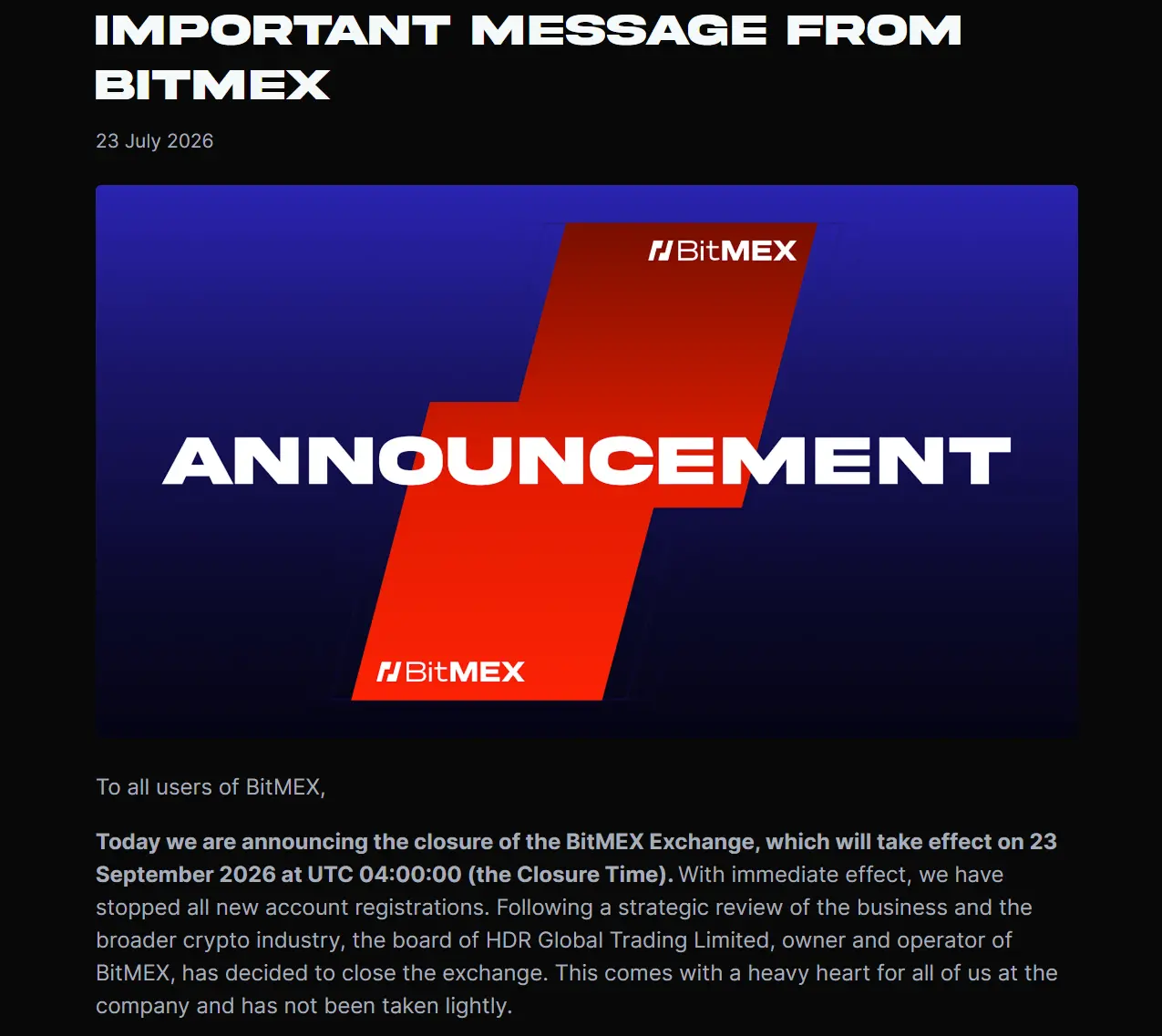
According to the official announcement, the timeline is divided into three phases:
- Effective immediately upon announcement, BitMEX will halt all new user registrations while existing trading functions will remain normal.
- From August 26, 04:00 UTC, the platform will impose risk limits, allowing users only to reduce their positions, not to establish new ones. From this point until the shutdown date, BitMEX will proactively liquidate existing positions to ensure an orderly market exit.
- The official shutdown time is September 23, 04:00 UTC, at which all remaining open positions will be immediately liquidated. BitMEX states that liquidation operations will be at the platform's discretion and will not be responsible for any trading losses incurred by users during this period due to the inability to liquidate themselves.
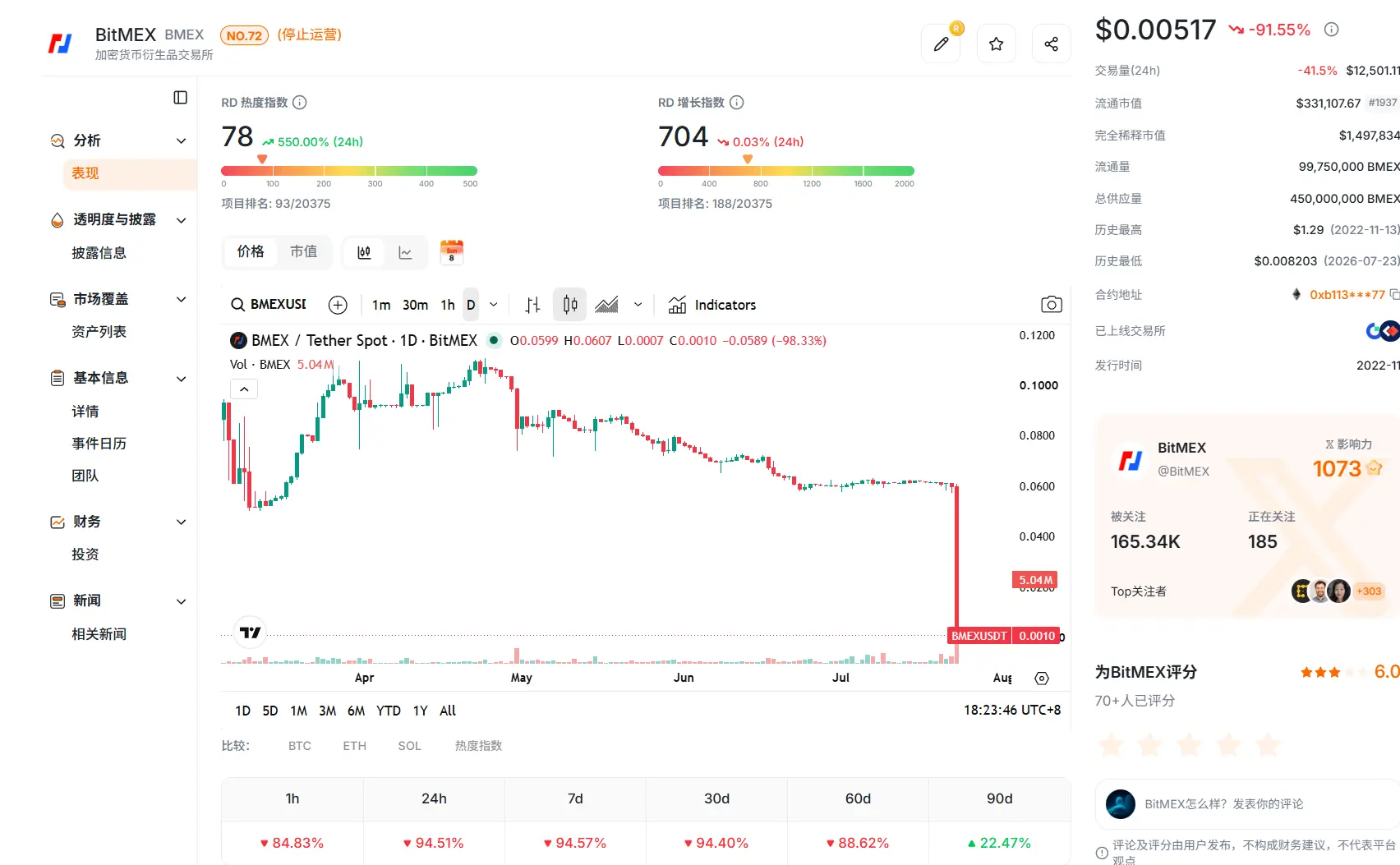
According to RootData data statistics, the BMEX token dropped about 94.51% within 24 hours of the announcement, falling from $0.06068 to $0.00517, setting a historical low. Compared to the high of $1.29 reached in November 2022, the retracement has reached 99.8%.
Sale process took one and a half years, but ultimately failed to find buyers
The announcement did not provide a specific reason for the shutdown, only stating that the board of HDR Global Trading made the decision after reviewing its business and the overall cryptocurrency industry.
By connecting publicly available information from the past year, the causal chain becomes much clearer.
According to public information, BitMEX hired boutique investment bank Broadhaven Capital Partners to handle the sale process as early as the end of 2024, when no buyer had yet been determined. This process never resulted in a public transaction.
About three weeks ago, BitMEX replaced its CEO Stephan Lutz, CFO Ina Steiner, and Chief Growth Officer Raphael Polansky, with Peter Wilkinson, who previously served as Global General Counsel and COO, taking over as CEO.
The industry interpretation at that time was that the platform was cutting management costs to enhance its attractiveness in potential transactions. In hindsight, this seemed more like the first step towards liquidation.
Liquidity collapse and regulatory blows
BitMEX once had a rare market position, pioneering Bitcoin perpetual contracts with the XBTUSD launch in May 2016, which eliminated expiration dates and anchored to spot prices through funding rates, offering up to 100x leverage.
According to a 2019 report by Bitcoin Magazine, BitMEX held approximately 53% market share in the cryptocurrency derivatives market, with the second-place Huobi DM at approximately 16% and OKEx around 12.5%.
The turning point came on March 12, 2020, when Bitcoin prices plummeted without resistance, dropping almost 50% within 24 hours. A series of forced liquidations on BitMEX led to positive feedback, with the liquidation engine flooding thin order books with sell orders, breaking through buy orders.
On March 13, the platform experienced two service interruptions, which BitMEX initially attributed to hardware issues with cloud service providers, but later confirmed that both interruptions were due to distributed denial of service attacks.
Afterwards, the market generally believed that these outages interrupted the downward spiral, but the cost was that the trust of market makers and large players in the platform's matching capabilities was breached. Liquidity migrated to Binance Futures, Bybit, OKEx, and the then FTX in the following weeks and did not return.
The exchange's moat is formed by liquidity; once depth is transferred, the original platform cannot regain established trading habits, even if it resolves technical issues. Over the next six years, BitMEX launched spot trading, copy trading, trading bots, and TradFi perpetual products, all in an attempt to reverse an irreversible process.
Additionally, regulatory blows followed closely after the liquidity collapse.
On October 1, 2020, the CFTC filed civil charges, while the Southern District of New York’s Attorney's Office simultaneously filed criminal charges, accusing BitMEX of operating as an unregistered derivatives platform and violating the Bank Secrecy Act by failing to establish effective anti-money laundering and KYC systems.
The prosecution claimed in documents that BitMEX effectively operated as a money-laundering platform and that its claim of exiting the US market was not true.
CTO Samuel Reed was arrested in Massachusetts, and the founding team subsequently exited the management.
The legal aftermath continued for four and a half years. In August 2021, BitMEX reached a $100 million settlement with the CFTC and FinCEN. In 2022, the three founders Arthur Hayes, Ben Delo, and Samuel Reed each pleaded guilty and paid a $10 million penalty.
HDR Global Trading pleaded guilty on July 10, 2024. According to the United States Department of Justice, Judge John Koeltl of the Southern District of New York sentenced the company to a $100 million fine with two years of probation on January 15, 2025, totaling over $200 million in fines.
Afterward, mandatory KYC was implemented simultaneously, and the original advantage of anonymous account opening disappeared.
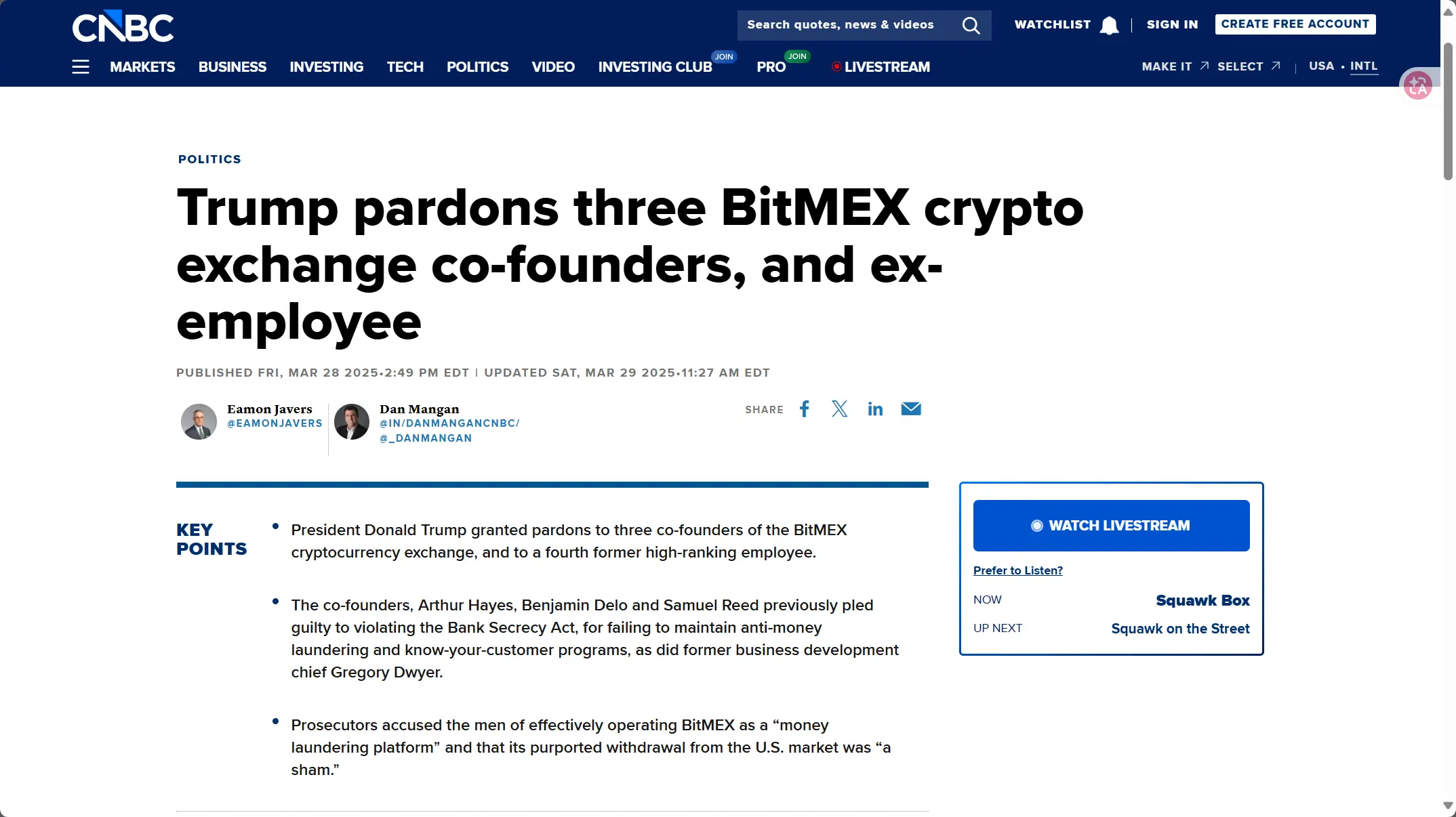
A turning point appeared two months later. According to CNBC, on March 27, 2025, Trump pardoned co-founders Arthur Hayes, Benjamin Delo, and Samuel Reed, along with former senior employee Gregory Dwyer, and also pardoned HDR Global Trading, the company owning BitMEX, marking the first corporate pardon in his second term.
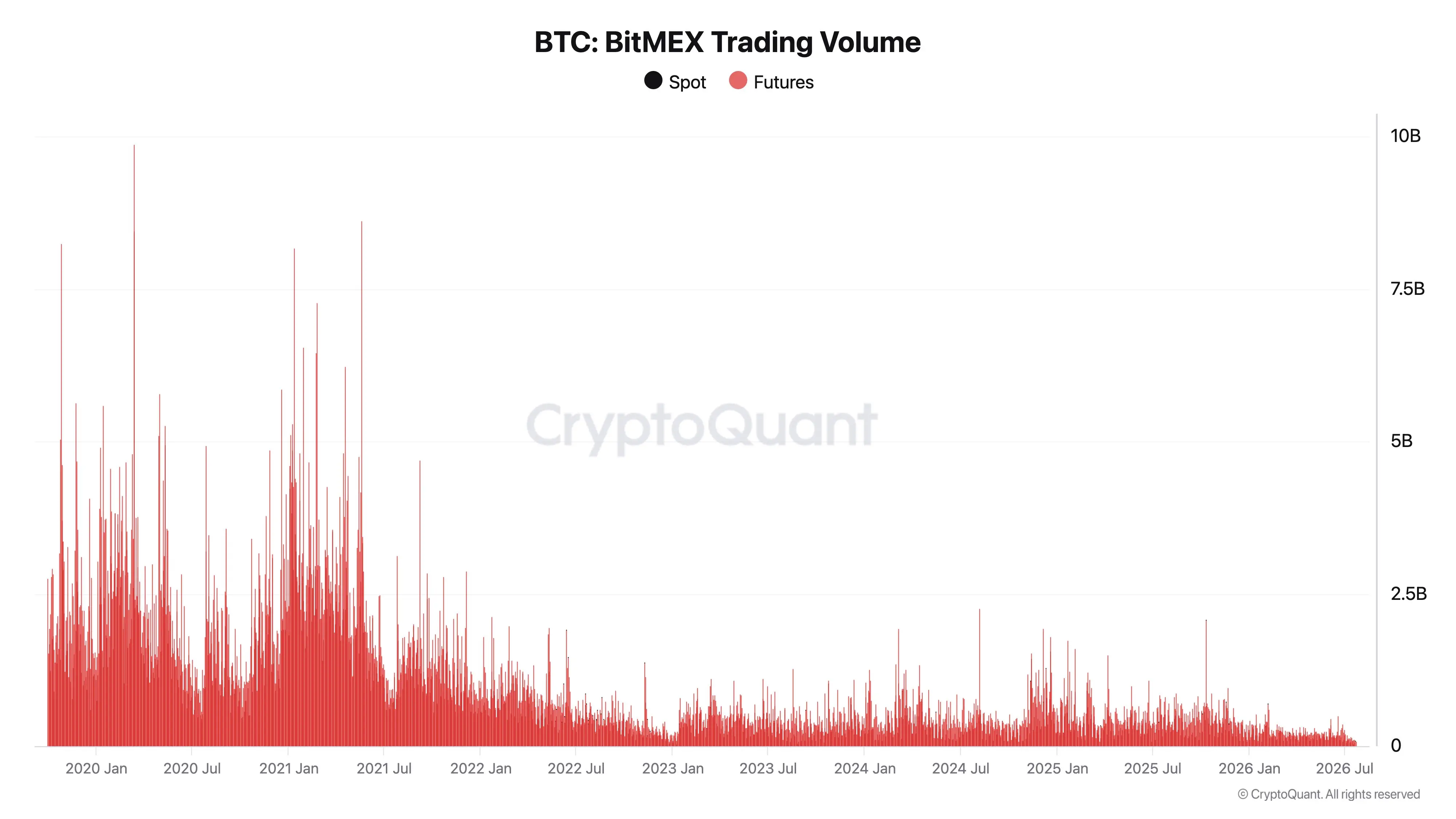
CoinMarketCap's latest data shows that BitMEX ranks 50th among derivatives exchanges, with about $177 million in open contracts and about $120 million in 24-hour trading volume.

According to CryptoQuant founder Ki Young Ju, BitMEX's Bitcoin futures trading volume yesterday was $84 million, accounting for only 0.08% of the entire market.
Perpetual contracts have been legalized while the inventors exit
It is worth mentioning that besides the perpetual contracts themselves, funding rates, marked prices, and automatic liquidation mechanisms were also introduced by BitMEX, which are still universal components of risk control for contracts across exchanges today.
Ten years later, this product has been legalized in the United States.
On May 29, the CFTC officially approved the listing of Bitcoin perpetual contracts BTCPERP on KalshiEX, while also issuing a no-action letter to Coinbase Financial Markets, recognizing its accessible Deribit perpetual contracts as foreign futures.
The weight of this product can be seen from the reactions of traditional exchanges. According to Reuters, CME filed a lawsuit against the CFTC on June 18, seeking to overturn the May 29 approval. After the approval, CME, Cboe, and ICE saw their stock prices drop by more than 10% cumulatively.
In ten years, perpetual contracts have gone from an offshore gray area to being legally classified in lawsuits against regulators by Chicago exchange giants. Binance, Bybit, and Hyperliquid have taken over these trading volumes, and now Kalshi and Coinbase have also joined (it is reported that Kalshi's crypto perpetual contracts have surpassed $8.5 billion in trading volume within weeks of launch).
Yet the platform that originally invented it announced its closure two months later. As former OKX listing business head Charles said, the era of BitMEX has actually long ended; it defined the last generation of cryptocurrency derivatives trading, but the platforms that have refined operations and product iteration to the extreme are a later batch of Chinese exchanges.
This also explains why the sale process went on for over a year without anyone taking over. The rights to the invention, brand, tech stack, and licenses are still there, but the only thing missing is liquidity, which is likely what buyers are really after.
免责声明:本文章仅代表作者个人观点,不代表本平台的立场和观点。本文章仅供信息分享,不构成对任何人的任何投资建议。用户与作者之间的任何争议,与本平台无关。如网页中刊载的文章或图片涉及侵权,请提供相关的权利证明和身份证明发送邮件到support@aicoin.com,本平台相关工作人员将会进行核查。


