Author: A Fox in Web3
Translated by: Shenchao TechFlow
Senchao Introduction: Uniswap has turned destruction from a symbolic action into a threshold for earning money. Its "token jar" mechanism forces anyone who wants to take a share of the protocol fee income to first burn UNI. This mechanism has launched on 11 chains, with the Robinhood Chain achieving a daily trading volume of $375 million, causing daily burn amounts to soar to 186,000 UNI, setting a new historical record.
The "token jar" of Uniswap is a smart contract that collects on-chain fee income from Uniswap, which will only be released when someone burns UNI to unlock it.
This mechanism will go live after the "UNIfication" vote passes on December 25, 2025, resolving the long-standing controversy over the "fee switch" in Uniswap's DeFi.
The Robinhood Chain went live on July 1, and with Uniswap as its native exchange, it has brought significant trading volume to Uniswap, accelerating new fee-related proposals.
UNIfication brings a new level of coordination between Uniswap Labs, liquidity providers, governance, and UNI tokens, which includes a built-in burn mechanism.
The Robinhood Chain was launched earlier this month, and it quickly saw a surge in on-chain activity. One of the biggest winners in all of this has been Uniswap, which experienced explosive growth in trading volume on the Robinhood Chain.
The trading volume on Uniswap has brought in substantial revenue, revealing a captivating recent change in how Uniswap connects its tokens and protocol income through the UNIfication proposal, which is what we will focus on today.
Uniswap's Token Jar
Uniswap has recently built a rather unique mechanism to provide value for its tokens, which has never been attempted in this field before. It has created a novel way to burn its own tokens, involving what they call the "token jar," which is simply a smart contract that collects a certain percentage of Uniswap's income.
Token burning is usually straightforward: you burn some supply, and assuming demand for the tokens remains constant as supply decreases, the price should increase.
This logic is similar to a company buying back its own stock. We discussed the basic idea of token buybacks in an article last year, where we cited Aave spending $1 million weekly to buy back and burn its own tokens.
This is how most projects try to link their revenue with token economics to drive up token prices. The usual practice is to send the revenue to the governance body, which then decides how much should be used for its own buyback and burn mechanism.
Uniswap takes this idea further by completely overturning the entire mechanism. Burning is no longer something the governance body decides to do quarterly; it has now been integrated into the way people actually earn rewards on the protocol, all achieved through their token jar!
As I stated at the beginning, the token jar is an immutable chain contract, deployed on each chain, that quietly accumulates a portion of every transaction fee generated by Uniswap. The key is that no one can withdraw from it for free. The only way to claim the contents inside is to burn UNI through a second contract called "Firepit."
The burning works by calling the "release()" method of Firepit and specifying which fee currency you want to withdraw as a reward. Anyone can trigger it at any time, as long as they are willing to burn UNI to do so.
As Uniswap simply states: "Every Uniswap transaction generates protocol fees. These fees accumulate in the jar. Anyone can burn them, permanently removing UNI from circulation." You can see this on their website tokenjar.xyz.
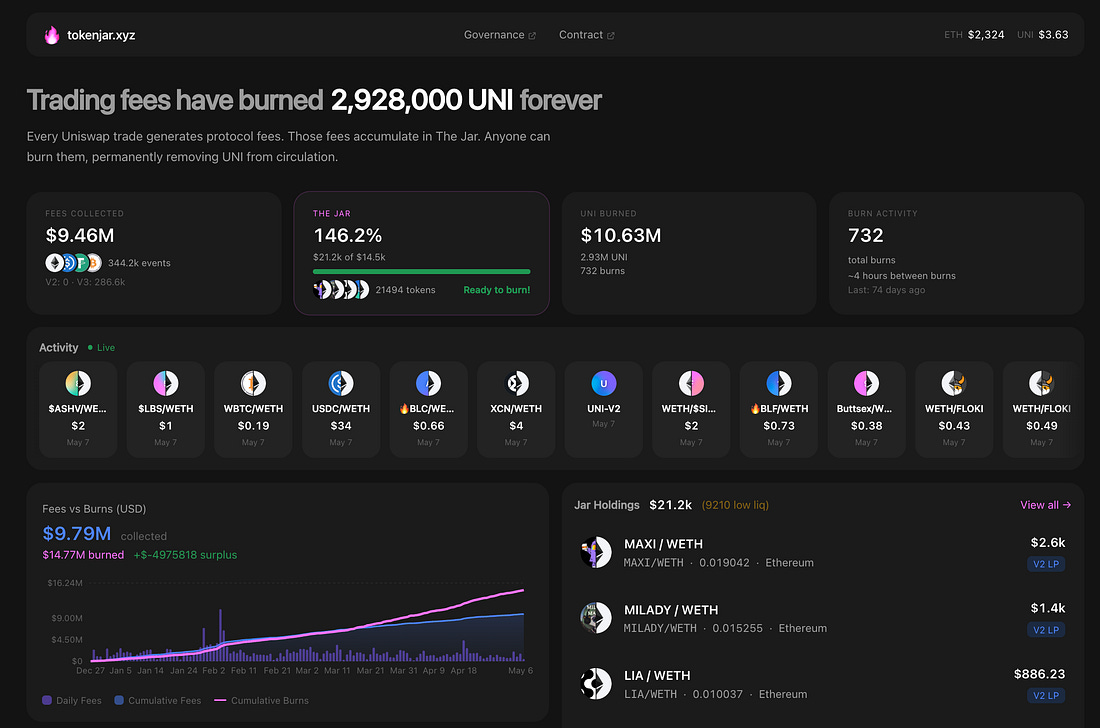
Image: Uniswap Token Jar (The Jar) dashboard showing the quantity of UNI permanently destroyed and the fee/burn trends. Source: tokenjar.xyz
Uniswap has integrated token burning into the process of claiming income from the token jar, making it a core mechanism, rather than the governance body purchasing symbolic amounts on the open market to reduce supply as most projects do.
UNIfication
The "fee switch," which suggests that the Uniswap protocol should retain a portion of transaction fees instead of routing all fees to liquidity providers, is one of the longest-standing debates in DeFi. It has remained unresolved for years.
Uniswap founder Hayden Adams ultimately forced this issue through a proposal named UNIfication. It bundles three things into one vote: activating protocol fees; burning 100 million UNI from the treasury in one go; and merging the Uniswap Foundation into Uniswap Labs for a unified legal structure.
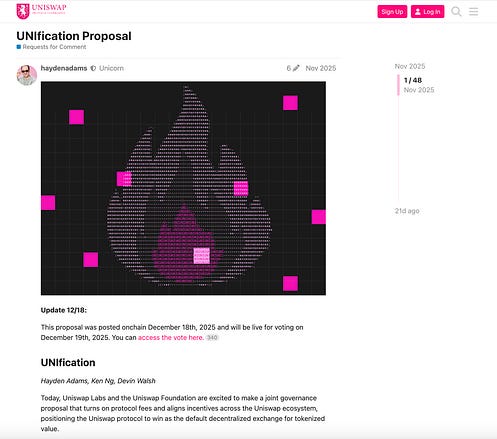
Image: UNIfication governance proposal page. Source: Uniswap Governance
The voting concluded on December 25, 2025. It passed with 125,342,017 votes in favor and only 742 against, easily surpassing the required 40 million quorum.
The burn of 100 million UNI, valued at approximately $596 million at the time of UNI's price, was positioned as a retroactive correction, simulating the estimated amount the protocol should have earned if fees had been activated since Uniswap's inception.
Fee distribution varies by version. Uniswap v2's fixed 0.3% fee became 0.25% for LPs and 0.05% for the protocol. Meanwhile, Uniswap v3 adopted a tiered reduction for LP revenue, with low-fee pools receiving 25% and high-volatility pools receiving 16.7%. They left v4 to be addressed later.
On the same day, Uniswap Labs reduced its own interface fee to zero. That fee used to generate around $125 million a year, so this is not just a small gesture. Instead, the governance body now pays Uniswap Labs a fixed budget directly of 20 million UNI per year, which is currently about $75 million, distributed quarterly from the treasury starting January 2026.
The developers building Uniswap are compensated similarly to the tokens that everyone else is burning, so if the protocol’s usage and destruction increase the value of UNI, Uniswap Labs' own budget will also become more valuable. They boldly direct guaranteed fee income towards incentives that align with everyone else holding UNI.
Robinhood Chain Fuels the Fire
Robinhood launched its own chain on July 1, called Robinhood Chain, a permissionless layer 2 built on the Arbitrum stack.
Image: Robinhood Crypto announcing the mainnet launch of Robinhood Chain via tweet. Source: @RobinhoodCrypto
The chain did not build its own DeFi building blocks from scratch, but launched with Uniswap and Chainlink as partners on day one. Uniswap automatically became the native exchange for the chain, described as the main venue for its trading.
In such a short time, Uniswap’s deployment on the Robinhood Chain has handled over $6 billion in cumulative swap volume. On July 10, it briefly surpassed Hyperliquid in daily DEX trading volume, trading $375 million within 24 hours.
While it’s true that most of the trading driving this is concentrated in WETH pairs and memecoin speculation, these are still very impressive figures, and their impact on Uniswap fees is evident.
The trading volume on the Robinhood Chain has already been substantial, and it has only just begun. You can expect to see even more volume on Uniswap when the promised tokenized stocks on that chain start to trade in large quantities!
New Proposals
Protocol fees have already been live on 11 chains: Ethereum, Base, Arbitrum, Polygon, Optimism, BNB Chain, and others. However, Robinhood Chain is not yet among them, at least not for now. Nonetheless, in response to the significant amount of trading brought by Robinhood Chain, two new Uniswap votes opened on July 19.
Proposal #99 specifically extends the aforementioned v2 and v3 fee mechanisms to Robinhood Chain. Meanwhile, Proposal #100 activates Uniswap v4’s new fee system across seven chains: Ethereum, Base, Arbitrum, Optimism, Polygon, BNB Chain, and Robinhood Chain.
Once these two initial proposals are approved, subsequent votes, which constitute the second part of the v4 rollout, will expand v4 fees to five additional chains.
Hayden Adams stated: "Based on the current trading volume, especially from Robinhood, we expect the impact on UNI destruction to be significant." The existing system has already burned a record 186,000 UNI in a single day last month, even without adding Robinhood Chain.
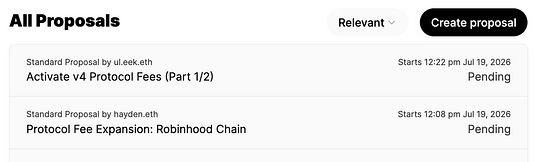
Image: Two new proposals on the Uniswap governance platform - Activate v4 Protocol Fees and Protocol Fee Expansion: Robinhood Chain. Source: Uniswap Governance
Why It Matters
The most interesting part of all this is the cycle built under it. The more chains adopt Uniswap, the more transaction volume it handles, the more fees fall into the token jar, and the more UNI gets burned. Once a chain’s fees are activated, none of this requires new governance votes.
This cycle cannot guarantee that it will remain favorable. When UNIfication first passed, experienced LPs warned that protocol fees would compress margins, and some experts predicted LPs would migrate and leave the ecosystem entirely. That has not happened yet, but we need to see how the competition develops.
Nevertheless, the shift in perception towards the UNI token is hard to ignore. For years, UNI has been criticized as a governance token without a real claim to value flowing through the protocol.
However, UNI now has one of the most interesting and novel mechanisms in the field, with their token jar leading the trend of meaningful token economics, ensuring that everyone in the ecosystem aligns towards the continually growing success of the token. It will be exciting to see how it develops!
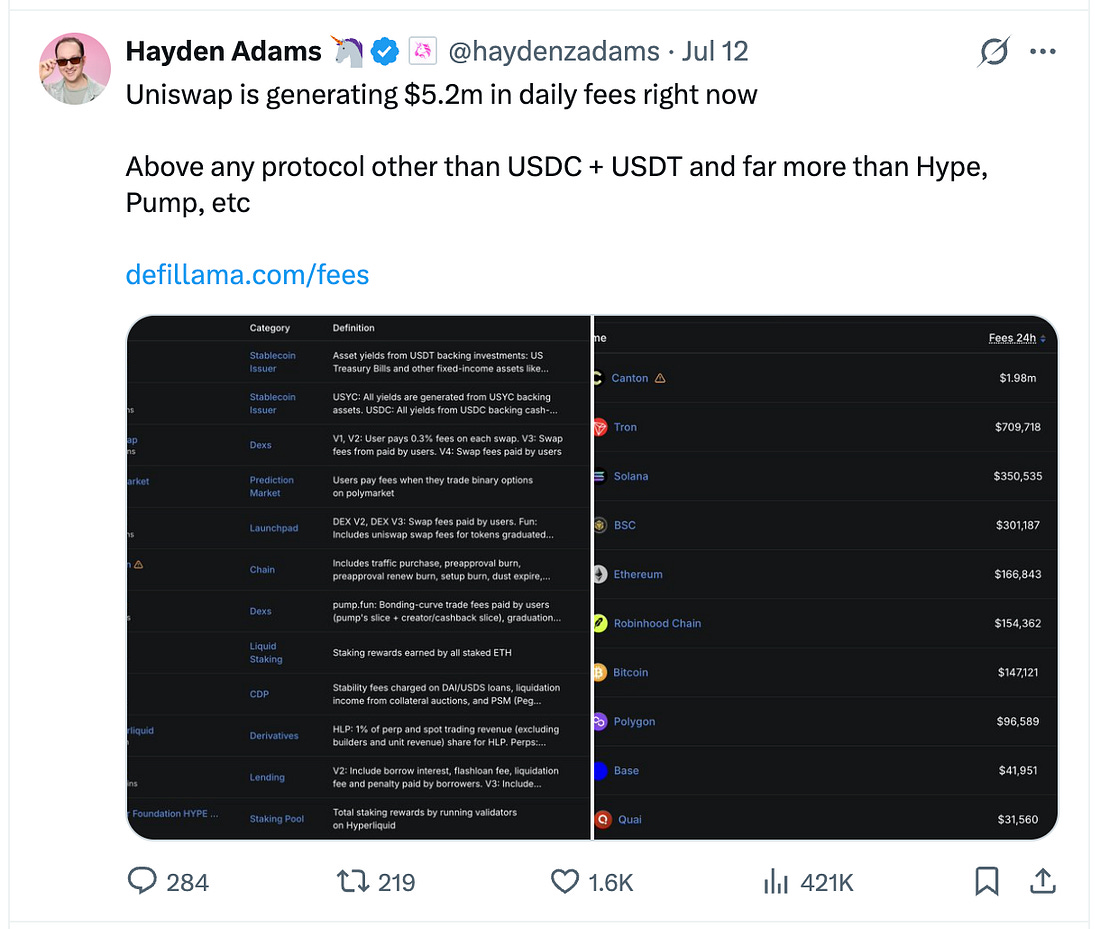
Image: Daily fee income of the Uniswap protocol is approximately $5.2 million, ranking first among all protocols except stablecoins. Source: DefiLlama
免责声明:本文章仅代表作者个人观点,不代表本平台的立场和观点。本文章仅供信息分享,不构成对任何人的任何投资建议。用户与作者之间的任何争议,与本平台无关。如网页中刊载的文章或图片涉及侵权,请提供相关的权利证明和身份证明发送邮件到support@aicoin.com,本平台相关工作人员将会进行核查。


