Elon Musk's latest shocking prediction: Within 5 years, AI intelligence will surpass that of humans, and 10 years later, humanity will likely lose control — "We are merely an evolved version of chimpanzees." Faced with a 10%-20% probability of AI destroying humanity, he chooses to calmly "get on board": since it cannot be stopped, it's better to be in the game. His ultimate bet is: by 2036, humanity may usher in a golden age of extreme material abundance.
Written by: Zhao Ying, Wall Street Journal
Faced with the unstoppable wave of AI, Elon Musk has put forward a radical timetable and pragmatic regulatory scheme: AI is expected to surpass human intelligence in five years, and top companies in the industry should immediately establish a model "mutual review" mechanism to mitigate safety risks.
Recently, Tesla CEO Elon Musk gave an exclusive interview to Zanny Minton Beddoes, the editor-in-chief of The Economist. In this interview, Musk not only made the latest assessment of the timeline for AI surpassing humanity and the potential risks, but also elaborated for the first time on his regulatory concepts for current top AI model development companies, openly discussing the grievances among key figures in Silicon Valley's AI giants.
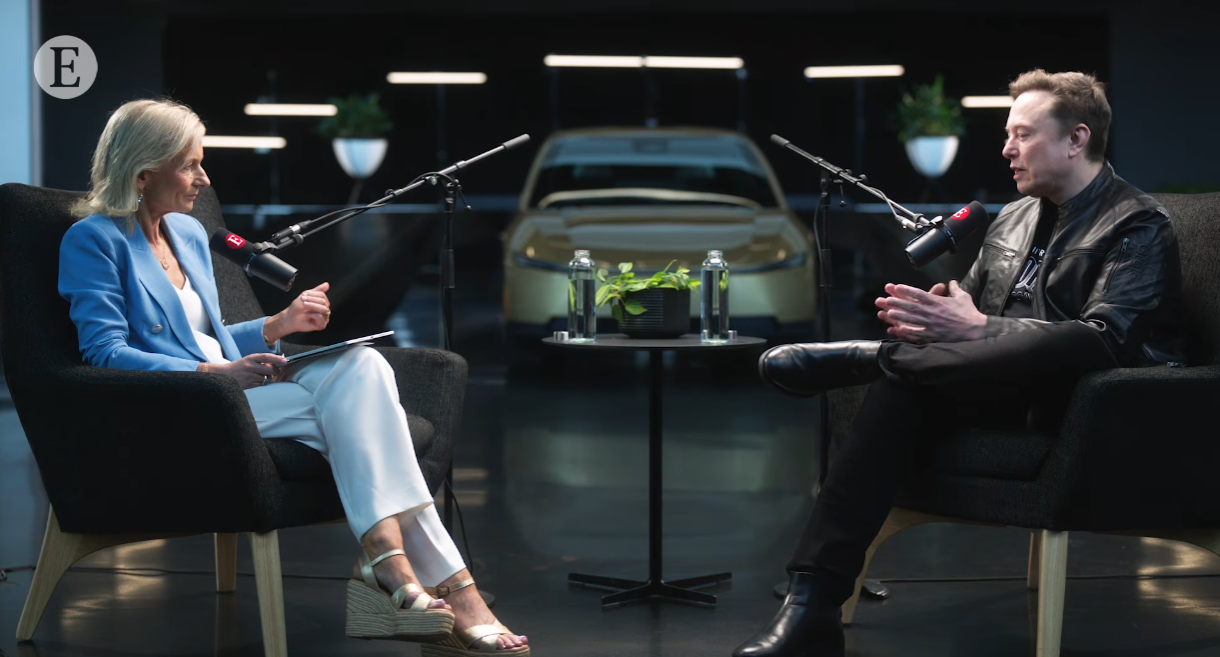
AI to Surpass Human Intelligence in 5 Years; Probability of Human Extinction at 10% to 20%; Must "Get On Board"
The market is currently highly focused on the timeline for AGI's implementation. In response, Musk has provided an extremely clear and radical prediction: "About 5 years from now, the intelligence level of artificial intelligence could exceed that of humans."
Accompanying the intelligence explosion is the loss of control. When asked whether humanity will be able to maintain control in 10 years, Musk bluntly stated that it "is unlikely." He used a brutal yet vivid biological analogy to explain this logic: "If the intelligence difference between artificial intelligence and humans is far greater than the intelligence difference between artificial intelligence and chimpanzees, it is hard to imagine chimpanzees being in dominance. We are essentially just the evolved version of chimpanzees, and not long ago, we were still eating bananas in the jungle."
Previously, Musk had repeatedly warned that AI could lead to humanity's end. In this interview, when asked if the probability of killer robots leading to human extinction is still between 10% and 20%, Musk did not deny this risk but chose a fate-tinged optimistic attitude.
He used a rocket launch as a vivid analogy. When the host asked, "If your rocket has a 10% to 20% chance of exploding and killing you, would you still get on it?" Musk gave an affirmative answer: "Yes. The only thing we can do is try to minimize the chances of bad outcomes."
He further explained the reality logic that forces him to "get on board": "The development of artificial intelligence and robots seems unstoppable; even if I wanted to stop it, I can't." He believes that since it cannot be stopped, the best choice is to be in the game to influence its direction, "The most likely outcome is that it brings tremendous benefits to everyone." Excluding extreme factors such as a global nuclear war, Musk predicts that around 2036, humanity is likely to usher in a "materially abundant era where everyone can have everything they want."
Calling for Establishing an AI "Mutual Review Mechanism": Using Business Competition to Maintain Honesty
As the arms race among AI giants such as OpenAI, Google, and Anthropic regarding underlying large models intensifies, how to effectively regulate has become a market focus. Musk proposed a very down-to-earth solution during this interview: let competitors review each other's models.
Musk revealed that he had long discussions with DeepMind founder Demis Hassabis, and he believes the most urgent action is "to have those leading AI companies at least hold regular meetings or communication to discuss any safety-related issues, like once a week or every two weeks."
Musk pointed out that government officials lack a strong technical background, making it hard to judge whether a cutting-edge model should be released. Therefore, commercial competition among the giants should be utilized to ensure safety: "For competitors, as long as they are given a week or two to review a new model, they can identify issues, thus encouraging all competitors to remain honest."
The core logic of this mechanism lies in the idea that "in a competitive environment, companies can realize that certain things may pose safety risks, so they won't hesitate to point out that the release of a competitor's model should be delayed." If a company refuses to address risks, the government needs to intervene. Musk emphasized that this mechanism must be immediately established; the industry's talk of "establishing within six months" is simply too long, as breakthroughs in AI can occur multiple times a day.
Criticizing OpenAI for Straying from Initial Purpose, Willing to Set Aside Personal Disputes for World Benefit
When discussing the barriers to cooperation in the AI industry, Musk did not hide his dissatisfaction with OpenAI's current CEO Sam Altman. This frank statement reveals the root of the distrust between top AI laboratories to the market.
"I don't like Sam Altman because OpenAI was originally meant to be an open-source AI company that should belong to the world. However, somehow it turned into a profit-making company valued at $800 billion using closed-source technology." Musk stated openly that this completely contradicts the original intention of his donations.
At the same time, Musk also disclosed insider information from Anthropic (currently one of the highest-valued AI startups founded by former core members of OpenAI): "Dario (Anthropic CEO) also doesn't like Sam Altman; in fact, the reason the Anthropic team left OpenAI was that they didn't trust Sam Altman; otherwise, they should still be working at OpenAI."
Despite the strong personal animosities between giants, Musk showed a compromising attitude at the end of the interview. He described the Anthropic team as "principled, caring about the future of the world." To advance the establishment of an AI safety mutual review mechanism, Musk called for: "For the benefit of the world, let's set aside personal disagreements."
Text Record
Musk
I believe that about 5 years from now, the intelligence level of artificial intelligence could exceed that of humans. Five years is about the timeline for such predictions. So, besides being human themselves, AI can indeed perform better than humans.
Host
So, what will life look like in the future?
Musk
The most likely scenario is that we will enter a materially abundant era where everyone can have everything they want. This may sound a bit absurd, but we are living in 2026 right now. Let's see what our situation will be in 2036.
Of course, there are some factors that may hinder the realization of this goal, such as a large-scale global nuclear war. However, assuming there is no Third World War, I believe we will enter a materially rich era. So, this might be considered a kind of optimism and excitement about the future.
Host
Do you believe that in 10 years, humanity will no longer be able to maintain control?
Musk
I think that is unlikely. If the intelligence difference between AI and humans is far greater than that between AI and chimpanzees, it is hard to imagine chimpanzees being in dominance. We are essentially just an evolved version of chimpanzees, and not long ago, we were still eating bananas in the jungle, and we still do.
Host
Do you think there’s still a 10% to 20% chance that having killer robots could lead to human extinction? You seem quite relaxed about it now. Have you changed your mind?
Musk
I still believe that there are risks associated with AI and robots, and that risk is not zero. However, I have to take an optimistic attitude. Regarding the development of AI and robots, sometimes I even think that even if there were a stop button, we might not should press it — because the most likely outcome is that it will bring tremendous benefits to everyone. I realize that it seems everyone has determined that this development is inevitable. Let's hope for the best and move forward. The development of AI and robots seems unstoppable; even if I wanted to stop it, I can't.
Host
Do you think there is still a 10% to 20% chance of killer robots leading to human extinction?
Musk
That is indeed a terrible situation. Ultimately, we all face death. According to the physical standard model, the end of the universe will be a long and dull process — like a glass of gradually cooling dilute gray liquid, referred to as "heat death of the universe." So if the heat death of the universe is indeed the ultimate conclusion of our reality, then all of this is just part of the journey.
Host
If you think your rocket has a 10% to 20% chance of exploding and killing you, would you still get on it?
Musk
Yes. The only thing we can do is try to minimize the chances of bad outcomes. I have always been reluctant to engage in artificial intelligence or related fields. Initially, OpenAI existed as a counterbalance to Google, as at that time, Google nearly monopolized the advancement of AI. But now, Anthropic has become a leader in the AI field. These initiatives have indeed accelerated the development of AI, which was not my original intention. It seems everything points toward further development of AI. So I thought, well, you can feel sad about this or join the ranks — and you clearly have joined.
Host
If you can't beat them, then join them. It’s understood that other leaders in the model development fields are also striving to find ways to reduce risks. Just last week, Demis Hassabis proposed a suggestion about establishing a public-private cooperation regulatory body. Do you think you should be more actively involved in this? Can we take some measures to control these risks?
Musk
Yes, my suggestion to Demis was that prior to publishing his article, I had a few hours of conversation with him. We believe that the most urgent action is to have those leading AI companies at least hold regular meetings or communication to discuss any safety-related issues every few weeks. Why haven't you done this yet? I mean, you don't all like each other, after all, you are in competition and all want to be number one.
Musk
However, I believe that this competition can spur people to remain honest. For government officials lacking a strong technical background who do not lead the AI frontier, it is indeed difficult to judge whether a model should be released. However, for competitors, as long as they are given a week or two to review a new model, they can identify problems, which in turn encourages each competitor to remain honest. This way, model creators can check each other's work. If there is anything that worries them, they can inform the government, which will then be able to determine if there are issues that need addressing — if that company is not taking any steps to counter that risk, then it is time for the government to intervene and take action.
Action must be taken immediately. People have been telling me that this system must be established in the next six months because the pace of model improvements is accelerating. Six months is indeed a long time; this time frame should be shortened. There are now too many groundbreaking developments in AI; sometimes multiple breakthroughs occur within a single day, and last week there were many.
Host
So you need to gather now and arrange this matter. It sounds like you are telling me that.
Musk
Yes, I suggest at least holding some informal meetings periodically, like once a week or every two weeks. This way, there is a week or two to review relevant content ahead of time.
Musk
This is why I believe this incentive mechanism is effective — competitive companies can realize that certain things may pose safety risks, so they won’t hesitate to point out that the release of a competitor’s model should be delayed.
Host
You don’t really like each other and lack trust; you often attack each other on social media. So, do you think you can treat those you don't like in this way? There are indeed personal grievances among these leaders.
Musk
I don't like Sam Altman because OpenAI was originally meant to be an open-source AI company that should belong to the world. However, somehow it turned into a profit-making company valued at $800 billion using closed-source technology. I feel this completely contradicts the original purpose of my donation, and I am very unhappy about this. Also, Dario doesn't like Sam Altman either; in fact, the reason the Anthropic team left OpenAI was that they didn't trust Sam Altman; otherwise, they would still be working at OpenAI.
Musk
I think Dario is a very principled person; he cares about various issues and the future of the world. So far, everyone I have met at Anthropic has been like this, and no one has made me feel they have malicious intent — they all seem to have good intentions. The road to hell is often paved with good intentions, and while there are indeed a few who act from good intentions, we cannot be complacent. However, if discussion is needed, then let's discuss it. For the sake of the world, let's set aside personal disagreements.
免责声明:本文章仅代表作者个人观点,不代表本平台的立场和观点。本文章仅供信息分享,不构成对任何人的任何投资建议。用户与作者之间的任何争议,与本平台无关。如网页中刊载的文章或图片涉及侵权,请提供相关的权利证明和身份证明发送邮件到support@aicoin.com,本平台相关工作人员将会进行核查。


