BlackRock, Coinbase, and Strategy lead the establishment of an alliance, but the biggest challenge is not technology.
Written by: Oluwapelumi Adejumo
Translated by: Saoirse, Foresight News
BlackRock, Coinbase, and Strategy are investing $15 million in resources to prepare Bitcoin for potential quantum computing attacks in the future.
The mentioned companies are among the nine founding members of the newly established Bitcoin Security Alliance. The alliance was officially announced on July 23 and aims to support developers and researchers dedicated to maintaining the long-term security of the Bitcoin network.
Other members of the alliance include Anchorage Digital, ARK Invest, Block, Blockstream, Fidelity Digital Assets, and Galaxy. The member roster covers asset management firms, custodians, cryptocurrency exchanges, infrastructure service providers, and many companies that hold Bitcoin and are deeply involved in Bitcoin operations.
As quantum computing technology continues to advance, the potential vulnerabilities of existing cryptographic systems have drawn widespread attention, which is why the alliance has prioritized quantum computing threats as a primary research direction.
Strategy CEO Phong Le stated:
“As long-term holders, we have every incentive to ensure Bitcoin can operate safely for a long time. Funding researchers in this field and promoting rational discussions within the industry around this topic is a natural choice for us to contribute.”
Advancements in Quantum Technology Force Bitcoin to Reassess Security Time Windows
Governments and technology research teams around the world are intensifying their development of cryptographic technologies capable of withstanding future quantum computer attacks, while institutional funding commitments are increasing accordingly.
In the past year, various research teams, including Google's quantum AI team, have revised a forecast: the computational power required to break the cryptographic algorithm currently used by Bitcoin is lower than previously expected.
Bitcoin relies on elliptic curve cryptography to generate digital signatures, proving that the holder possesses the private keys needed to transfer Bitcoin. Traditional computers are nearly incapable of reversing this relationship. However, theoretically, a sufficiently powerful quantum computer running Shor's algorithm could derive the corresponding private key from the public key.
This poses a risk to Bitcoin: a large number of public keys have already been permanently recorded on the blockchain, raising the possibility of being compromised.
Data from Dune Analytics shows that there are over 7 million Bitcoin located in transaction output addresses whose public keys are completely exposed, accounting for 34.9% of the total circulating Bitcoin according to this statistic. At recent market prices, these assets are valued at about $46.08 billion. In the most recent complete reporting month, the number of Bitcoin exposed to this risk increased by approximately 77,275 coins.
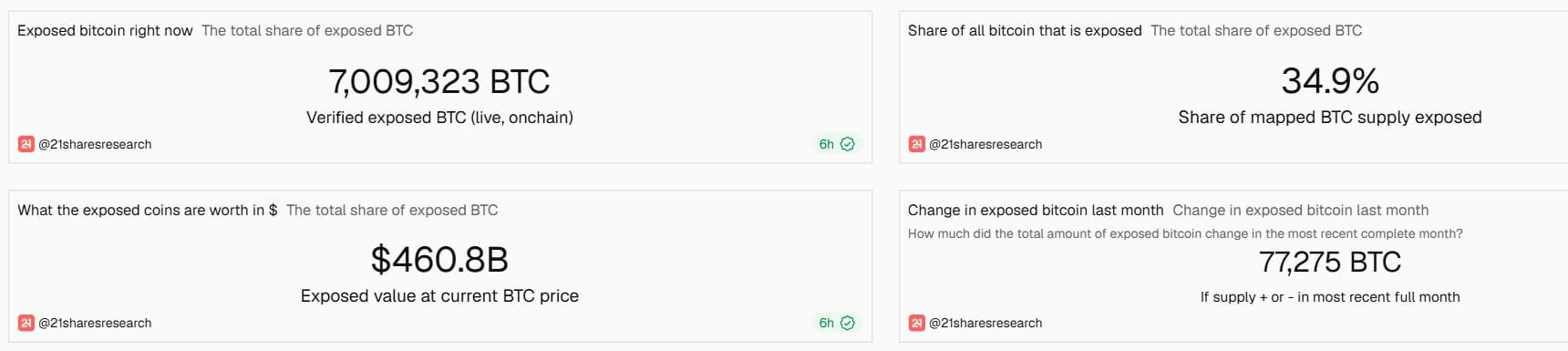
Bitcoin faces quantum computing threats (Source: Dune Analytics)
At this stage, these Bitcoin are not at risk of being stolen through quantum attacks; currently, there is no quantum computer capable of breaking the Bitcoin signature system or that has practical value for cryptographic attacks. The real concern is: if technology continues to evolve and the barriers to attack continue to decrease, how much time does the Bitcoin network have to complete defense modifications.
Charles Edwards, founder of Capriole Investments, pointed out this uncertainty. Recently, he stated that his calculated "quantum risk discount factor" for Bitcoin has reached 30%, defining quantum computing as the greatest technological threat facing the Bitcoin network in the long term.
The increasing exposure of Bitcoin supply, coupled with the decreasing estimated resources required for quantum attacks, explains why many Bitcoin-related institutions began funding relevant research long before practical quantum computers were available.
In order to switch to a quantum-resistant signature scheme, developers first need to design, review, and test a completely new cryptographic scheme; then wallets, exchanges, miners, node operators, and users throughout the network can gradually deploy it. For BlackRock, Coinbase, Strategy, and other alliance members, investing funds in R&D while the threat remains theoretical allows for a more ample preparation period for developers.
Corporate Funding Unable to Eradicate Bitcoin's Quantum Security Dilemma
The alliance has set mechanisms in its structure to restrict the influence of companies, but these constraints also reflect that the member companies cannot actually dominate which quantum defense scheme Bitcoin ultimately adopts.
The large stakeholders in Bitcoin have committed millions of dollars to support open-source development, immediately giving rise to a governance challenge: how to support network development while preventing funding institutions from influencing the technological direction.
The alliance hired Mike Schmidt, the executive director of the nonprofit organization Brink, to coordinate daily work as a volunteer, assuring that each member company communicated individually with him before his appointment to confirm that the project could be compatible with Bitcoin's decentralized development model.
To achieve this goal, the alliance established two core safeguarding rules: First, the alliance will not collectively pool funds from various companies, nor will it select funding recipients on their behalf; each company will independently decide which developers, research teams, and institutions to fund. Second, the alliance will not express an official position on modifications to the Bitcoin protocol. Member companies can express their opinions independently, but the alliance itself will not participate in protocol development nor will it direct protocol maintainers to undertake work.
Based on these rules, institutions like BlackRock, Coinbase, and Strategy can continue to increase their R&D investments in quantum fields without having to finalize which solution Bitcoin will ultimately adopt.
As the industry's focus shifts from "identifying threats" to "formulating responses," this boundary will become particularly crucial.
No government, company, or developers' group can force the entire Bitcoin network to adopt a new signature system. Any significant adjustment to the cryptographic mechanism must undergo design, review, and testing, and gain broad acceptance from developers, wallet service providers, exchanges, miners, node operators, and a wide user base.
Galaxy stated that compared to the huge scale of risk assets, the number of developers specifically researching Bitcoin's quantum resilience still remains low. Increasing funding can expand the R&D team but cannot eliminate the technical contradictions and governance challenges that are difficult to balance during the network transition process.
One of the hardest problems to solve currently: how to handle Bitcoin that is still protected by the old signature mechanism after quantum-resistant alternatives are implemented.
The BIP-361 draft, co-authored by Casa co-founder Jameson Lopp and other developers, plans to gradually phase out the elliptic curve digital signature algorithm (ECDSA) and Schnorr signatures.
The first stage of this proposal plans to prohibit users from directing new Bitcoin deposits to addresses that are vulnerable to quantum attacks. Subsequent stages will tighten the transfer rules for existing old assets, while establishing asset relief mechanisms to distinguish between legitimate asset holders and attackers who rely on quantum computers to crack private keys.
One possible approach: allow deterministic wallet holders to present unique information proof derived from the original wallet seed, which quantum attackers cannot access. Researchers are also exploring using zero-knowledge proofs and commit-reveal mechanisms to help users recover threatened assets.
However, the above schemes still cannot cover all types of Bitcoin transaction outputs.
The authors of BIP-361 mention that some early "public key direct payment" type transaction outputs find it difficult to provide equivalent protection benefits to legitimate holders. Leaving a lingering question: how to allow such Bitcoin to transfer normally while no longer being continuously exposed to the risk of future quantum attacks. The proposal discusses a scheme called "Hourglass" which attempts to handle some of these assets compatibly.
The trade-offs facing developers are extremely difficult: if the availability of the old signature mechanism is retained indefinitely, some Bitcoin will ultimately face the risk of theft; if old signatures are restricted too early or too strictly, many legitimate holders who have not completed asset migrations in time will be completely unable to access their Bitcoin.
Currently, BIP-361 is still just a draft, merely included in the Bitcoin Improvement Proposals repository, and does not represent formal acceptance of this scheme by the Bitcoin network.
The alliance can fund more researchers to tackle challenges and secure more preparation time for developers but cannot finalize the ultimate decisions that all Bitcoin users must make.
免责声明:本文章仅代表作者个人观点,不代表本平台的立场和观点。本文章仅供信息分享,不构成对任何人的任何投资建议。用户与作者之间的任何争议,与本平台无关。如网页中刊载的文章或图片涉及侵权,请提供相关的权利证明和身份证明发送邮件到support@aicoin.com,本平台相关工作人员将会进行核查。


