Author: Gao Zhimou, Wall Street Journal
The global stock market is facing a severe stress test this summer, with skyrocketing oil prices, ever-expanding AI capital expenditures, and the reintroduction of tariff policies simultaneously impacting the core pillars supporting the current bull market.
Due to severe disruptions in shipping in the Middle East and Red Sea regions, Brent crude oil surpassed $100 per barrel this week, reaching a two-month high. Meanwhile, Trump proposed tariffs of 10% to 12.5% on about 60 economies, and the combination of these two factors rapidly raised market inflation expectations, pushing the 10-year US Treasury yield up to 4.66%.
The technology sector faced heavy losses this week, as Google significantly raised its capital expenditure guidance, triggering market concerns about AI investment returns, causing the "magnificent seven" to lose nearly 6% in market capitalization in just one week. As a result, the S&P 500 index fell for the second consecutive week, recording its largest single-day drop of the month, with the 30-year US Treasury yield approaching the highest level since 2007.
The bull market logic built on resilient earnings, controllable inflation, and continuous expansion of AI spending has begun to waver. Currently, Barclays has downgraded its outlook on risky assets to neutral, Goldman Sachs maintains a neutral outlook for three months, and HSBC has shifted its strategy from the semiconductor sector to European banks, as Wall Street institutions intensively release tactical defensive signals.
$100 Oil and the Ghost of Inflation
The conflict in the Middle East is the epicenter of this week's market turbulence.
The flames of war have spread from the Strait of Hormuz to the Red Sea, causing a triple breakdown in the global oil supply chain: According to maritime data company Kpler, only 6 ships passed through the Strait of Hormuz on Thursday, with traffic reduced to one-tenth of pre-war levels; a previously utilized alternative route in the Red Sea by Saudi Arabia was obstructed due to attacks on two Saudi oil tankers by Houthi forces; escalations in the Russia-Ukraine conflict further compressed exports from Kazakhstan.
Analysts at maritime intelligence firm Windward estimate that about 25% of global oil supply is under threat.
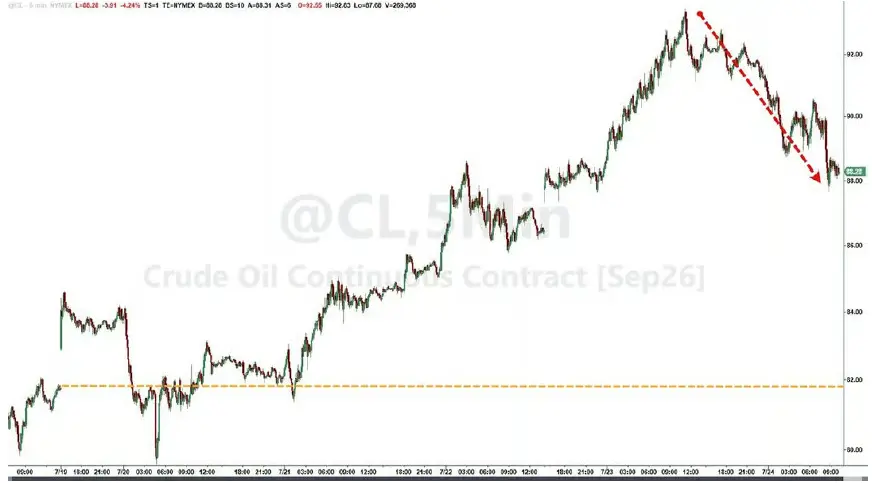
The transmission link is closely interconnected: higher oil prices raise inflation expectations, changes in inflation expectations alter interest rate pricing, and higher interest rates tighten financing conditions. The 10-year US Treasury yield rose about 10 basis points this week to 4.66%, the highest level since Trump’s second term began; the market has priced in two rate hikes this year, with a 30% probability of a rate hike by the Fed next week.
"Oil is the most likely triggering factor," said Nomura cross-asset strategist Charlie McElligott—higher oil prices are repricing the "tail risks of inflation," that is, the likelihood of more persistent inflation occurring, and this impact will first feed into the interest rate market before eroding corporate profits.
J.P. Morgan global strategist David Lebovitz is focusing on sustainability: if oil prices stay high throughout the summer, the risk premium will need to be comprehensively reassessed.
The AI Arms Race Faces Trust Cracks
Beyond oil prices, the AI investment narrative also showed cracks this week.
Alphabet, the first mega-cap tech company to report this season, had no issues with its performance—cloud services grew 82% year-on-year, and search grew 17%. However, the company simultaneously raised its 2026 capital expenditure guidance by 8% to $195 billion to $205 billion, and its stock price plunged about 8% that week. Tesla's situation was even more dire: its second-quarter non-GAAP earnings per share fell short of expectations due to declining margins, coupled with concerns over the pace of AI product rollout, causing a near 20% drop in a single week.
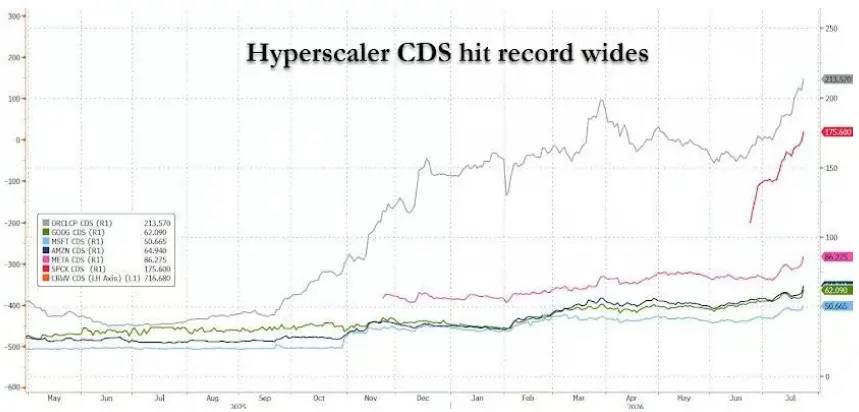
The fragmentation of the credit market is particularly noteworthy.
According to Goldman Sachs data, there has been $489 billion in AI-related debt issuance from 2026 to date, a 50% increase from the entire previous year, with 60% coming from non-mega-cap tech firms. The CDS spreads for mega-cap spenders have risen to historical highs—while the overall credit spread remains tight at levels not seen in years. The pressure has not spread broadly but is highly concentrated within the AI supply chain.
The entire industry is pouring unprecedented funds into projects with uncertain returns.
Some estimates suggest that cumulative capital expenditures in the AI sector could approach $1 trillion by 2027. Higher interest rates raise the return threshold that these investments must ultimately surpass. "Financing channels remain open, but investors are becoming increasingly choosy," Lebovitz said, "The biggest disconnect is the assumption that 'AI spending can expand infinitely.'”
Jensen Huang and Musk publicly supported open-source models this week, which may further undermine this logic: cheaper models mean lower spending needs, and the risk of semiconductors returning to cyclical patterns is rising.
Next Week: The Ultimate Test for Bulls
Next week, the Federal Reserve, the Bank of England, and the Bank of Japan will hold meetings, and companies representing 34% of the S&P 500 will release earnings reports, including four from the "magnificent seven"—Microsoft and Meta (Wednesday), Apple and Amazon (Thursday). Latest signals on AI capital expenditures will be densely released.
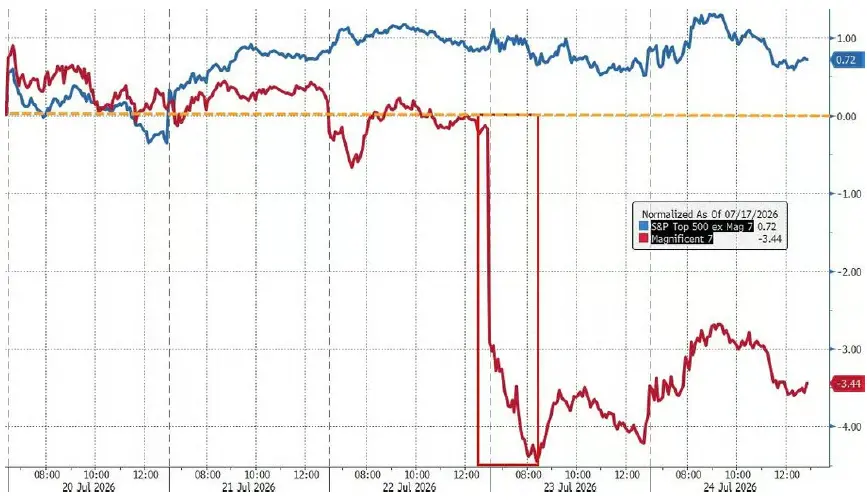
The technical outlook has worsened. Goldman Sachs's trading department reported this week that overall fund flows leaned sell by 12.6%, with long-term funds' net sales having a tilt of 21%—"There has been almost no buying seen, and tech earnings reports have not become the stabilizing force many hoped for." The S&P 500 has dropped below the 50-day moving average, and market makers are in a negative gamma state, with the trigger levels for CTAs being closely monitored; the Nasdaq similarly fell below the 50-day moving average and is testing the June 9 low. Gold has regained $4,000, and the dollar recorded its best weekly performance in over a month—safe-haven assets are pricing in the same unease.
Bank of America’s European strategy head Sebastian Raedler provided a straightforward assessment: profit margin expectations, five-year forward earnings growth rates, and the global market capitalization/GDP ratio are all at historical highs, while risk premiums are at a 20-year low. "The market is pricing in a scenario where everything goes smoothly and without risk," he said. He expects the global stock market to have another 7% to 8% downside potential.
免责声明:本文章仅代表作者个人观点,不代表本平台的立场和观点。本文章仅供信息分享,不构成对任何人的任何投资建议。用户与作者之间的任何争议,与本平台无关。如网页中刊载的文章或图片涉及侵权,请提供相关的权利证明和身份证明发送邮件到support@aicoin.com,本平台相关工作人员将会进行核查。


