Written by: Dong Jing
With only a few days left until the Federal Reserve's interest rate meeting on July 29, the market's judgment on its policy direction is highly divided—which is extremely rare in recent years. The surge in oil prices and persistent inflationary pressure, combined with the new chairman Waller completely abandoning the previous forward guidance practices, forces investors to seriously consider the possibility of an interest rate hike next week.
According to CME Group federal funds futures data, the market is currently pricing in a roughly 38% probability of the Federal Reserve raising interest rates by 25 basis points next week, a significant jump from 13% a week ago. Meanwhile, the interest rate swap market shows a roughly 30% probability of a rate hike and about a 70% probability of maintaining the current level. Such a large division so close to the meeting date is extremely rare in recent years.
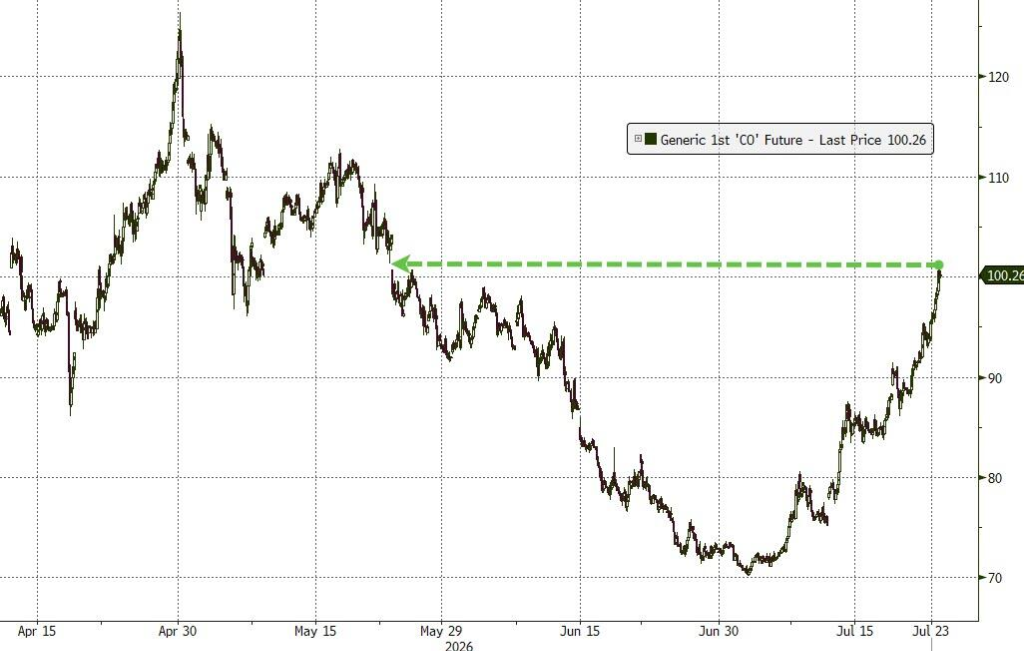
The immediate trigger for this shift is Brent crude oil's intraday breach of $100 per barrel on Thursday, marking a cumulative increase of 25% since the Federal Reserve's June meeting. Additionally, the new Fed chairman Waller previously made it clear that "there will be no guidance."
Analysts believe that Waller's tough stance combined with the impact of oil prices has intensified market concerns about the inflation outlook. The Fed's preferred PCE inflation measure recorded a reading of 4.1% in May, more than double its 2% target. Some economists and investors warn that if the market's pricing for an interest rate hike continues to rise, it could force the Fed to take action.
Oil Price Shock Rekindles Rate Hike Expectations
Brent crude oil's breach of $100 per barrel on Thursday, the first time since May of this year, directly triggered concerns about a renewed rise in inflation.
Due to escalating geopolitical tensions pushing oil prices higher, gasoline and diesel prices have significantly increased in recent weeks, placing pressure on both consumers and American industry costs.
Mark Cabana, head of U.S. interest rate strategy at Bank of America, stated:
"The July Federal Reserve meeting is absolutely 'live.' Whether current monetary policy is restrictive is a significant question in itself. And oil prices are rising again."
PGIM's chief U.S. economist Robert Sockin described next week's meeting as "almost fifty-fifty."
Waller's "No Guidance" Makes Market Pricing More Difficult
Another significant source of market uncertainty comes from Waller's starkly different communication style compared to his predecessor Powell.
Since taking office in May, Waller has made it clear that he will abolish the Fed's longstanding practice of signaling interest rate paths to the market in advance, believing that forward guidance creates unnecessary constraints on policymakers when economic conditions change.
Earlier this month, Waller testified before Congress, stating he has "zero tolerance" for persistently high inflation but gave almost no clues about the policy path.
A previous Wall Street Insights article noted that Jim Bianco, president and macro strategist of Bianco Research, stated:
"Without forward guidance, we will frequently see probability distributions of 20%, 30%, and 40%. The market is transitioning to this new way of thinking."
Agha Mirza, head of global rates and OTC products at CME Group, pointed out that federal funds futures trading volume before this meeting is 50% higher than at the time of the July 2025 decision, this unusually active trading "is driven by the growing discussion about whether the pricing of the rate hike probability is accurate, underpinned by Waller's high vigilance regarding inflation."
Hawkish Voices Accumulate Within the FOMC, Economists Lean Towards Inaction
Meanwhile, hawkish forces within the Federal Reserve are gaining some scale.
Dallas Fed president Lorie Logan and Cleveland Fed president Beth Hammack publicly stated that the Fed has waited too long in addressing inflation issues, which continue to plague American families and businesses.
Minneapolis Fed president Neel Kashkari may also support a rate hike, even if most committee members choose to remain inactive.
Sockin from PGIM stated:
"The hawkish sentiment within the Fed is reaching some critical mass."
However, influential voices within the FOMC, such as New York Fed president John Williams, tend to favor waiting until September to make a decision, to allow more time to observe inflation trends. June's CPI data showed an inflation rate of 3.5%, lower than expected, providing a basis for the waiting camp's argument.
Joe Lavorgna, chief U.S. economist at SMBC Nikko Securities America and former economic advisor to Treasury Secretary Scott Bessent, directly questioned: "If we can raise rates now, why wait until September?"
He also suggested that Waller could explain to Trump that now is the time to decisively fight inflation, which would help lower long-term borrowing costs—"this is a win-win."
Despite rising expectations for an interest rate hike, most economists still lean towards the Fed maintaining rates next week. According to a Bloomberg survey of 76 economists, all respondents expect the Fed to keep the benchmark rate unchanged in the range of 3.5% to 3.75% at the meeting on July 28-29.
Former Fed official and current chief economist at New Century Advisors Claudia Sahm stated:
"They will seriously discuss the pros and cons of a rate hike, but from the statements of various Fed officials, I do not see a majority supporting a rate hike now."
Eric Wallerstein of Clocktower Group also believes, "Now is not the time for a 'shock action' because there is nothing in the underlying data to justify an unexpected rate hike."
John Brady, managing director of RJ O'Brien, stated:
"I still do not believe the Fed will raise rates next week, but the market tells me that the outcome of this vote will be closer than I expected."
Analysts believe that this rare divergence between economists and the market itself is a reflection of the market ecosystem changes brought about by Waller's new style—in an era without forward guidance, the noise of price signals will be significantly amplified, and uncertainty may become the new normal.
免责声明:本文章仅代表作者个人观点,不代表本平台的立场和观点。本文章仅供信息分享,不构成对任何人的任何投资建议。用户与作者之间的任何争议,与本平台无关。如网页中刊载的文章或图片涉及侵权,请提供相关的权利证明和身份证明发送邮件到support@aicoin.com,本平台相关工作人员将会进行核查。


