Author: Steven, Payment 201
Recently, while chatting with several friends in the payment industry, I found an interesting contrast.
In recent years, the impression many Chinese people have of India often comes from business news. In many people's understanding, India is a market with immense opportunities but also very complex. Many Chinese companies that entered India went through varying degrees of adaptation: the regulatory environment, local business rules, and operational culture all differ significantly from the Chinese market. Thus, many people's first reaction is: the Indian market is large, but difficult to navigate. It is not another China.
However, in recent years, as more and more Chinese payment talents move to overseas workplaces, they have discovered a completely different India.
There are more and more around us: colleagues are Indians, bosses are Indians, partners are Indian founders, core leaders at banks, fintechs, and payment companies are of Indian background, and even many management levels in global payment companies have Indian talent.
Interestingly, many Chinese practitioners' evaluations of these Indian colleagues and bosses often go through a very similar process.
At first: "Not very convinced," questioning whether this person is particularly good at expressing themselves? Is their presentation skill very strong? Are they better at managing the boss's expectations? Do they talk more than they do?
However, after going through a few truly complex projects, many people's views begin to change. During a cross-regional payment project, a bank collaboration, an account system communication, or handling regulatory or compliance issues, many eventually discover: this person is indeed impressive.
Why? Because we initially underestimated a certain capability.
A Contrast: The Indian Market is Difficult, but Indian Talent is Rising in Global Competition
There is a very noteworthy phenomenon here.
Many Chinese people's perceptions of India often stem from the country itself.
However, in the global business environment, the Indians we truly encounter are usually not an average sample of India’s 1.4 billion population. Instead, they are a highly selected group of individuals.
India is indeed a vast market, and there are very clear developmental disparities, with top-notch tech talents, financial talents, and entrepreneurs, as well as a large number of regular laborers.
But when you encounter Indian colleagues in financial and tech hubs like the US, Singapore, Europe, and Hong Kong, you often meet the most internationalized group of talent from India.
They may come from India's top educational systems or may have been educated in the US or Singapore; they might have grown up in Indian universities and then entered global banks, tech companies, and financial institutions.
They have undergone multiple rounds of selection: educational selection, professional selection, and globalization selection.
So, many Chinese people encountering Indian talent overseas are essentially interacting with a group of elites participating in global competition.
This is also why many people's first impressions can be skewed. The image many have of Indians may stem from certain stereotypes.
However, the Indian talents truly entering the global fintech industry have become highly internationalized. They may not have a distinct accent, they are familiar with Western business culture, they understand how global enterprises operate, and they know how to collaborate with people from different countries and cultural backgrounds.
They do not merely represent the Indian market; they represent India joining the global system.
What We Initially Underestimated was Not the Professional Capability of Indians, But Their Organizational Ability
Over the past twenty years, the Chinese payment industry has nurtured a strong talent pool. The scale of mobile payment development in China is a particularly unique case globally. From WeChat Pay, Alipay, to e-commerce payments, cross-border payments, and wallet ecosystems, Chinese enterprises have navigated one of the most complex and largest payment scenarios in the world.
As a result, Chinese payment talent has formed a very strong capability model: they understand the business, understand the products, execute quickly, possess strong problem-solving abilities, and can accelerate progress under pressure.
This capability is indisputable. It can even be said that it is the core reason behind the past successes of the Chinese payment industry.
However, when these talents enter global large fintech companies, they find that the evaluation standards for senior positions are changing. Because the global payment industry involves not just professional capabilities at higher levels, but organizational abilities as well.
The payment industry is essentially not a single-point product but a complex network.
A cross-border payment project connects: banks, card organizations, regulatory bodies, acquirers, wallets, merchants, headquarters, and regions, front office and back office. If any link has a problem, the project could potentially stall.
Often, failures are not due to technical infeasibility, but because: banks did not fully understand the requirements, compliance did not get involved early, the business team did not reach a consensus, headquarters did not see the strategic value, and partners lacked sufficient motivation.
So, as one ascends to senior positions, the truly important question is not:
“Can I get the job done?”
But rather:
“Can I get a complex organization to work together to get the job done?”
This is also why many Indian managers are easy to underestimate at first but are eventually recognized. They may not be the ones who delve deeply into a particular technical detail within the team.
But they often know:
When to consult whom, who needs to be involved early, who needs to be persuaded, who needs to see the business value, who requires a sense of security, and who needs to be a project supporter.
This ability may not be obvious in small teams, but it is incredibly valuable in large global organizations.
The Core Ability in Global Organizations: Stakeholder Management
Many Chinese talents, when they first enter global companies, often underestimate one critical capability: stakeholder management.
The development model of China’s internet and payment industry in the past has emphasized: identifying problems, analyzing problems, solving problems, rapidly launching, and iterating quickly. This culture has trained a large number of excellent execution talents.
However, in large global organizations, many problems are not technical but organizational. Why doesn’t this department support? Why is this bank slow to move forward? Why does compliance raise different opinions? Why hasn't headquarters allocated resources? Why do partners lack sufficient motivation?
Behind these issues, the test is not a person's professional ability but whether they understand the objectives of different roles and how to build consensus among various stakeholders.
Many Indian managers excel in this regard.
They are accustomed to establishing relationships before formally pushing things forward, understanding key individuals' concerns, getting relevant parties involved, finding supporters, and reducing potential resistance.
Thus, when projects officially enter the execution phase, many issues have already been coordinated in advance.
To an outside observer, one might wonder: “Why do they always know who to approach?,” “Why does their project progress so smoothly?” But in reality, this stems from a long-term trained organizational ability.
This is also an area that many Chinese talents need to reunderstand.
In the rapidly developing domestic environment, many issues can be relied upon: strong execution, strong resources, strong push.
However, in global companies, often no one person possesses absolute power. You cannot demand that banks cooperate immediately, cannot expect headquarters to invest right away, and cannot expect other regional teams to act entirely according to your rhythm.
What you need is: influence, coordination, building trust, and forming alliances.
Expressing Ability is Not Packaging but Influence in Global Organizations
Another frequent source of misunderstanding is the ability to express oneself.
Many Chinese people, when first encountering Indian managers, might think: “Is this person too articulate?,” “Does their presentation ability exceed their actual capability?”
However, once they enter global organizations, they realize: expression itself is part of leadership.
A senior executive not only needs to get things done. They also need to ensure the organization understands: why this matter is important, why it should be done now, why it is worth investing resources, where the risks lie, and what support is needed.
Global enterprises have never lacked information.
What they lack is: someone who can convert complex information into consensus.
This is also why many Indian-origin managers place great importance on: storytelling, executive communication, visibility, and leadership presence.
These might easily be perceived as “showing off” in various Chinese workplace environments, but in global organizations, they are crucial capabilities for driving resource flow.
Achieving success in a project has two layers.
The first layer: the task is genuinely completed.
The second layer: the organization knows why it succeeded and why it would continue to support you next time.
Many Chinese talents excel at the first layer, while global leaders need to possess both layers.
Professional Network: Long-Term Compounding for Indian Talent
Apart from personal abilities, there is another very important factor: professional ecology and mutual support characteristics.
Many Indian talents abroad realize early on: career development is not a solo game but a networking game. One person at JPMorgan, one at Visa, one at Mastercard, one at Stripe. One at Circle. And years later, they may become: partners, clients, investors, recruitment sources, and industry resources.
This professional network generates long-term compounding returns.
Individual capabilities determine the starting point, but professional ecology dictates the growth speed. This is also why many Indian talents, after joining global companies, are likely to establish lasting career paths. Today’s colleagues may become tomorrow’s clients. Today’s boss may be a future investor. People collaborated with today may become important sources of talent for the next company.
Of course, Chinese people also have a very strong community abroad.
Especially in entrepreneurship, trade, manufacturing, and investment, the Chinese network has always been robust. However, in large tech and financial organizations in Europe and the US, the two professional cultures exhibit some differences. Many Chinese talents are more accustomed to relying on individual capabilities to break through, do things well, and prove themselves.
In contrast, Indian talents are more accustomed to placing career development within a long-term ecological context. Who do you know, who do you connect with, who do you help, and who do you cultivate. These relationships eventually turn into career assets.
This is not to say that one culture is necessarily better than the other. It’s about the changing global competitive environment. In the past, individual capabilities may have accounted for 80% of the results. In the future, in large organizations and complex industries, the importance of networking capability will rise significantly.
Why Are More and More Indian-Origin Entrepreneurs Entering the Payment Infrastructure Field?
This has also been a very obvious trend in the payment industry in recent years.
If you observe the global payment industry, you will find many Indian-background entrepreneurs are not simply creating consumer payment products.
They are more involved in: cross-border payments, corporate payments, funding flow infrastructure, digital asset payments, and these more foundational areas.
For example, TerraPay focuses on connecting global money flows, essentially helping wallets, banks, and payment institutions from different countries connect more efficiently; Tazapay focuses on cross-border commercial payments, solving issues related to receiving payments, settling, and fund flows in global markets for enterprises; Onmeta explores the connection between traditional payment systems and Web3.
These companies share a common characteristic: they emerge from red ocean markets, solving a more fundamental problem: how to allow global money to flow more efficiently.
This is closely related to the development path of Indian talents over the past decades.
Many Indian payment entrepreneurs and executives have experienced: the Indian education system, IT service companies, global banks, payment networks, and financial technology. They have long understood: technology, finance, regulation, and business.
Therefore, they find it easier to enter the payment infrastructure sector, which requires comprehensive capabilities.
Singapore: A Magnifier for Indian Talent in the Asian Payment Industry
If the US is a key market for Indian-origin talent entering global tech companies, then Singapore is a very critical node in the Asian payment industry.
The reason is simple.
Singapore is an Asian financial hub and hosts the regional headquarters of many international payment companies. JPMorgan, Citi, Standard Chartered, DBS, Visa, Mastercard, PayPal. Stripe has a significant presence here for many Asian businesses.
Indian-origin talents in Singapore also have their unique characteristics.
Indian-origin individuals in the US often head to global tech companies, headquarters strategic roles, and senior management.
In contrast, Indian-origin individuals in Singapore are more likely to become Asian financial professionals. They are familiar with: banking systems, regulatory environments, Southeast Asian markets, regional business relationships, and long-term collaboration models.
Thus, in the Asian payment industry, you often see: APAC Payment Heads, Regional Partnership leaders, bank cooperation heads, fintech business leaders with Indian backgrounds.
They connect not just the Indian market but also the commercial network between Asia, Europe, America, and emerging markets.
The Last Piece of the Puzzle for Chinese Payment Talent Going Overseas
Discussing the advantages of Indian talent does not imply that Chinese talent is weak. In fact, Chinese payment talent possesses very rare global experience. China has experienced: the world’s largest mobile payment market, complex e-commerce payment scenarios, wallet ecosystem competition, high-concurrency transaction systems, and rapid commercialization. These capabilities are scarce in the global payment industry.
However, as Chinese payment talent moves into the global market, they need to supplement their capabilities. In the past, Chinese talent often relied on personal abilities to break through. In the future, they need to transition from individual heroes to talents suited for global organizations.
First, they need to move from executors to facilitators.
They not only need to solve problems themselves but also need to encourage different teams to want to tackle problems together.
Second, they need to transition from business language to a global business language.
They need to explain not only: what we did.
But also: why it is important, why it should be done now, and why it is worth the company's investment.
Third, they need to shift from personal struggle to professional ecology.
Future global competition is not just a battle for talent but also a competition for talent networks.
Chinese talent overseas needs more: industry connections, community building, mentor culture, and mutual assistance to allow outstanding talents to generate long-term compounding returns.
Fourth, they need to redefine expression and personal influence.
Many Chinese talents are very capable but tend to be low-key. They believe: doing well will naturally be noticed.
However, global organizations do not operate this way. Letting others understand your value is not about packaging but a part of leadership.
In Conclusion
The Indian market may not be an easy market to enter. But Indian talent is demonstrating increasingly strong competitiveness in the global payment industry.
This is not simply due to factors like: large population, good English skills, or a single advantage.
Rather, it is a group of individuals selected through intense competition and trained for a long time in globalization, forming a suite of capabilities that adapt to international organizations. They excel at: connecting different cultures, coordinating varying interests, and driving complex organizations.
In the future, the people truly rare in the payment industry will not necessarily be those who understand a particular product the best. Instead, they will be the individuals who can connect: banks, regulations, technology, business, capital, and teams from different countries while keeping complex systems running smoothly.
The transition many Chinese payment professionals experience, from "not convinced" to "convinced," is essentially a re-recognition of a globalization capability.
This is not about Indian talent replacing Chinese talent but indicates that the global payment industry has entered a new phase of competition.
Chinese payment talent already possesses world-class business capabilities.
The next stage needs to focus on how to make these capabilities visible, connect them, and amplify them within global organizations.
Because the future truly belongs to globalized talent, where the competition is not just about the ability to execute but the capacity to get the whole world to succeed together.
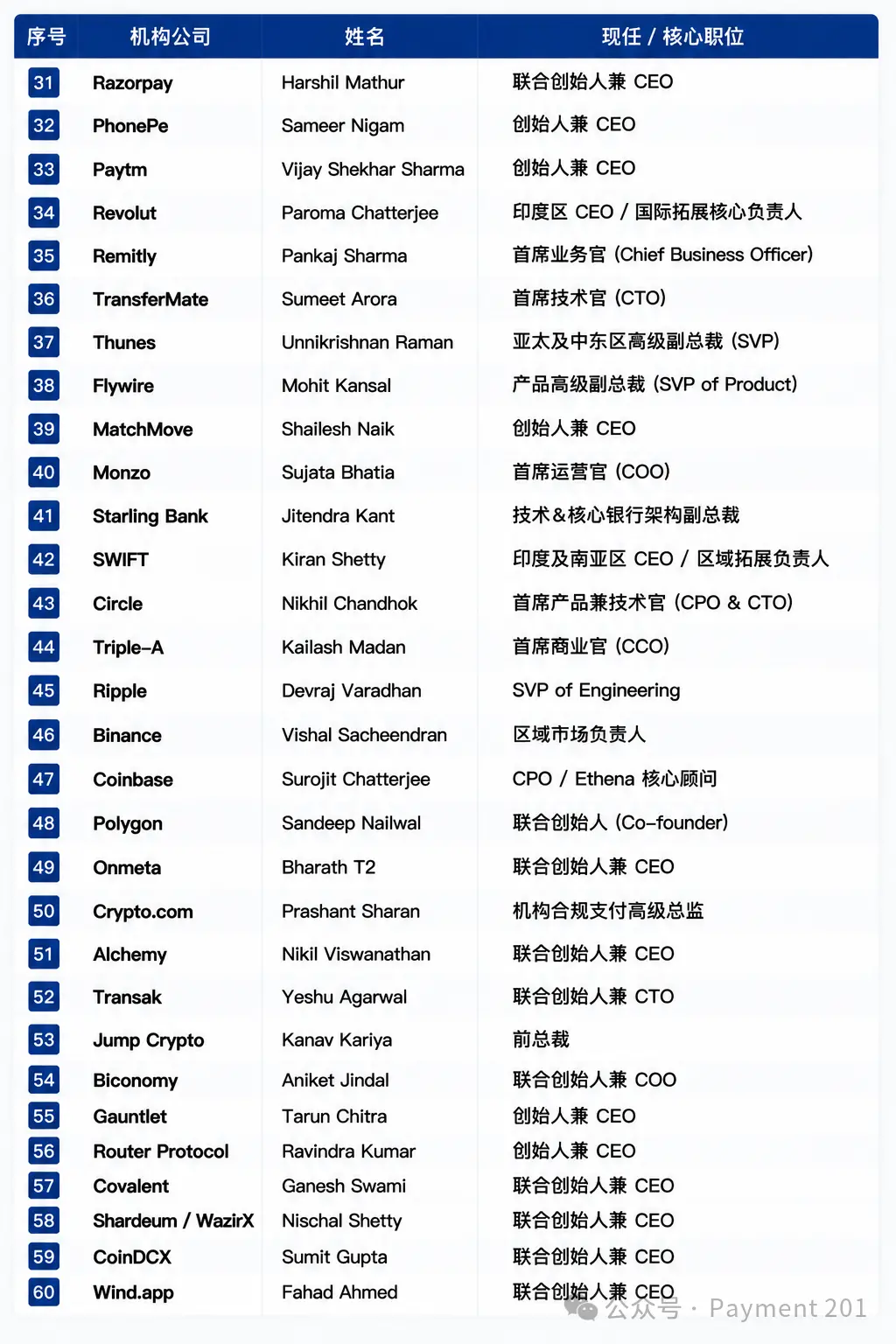
Appendix: A Map of Indian-Origin Executives and Entrepreneurs in the Global Fintech and Payment Ecosystem (60 people), the following data is sourced from the internet

免责声明:本文章仅代表作者个人观点,不代表本平台的立场和观点。本文章仅供信息分享,不构成对任何人的任何投资建议。用户与作者之间的任何争议,与本平台无关。如网页中刊载的文章或图片涉及侵权,请提供相关的权利证明和身份证明发送邮件到support@aicoin.com,本平台相关工作人员将会进行核查。


