The end of the CASP transition period marks a watershed moment for the EU crypto asset service market as it shifts from transitional operation to licensed operation.
Written by: FinTax
1 The CASP transition period has arrived, and most companies lose their operational eligibility in the EU
MiCA is the EU's first unified regulatory framework for crypto assets, mainly covering cryptocurrency assets, crypto asset issuance, and service activities not yet regulated by existing EU financial services legislation. It systematically regulates aspects such as transparency requirements, information disclosure obligations, licensing procedures, and trading supervision measures. Before the implementation of MiCA, each European country had its own independent cryptocurrency regulatory rules, and European crypto asset service providers mainly relied on national-level VASP registration or anti-money laundering registration systems to conduct their business. The registration thresholds, review focuses, and regulatory intensity varied across countries, making it difficult for service providers to operate across the EU market based solely on registration in one country. MiCA aims to improve this fragmented regulatory situation: once service providers obtain CASP authorization, they can essentially conduct business in 27 member states through the MiCA passport mechanism.
In June 2023, MiCA began to take effect, with rules related to stablecoins such as asset-referenced tokens (ART) and electronic money tokens (EMT) applicable from June 30, 2024, and CASP authorization rules applicable from December 30, 2024. For institutions that have previously provided services legally based on the laws of member states, MiCA has established a transitional period arrangement allowing them to continue operation for a certain time. The EU-level transition period is 18 months, while countries can independently decide whether to shorten the transition period, for instance, Germany has set it to 12 months and Finland to only 6 months.
The overall transition period for MiCA ended on July 1, after which cryptocurrency exchanges, brokers, and wallet service providers that have not obtained MiCA licenses will be unable to continue offering relevant services to EU users. According to Hogan Lovells, over 3,000 crypto companies are expected to be registered and operational by 2024. However, as of now, only about 280 companies have obtained CASP authorization, a number far below the market size before the implementation of MiCA. It is expected that approximately 75% of existing companies will lose their operational eligibility, including well-known crypto trading platforms like Binance, MEXC, and HTX.
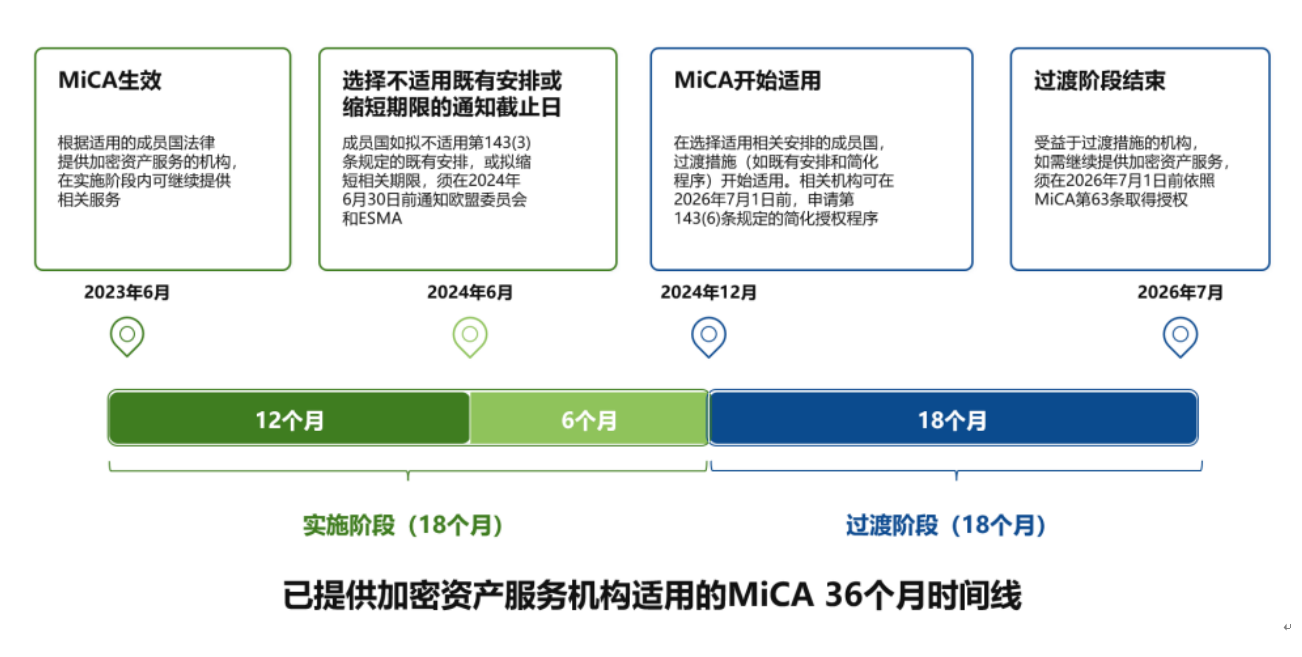
The transition window has officially closed across the EU; the EU crypto market will fully enter a clearer licensed operating phase. Any crypto asset service provider operating without MiCA authorization must cease relevant activities — including stopping the processing of new customer onboarding, halting marketing and customer acquisition activities, and guiding existing users to withdraw assets or transfer to licensed institutions. Business activities must be limited to those necessary for an orderly exit; otherwise, it will violate the law. Some national regulatory authorities will also implement measures such as website bans and public warning lists to ensure that the licensing system is enforced.
2 What is MiCA? A review of the core content of the bill
The implementation of MiCA adopts a model combining EU-level coordination and execution by member state authorities. The European Banking Authority (EBA) and the European Securities and Markets Authority (ESMA) are responsible for technical standard setting, regulatory coordination, and some direct supervision duties, while the authorization review and daily supervision of CASP are mainly carried out by the market regulatory agencies and central banks designated by each member state. For example, in France, the local regulatory responsibilities are handled by the Autorité des Marchés Financiers (AMF) and the Autorité de Contrôle Prudentiel et de Résolution (ACPR), while in Croatia, it is managed by the national bank and financial regulatory agency (HANFA), and in Slovakia and Hungary, the central bank is responsible.
MiCA applies to natural persons, legal persons, and other entities engaged in the issuance of crypto assets, public offerings, trading, or providing services related to crypto assets within the EU. Its core rules are summarized as follows:
2.1 Asset classification
MiCA defines crypto assets as a digital representation of value or rights that can be electronically transferred and stored using distributed ledger technology or similar technologies. Under the MiCA framework, crypto assets can be primarily categorized into three types.
- The first type is electronic money tokens (E-money Tokens, EMT), which are crypto assets that maintain a stable value by referencing the value of a single official currency, functioning similarly to electronic money. USDC and USDT are typically discussed under this category.
- The second type is asset-referenced tokens (Asset-Referenced Token, ART), referring to crypto assets that maintain a stable value by referencing the value of several fiat currencies, one or more commodities, or one or more crypto assets or related combinations.
- The third type is other crypto assets, such as utility tokens (Utility Token, UT), which aim to provide digital access to a certain commodity or service, offered on DLT, and accepted only by the issuer of the token.
2.2 Regulatory requirements for crypto asset issuers
According to Article 3 of MiCA, "issuer" is defined as an individual, legal entity, or other organizations that issue crypto assets. The issuance requirements vary depending on the type of crypto asset.
- Crypto assets, utility tokens: In principle, a white paper for the crypto asset must be drafted, notified, and published before the public offering or request for access to trading; however, MiCA has set exemption rules for small-scale offerings, those only aimed at qualified investors, and free distributions.
- Asset-referenced tokens (ART): The issuer must obtain authorization from the designated regulatory authority in the home country, draft a white paper, and get it approved by the national regulatory authority before issue; must meet own fund requirements, generally not lower than €350,000, and the specific amount must be determined in conjunction with the scale of reserve assets; must comply with reserve asset management standards, including segregation, custody, investment, etc.; for important ART issuers, the restrictions on risk management, liquidity policies, and own funds requirements are stricter.
- Electronic money tokens (EMT): EMT can only be issued by licensed credit institutions or electronic money institutions and must draft and notify a white paper; additionally, the issuer must comply with requirements related to fund protection, redemption rights, reserve management, and additional regulation of important EMT.
- Non-fungible tokens (NFT): In principle, not subject to MiCA restrictions; however, Recital 11 points out that if NFTs are issued in the form of "large series or collections," they may be deemed not to be "non-fungible," meaning that their issuance and other services established on such NFTs may be subject to MiCA requirements.
Securities tokens: Not subject to MiCA but governed by securities regulations.
The Reserve Bank of India (RBI) reiterated its stance on curbing or even banning private cryptocurrencies in a document submitted to the parliamentary financial permanent committee. The RBI stated that implementing conventional financial regulations on crypto assets could give cryptocurrencies "false legitimacy" and "false security," emphasizing the need to isolate the banking system from crypto asset risks and requiring banks and other regulated financial institutions not to hold, trade, or provide exposure to crypto assets and privately issued stablecoins.
2.3 Regulatory requirements for crypto asset service providers (CASP)
Crypto asset service providers (CASP) refer to entities that professionally provide one or more crypto asset services to third parties. Under the MiCA framework, "crypto asset services" include:
- Custody and management of crypto assets on behalf of clients
- Operating crypto asset trading platforms
- Converting crypto assets into funds
- Converting crypto assets into other crypto assets
- Executing crypto asset orders on behalf of clients
- Distributing crypto assets
- Receiving and transmitting crypto asset orders on behalf of clients
- Providing crypto asset advisory services
- Providing crypto asset portfolio management
- Offering crypto asset transfer services on behalf of clients
It is evident that MiCA defines the scope of CASP quite broadly. Anyone providing any service defined as a crypto asset service in this regulation for commercial purposes will be classified as a CASP and must obtain such authorization from the competent authorities of member states to operate.
In addition to authorization requirements, MiCA imposes ongoing compliance obligations on CASPs. For example, CASPs need to maintain sufficient capital, and members of the management body must have a necessary good reputation and capability regarding their qualifications, experience, and skills in performing their duties and must demonstrate their capability to devote sufficient time to effectively fulfill their responsibilities. The different types of services provided by CASPs will correspond to more specific regulatory requirements:
- Custodians need to develop custody policies and regularly inform clients about asset situations, and they bear responsibility for the loss of client assets due to their own fault;
- Trading platforms need to implement market abuse detection and reporting systems, or publicly disclose current buy and sell prices and trading depth;
- Brokers need to establish non-discriminatory policies with clear pricing methods;
- Advisors and portfolio managers need to assess whether crypto asset investments are suitable for their clients based on risk tolerance and knowledge.
3 The impact and significance of the end of the CASP transition period
The end of the CASP transition period under MiCA marks the official shift of the EU crypto asset service market from transitional operations under existing national systems to a unified authorization and regulatory phase under MiCA. This change not only affects the market positions of licensed and unlicensed entities but also further influences regulatory practices in various countries and the competitive landscape of the EU market.
3.1 Ordered exit for unlicensed CASP
After July 1, 2026, CASPs that have not obtained MiCA authorization will no longer be able to normally provide crypto asset services to EU customers, but they may continue to provide services strictly necessary for an orderly exit, such as selling, transferring, reallocating assets, or closing positions.
On June 23, ESMA released a public statement reiterating that unlicensed CASPs must develop a credible and immediately executable exit plan and clearly, promptly, and repeatedly communicate with clients regarding the measures taken to protect client assets and the exit arrangements. National regulatory authorities also released similar clear signals. On June 26, the chairman of the Spanish market regulator, Carlos San Basilio, stated that for cryptocurrency companies unable to obtain a license under MiCA, the Spanish market regulator would not grant any extensions or exemptions. The regulatory focus after the end of the transition period will be on ensuring the orderly exit of unlicensed entities while protecting client assets and market order during the exit process.
Under the aforementioned regulatory requirements, unlicensed CASPs also need to reconsider their EU market strategy on a business level. Some service providers may continue to seek MiCA authorization to maintain their EU market presence. For example, Binance, despite setbacks in applying for a Greek license, has stated that it will not give up on the EU market. According to Reuters, Binance has already engaged in talks with regulators in Ireland, Latvia, and Greece but faced varying degrees of resistance. At the same time, some companies may decide to scale back operations or exit the EU, shifting resources to other jurisdictions, such as choosing to focus resources on emerging crypto asset markets in the Middle East that have relatively flexible environments and strong policy attractiveness. Additionally, some enterprises may gain operational eligibility through cooperation, reorganization, or mergers and acquisitions. To some extent, the implementation of MiCA has raised the entry and compliance thresholds for the EU market. With the end of the transition period, smaller operators or those unable to bear compliance costs will be forced out of the market, leading to a reallocation of industry resources and accelerating the concentration towards authorized leading institutions.
3.2 Market opportunities flow to licensed CASP
In contrast to the exit pressure faced by unlicensed entities, licensed CASPs have embraced new market opportunities. MiCA authorization allows for the provision of relevant crypto asset services across the EU via the passport mechanism. They not only have the qualification to continue serving EU customers but can also convert this compliant status into a competitive advantage in the market.
This competitive advantage first manifests in customer migration. As unlicensed platforms cease normal operations, licensed entities with complete compliance qualifications and faster compliance progress will have opportunities to absorb more customer migrations, asset inflow service demands, and overflow transaction volumes, thereby broadening their business reach. Currently, licensed platforms in the market have begun proactively competing for migrating users' assets through deposits, transfers, and new user rewards. For example, a well-known exchange has directly utilized the MiCA deadline as a marketing context, offering EEA users deposit rewards of up to 8% and up to 20,000 USDC, as well as welcome benefits for new users.
3.3 Full implementation of MiCA, compliance challenges remain
The comprehensive implementation of the MiCA framework also brings various challenges. On the one hand, the impact of MiCA will not stop at the license itself. Obtaining CASP authorization is only the first step into the EU market; future crypto companies will also need to respond to rules regarding anti-money laundering, data protection, and tax information reporting, which collectively form the basic framework for EU crypto compliance.
On the other hand, execution discrepancies among member states still exist. Although MiCA has solved the issue of uniformity at the rule level, the specific authorization reviews, daily supervision, and enforcement are still mainly the responsibility of the competent authorities of each member state. The technical standards that countries can implement may differ slightly, inevitably leading to practical gaps. Public data shows that as of April 2026, some national agencies have approved a large number of CASP applications, while others have approved only a few, and some have not approved any applications at all. Regulations originally aimed at creating a unified market have resulted in distinctly different execution effects due to differences in application submission locations. Consequently, some enterprises tend to choose regions with lower regulatory requirements and higher approval efficiency to apply for authorization. Beyond license applications, member state authorities can independently decide how to implement some of the more flexible technical standards under MiCA, and authorized service providers and issuers should prepare for compliance, paying attention to subtle differences in the implementation processes at the national level.
4 Conclusion
The end of the CASP transition period is a watershed moment for the EU crypto asset service market as it moves from transitional operations to licensed operations. Unlicensed entities will face pressure to exit or restructure, while authorized platforms can expand their market share using the passport mechanism and the customer migration window. In the future, the impact of MiCA will continue to extend into areas such as stablecoins, cross-border enforcement, member state regulatory coordination, and industry consolidation. The competitive logic of the European crypto asset market will also change accordingly: compliance capability will no longer merely be a regulatory cost but will become a core competitive strength for platforms in gaining users' trust, attracting asset inflows, and achieving long-term operations.
免责声明:本文章仅代表作者个人观点,不代表本平台的立场和观点。本文章仅供信息分享,不构成对任何人的任何投资建议。用户与作者之间的任何争议,与本平台无关。如网页中刊载的文章或图片涉及侵权,请提供相关的权利证明和身份证明发送邮件到support@aicoin.com,本平台相关工作人员将会进行核查。


