Author: Gu Yu, RootData
Recently, with projects like BitMEX and Bitmart announcing shutdowns one after another, dead projects have once again become a focal point of market discussion. Currently, RootData's compilation of the 2026 Crypto Project Death Compilation has included over 100 projects.
The large-scale elimination of low-quality projects and the extreme pessimism of sentiment are often viewed as signs of the bear market bottoming out. At this point in time, what phase is the cryptocurrency industry in within its historical cycle? How are indicators like the number of new projects, new tokens, and funding data looking?
Based on these questions, RootData has organized exclusive multi-dimensional data on the platform and created 5 charts to better help everyone understand the current state of development in the crypto industry and its position in the entire historical cycle.
1. Number of New Projects
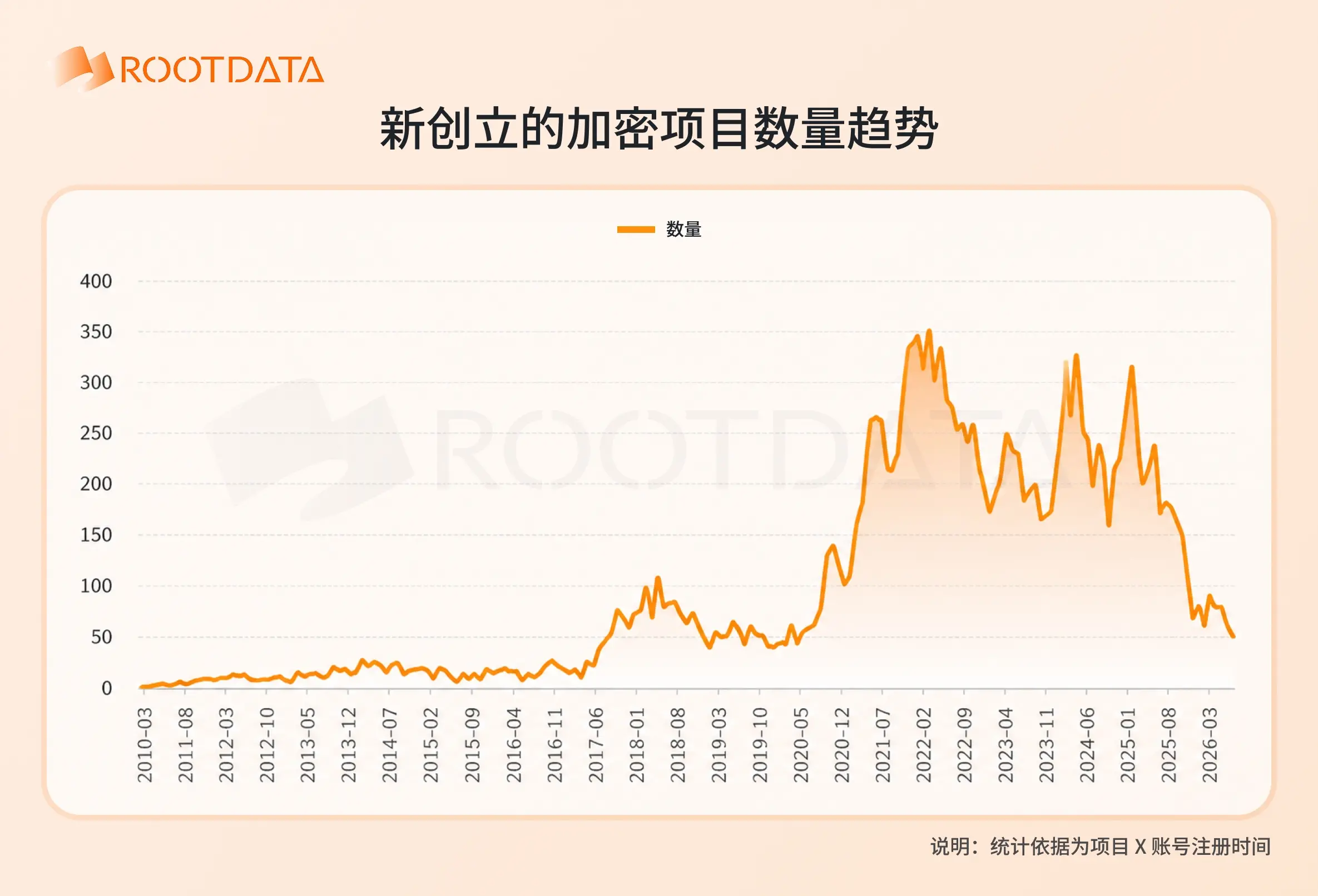
The number of new projects is one of the most important indicators of crypto market activity, reflecting entrepreneurs' enthusiasm for the prospects and opportunities in the crypto market.
This chart is primarily based on the registration time statistics of over 20,000 projects recorded by RootData's X account, which can accurately represent the establishment and market entry of new projects, down to the month.
From this chart, we can see that the peak period for the number of newly established crypto projects was from September 2021 to January 2022, with over 300 new projects every month, during which the price of BTC reached a historical high of $69,000. Since then, the number of new projects has shown a continued downward trend, with slight rebounds in March 2023, March 2024, and January 2025.
After that, the number of new projects has drastically declined, with the monthly number of new projects this year not exceeding 80, nearing levels before August 2020. Notably, at this time, the BTC price is on par with the price during the peak of new project numbers at the end of 2021.
2. Project Funding Data
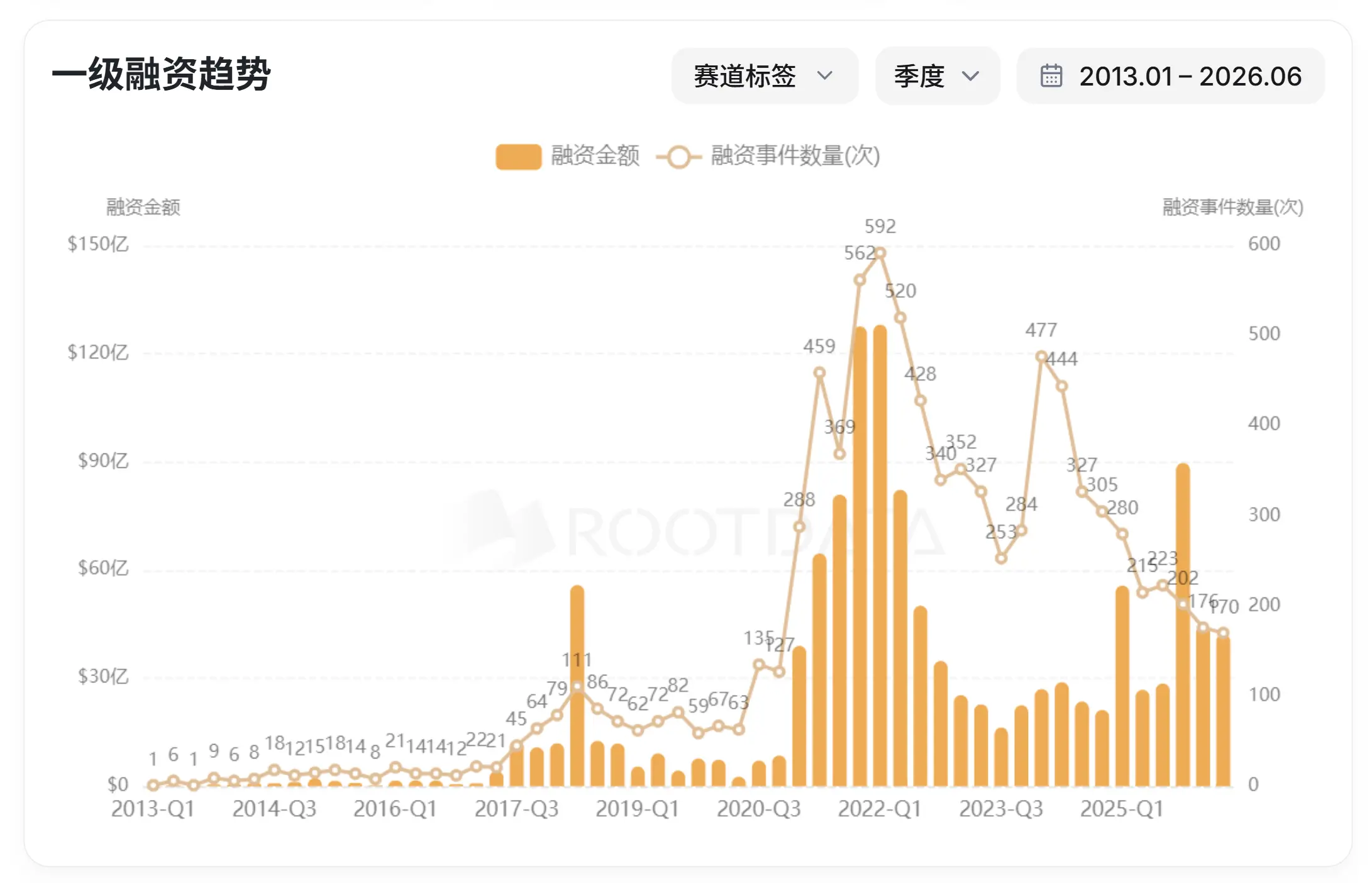
In recent years, funding in the crypto primary market has shown obvious characteristics of peak decline and structural adjustment.
From 2021 to early 2022, the market was in an extremely active phase, with quarterly funding amounts repeatedly surpassing $10 billion, reaching nearly $13 billion at its highest, and the number of funding events also soaring to a historical peak of 592, with both the scale and frequency of capital influx reaching phase highs.
As the prices of mainstream cryptocurrencies fell and the market turned bearish, the investment amounts in 2023 dropped to near five-year lows and continued to hover at low levels, but the number of funding events quickly surged in March 2024, attempting to capture potential opportunities through a decentralized investment strategy amid limited funding, which later proved difficult to avoid poor investment returns.
In the past year, the trends of funding quantity and amounts have gradually diverged in opposite directions; although the number of funding events has continued to decline in recent years, the funding amount has significantly increased since late 2024, primarily due to the substantial funding of major projects such as Binance, Polymarket, and Dunamu.
Currently, the number of funding events in the crypto market has declined for three consecutive years, marking the longest downtrend period in the history of the crypto industry. Even a new high in BTC prices in 2025 has not reversed this trend, reflecting a shift in capital toward a highly cautious allocation logic, accelerating the concentration toward top tracks and projects with strong certainty and high barriers, rather than broadly betting on emerging projects, thus intensifying the market's Matthew effect.
3. Number of Mergers and Acquisitions
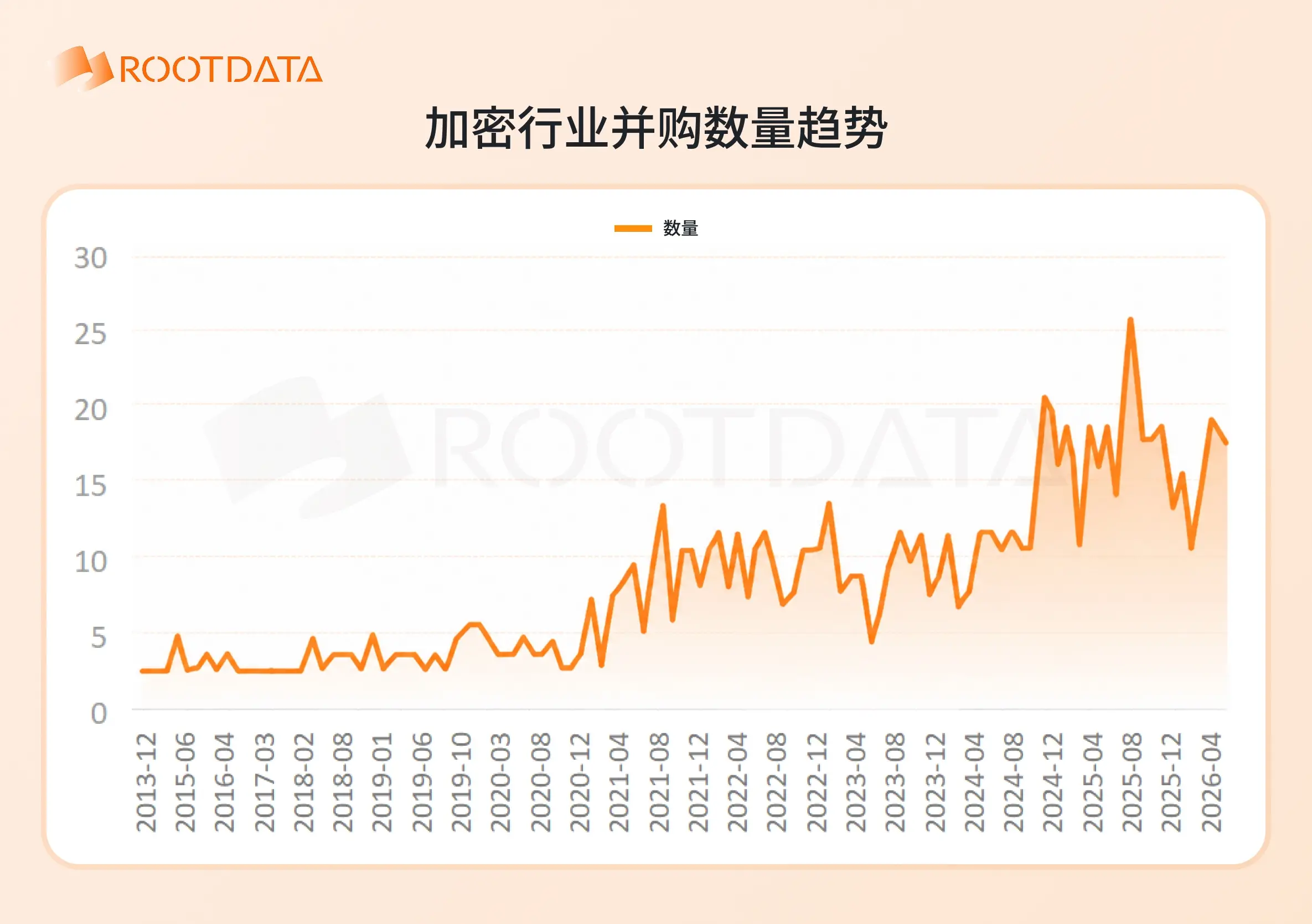
In contrast to the significant contraction trend in the crypto investment and financing market, the number of mergers and acquisitions in the crypto industry remains at a historically high level, experiencing a structural shift from sporadic experimentation to widespread outburst.
Between 2013 and 2020, the merger and acquisition transaction volume in the crypto industry remained in single digits for a long time, breaking through 10 transactions for the first time in 2021, reaching 11 transactions in 2022, and then accelerating upward. The year 2025 became a landmark watershed: a total of 267 mergers and acquisitions were completed throughout the year, a year-on-year increase of over 50%.
Entering 2026, despite the bearish spot prices in the crypto market, M&A activities have instead heated up. In the first half of the year, a total of 75 transactions occurred, with a total amount exceeding $9 billion, surging 26 times compared to the same period last year.
Typical cases include Mastercard's acquisition of payment infrastructure BVNK for $180 million, and Blockworks acquiring data platform Messari at a price far below its earlier valuation (with a discount of over 90%), clearly indicating that low-cost bottom-fishing and foundational positioning have become mainstream strategies.
Meanwhile, crypto giants like Coinbase, Kraken, and Moonpay aim to enhance their control over upstream and downstream industrial chains through mergers and acquisitions while traditional internet and financial companies are accelerating their entry into the market, acquiring core capabilities through M&A to gain an advantageous position in the increasingly large crypto market.
Overall, crypto mergers and acquisitions are evolving from cyclical activities into a wave of institutional consolidation. As the global regulatory framework becomes clearer, the future of the crypto industry may be dominated by a few giants that hold licenses and infrastructures, with the integration process likely to deepen further.
4. Number of New Tokens
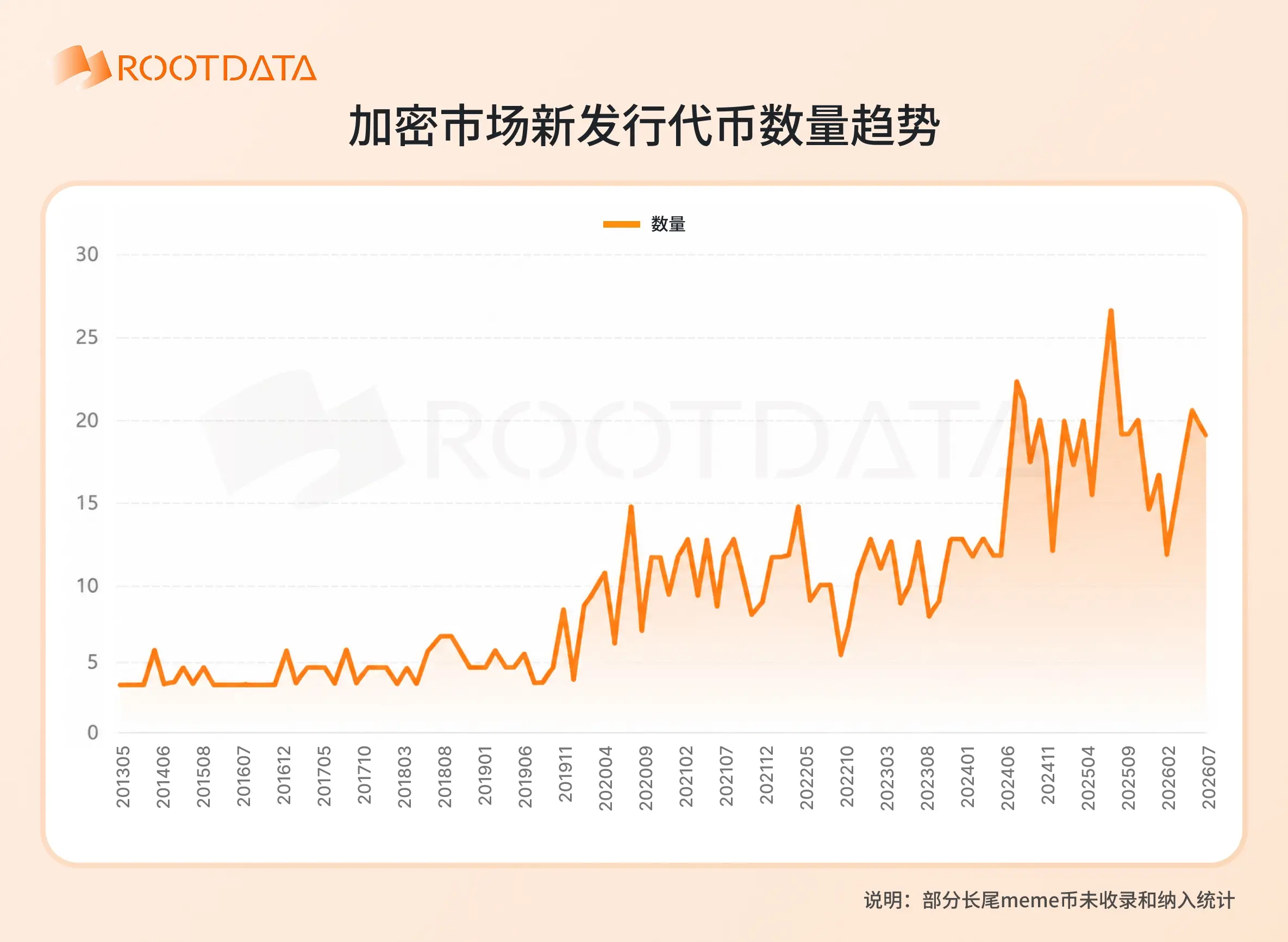
The number of new tokens is one of the most important indicators reflecting the activity level in the crypto secondary market; most project parties tend to issue tokens during periods when the market is warming up and the situation is favorable, closely tied to the popularity of new narratives.
Throughout the entire historical cycle, the number of new tokens peaked twice in 2018 and 2021, but the real historical peak period begins in March 2024, creating a historical record of 145 new tokens in January 2025, which is vastly different from the peak periods shown in other charts.
This is primarily related to the Meme craze and AI agent narrative that emerged since 2024. In January 2024, pump.fun launched on the Solana mainnet, greatly lowering the technical barrier for ordinary users to issue tokens. Around March 2024, the meme wave officially erupted, with various tokens like BONK, WIF, and BOME seeing hundredfold increases, leading to a market narrative of "attention equals value": anything that can attract attention can be tokenized.
By the end of 2024, projects like Truth Terminal and ai16z drove the AI agent narrative to fame, with the Virtuals Protocol allowing users to quickly create, tokenize, and trade AI agents, resulting in over 10,000 AI agent projects created in recent years.
The foundation is the technological democratization of token launch platforms, the fuel is meme culture, and the AI agent craze serves as a strong booster in later stages. These factors collectively contributed to the high number of new tokens in the crypto market reaching a peak in January 2025.
However, in this cycle, many tokens have very short lifecycles, with most tokens going to zero in a short time, leading to a severe dilution of market liquidity, and the traditional "alt season" has been postponed or fragmented.
5. Number of Primary Market Investors
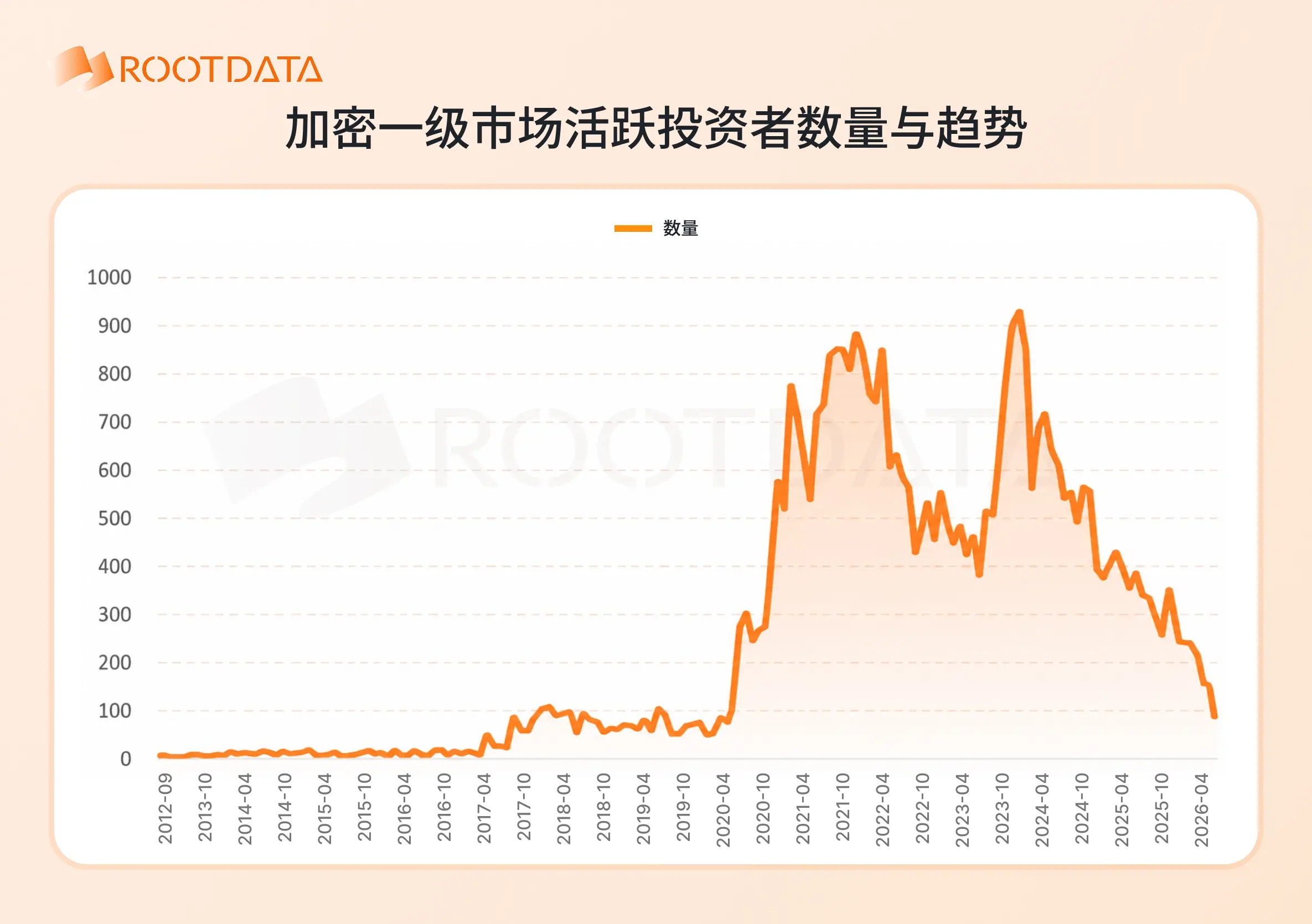
According to RootData data, nearly 7,000 projects, VCs, or individuals have participated in primary market funding rounds, with the number of VCs totaling 2,617 and nearly 3,000 individuals.
Although related to the state of the crypto primary market, this chart did not see a significant decline since 2021 like funding amounts and quantities. Instead, it experienced a peak in April 2024, with the number of participating investors exceeding 900, setting a historical record.
This is primarily due to changes in the thematic structure of investors. From 2021 to 2022, the main participants in the crypto funding market were VCs, with many secondary and tertiary VCs heavily investing in altcoin projects, averaging over 20 investments per month at one point. Likewise, many projects’ funding rounds often featured 20-40 VC names to showcase their popularity.
However, during the bear market from 2022 to 2023, many VCs were eliminated from the market, and angel investors, primarily consisting of entrepreneurs and KOLs, began to become among the most active participants in the primary market. Numerous projects started listing dozens of angel investors in their funding PRs, with the highest record exceeding 100.
But as the number of funding rounds continues to decline and investor returns are very poor, angel investors are also beginning to fade from most projects' investor lists. This month, the number of investors with investment records is only around 100, marking a new low since July 2020.
6. Number of New Ecosystem Projects
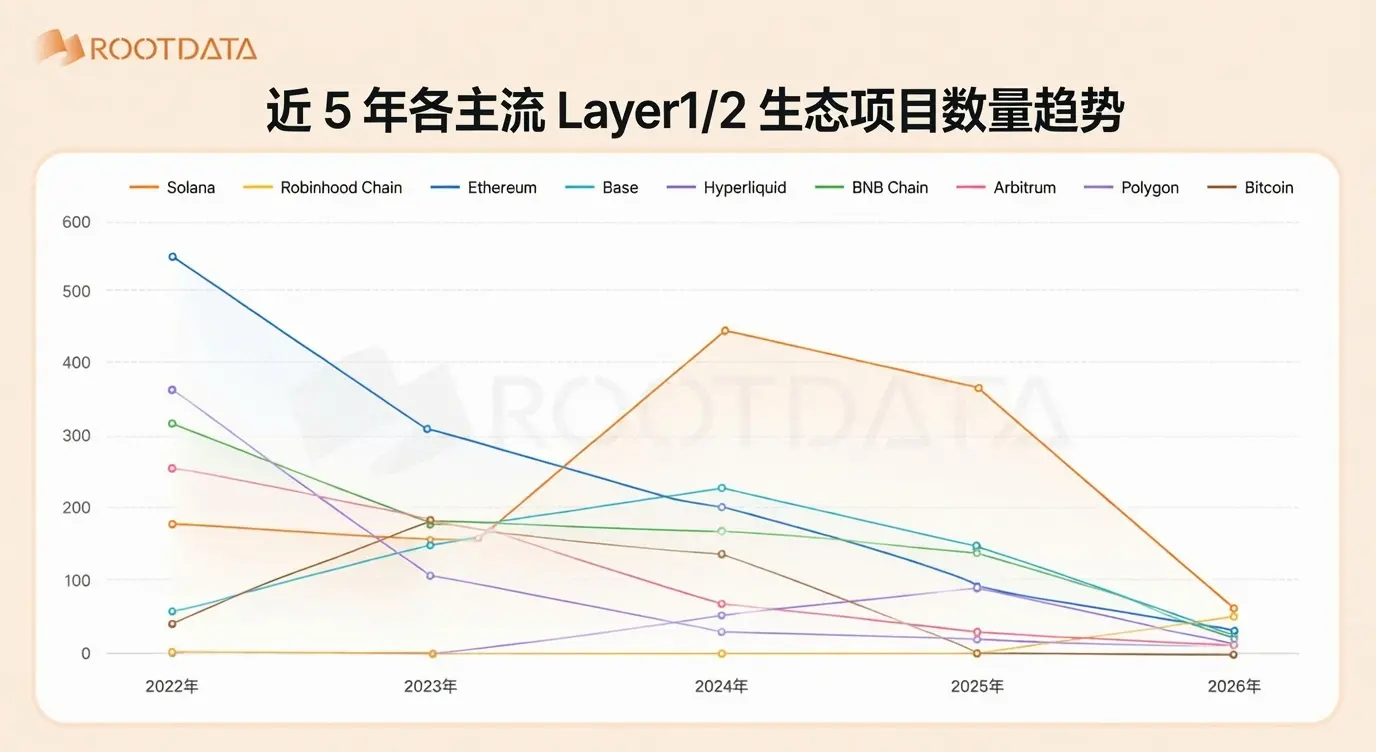
New ecosystem projects across various Layer1/2 have long been a major source of new projects in the cryptocurrency industry, with many Layer1/2 hosting various hackathons, incubation programs, etc., to enhance their ecosystem activity.
For a long time, Ethereum and its Layer2 have dominated the number of new projects, claiming the top four spots in 2022, while Solana emerged as a major destination for new projects in 2024 during its DeFi and meme wave. Meanwhile, Hyperliquid, Arc, and Robinhood Chain became few new Layer1/2 that made the list in the past two years, further squeezing the market space of the Ethereum ecosystem.
In the first seven months of this year, the number of new ecosystem projects recorded by RootData across various Layer1/2 has significantly declined, with the current top 8 Layer1/2 being Solana (59), Robinhood Chain (42), Ethereum (36), Base (30), Hyperliquid (19), BNB Chain, Arbitrum, Polygon, Arc, and Sui.
免责声明:本文章仅代表作者个人观点,不代表本平台的立场和观点。本文章仅供信息分享,不构成对任何人的任何投资建议。用户与作者之间的任何争议,与本平台无关。如网页中刊载的文章或图片涉及侵权,请提供相关的权利证明和身份证明发送邮件到support@aicoin.com,本平台相关工作人员将会进行核查。


