
Author: Jae, PANews
In traditional financial markets, high-frequency trading firms are willing to spend tens of millions of dollars to lay exclusive fiber optics and even rent microwave towers to shorten the signal transmission time between Chicago and New York for a few milliseconds of latency advantage. This is a pure physical race; the closer one is to the exchange's data feed, the quicker they can capture prices and execute orders first.
Now, Hyperliquid has brought this competition on-chain and rewritten the rules. There is no longer a need to lay fiber optics or rent microwave towers. Traders just need to pay HYPE tokens to "jump the queue" in the data propagation and order matching queues.
According to data from the crypto research firm GLC Research, this mechanism called “Priority Fee” has generated over $5 million in protocol revenue since its launch. Based on average levels over 14 days and 30 days, the annualized buyback scale supported by priority fee revenue will exceed $30 million, accounting for about 7% of the total protocol revenue.
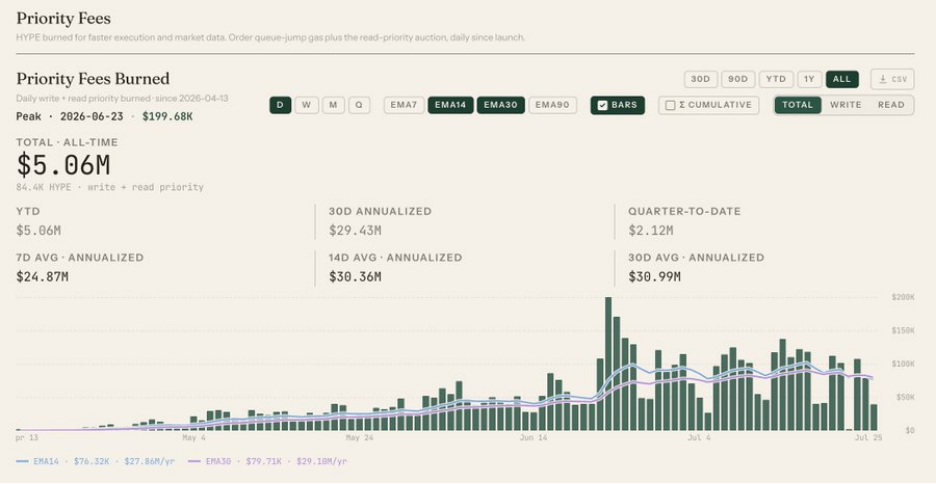
This is not just a simple functional iteration; it also marks the first time that a Perp DEX (decentralized perpetual contract exchange) has the capability to realize MEV (maximum extractable value) through block space and latency pricing, similar to public chains like Ethereum and Solana.
Dual-track Architecture: Splitting Millisecond Latency into Two Auction Items
In traditional centralized exchanges, the speed advantage of high-frequency trading firms comes from dedicated lines, custody server rooms, and a hardware arms race. However, in the on-chain world, Hyperliquid has transformed this “millisecond war” into a publicly accessible and transparent economic game system.
The priority fee is not simply a "pay Gas fee to jump the queue", but a time-delay auction and memory pool reconstruction system tailored for decentralized limit order books (CLOB), divided into two independent technical tracks: “Data Reading Priority” and “Order Writing Priority”, addressing the two major demands of high-frequency quantitative firms regarding “information perception” and “trade execution”.
Data Reading Priority (Gossip Priority): Bidding for Information Privilege
For high-frequency quantitative strategies, perceiving market changes and clearing signals a few milliseconds earlier means making decisions sooner, and victory or defeat often lies in that fleeting moment.
Hyperliquid allows nodes to receive data streams ahead of complete trade execution. The platform holds a Dutch auction every 3 minutes, selling 5 data propagation priority slots. The winning nodes will receive the fastest data push, with each slot averaging about 25 milliseconds of latency advantage. Bidding fees are directly deducted from the user's spot account HYPE balance.
Order Writing Priority: Transaction Execution Queue Jumping Rights
Simply knowing early is not enough; whether an order can be executed first is the key to determining profit and loss.
For IOC (Immediate or Cancel) and ALO (Limit Maker) orders, users can specify fee rate parameters to purchase order sorting priority in the memory pool. Within a fee range of 0 to 8 basis points, for each additional basis point of priority fee, the order's end-to-end execution latency can be reduced by about 45 milliseconds. Within a 70-millisecond time block, orders with fees exceeding 8 basis points are ranked in descending order according to the amount of priority fee.
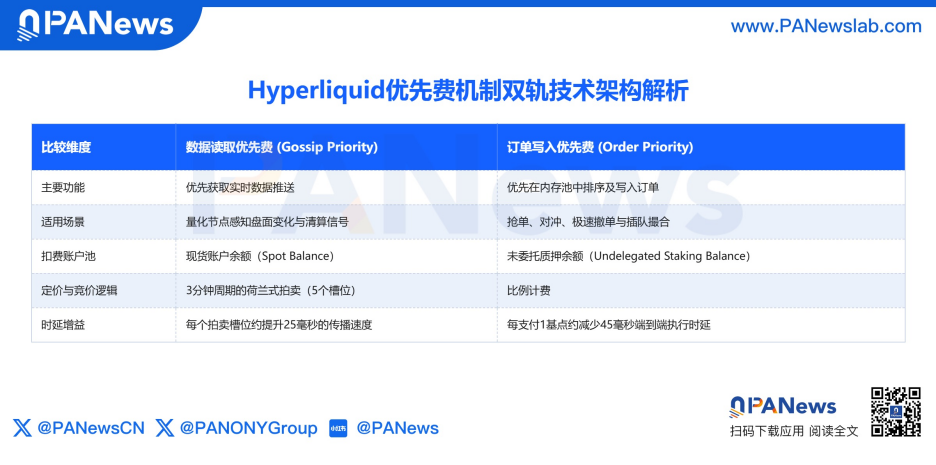
The most significant advantage of this design is that it transforms the hardware competition for physical machines and dedicated network lines seen in traditional high-frequency trading into an open economic game on-chain. Speed is no longer monopolized by hardware but is allocated through market-based pricing.
Income Potential Explosion, Protocol Retaining MEV Intrinsic Value
The priority fee is a new feature that has generated $5 million in revenue in a short time and is even expected to challenge an annualized $100 million, reflecting the structural demand in the current decentralized derivatives market.
"Certainty" is the Line of Life and Death
Hyperliquid gathers a large number of whales and institutional funds, whose account positions have long maintained above $5.4 billion. In the high-leverage perpetual contract game, a latency difference of just a few milliseconds can determine the success or failure of an arbitrage strategy, the profit or loss of a hedging operation, and even whether an account will be liquidated.
Especially for market makers, the priority fee is an essential "protection fee". To prevent being “frontrun” or having their orders “eaten” during extreme market fluctuations, they would rather pay a high priority fee to ensure their orders or cancellations are accurately positioned at the front of the queue, in exchange for certainty in trade execution.
Market makers who gain protection for their orders will be more willing to provide deeper market liquidity, further narrowing the bid-ask spread on Hyperliquid, allowing ordinary users to enjoy better market depth and lower trading slippage.
However, efficiency improvements often come with a compromise on fairness. Priority fees are also no exception; their essence is to convert the capital advantage into a latency advantage. Well-capitalized quantitative firms can afford to pay high priority fees long-term, maintaining the front position in liquidation, arbitrage, and order matching. Ordinary users, especially during severe market fluctuations, are more likely to encounter large slippage or delayed executions, making them “victims” in the “bidding game”.
MEV Earnings "Are Not Flowing to Outside Fields"
In traditional public chains or DEX models, arbitrageurs such as Flashbots pay bribes to validators or inflate Gas fees to frontrun transactions, with most of the value flowing to external validators or MEV seekers. Hyperliquid, through its priority fee auction mechanism, internalizes the MEV value that would otherwise leak out into protocol revenue.This means that the platform itself has gained control over the pricing rights of block sorting, keeping the "toll fee" in its own pocket, representing yet another upgrade in the business model of Perp DEX and opening a new growth point for profit beyond conventional trading fees.
Ecological Expansion Stimulates Flywheel Effect
The growth of priority fees is also inseparable from the expansion of the platform's ecological boundaries.
As HIP-3 markets continue to expand, asset classes are becoming increasingly diversified, and cross-market, cross-category arbitrage opportunities will grow exponentially.Arbitrage activities typically have high execution speed requirements, which may form a positive cycle of "ecological asset expansion → growth in arbitrage demand → increase in priority fee income".
Token Economic Model Supplement: Dual Destruction + Fund Accumulation
The explosion of priority fees has not only added a source of income but fundamentally strengthened the value capture chain of the HYPE token, resonating with the existing token economic system.
For a long time, Hyperliquid's Assistance Fund mechanism has used 97% of the protocol's transaction fees to continuously and automatically buy back HYPE tokens in the secondary market. To date, the assistance fund has spent over $2.5 billion to buy HYPE, with a holding scale accounting for about 18% of the total circulation, serving as the backbone to support the token's price.
The priority fee mechanism adds a second engine of "deflationary effect" to HYPE. Unlike transaction fees entering the fund and being repurchased from the secondary market, the HYPE collected from priority fees is directly destroyed by the smart contract, reducing the total circulation without going through the secondary market.
On the other hand, the priority fee also brings a money accumulation effect. Order writing priority fees are forcibly deducted from the "Undelegated Staking Balance," meaning quantitative firms must keep a large amount of undelegated staked HYPE tokens in their accounts to maintain high-frequency trading queue jumping rights, which effectively locks up circulating chips in the market, significantly weakening the marginal selling pressure that could arise from token unlocking and providing extra stability for HYPE prices.
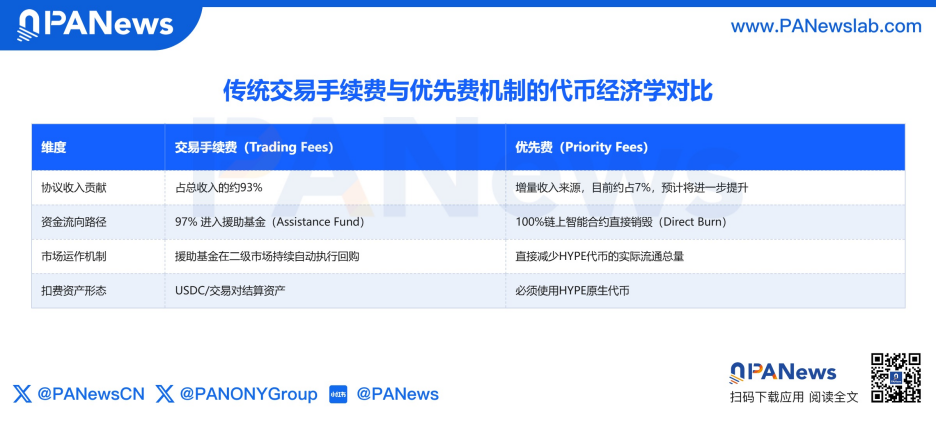
More importantly, the priority fee mechanism has created a new model for public chain economies to self-generate. Traditional public chains often rely on high token emission to subsidize validators, falling into a cycle of "issue → selling pressure → issue again". Hyperliquid auctions latency as a scarce resource, proving that decentralized networks can rely on real economic value to achieve self-sustainability and return profits to token holders.
However, how to balance the efficiency demands of whales with the trading fairness for retail investors will be a long-term challenge that the priority fee mechanism must address in its maturation process.
免责声明:本文章仅代表作者个人观点,不代表本平台的立场和观点。本文章仅供信息分享,不构成对任何人的任何投资建议。用户与作者之间的任何争议,与本平台无关。如网页中刊载的文章或图片涉及侵权,请提供相关的权利证明和身份证明发送邮件到support@aicoin.com,本平台相关工作人员将会进行核查。


