Written by: Cookie, Rhythm
Last month, we detailed the narrative of on-chain TCG cards, where "drawing cards" is almost currently second only to Hyperliquid and pump.fun as a crypto-native "printing press":
"CARDS increased 5 times in 2 months; are on-chain TCG cards another big narrative after HYPE?"
And last week, the winds of "drawing cards" finally blew onto the ETH mainnet. A new protocol named Fake World Assets has achieved approximately $1.3 million in revenue in just over a week since launch, ranking 15th in the past 7 days’ crypto application revenue leaderboard:
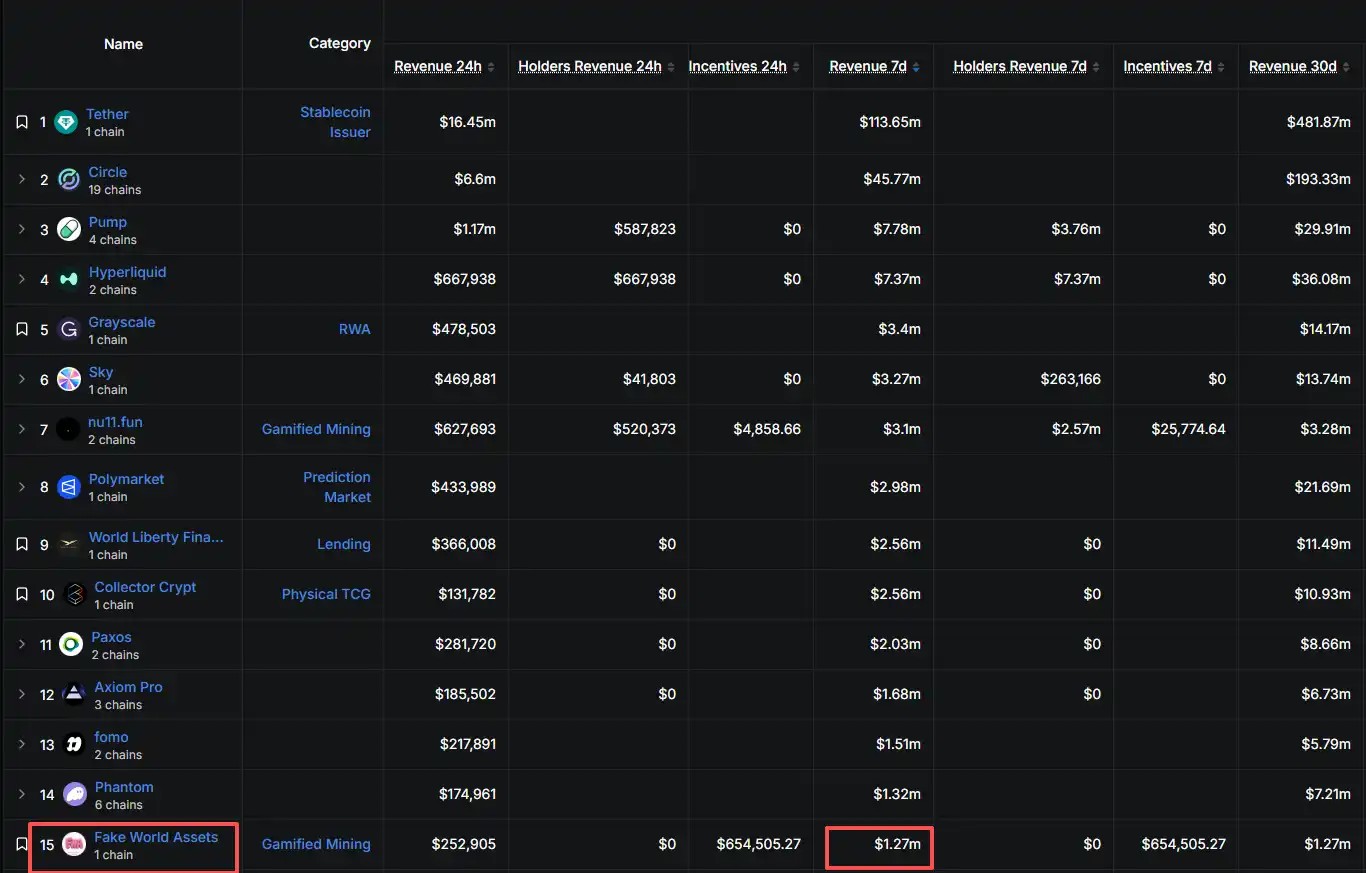
Meanwhile, the protocol token $FWA also soared from an initial market value of approximately $47,550 to about $38.8 million at its peak, an 800-fold increase. However, during this time, Collector Cards, despite maintaining strong revenue momentum, saw its token $CARDS drop from a peak market value of nearly $90 million a month ago to only about $28.87 million now.
Why?
The Gameplay of FWA
The team behind FWA, TokenWorks, should not be too unfamiliar to everyone. Their previous successful project was "PunkStrategy," which hit a maximum market value of $300 million in a month.
However, TokenWorks does not release successful projects every time. Their last project, TTT (Ten Thousand Tokens), was launched during the late stage of the Uniswap v4 hook craze. The gameplay was essentially a launchpad where only NFT holders could issue tokens, with an NFT total of 10,000, corresponding to only 10,000 tokens being issued from the platform, with transaction fees distributed among token issuers, all NFT holders, and the protocol.
Due to the inability to generate a hot product, the NFT price plummeted shortly after the platform opened.
Initially, I also missed out on FWA, thinking it was merely a simple "NFT draw" mechanic. But it has designed a token flywheel that allows $FWA to grow like a Ponzi scheme.
The $FWA token cannot be directly purchased externally. To acquire it, one must "draw cards."
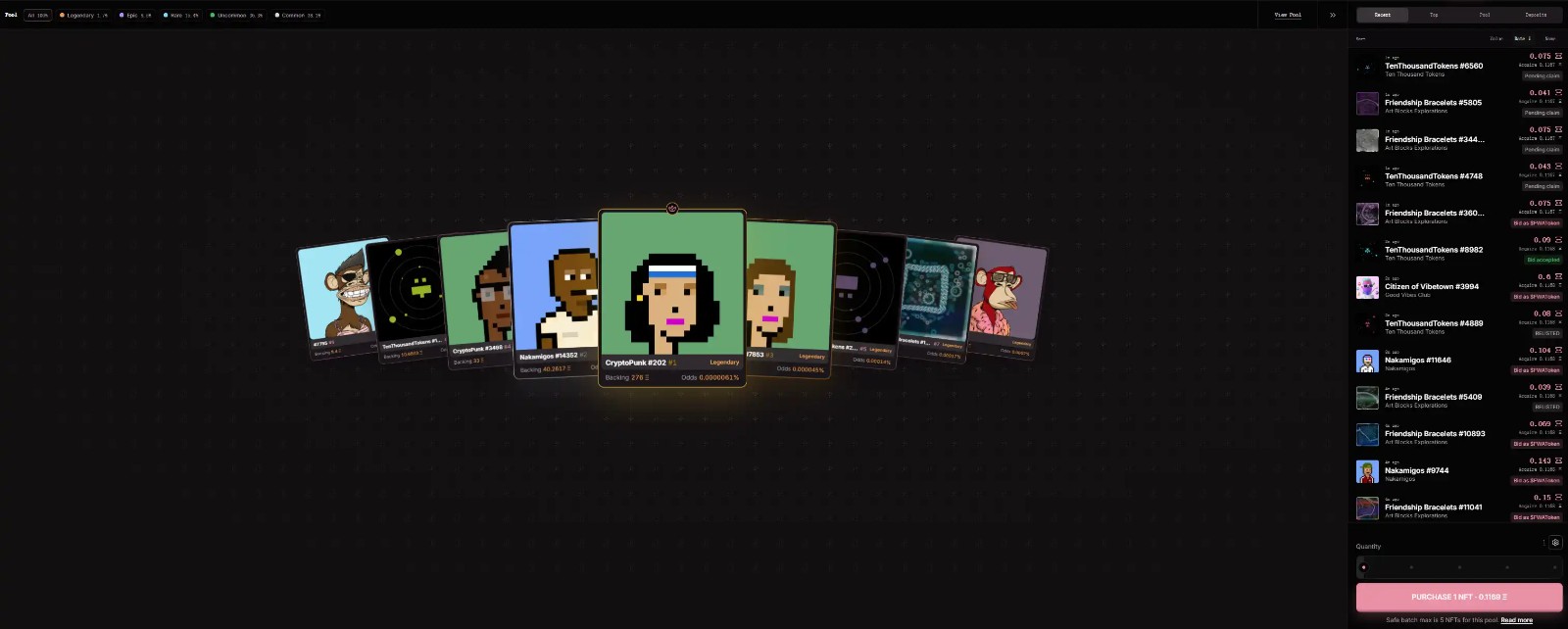
The NFTs in this pool are submitted voluntarily by players. When depositing NFTs, players must also deposit ETH as bilateral liquidity. This means that each player depositing assets effectively opens their own pool.
The more ETH deposited, the lower the probability of drawing the corresponding NFT. For example, for this CryptoPunks, there are 276 ETH paired with it, giving it a draw probability of only 0.0000061%, meaning that it may require drawing over 10 million times to potentially win it. Since the protocol began operating on July 3, there have been only 73,884 draws so far, averaging over 3,000 draws per day.
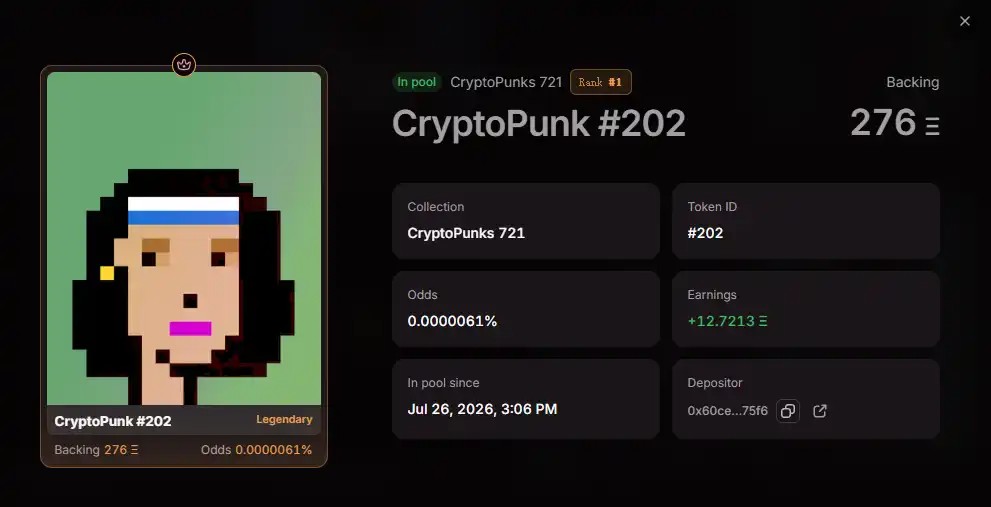
Moreover, it can be seen that the depositor of this CryptoPunks has already accrued 12.7213 ETH in revenue in just over a day. This income comes from:
- 1% fee is fixedly deducted every time someone draws a card
- If someone draws a satisfactory NFT and chooses to keep it, 1% of the earnings generated from the NFT’s depositor will be deducted
- Most players who draw common NFTs will immediately sell this NFT back to the corresponding depositor at an 85% discount; this price difference forms income
As for how much each player depositing NFTs and ETH can share, it does not depend on the amount of deposited assets but rather on how long the deposited NFT lasts in the pool; if the deposited NFT is never drawn, then profits can keep being shared. If it gets drawn, the dividends stop, and new NFTs must be deposited.
To ensure that one can remain in the pool long enough, more ETH needs to be deposited, incentivizing the pool to grow thicker and thicker.
At this point, we can give a clear summary that this mechanism is quite akin to an NFT AMM layered with a draw card mechanic.
The Flywheel of FWA
The most interesting aspect of the protocol token $FWA is that it cannot be purchased directly from external sources. To obtain this token, one must genuinely engage with this NFT gacha machine.
50% of the total token supply is used for adding initial liquidity, 30% for emissions in the first half month after launch (1% daily for asset depositors and card draw players), and 20% for early snapshot airdrops.
The most widespread way to acquire $FWA is to draw cards, and as mentioned earlier, when players draw NFTs they do not want, they can sell them back to the NFT depositors at an 85% discount. At this point, they can choose to get back ETH or opt for $FWA (the protocol automatically converts this ETH back into $FWA).
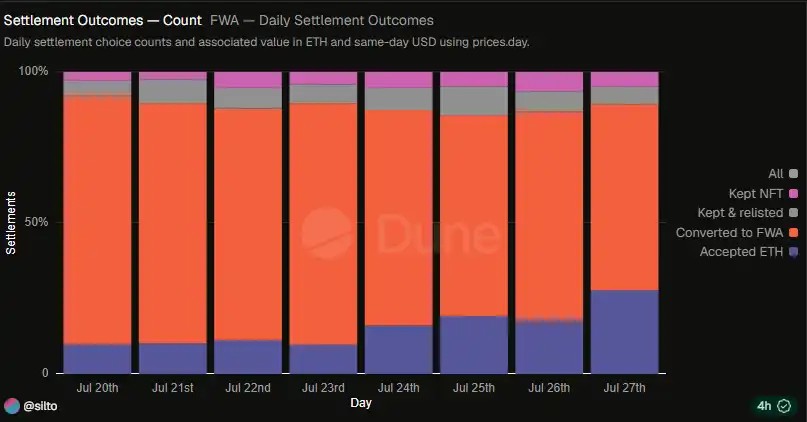
Most players choose to take $FWA after selling back undesired NFTs. Data shows that in the past 7 days, as much as 82.3% of operations opted to immediately sell back after drawing to acquire $FWA, especially during the early days when the token price hadn’t started yet. However, in recent days, as the price of $FWA rose to a high and began to correct, the choice to get ETH after an immediate sell-back has been gradually increasing, but the option to acquire $FWA still occupies over 60% on a daily basis.
If we directly convert the cost of acquiring $FWA, we find that each draw is actually a negative expectation; the cost of acquiring $FWA through drawing is actually higher than the today’s price of $FWA, resulting in a premium purchase.
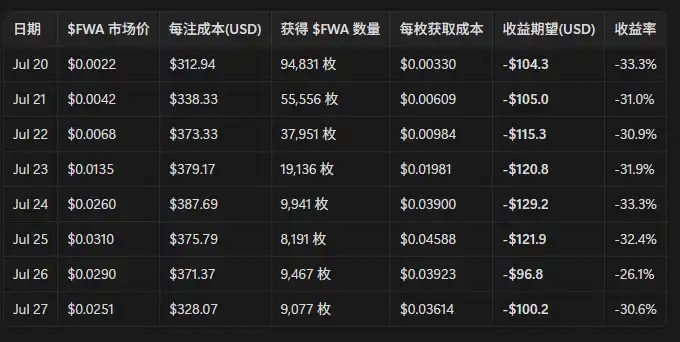
However, if one holds onto $FWA instead of selling it directly, during the period from July 20 to 23, each draw for $FWA was akin to printing money frantically. This is quite similar to earlier risking wear-off offers for the Blur airdrop; both are betting on subsequent tokens taking off, wagering time against space. But there is a distinction since this is actually a game of a significantly shorter betting cycle that primarily focuses attention—if this mechanism can be quickly discovered and becomes the focus of attention, as long as there is an increase in card drawing, there will be a large influx of buying $FWA. Newcomers will continually drive up the holdings' value for those who already hold $FWA.
This is also why FWA was able to surpass Collector Cards in market value in such a short time. Both have card drawing as their core gameplay and immediate repurchase price differentials as their core revenue, even though the drawing theme for Collector Cards (Pokémon cards) can attract a broader audience than NFT, and profit performance is better, but the utility of Collector Cards’ tokens has drawn considerable community criticism. Aside from the project’s repurchase (which has not disclosed specific details due to the Clarity Act not passing), the token of Collector Cards has almost zero utility.
Even with pump.fun's previous high daily repurchases, the market remains skeptical, let alone the far lesser repurchase strength of Collector Cards.
Conclusion
The flywheel of FWA is likely difficult to sustain in the long run. When the token price is rising, everyone rushes to draw cards, praising this great innovation that saves NFTs. But once the token price falls, the losses from drawing cards cannot be covered by the persistent surges in $FWA's price, and this protocol will gradually be forgotten, and the "great revival" of NFTs will abruptly halt.
However, the more valuable lesson we can learn from this is that profitability in the cryptocurrency market is a narrative that is easily forgotten. If we understand the relationship between attention and buying pressure conversion, we might be able to avoid many situations of getting stuck at the peak.
免责声明:本文章仅代表作者个人观点,不代表本平台的立场和观点。本文章仅供信息分享,不构成对任何人的任何投资建议。用户与作者之间的任何争议,与本平台无关。如网页中刊载的文章或图片涉及侵权,请提供相关的权利证明和身份证明发送邮件到support@aicoin.com,本平台相关工作人员将会进行核查。


