Written by: Gao Mengyang
The cessation of operations at the exchange, on the surface, seems to be an issue of "how users can withdraw their assets," but for a platform that has long provided spot trading, perpetual contracts, investment, staking, and promotional commission services, the shutdown usually also brings up two additional lines of risk: one pointing to remote employees still working domestically, the other to KOLs and agents who have long been involved in attracting new users, leading trades, and promoting contract business.
Therefore, the issues brought about by BitMart's cessation of operations cannot be understood solely from the perspective of "can the coins in the account still be withdrawn." For users, they need to deal with positions, redeem products, record fixed assets, and assess legal protection paths; for domestic employees, they need to quickly clarify what business they participated in, what permissions they had access to, and whether they have discovered any anomalies; for KOLs and agents, they must re-examine whether their promotional content, commission structure, and methods of attracting new users could be deeply tied to the platform's high-risk business.
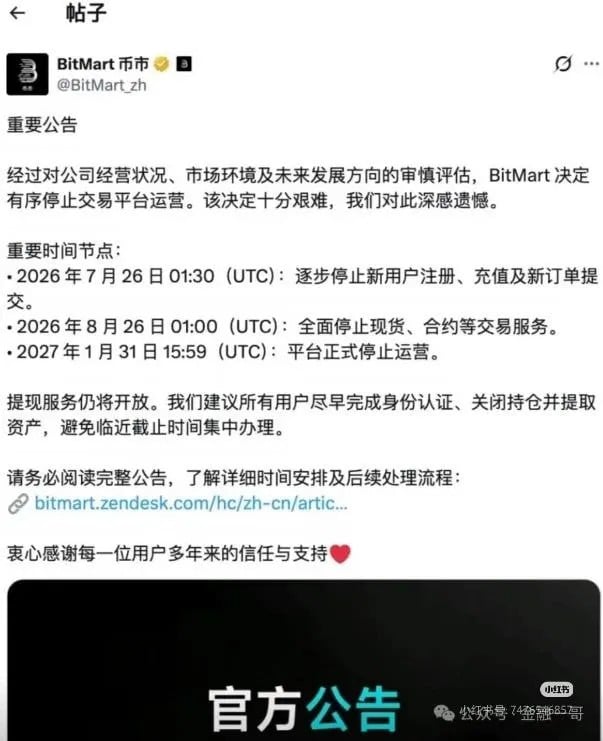
On July 26, 2026, BitMart announced that after a comprehensive assessment of the company's operational status, market environment, and future development direction, it decided to orderly cease the operation of the trading platform. According to the announcement, the platform began to gradually stop new user registrations, digital asset, and fiat currency deposits, and ceased to accept new spot orders and contract openings starting July 26; spot, contract, and other trading services are scheduled to cease on August 26, and the trading platform plans to officially stop operations on January 31, 2027.
The same exchange shutdown presents different issues for three types of people
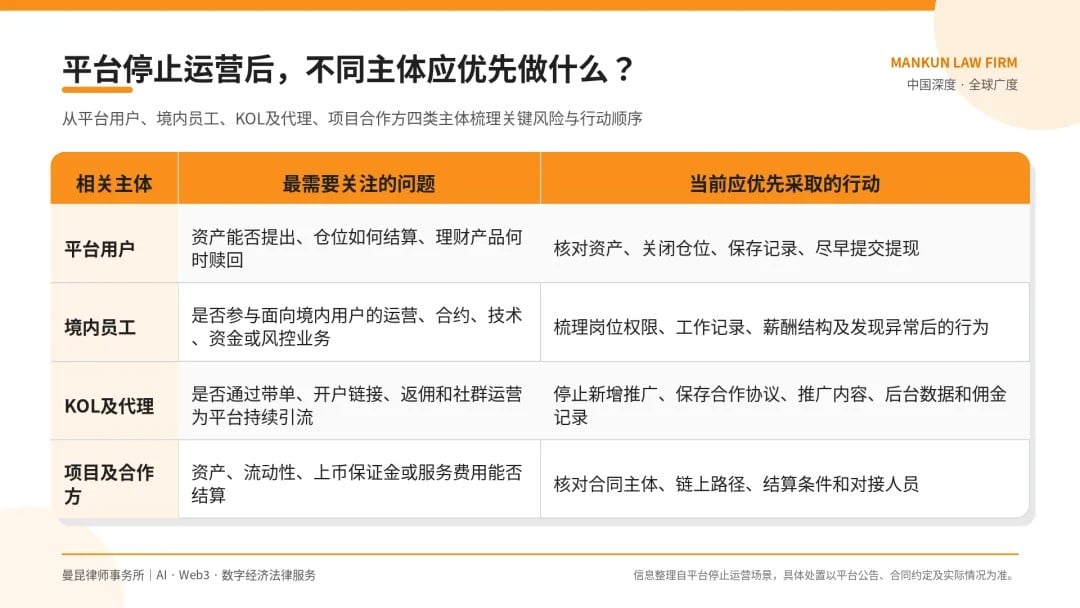
The legal positions among these three subjects are not the same. Users are typically the ones that directly suffer property losses after the platform's shutdown; employees and KOLs may face further scrutiny regarding whether they provided substantial assistance to the relevant businesses by participating in platform operations, attracting new users, or promoting contracts.
However, neither employees nor KOLs can be held accountable solely based on one identity label. What really needs to be examined is their specific level of participation, subjective understanding, actual earnings methods, and control over the core business of the platform.
Users should not only look at "total assets," different products need to be withdrawn separately
BitMart's announcement indicates that the platform has already stopped or plans to stop spot trading, contract trading, copy trading, grid trading, and other automated trading functions; products such as Earn, staking, lending, and Launchpad will be phased out based on their actual situations, with special announcements or internal notifications detailing redemption and settlement arrangements.
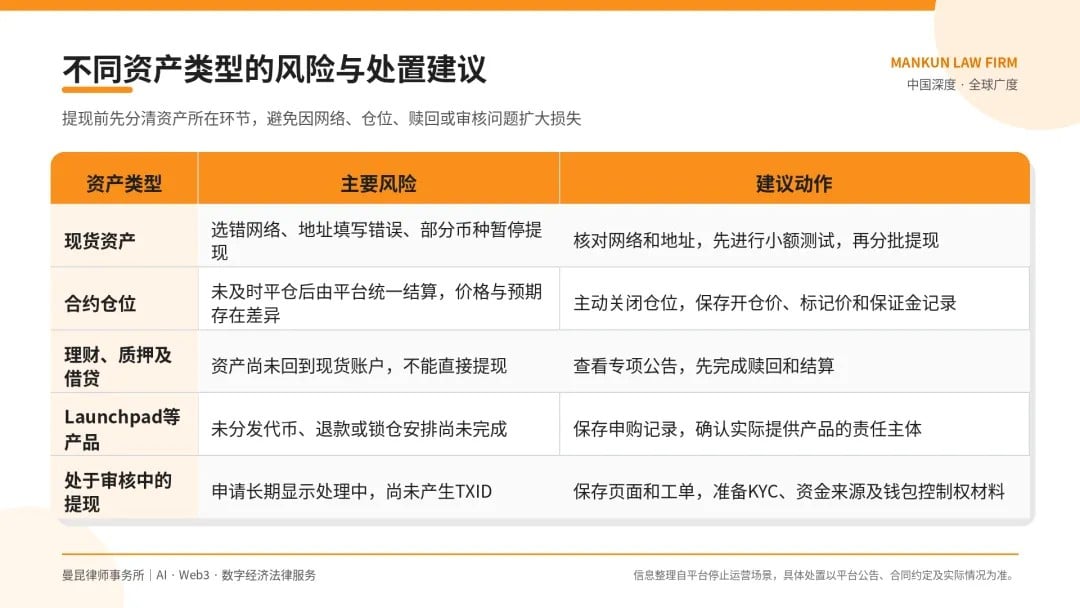
The platform has clearly stated that submitting a withdrawal application does not mean that the review is complete, nor does it mean that the assets have been sent to the blockchain. Some applications may be subject to verification of account identity, login devices, IP addresses, withdrawal addresses, sources of funds, transaction records, Travel Rule, and sanction lists, and may also require additional proof of fund sources or wallet control in necessary cases.
Therefore, when users see that the withdrawal status is long-term "Processing," they should first confirm whether a TXID has been generated. No TXID typically means that the assets are still within the platform's internal review or processing phase; once a TXID is generated, it should be verified on the corresponding blockchain explorer.
No progress in withdrawals, should users pursue cross-border rights protection or report domestically?
After the exchange stops operations, the most common legal question for users is: customer service has not provided a clear response, what other ways can assets in the account be recovered?
There are generally three paths for handling this.
The first is to continue negotiating through official channels of the platform. For users who can still log into their accounts, submit tickets, and for whom the platform is still processing withdrawals, they should first organize their account UID, currencies, amounts, networks, withdrawal addresses, application numbers, and submission times all at once, and formally request the platform to explain the reasons for the review and the required materials.
In cases where there are trustworthy partners, platform contacts, or KOLs, having an intermediary help confirm the review progress and supplementary material requirements can sometimes be more efficient than directly engaging in high-cost cross-border procedures. However, all relevant communications must be fully documented, and payments for so-called "expediting fees" or "unfreezing fees" to personal wallets are not allowed. BitMart has clearly stated that there is no paid priority queue or expedited withdrawal channel, and staff will not ask for private keys or mnemonic phrases.
The second option is to consider offshore litigation or arbitration based on the user agreement and account subject. This path requires confirming which company the user has actually contracted with, what laws apply, where the dispute resolution location is, and whether the judgment outcome can be executed at the asset location. Simply knowing the platform's name is not sufficient to identify the correct defendant or the party to be applied for arbitration.
The third option is to report to the domestic public security agency. However, the mere cessation of operations, delayed withdrawals, or price drops do not automatically constitute fraud or other crimes. Whether there is a basis for criminal reporting also depends on whether the platform has fabricated assets, maliciously transferred user funds, manipulated the background, continued to absorb funds knowing it could not fulfill them, or if there is personnel disappearances, destruction of evidence, or other anomalies.
The notification from eight departments in 2026 stipulates that personal investments in virtual currencies and related financial products, if they violate public order and morality, may be deemed invalid, and losses arising therefrom will be borne by the participants themselves. However, "investment risks are borne by oneself" does not mean that platforms can withhold assets that have been confirmed to belong to users without basis, nor does it mean that clues related to fraud, embezzlement, or transfer of property cannot be legally investigated.
Therefore, cross-border litigation, domestic reporting, and communication and coordination do not have absolute advantages or disadvantages; the specific judgment still needs to consider the location of the assets, subject of the platform, evidence circumstances, and causes of user losses.
Why do domestic employees still face risks, despite the operating entity being located overseas?
Many virtual currency exchanges set their registration and operational entities overseas, but technical, operational, business, customer service, community, or product personnel may still work remotely within China.
Current regulatory rules have made it clear that overseas units and individuals must not illegally provide virtual currency-related services to domestic entities in any form; domestic units and individuals who knowingly or should have known that the overseas entities are illegally providing related services and still assist them can be held legally accountable, and those that constitute crimes can face criminal responsibility.
This does not mean that anyone who has worked at an exchange must bear criminal responsibility. Law enforcement agencies typically still need to further examine the employee’s time of employment, position level, job permissions, actual work content, service targets, salary and bonus structures, as well as whether they participated in the platform’s contracts, user acquisition, funds, risk control, and settlement processes.
For instance, simply being responsible for ordinary administrative, human resources, or basic work that does not directly touch users poses a significantly lower risk than directly designing high-leveraged contracts, formulating liquidation rules, operating domestic communities, handling user funds, or managing agent commissions.
From the cases of exchanges we have handled, the final responsibility allocation has never been as simple as just labeling "exchange employee," but rather requires specific answers: what exactly did the employee do, what did they know, what did they gain from it, and what actions did they take upon discovering abnormalities.
Conversely, if an employee joins the project for a short time, only receives a standard salary, has not participated in return commitments, trading guidance, or fund handling, and genuinely lacks a comprehensive understanding of the overall business model, and has timely stopped any related work, raised objections, or voluntarily resigned upon discovering anomalies, then these facts should be thoroughly reviewed in the determination of responsibility.
In a case we previously handled, it involved sorting through evidence concerning the person's time of employment, salary structure, job permissions, actual participation scope, and their responses upon discovering anomalies, compiling a complete defense perspective based on this, and ultimately achieving a positive result of non-prosecution.
Can KOLs, who just share links and receive commissions, also be implicated?
Exchanges often heavily rely on KOLs, agents, and community operators to expand their user base, particularly for perpetual contracts and copy trading businesses. KOLs attract users through referral links, invitation codes, guided trading communities, and trading courses, and the platform pays them commissions based on users’ trading volumes or fees.
During normal platform operations, these earnings are typically packaged as promotional fees, channel fees, or commissions. However, once the core business of the platform is deemed to involve criminal activity by judicial authorities, whether a KOL is merely an ordinary advertising partner or has deeply participated in soliciting users and organizing trades may become a key focus in the investigation.
To assess KOL risk, one should not only look at whether they have a platform account or have received commissions, but should critically examine: whether they primarily promoted high leverage and guaranteed profits; whether they provided specific guidance on long or short positions or trade openings; whether they set up multi-layered agencies or lower-level commissions; whether they assisted users with deposits, withdrawals, and account handling; whether their income primarily comes from user trading volumes, liquidations, or high fees.
The regulatory notification from 2026 already made it clear that internet companies must not provide commercial display, marketing promotion, or paid traffic directing services for virtual currency-related businesses; domestic entities that knowingly or should have known that related overseas services are illegal and still provide assistance may also face legal accountability.
Consequently, after the exchange shutdown, KOLs should not rush to delete promotional content, close communities, or unify statements with partners, but should fully retain cooperation agreements, account registration back-end data, promotional wording, user source records, commission calculation methods, and actual account records. Whether related commissions are considered illegal gains that need to be returned should also be assessed based on their subjective understanding and actual level of participation, rather than processing all historical income uniformly.
Does providing perpetual contracts automatically constitute the crime of operating a gambling house?
From the handling of cases in recent years, perpetual contracts have become a high-frequency entry point for investigations into exchange controllers, executives, technical personnel, operational staff, and KOLs under the crime of operating a gambling house.
In June 2026, an article on the website of the Supreme People's Procuratorate quoted from prosecutorial practical work, indicating that the criminal law qualification for virtual currency perpetual contract platforms should be substantively examined based on the platform’s operation and profit models, accurately distinguishing between financial investment, gambling, fraud, and illegal business operations. Key examination focuses include whether the leverage is extreme, whether the platform acts as a dealer against users, whether they obtain user losses by controlling market conditions and liquidation mechanisms, whether betting and payout loops are formed, and whether the platform has substantial control over trading rules and fund settlements.
This implies that simply acting as a facilitator for genuine market matchmaking and charging reasonable fees cannot be equated with the platform becoming the counterparty in user trades, manipulating K-lines, or using liquidations to directly obtain user capital in criminal evaluations.
This distinction is equally important for ordinary employees and KOLs. Participation in contract rule design, market access, liquidation algorithms, agency systems, and fund settlements will directly affect how closely their actions align with the platform's core criminal model.
What needs to be preserved now is not just a balance screenshot
Whether they are users, employees, or KOLs, the most important common action after the exchange stops operations is to secure evidence.
Users should save account balances, orders, positions, deposit and withdrawal records, investment subscription and redemption records, platform announcements, customer service tickets, and blockchain TXIDs; employees should preserve labor contracts, salary records, job descriptions, work instructions, permission ranges, resignation records, and communications raising objections; KOLs should keep cooperation agreements, promotional copies, referral links, back-end data, commission details, and complete communications with the platform.
It is important to note that preserving evidence does not equate to hiding assets, deleting records, or creating new explanatory documents. After the exchange ceases operations, if relevant personnel suddenly bulk delete chats, transfer commissions, or forge contracts, behaviors that could originally be explained might instead become new anomalies.
Lawyer's Observation
BitMart's cessation of operations is not just a simple withdrawal of an exchange; it simultaneously places users, domestic employees, and KOLs in three different legal positions.
Users are concerned about whether they can recover their assets and whether they should defend their rights through communication, cross-border dispute resolution, or criminal reporting; domestic employees need to clarify what businesses they participated in, what permissions they had, and whether they were aware that the platform continued to provide services to domestic users; KOLs must clarify whether they were merely ordinary brand partners or had deeply participated in user trades through leads, commissions, and community operations.
The cessation of operations of the exchange does not automatically determine anyone's legal responsibility, but it does expose previously overlooked business models, fund paths, and personnel divisions.
For users, the sooner they complete asset inventory, position processing, and evidence preservation, the greater the space they will have for handling unusual withdrawals afterward; for employees and KOLs, the sooner they clarify their job boundaries, sources of income, and actual levels of participation, the more beneficial it will be in providing accurate explanations when risks truly arise.
免责声明:本文章仅代表作者个人观点,不代表本平台的立场和观点。本文章仅供信息分享,不构成对任何人的任何投资建议。用户与作者之间的任何争议,与本平台无关。如网页中刊载的文章或图片涉及侵权,请提供相关的权利证明和身份证明发送邮件到support@aicoin.com,本平台相关工作人员将会进行核查。


