Written by: Blockchain Knight
If one only looks at prices and the current situation, today’s cryptocurrency market can easily feel pessimistic, even disdained.
Even though Bitcoin set new historical highs in the past year, spot ETFs continue to attract institutional capital inflows, and more and more traditional financial institutions are starting to layout digital assets.
On the other hand, most projects are deeply caught in downturns, with many not only erasing all gains from the last bull market but even falling back to prices before the bull market began in 2020.
Meanwhile, market discussions continue to cool, and more people are choosing to leave the industry, leading to a growing skepticism about whether the crypto industry has entered a long-term recession.
This seemingly contradictory phenomenon is precisely evidence that today’s market cannot simply be defined as a bull or bear market. The real change occurring is not just in prices, but in the entire operational logic of the industry.
Over the past decade, the crypto industry has achieved rapid expansion through liquidity and narrative, where a hot concept could support astonishing valuations.
However, as liquidity returns to rationality and institutional money gradually becomes market participants, this valuation system is rapidly disintegrating.
The market is beginning to refocus on a fundamental question: what value does a project actually create?
If I had to summarize today’s crypto market in one sentence, I would prefer to define it as a cycle that is not eliminating the industry, but rather the outdated logic of growth that relied on liquidity, narrative, and financing over the past decade.
Understanding this may be more important than predicting when the next bull market will arrive.
Historical cycles, the moment the internet bubble burst
Many people are accustomed to comparing today’s crypto market with the bear markets of 2018 or 2022, but if we extend the timeframe, it resembles more the phase after the 2000 internet bubble burst than an ordinary market adjustment.
After the internet bubble burst, the Nasdaq index plummeted, a large number of internet companies went bankrupt, and venture capital quickly cooled.
At that time, many believed the internet was merely an overstated concept by capital, and the entire industry had reached its end.
However, looking back over twenty years later, what that bubble really eliminated was not the internet itself, but those companies lacking business models and competitiveness.
The enterprises that truly survived, such as Amazon and Google, not only weathered the cycles but became essential infrastructures of the internet era.
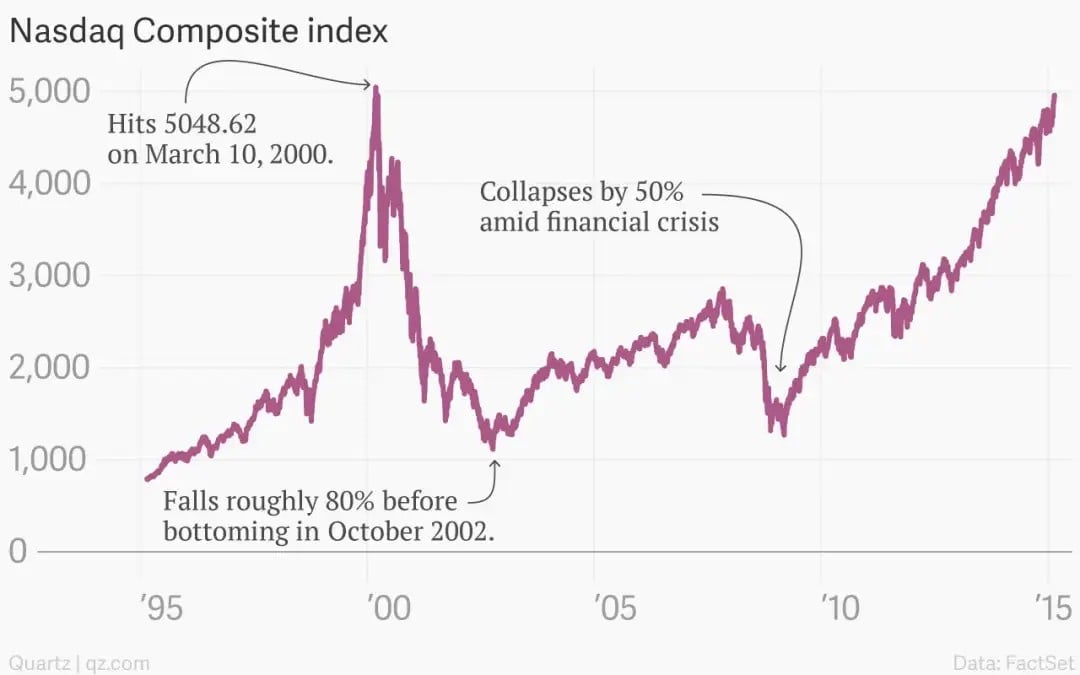
Today’s crypto industry is undergoing a similar process.
In recent years, abundant liquidity has driven rapid industry expansion. From DeFi, NFT to L2, AI Agent, each new narrative attracts a massive influx of funds, with projects not yet validated by the market achieving billion-dollar valuations – indeed incredible.
But as liquidity returns to rationality, this valuation logic is starting to fail.
Thus, rather than saying the industry has entered a bear market, it is more accurate to say it is undergoing a valuation reassessment.
The market is also questioning a fundamental issue: which projects truly deserve to exist in the long term?
Survival of the fittest, the ineffective will be eliminated
In recent years, the number of crypto projects has experienced explosive growth. Every time a hot topic emerges, it quickly spawns numerous homogeneous projects. The barriers to issuing tokens are becoming lower, and this prosperity once led people to mistakenly believe that the more projects there are, the faster the industry develops.
But this is not the case.
Any industry’s growth cannot expand indefinitely. While the number of projects can increase rapidly, users and funds are always limited. When supply far exceeds demand, the market will ultimately complete a self-correction.
Today, those eliminated projects share common characteristics: no real users, no stable income, and no difficult-to-replicate competitive barriers.
They previously relied on market sentiment for short-term growth but failed to establish long-term value; once liquidity tightens, this model is plunged into an abyss.
Many perceive this as an industry recession, but viewed from another angle, this is actually a necessary supply clearing process in industrial maturation.
After the internet bubble, many portal sites and search engines disappeared, leaving behind only a few platforms; the electric vehicle sector once had hundreds of companies competing, and now very few have truly survived.
Therefore, the exit or bankruptcy of many current crypto projects is eliminating not only ineffective supply but also inefficient development models.
The end of the narrative era, value reassessment
As I mentioned earlier, for the past decade, the crypto industry has always been a narrative-driven market.
From IXO to DeFi, from NFT to the metaverse, to AI Agent, almost every trading cycle is accompanied by a new narrative.
For the early days of the industry, this model posed no problem; new technologies need visions to attract developers and capital, and the market also needs to "suffocate dreams."
However, as the industry matures, merely telling stories can no longer support long-term valuations.
In the past two years, a marked change has been that more and more investment institutions are starting to focus on protocol revenue and active users, rather than simply discussing financing backgrounds, community heat, or market concepts.
But for the crypto industry, having revenue alone is not enough.
The value created by traditional companies ultimately reflects on shareholder equity, whereas in crypto, the more successful a protocol becomes, it does not necessarily mean the token will be worth more.
If a protocol generates significant revenue yet fails to return value to token holders, the protocol’s value and the token will gradually drift apart.
Thus, what is truly important is not just revenue, but value capture.
In the past two years, an increasing number of protocols have begun discussing Fee Switch and Buyback, which essentially address the same issue: how to ensure the value created by the protocol flows back to the token itself.
Only when tokens can share the benefits of the protocol's growth can they possess long-term value support, and not merely serve as a governance tool or market proxy.
This suggests that the crypto industry is transitioning from a narrative-based economy to value pricing.
The market is no longer searching for the next hot concept but rather for protocols that can continually generate revenue and establish a value loop.
And this is something Wall Street excels at.
Old money enters the market; they don’t listen to stories
Many believe that the biggest significance of the approval of Bitcoin spot ETFs is the influx of incremental funds into the crypto market. However, I believe a more important change is that the participants entering the market have changed.
In the past, the crypto market was mainly dominated by Crypto Natives, who were willing to pay a premium for new narratives and high growth.
Wall Street, however, is more concerned with another set of standards: whether there is stable income, real users, and a competitive moat. This suggests that the crypto industry is gradually adopting the valuation logic of mature capital markets.
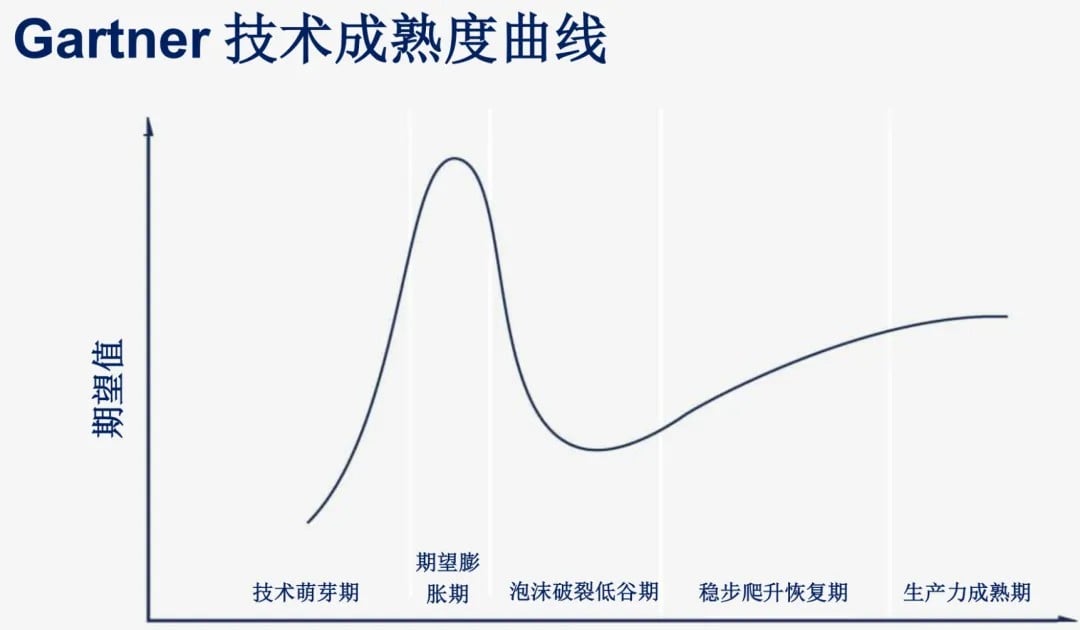
This change is already reflected in the flow of funds.
In recent months, the projects that first emerged from the trough were not those with the latest narratives, but those that have established business models as fundamental infrastructures.
For instance, Aave remains the leader in on-chain lending, Uni has long held an important share in DEX, and Sky continues to support the stablecoin ecosystem. These protocols have weathered multiple cycles, possess real users, and have sustained income, making it easier to gain market recognition.
At the same time, a new generation of infrastructures is also beginning to emerge. Hyperliquid has rapidly gained users with high-performance on-chain derivatives trading, proving that DeFi can still innovate continuously.
Moreover, BlackRock's launch of the BUIDL fund, along with Robinhood's recent strong push for RWA, signals a more important message: traditional finance is concerned not just with Bitcoin, but whether blockchain can become the next generation of financial infrastructure.
Infrastructures such as lending, trading, stablecoins, and RWA are gradually becoming new support points for the industry.
As more and more smart old money enters the market, the valuation system of the crypto industry will also return to its business essence.
The next bull market will not belong to all projects
The previous trading cycles have led many investors to develop a kind of habitual thinking that whenever a bull market arrives, altcoins will inevitably experience a broad rally.
However, in the future, this scenario is unlikely to occur again.
In the past two years, AI attracted vast amounts of capital and entrepreneurs not because it had a better story, but because it first proved its commercial value.
Capital has not left risk assets; instead, it is re-seeking more efficient directions with clearer returns.
For the crypto industry, this also means a new era has begun, where the market will increasingly focus on real value rather than liquidity-driven valuation bubbles.
Therefore, the flow of funds in the next bull market may be more concentrated than in the past.
One category is core assets that have already become industry consensus, such as Bitcoin and Ethereum. Another category is truly business-model-driven on-chain financial infrastructures, such as stablecoins, lending protocols, and RWA-related ecosystems.
In contrast, those projects lacking users and real income will find it increasingly difficult to attract capital in the future. Of course, low-probability events may still happen, especially with the existence of MEME.
Looking back, after the internet bubble, many internet giants emerged, while countless previously popular star companies were eliminated.
Today’s crypto industry is also undergoing the harsh process of survival of the fittest.
Upon closer examination, the real problem lies within the industry itself. After all, a market filled with false prosperity will eventually be educated by the market; such a dramatic change may make most people uncomfortable, but once this hurdle is crossed, time will prove what truly has value.
Therefore, I want to say that what the market is eliminating is not the blockchain technology, but the outdated logic that relied on liquidity and narratives for growth; what can traverse cycles will ultimately be those projects that continuously create value. This is the essence of business development.
免责声明:本文章仅代表作者个人观点,不代表本平台的立场和观点。本文章仅供信息分享,不构成对任何人的任何投资建议。用户与作者之间的任何争议,与本平台无关。如网页中刊载的文章或图片涉及侵权,请提供相关的权利证明和身份证明发送邮件到support@aicoin.com,本平台相关工作人员将会进行核查。


