SpaceX surged 4.5%! Institutional holdings revealed, 4.9 billion shares about to unlock, is the real test coming?
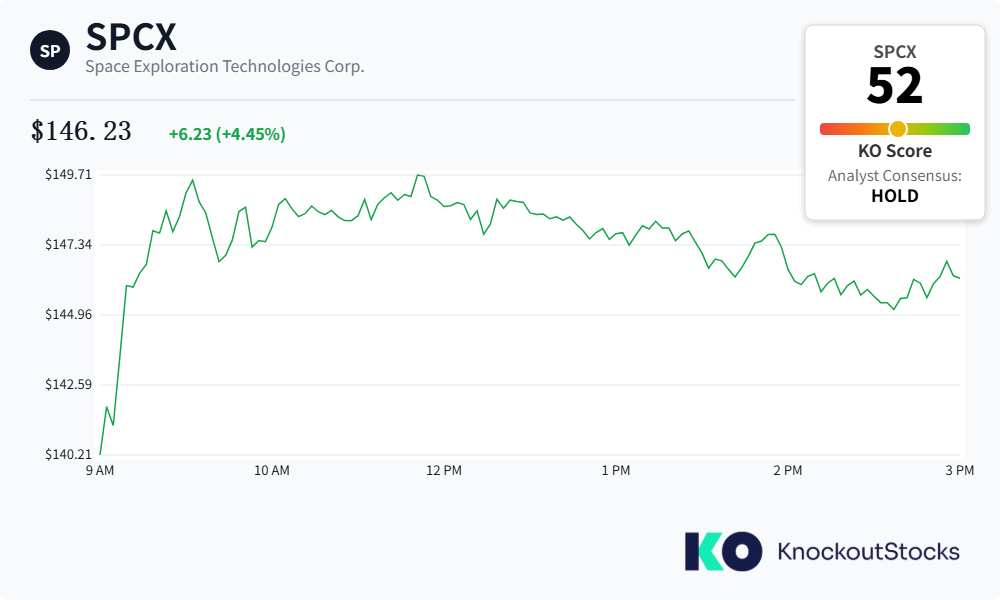
SpaceX's stock price rose 4.5% on Monday, closing at $146.23, defying market weakness.
This time, what drove market sentiment was not just the company's performance.
With several large institutions disclosing their holdings in SpaceX, the market began to reassess the valuation of this aerospace giant.
Alphabet holds approximately $94 billion worth of SpaceX shares, Nvidia's holdings are valued at around $21 billion, and other large institutions are also appearing on the disclosure list.
However, at the same time, a larger variable is approaching:
A large number of shares held by early investors are about to enter the market.
About 319 million shares will begin unlocking on August 20, with more shares entering trading in September and October.
By the end of the year, nearly 4.9 billion shares are expected to become eligible for circulation.
So, is this round of increase for SpaceX the beginning of a new valuation reassessment, or is it the last celebration before a massive unlocking?
Daily shares of real-time trading strategies, free position diagnosis, and market practical insights, scan to follow the public account“Bitcoin Radar”, join the community for strategies!

First, look at the most crucial data: Institutions are betting on SpaceX
The recent rise of SpaceX has an important catalyst from the disclosure of institutional holdings.
Alphabet disclosed that as of the end of June, its holdings in SpaceX were valued at approximately $94 billion.
Compared to the initial investment of about $900 million in 2015, this investment has generated more than 100 times the book return.
This is also a key reason why the market is re-focusing on SpaceX's valuation.
And Alphabet is not the only large institution.
Nvidia disclosed it holds about 122.8 million Class A shares of SpaceX, valued at around $21 billion.
Harvard Management Company holds approximately $2.2 billion worth of SpaceX shares.
The Norwegian Government Pension Fund Global has also disclosed holding about 0.05% of SpaceX shares, valued at over $1.2 billion.
Additionally, Fidelity, the Saudi Public Investment Fund, and Hancock Prospecting also appear on the holding list.
This indicates one issue:
SpaceX is no longer just a star company in the private capital market.
More and more large institutions are gaining exposure to its equity in various ways.
Why did SpaceX rise so quickly this time?
Institutional holdings are just one factor.
More importantly, the company's recent second-quarter performance was quite impressive.
SpaceX's second-quarter revenue reached approximately $7.8 billion, up 92% year-over-year.
Among these, revenue related to artificial intelligence saw particularly significant growth, with a year-on-year increase of 247%.
Newly signed cloud service contracts also contributed about $1.6 billion in revenue to the company.
This has led the market to start re-evaluating SpaceX.
In the past, many investors would think of SpaceX and immediately respond with:
Rockets.
Satellites.
Starlink.
But now SpaceX is continuously adding new growth stories.
Aerospace business is only one of them.
Starlink provides sustained user revenue.
Cloud infrastructure is starting to enter the market's vision.
AI-related businesses further enhance the market's imagination of future growth space.
This is why SpaceX's valuation is becoming increasingly difficult to measure against a traditional aerospace company.
The real variable is coming: a large number of stocks are about to unlock
If institutional holdings and performance are positive news.
Then the upcoming stock unlocking might become the biggest variable in the market.
About 319 million shares held by early investors will begin to enter free trading on August 20.
In September, another approximately 700 million shares will be unlocked.
In October, over 650 million shares will be unlocked.
By the end of the year, nearly 4.9 billion shares are expected to enter a tradable state.
What does this mean?
Supply might suddenly increase.
In the past, many early investors could not sell their shares directly.
Once the lock-up period ends, they gain greater trading freedom.
For the market:
The increase in more stocks in circulation does not necessarily mean a drop in prices.
But it will definitely increase the supply that the market needs to digest.
Therefore, in the coming months, SpaceX's stock price may face a very unique phase:
On one side, institutional continued interest.
On the other side, a large number of early shareholders may start to cash in their profits.
Why did SpaceX's stock price briefly fall below $105 in July?
This actually provided a rehearsal for the market.
In July, SpaceX's stock price briefly fell below $105.
One of the biggest concerns at that time was that early investors might choose to sell their stocks after unlocking.
Because for many early investors, even if the stock price fell significantly, they might still have substantial unrealized gains.
This creates a natural selling pressure.
As the unlocking date got closer, the market began to pre-trade this expectation.
But then the situation changed.
After the second-quarter financial report was released, SpaceX's stock price quickly rebounded.
The stock rose about 23% in the week following the earnings release, and then continued to rise about 5% in the following week.
This indicates that the market is currently playing a game between two logics:
Earnings growth.
VS
Increased stock supply.
Why is there a completely different voice on Wall Street?
Interestingly, institutions do not have a consistent judgment about SpaceX's future valuation.
UBS currently maintains a “buy” rating, with a target price of $210.
UBS is particularly optimistic about SpaceX's cloud infrastructure business and AI-related capabilities.
At the same time, the institution expects that the number of Starlink users will significantly increase in the coming years.
If this prediction ultimately materializes, then SpaceX's future revenue structure may undergo further changes.
On the other hand, Phillip Securities has a completely different viewpoint.
This institution maintains a “sell” rating, with a target price of only $75.
The gap between the two is very obvious.
Why?
One of the core reasons is customer concentration.
In the second quarter revenue of SpaceX, one AI customer contributed about 19.5%.
Whereas this proportion was less than 10% the same period last year.
This means:
AI business growth is very fast.
But at the same time, the company is also becoming increasingly dependent on a small number of large customers.
If major customer demands change in the future, revenue growth may be significantly impacted.
How much is SpaceX worth now?
This is the hardest question for the market to answer.
Because traditional valuation models may not be entirely applicable to SpaceX anymore.
A traditional aerospace company mainly looks at:
Orders.
Launches.
Commercial contracts.
Profit.
Cash flow.
But SpaceX has several different cards:
Starlink.
AI.
Cloud infrastructure.
Satellite networks.
The future space economy.
The potential value of these businesses may far exceed the traditional rocket launch business itself.
Goldman Sachs even predicts that by 2035, the global space economy could reach $18 trillion.
If this market truly expands as expected, then SpaceX is clearly one of the most important players.
But the problem is precisely here.
The greater the future growth space, the higher the valuation the market is willing to give.
But if the growth rate cannot be realized, then a high valuation may also become a major source of pressure.
Does institutional holding mean the stock price will definitely rise?
Not necessarily.
This is the most crucial point to note in this event.
Alphabet, Nvidia, and other large institutions holding SpaceX shares indeed indicate that these institutions recognize the long-term value of the company.
However, institutional holdings do not equate to short-term price guarantees.
Especially in the context of a large number of stocks about to unlock.
The market may exhibit a very complex situation in the future:
Institutions continue to be optimistic about SpaceX.
Retail sentiment continues to heat up.
The company's performance continues to grow.
But at the same time, a large number of early investors begin to sell their stocks.
Where will the stock price ultimately go?
The key still lies in:
Will new demand absorb the additional supply?
If the buyers are strong enough, the unlocking may not create significant pressure.
But if market demand is insufficient, then a large number of newly floating shares may become a significant resistance to the stock price.
The three signals to focus on next
First, the first batch of unlocking on August 20.
The market will observe how many shares will actually enter trading.
Second, the growth rate of Starlink and AI businesses.
If these two businesses continue to grow rapidly, the market may continue to raise its expectations for SpaceX's future revenue.
Third, the attitude of institutional capital.
If large institutions continue to increase their holdings, the market may interpret the supply pressure brought by the unlocking as a short-term disturbance.
Conversely, if institutions start to reduce their exposures, market sentiment may change rapidly.
Finally: The real story of SpaceX may just be beginning
What SpaceX is facing now is no longer simply “how much is an aerospace company worth.”
It is gradually transforming into a super platform integrating aerospace, satellite internet, AI, and cloud infrastructure.
This is also why the market is willing to assign it such a high valuation.
But the other side of a high valuation is higher expectations.
As long as the performance continues to exceed expectations, the market may continue to grant higher valuations.
But once the growth rate slows down, valuations can also be quickly repriced.
And now, it coincides with a large-scale stock unlocking.
So in the coming months, SpaceX may enter a very critical phase:
On one side, institutions continuously release optimistic signals.
On the other side, billions of shares are about to enter the market.
The real question is no longer:
“Does SpaceX still have a story?”
But rather:
“With such a big story, can it continue to support such a high valuation?”
The content of this article is for the purpose of organizing market information and industry research only, and does not constitute any investment advice. Changes in SpaceX's related equity transactions, valuations, and stock unlocking arrangements may occur and should be based on company and regulatory disclosures.
Daily shares of real-time trading strategies, free position diagnosis, and market practical insights, scan to follow the public account“Bitcoin Watermelon”, join the community for strategies!

免责声明:本文章仅代表作者个人观点,不代表本平台的立场和观点。本文章仅供信息分享,不构成对任何人的任何投资建议。用户与作者之间的任何争议,与本平台无关。如网页中刊载的文章或图片涉及侵权,请提供相关的权利证明和身份证明发送邮件到support@aicoin.com,本平台相关工作人员将会进行核查。