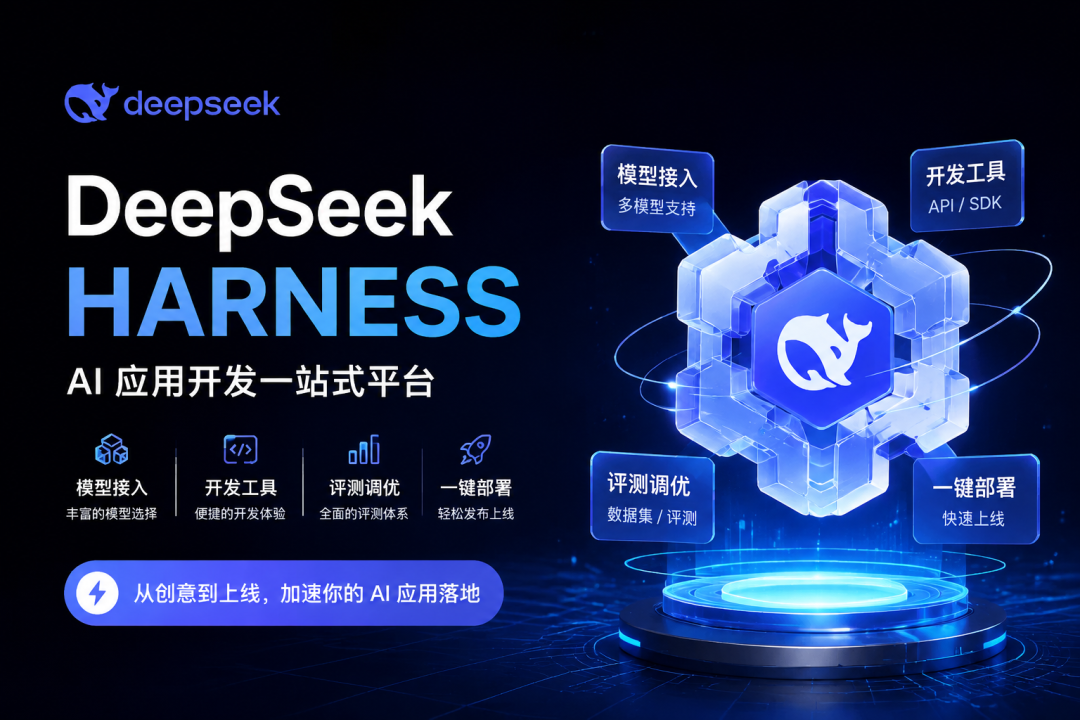
On the evening of August 13, DeepSeek did not release a new model, but open-sourced something called Harness.
In just one day, it gained nearly 80,000 stars on GitHub. This speed surpassed the records of R1 and Grok-1 from previous years.
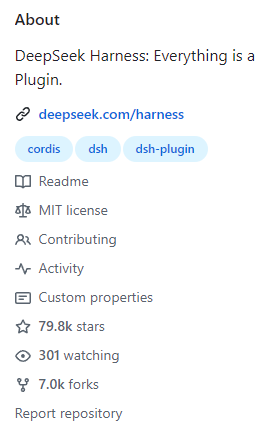
Harness is not a model weight, nor an API interface, but a layer of "shell" — a system that makes the model truly functional. DeepSeek provided a formula: Model + Harness = Agent.
To translate: the model is responsible for thinking, the Harness is responsible for doing.
Why did DeepSeek create this?
This question is the most interesting part of the entire thing.
Right before the release of Harness, DeepSeek's API documentation listed dozens of third-party Agent integration tools — Claude Code, Codex, Cursor, Copilot... everything you can think of, except for their own Agent product. The model belongs to them, but the working hands belong to others.
This is like someone who has built a top-notch engine discovering that all car manufacturers are using his engine, but the steering wheel, chassis, and transmission are all from other manufacturers. He decides to build a complete car himself.
The deeper reason is: the same model may perform significantly worse when placed in different Agent systems. The model is only responsible for predicting the next step, but it is the Harness that truly determines the experience — it decides what context the model can see, which tools it can adjust, how to retry when an error occurs, and when to consider the task as completed.
A strong model without Harness is essentially just "an expensive autocomplete".
What does "everything is a plugin" actually mean?
The core design principle of Harness is written on the homepage: Everything is a plugin.
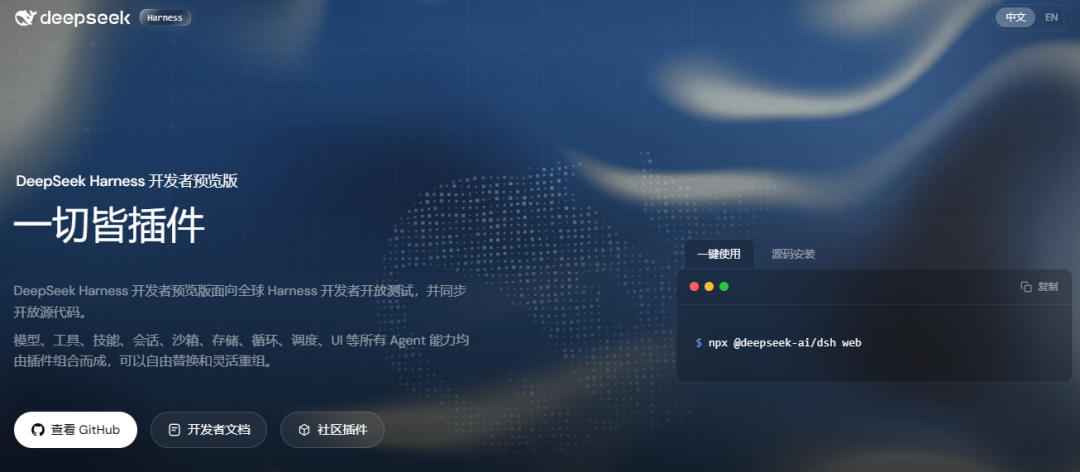
Most Agent frameworks only offer extensions at the tool level — adding a search tool, connecting an MCP server, and that’s it. DeepSeek Harness takes the plugin boundary all the way down to the runtime layer: model adapters, tools, skills, sessions, sandboxes, storage, Agent loops, scheduling, and even the UI, all are replaceable plugins.
The entire architecture is built on the Cordis plugin meta-framework. Developers do not need to modify the source code; they can just adjust the plugin list in the configuration file to change the model, sandbox, loop logic, or even the entire interface.
This is completely different from the approach of orchestration libraries like LangChain and LangGraph. LangGraph draws flowcharts within the framework, where nodes and edges are hardcoded; Harness gives you a huge board with holes, allowing every piece to be pulled out and replaced.
The four running modes are essentially four combinations of the same set of plugins:
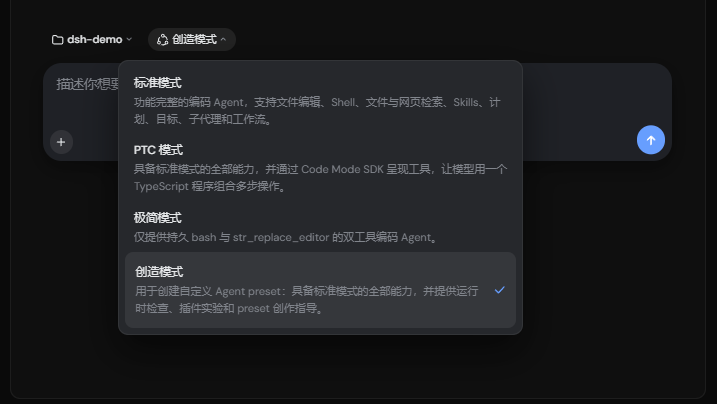
Standard mode: fully equipped; file editing, shell, search, sub-agents, workflows — suitable for daily development.
PTC mode: instead of sequentially adjusting tools, the model first writes a piece of TypeScript code to orchestrate multiple calls — suitable for complex multi-step tasks.
Simplified mode: only keeps shell and file editing tools, specifically for model benchmarking. The score of the V4-Flash Agent was run in this mode.
Creative mode: real-time checks of runtime, experimenting with plugins in memory, piecing together new running modes — this is a laboratory prepared for framework developers.
What is the difference from Claude Code and Codex?
The direct counterparts are Anthropic's Claude Code and OpenAI's Codex. All three recognize that the execution layer is the final part where model capabilities are realized.
However, the paths are entirely different:
Claude Code is a closed-source finished product, ready to use out of the box, with a smooth experience, but the orchestration core is not open, naturally favoring Anthropic models. If you use it, you have to play by its rules.
Codex is OpenAI's managed Agent solution, also closed-source, deeply tied to the GPT series.
DeepSeek Harness chose the hardest path: open-source, MIT license, and model neutrality. It supports DeepSeek, Anthropic, OpenAI, Bedrock, Vertex, Azure, and any OpenAI compatible endpoint. You do not necessarily have to use DeepSeek's model — you can use Harness as a generic Agent base.
What does this mean? It means DeepSeek is betting not on "my model is the best", but on "my shell is the best; if you use my shell, you are likely to choose my model".
This strategy is very clever. The framework is the entry point, and the model is the monetization. Harness is free and open-source, but running an Agent requires consuming model tokens — and DeepSeek just raised the API prices.
A design detail worth mentioning
Harness has a seemingly inconspicuous but extremely crucial design: append-only session logs.
Everything the model sees — system prompts, thought chains, tool call results, sub-agent scheduling, every context injection — is written into an event stream that is only appended to, not modified. Recovery, branching, retrieval, and playback are all based on the same event stream.
This solves a very painful problem in Agent development: during a long task, if it crashes, you want to resume from the breakpoint but do not know what the model saw at that time. If the context only lives in memory, resuming would lead to a mix-up. Harness provides a "unique source of truth" for the task status.
This design idea is closely related to event sourcing in distributed systems.
Conclusion: The battleground of AI competition is shifting
DeepSeek Harness extends the boundary of open-source competition from models to the Agent engineering system.
Previously, competition was based on the size of the context window, scores, and prices. Now DeepSeek has pushed the competition to a new dimension: whose Agent runs stably, scales effectively, and builds a sustainable ecosystem.
Of course, v0.1 is just a developer preview version, and the official warning clearly states "there will be breaking changes". The repository has over 230 workspace members, the architectural ambitions are vast, but it is still a distance from production-level stability. It is too early to say who it will disrupt.
However, three signals are already clear:
First, the next battleground for model vendors is not the models themselves, but the execution layer and feedback loops.
Second, the "everything is a plugin" microkernel architecture may become the mainstream direction for Agent frameworks to break free from monolithic bottlenecks.
Third, whoever masters Harness is closer to the true task entry point — which in turn influences model choices, tool distribution, and developer workflows.
DeepSeek has created an engine, and now it is building a car. As for how far this car can run, it depends on how many people are willing to install their own parts on it.
免责声明:本文章仅代表作者个人观点,不代表本平台的立场和观点。本文章仅供信息分享,不构成对任何人的任何投资建议。用户与作者之间的任何争议,与本平台无关。如网页中刊载的文章或图片涉及侵权,请提供相关的权利证明和身份证明发送邮件到support@aicoin.com,本平台相关工作人员将会进行核查。


