“Long semiconductor, short software,” the golden rule for hedge fund profits over the past six months, has been proven ineffective after being battered by the market in July.
(Image Source: ChatGPT Generated)
When the market rises, everyone goes all in, and when it falls, they remember that having a concentrated position comes with a cost.
The market has begun to select outstanding companies from the software sector and provide them with doubled returns.
In our previous video “Semiconductor Crash! Is AI Investment the Next Wave? Are Software Stocks Golden Pits? Which Software Stocks Benefit More?”, we mentioned that Palantir has risen more than 40% after the earnings report, and those who watched the video are likely to have earned profits.
So can software stocks still be bought now? Which software stocks can be bought?
This article gives you an answer, and the result may be quite different from what you think.
TL;DR
1. The software sector has become one of the main directions for capital to absorb funds after the semiconductor deleveraging in July.
2. Within the software sector, funds are mainly flowing in three directions, with cybersecurity being a relatively more certain main line at present.
3. Whether enterprise AI infrastructure can grow depends on whether products can enter the production environment, with the deep integration of corporate data forming the moat for software companies. PLTR is currently the most typical example on this main line, with results significantly exceeding expectations and a nearly 30% increase in a single day post-earnings.
4. Trading and advertising platforms enhance monetization efficiency through AI, and their revenue is less affected by the number of seats. SHOP is currently the most typical case in this main line, with a sharp rise in stock price after the earnings report.
5. The risks of software stocks also need attention, the issue of DDOG's large clients self-building will test the long-term growth ceiling of AI infrastructure software.

(Image Source: ChatGPT Generated)
1. Fund Rotation: Software Absorbing Funds, Position Differentiation Intensifying
Since July, U.S. stocks have experienced multiple rounds of severe fluctuations, but the adjustment of sectors and individual stocks has not evolved into a comprehensive loss at the index level.
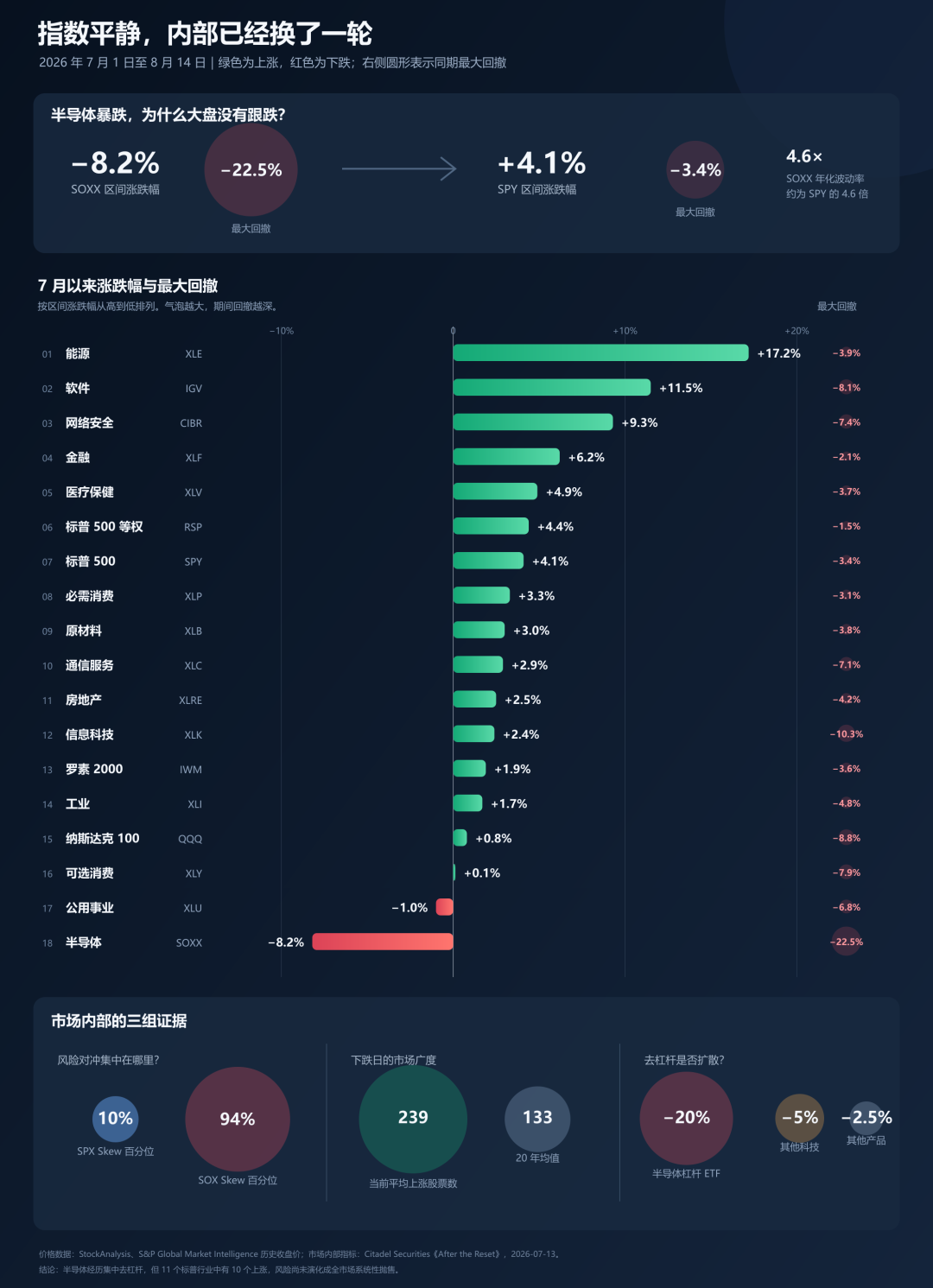
From July 1 to August 14, S&P 500 ETF(SPY) rose 4.1%, S&P 500 Equal Weight ETF (RSP) rose 4.4%, and Russell 2000 ETF (IWM) rose 1.9%.
During the same period, semiconductor ETF (SOXX) fell 8.2%, with the maximum drawdown reaching 22.5%, and the annualized daily volatility was about 4.6 times that of SPY.
In the past, a significant drop in the Philadelphia Semiconductor Index usually meant overall pressure on tech stocks, further dragging down the S&P 500 index. Recently, this correlation has significantly weakened, with semiconductor adjustments mostly remaining within the sector, while other industries absorbed the outflowing funds.
Citadel Securities believes that market breadth is improving and that risk is no longer highly concentrated in a few tech leading stocks.
(Image Source: ChatGPT Generated)
Position concentration and technical adjustments have also amplified this round of sector rotation. Goldman Sachs Prime Brokerage data shows that the share of global semiconductors in hedge funds' net positions has risen from about 10% at the beginning of the year to a maximum of 24% in June, then fell to 18%, with the scale of tech stock sell-offs reaching a high in their ten-year data records.
Software has become one of the clearest capital absorbing parties in this round of sector rotation. From July 1 to August 14, software ETF (IGV) rose 11.5%, cybersecurity ETF (CIBR) rose 9.3%. During the same period, the Nasdaq 100 ETF (QQQ) rose 0.8%, while semiconductor ETF (SOXX) fell 8.2%.
The accumulated shorts in the software sector also provided additional buying. S3 Partners statistics show that IGV short positions rose from about 8 million at the end of 2025 to nearly 50 million at the end of April 2026, with about 40 million remaining at the beginning of June. During the same period, IGV re-established itself above the 50-day and 200-day moving averages. After the sector rose, short covering further pushed up prices, and the better-than-expected earnings accelerated this process.
(Image Source: ChatGPT Generated)
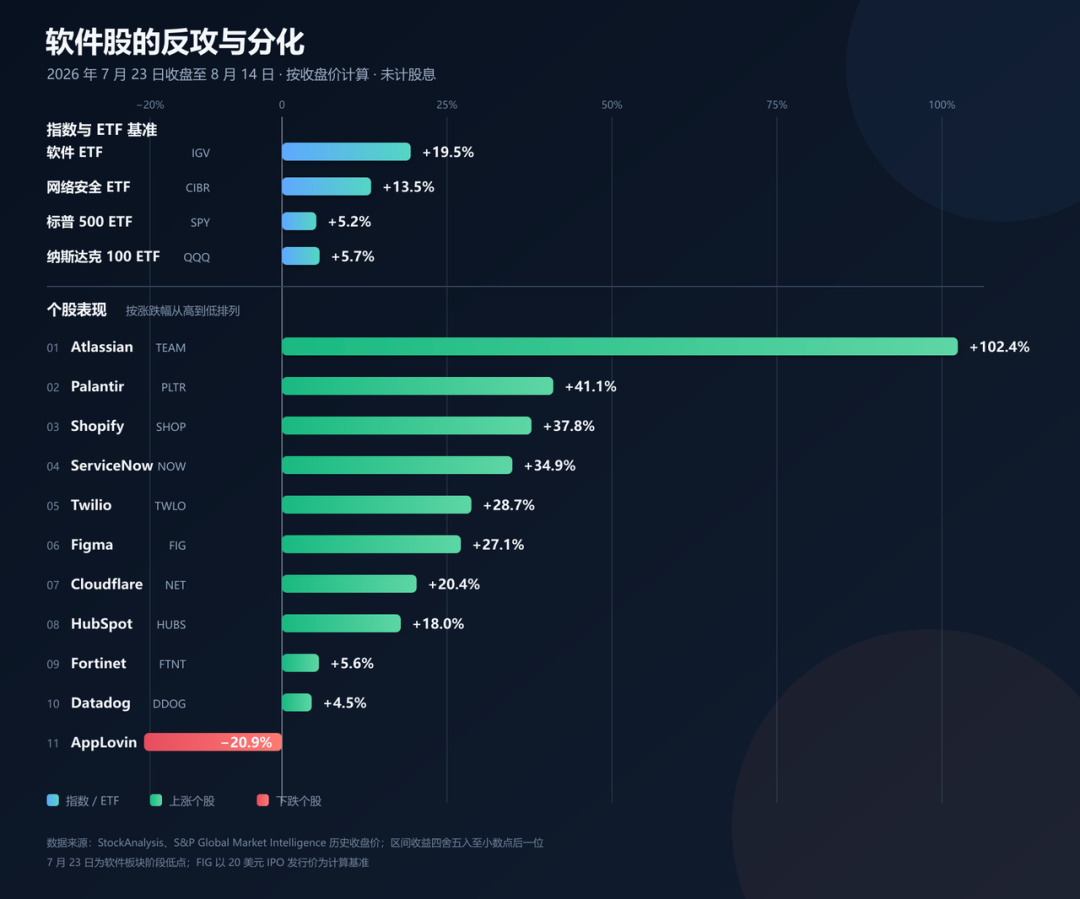
From July 23 (the cyclical low point for the software sector) to August 14, software ETF (IGV) rose 19.5%, cybersecurity ETF (CIBR) rose 13.5%, during the same period S&P 500 ETF and Nasdaq 100 ETF rose 5.2% and 5.7% respectively.
In terms of individual stocks, the earnings report performance has widened the gap between companies: Atlassian (TEAM) rose 102.4%, Palantir (PLTR) rose 41.1%, Shopify (SHOP) rose 37.8%, ServiceNow (NOW) rose 34.9%, and AppLovin (APP) fell 20.9%. The earnings reports of PLTR and SHOP prompted the market to revise up growth expectations. DDOG and APP's revenue still maintain high speed growth, but customer self-building, marginal slowdown, and overly high expectations triggered post-earnings sell-offs.
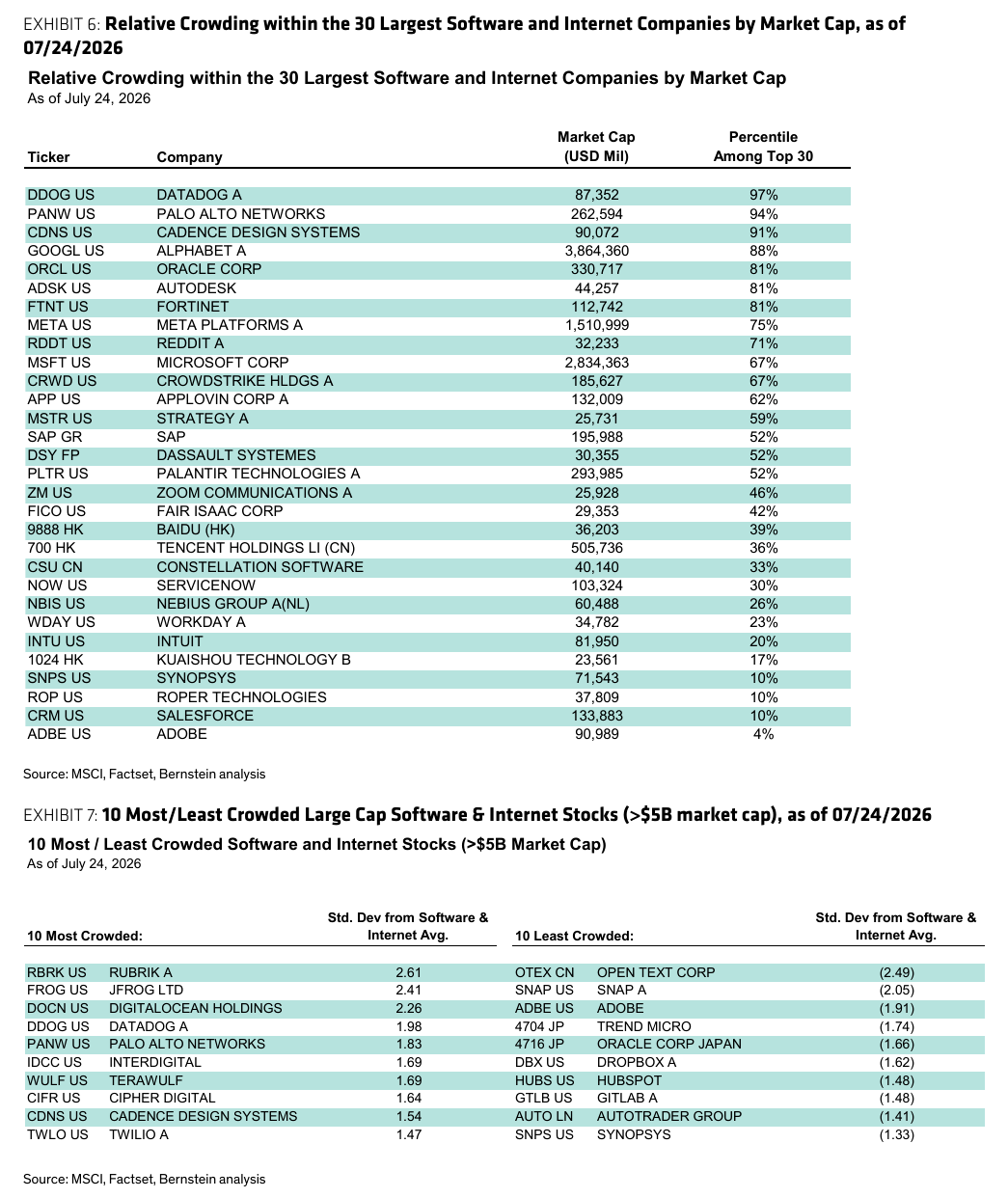
The positioning data from Bernstein adds another layer of information, the overall crowding in the software sector is still below its 25-year historical average, but internal differences are significant. As of July 24, among the top 30 software and internet companies by market capitalization, DDOG ranked first in terms of crowding, corresponding to the 97th percentile; PANW at 94%, FTNT at 81%, PLTR at 52%, NOW at 30%, TEAM at 23%, CRM at 10%, and ADBE only at 4%.
(Image Source: Bernstein)
The higher the crowding, the more funds have already bet on the same growth expectations. Companies with high positions and expectations need to continue to exceed expectations; ordinary good performance may not be enough to drive up stock prices. Companies with low crowding will not automatically rebound because of low positions; only when the fundamentals begin to improve can low expectations be transformed into valuation recovery.
Therefore, the subsequent returns of software stocks will depend on individual stock performance; betting on a broad sector rally in the future is less favorable than focusing on high-quality individual stocks within the sector.
2. Earnings Verification: Four Companies' Growth and Revaluation
From the companies that have disclosed their earnings so far, Palantir (PLTR), Fortinet (FTNT), Cloudflare (NET) and Shopify (SHOP) show a higher certainty. PLTR's customer expansion flywheel, FTNT's security hard control points, NET's new position in the Agent network, and SHOP using AI to improve transaction efficiency each provide four growth paths already supported by performance.
1. Palantir (PLTR): AIP Growth Flywheel Accelerates, Scale and Profit Confirmed Simultaneously
The most noteworthy change in Palantir's latest quarter is that both commercial and government business are accelerating in tandem, driving customer expansion, contract growth, revenue recognition, and cash flow to mutually reinforce each other.
This growth model starts from Bootcamp and pilot projects, with the core point being the FDE (Forward Deployed Engineer) that Palantir pioneered and promoted. FDE can directly immerse into the customer's work site, using real data to solve specific business problems, and then connect the pilot to the enterprise's production systems. Once a project enters the production environment, customers often expand from a single scenario to more departments and processes.
As the competitive focus of enterprise AI shifts toward production implementation, the importance of the FDE model is rising. Companies like OpenAI and Anthropic have established FDE teams, indicating that model capability alone is no longer sufficient to determine the success or failure of enterprises in the market, as deployment speed and delivery capability have become new competitive focal points.
1.1 Customer Expansion, Revenue Growth and Cash Flow Form a Positive Cycle
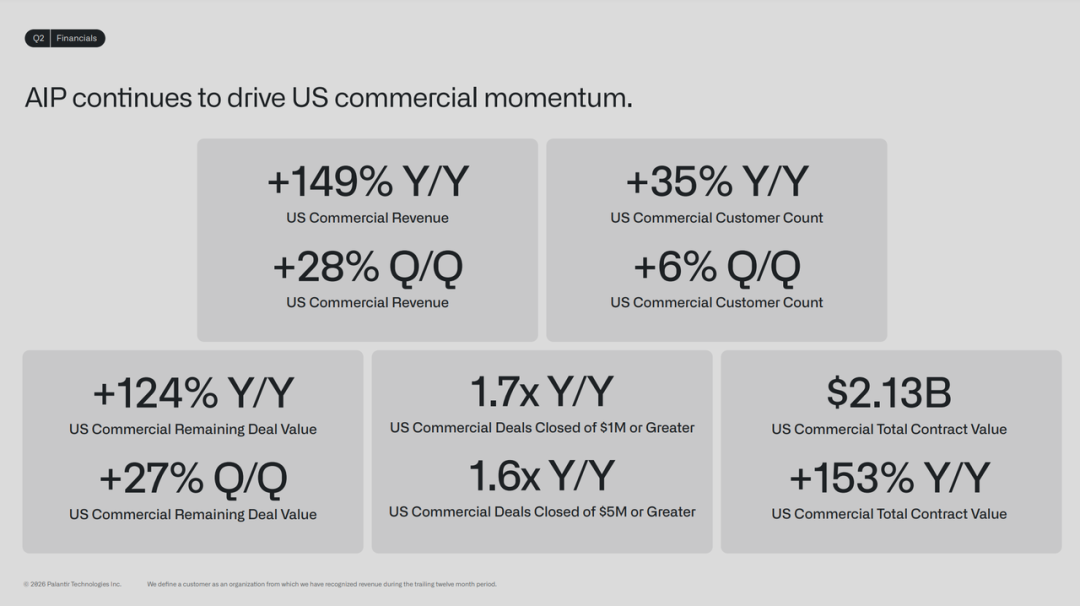
The company's total revenue in Q2 reached $1.935 billion, a year-on-year increase of 93%. Among them, U.S. commercial revenue was $764 million, an increase of 149% year-on-year; U.S. government revenue was $809 million, a rise of 90% year-on-year. In terms of year-on-year incremental calculation, U.S. operations contributed about 90% of revenue growth this quarter, with Palantir already forming two growth engines near the same scale.
The number of U.S. commercial customers increased to 653, a 35% year-on-year growth; net dollar retention rate (NDR) rose to 157%, indicating that revenue contributed by the existing customer group in the previous year increased by 57%. New customers continue to enter, while existing customers are expanding in departmental coverage, usage scenarios, and purchasing scale, with AIP's growth transitioning from acquiring pilot projects to expanding within the customer base.
(Image Source: Palantir)
This set of data presents a complete link from customer expansion to revenue recognition. Q2 U.S. commercial revenue grew by 149% year-on-year, with the number of customers increasing by 35%; U.S. commercial TCV reached $2.13 billion, up 153% year-on-year, and remaining transaction value increased by 124% year-on-year.
(Image Source: Palantir)
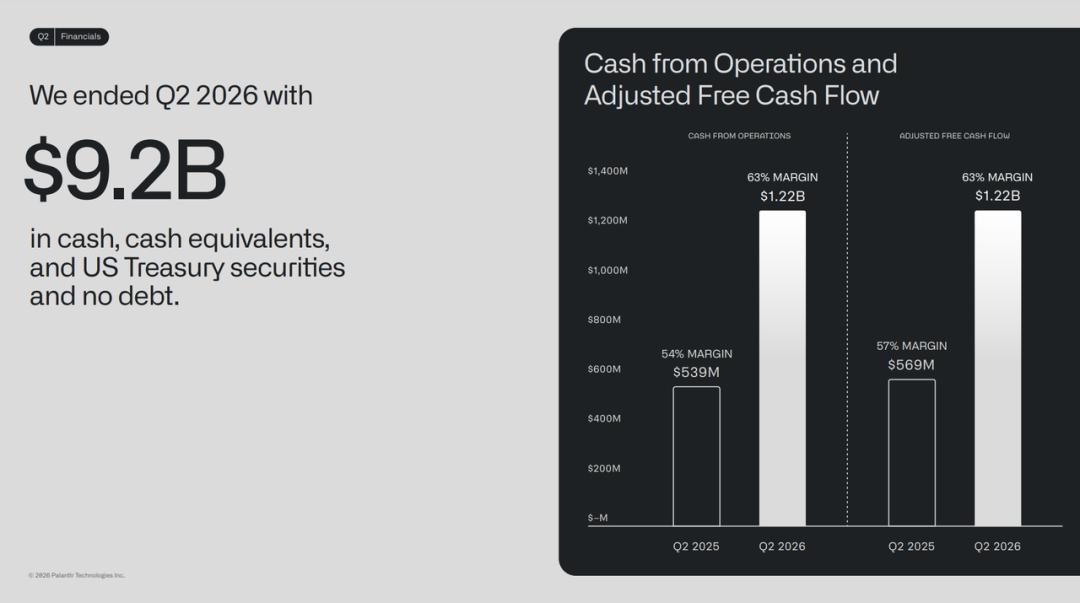
Growth is also quickly transforming into cash flow. Q2 operating cash flow and adjusted free cash flow both reached $1.22 billion, corresponding to profit margins of 63%. Cash, cash equivalents and U.S. Treasury bonds at the end of the period amounted to $9.2 billion, with no debt.
The number and scale of contracts are also amplifying synchronously. The company signed 220 contracts during the quarter, each worth no less than $1 million, among which 98 exceeded $5 million and 73 exceeded $10 million. The simultaneous growth of new customer numbers, net dollar retention rates, and large contracts indicates that the growth foundation has expanded from a few pilot projects to a broader scope of production deployment.
1.2 Operating Leverage Releases Cash Flow, Supporting the Next Round of Expansion
Palantir's Q2 adjusted total expenses grew 37% year-on-year, significantly lower than the 93% revenue growth; the adjusted operating profit margin reached 62%, with the Rule of 40 rising to 155%. New income is being transformed into profits and cash flow at a high ratio, with operating leverage being further released.
Strong cash flow provides ample space for Palantir to expand product R&D, customer deployment, and delivery teams. The company can continue to incur upfront investments, pushing more pilots into production environments and supporting the next round of expansion with new income.
This is also the most crucial difference between Palantir and traditional seat-based charging software. Its growth does not depend on simply increasing user accounts but rather on whether the platform can enter more production processes and replicate already validated applications within customer operations. CEO Alex Karp emphasizes that purchasing models and tokens alone do not automatically generate productivity; the real value comes from integrating the model into the enterprise's data, permissions, and decision chains. The company is developing an Ontology-native Agent Engine SDK that integrates the creation, governance, and operation of Agents into the same system, continuing to expand the business scope that the platform can undertake.
1.3 Key Validation for the Next Quarter: High Valuation and Business Concentration Heighten Risks
(Image Source: Palantir)
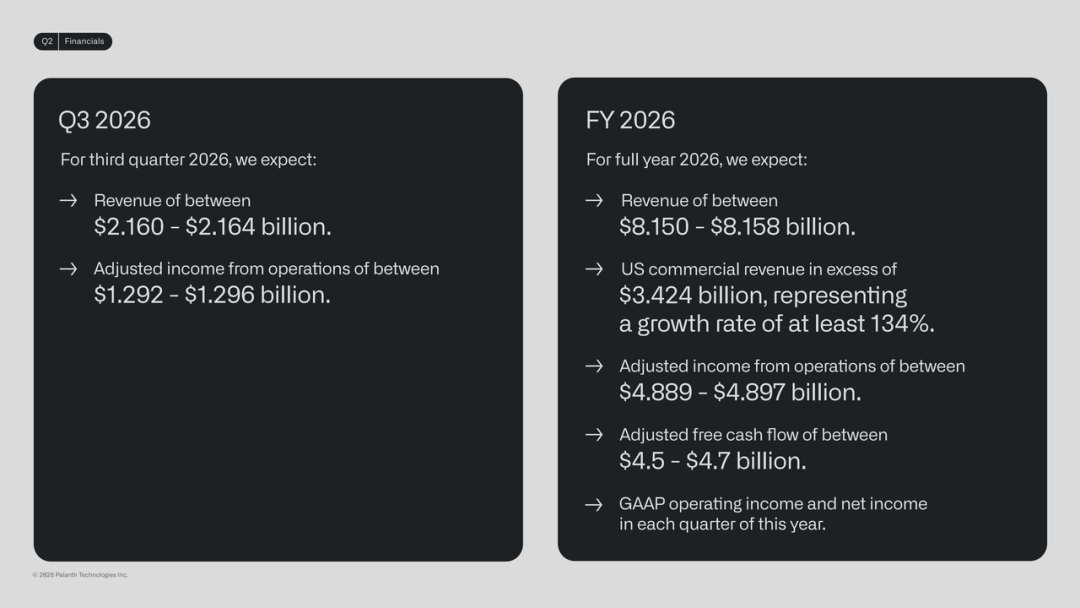
Palantir's Q3 guidance suggests that high-speed growth and high profit margins will continue simultaneously. The midpoint of the Q3 revenue guidance is expected to grow about 12% compared to Q2, and the adjusted operating profit margin is close to 60%. The company anticipates that U.S. commercial revenue for the whole year will increase by at least 134%, with adjusted free cash flow expected to reach $4.5 billion to $4.7 billion.
From the overall earnings report, Palantir has already crossed the initial verification stage of AI commercialization. The current risks are mainly concentrated on:
Reliance on government business and large clients. In 2025, government clients contributed 54% of revenue, with the top three clients collectively contributing 16%. Q2 U.S. government revenue still accounted for about 42% of total revenue. Government contracts are large-scale and long-term but can be affected by budget constraints, procurement progress, policy changes, and convenience termination clauses.
Continued insider selling. CEO Alex Karp, CTO Shyam Sankar, and other executives continued to sell stock in 2026, with multiple transactions executed under pre-established Rule 10b5-1 trading plans. Although planned selling does not directly indicate management's pessimism about the outlook, ongoing stock sales can heighten market concerns about valuation, equity incentives, and management's interest consistency.
High valuation limits room for error. As of August 14, PLTR's market capitalization was approximately $418 billion, with a forward P/E ratio of about 91 times and a forward P/S ratio of about 41 times based on adjusted EPS for the next 12 months. Current stock prices have factored in expectations of long-term high-speed growth in revenue, contracts, and profit margins; if performance slows, it may trigger simultaneous downgrades in profit expectations and valuation multiples.
2. Fortinet (FTNT): Vertical Integration Stalls Data Path, Product Revenue Increases 52% in a Single Quarter
Fortinet's advantages come from the vertical integration of security chips, operating systems, and subscription services. Founded in 2000, this company is one of the major global cybersecurity vendors. Its core product, the FortiGate firewall, utilizes self-developed FortiASIC chips and the FortiOS operating system, covering firewall, SD-WAN, SASE, cloud security, endpoint protection, and security operations, with revenue mainly derived from hardware sales and subscription services. The self-developed FortiASIC security chip is responsible for decrypting and inspecting traffic on real data paths, while FortiOS connects firewalls, SD-WAN, SASE, endpoints, OT, and security operations into a unified platform.
AI has increased machine identities, API calls, and encrypted traffic, and enterprises still need to enforce access policies and block attacks on data paths, which is precisely where Fortinet's chips and operating systems fit in.
2.1 Product Revenue Increases 52%, Replacement Cycle and AI Data Center Demand Release Simultaneously
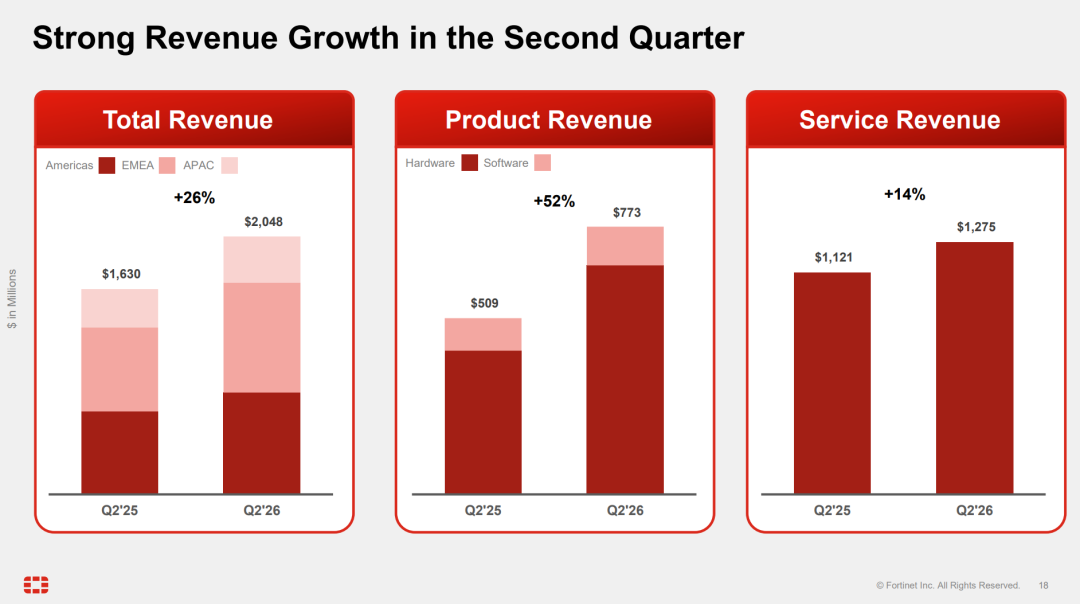
The highlight of Fortinet's Q2 earnings report is a 52% increase in product revenue, reaching $773 million, far exceeding market expectations. The replacement cycle for firewalls and demand for traffic from AI data centers have both been released in the same quarter, pushing total revenue up 26%, with new orders and renewals increasing by 33%. The adjusted operating profit margin was 38%, with a free cash flow margin of 49%. The company subsequently raised its annual revenue guidance by about 3%, with the new orders and renewals guidance adjusted similarly; management has explicitly listed replacement demand and AI data centers as continuing driving forces rather than positioning them as temporary spikes.
(Image Source: Fortinet)
2.2 Self-Developed Chips Form Performance Cost Advantages, FortiOS Promotes Platform-Based Procurement
Fortinet's advantages can be broken down into two layers:
The self-developed FortiASIC chips handle encrypted traffic at high speeds, creating differences in detection performance, power consumption, and unit cost;
FortiOS integrates firewalls, enterprise networks, remote access, and security operations into the same system.
Customers first purchase FortiGate devices and can subsequently add security modules and subscription services on the same platform, making hardware an entry point for expanding revenue per client.
AI data centers and hybrid clouds have increased encrypted traffic, machine connections, and the complexity of cross-environment management, requiring enterprises to have higher detection throughput while needing unified visibility of security data and enforcing access policies. By integrating multiple point tools into the Fortinet platform, the company can gain revenue from firewall replacements while also extending subsequent subscription and security operations service billing cycles.
2.3 Three Consecutive Quarters of Exceeding Expectations, Valuation Reaches Historically High Ranges
From Q4 2025 to Q2 2026, Fortinet has consecutively delivered three earnings reports that exceeded expectations. In last year's Q4, new orders and renewal amounts surpassed the guidance upper limit, with Q1 and Q2's revenue, orders, and profit margins also continuing to exceed expectations, leading management to raise the annual guidance consecutively. The demand for firewalls, AI data centers needing high-performance devices, and the company's execution in supply chain and product delivery have altogether accelerated performance.
In the next quarter, we will focus on monitoring the growth rates of product revenue and service revenue. As of August 14, Fortinet's P/E ratio, calculated based on adjusted earnings per share for 2026, is approximately 46 times, higher than the forward P/E range of about 28 to 40 times from 2022 to the end of 2025, yet still lower than some high-premium cybersecurity companies.
3. Cloudflare (NET): Extending from Internet Traffic Entry to Agent Infrastructure
In the traditional internet era, Cloudflare provided DNS, CDN, DDoS protection, WAF, and traffic acceleration between users and website origin servers. Once access to the site was established, performance and security could be accomplished on the same global edge network, which was the company's most challenging asset to replicate.
In the AI era, Cloudflare has quickly become an indispensable service provider for Agents:
Workers AI, Durable Objects, Browser Rendering, and Sandboxes provide an operating environment for Agents;
AI Gateway, Zero Trust, and security products observe model calls, validate identities, and enforce policies;
Crawl Control, Monetization Gateway, and Wallets attempt to charge Agents for content, API, and MCP tools.
3.1 Q2 Revenue Growth Resumes Acceleration, Contract Reserves Continue to Expand
Cloudflare is converting the traffic entries accumulated during the internet era into connection, operation, and security control points in the AI era. The most noteworthy aspect of Q2 is that this positioning is beginning to receive validation from core business data:
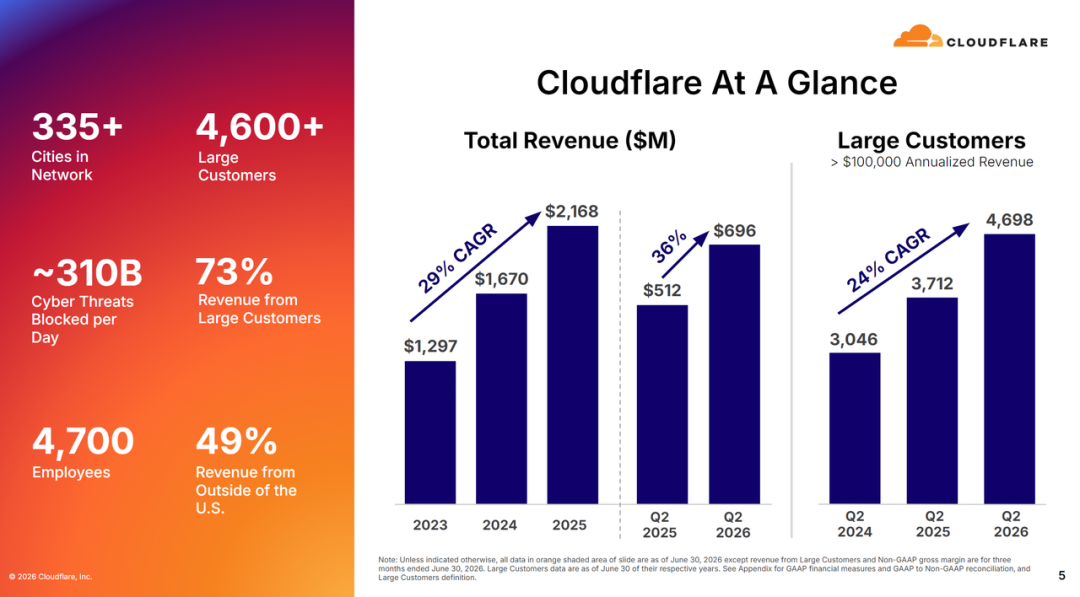
(Image Source: Cloudflare)
Revenue Resumes Acceleration: Q2 revenue reached $696.1 million, a year-on-year increase of 36%, higher than the previous quarter's 34%.
Contract Reserves Continue to Expand: Contract revenue expected to be recognized in the next 12 months increased 35% year-on-year, closely matching the revenue growth during the period; the number of large customers exceeded 4,600, as enterprise customers continued to expand procurement.
Growth Begins to Convert to Profit and Cash Flow: Adjusted operating profit reached $96.1 million, corresponding to a profit margin of about 14%; the free cash flow margin was about 8.1%, up from 6.5% in the same period last year.
3.2 Surge in Agent Requests, Cloudflare Captures AI Infra Entry
Cloudflare co-founder and CEO Matthew Prince views AI as a replatforming of the internet.
Cloudflare plans to have its globally distributed server nodes simultaneously handle Agent operations, connections, and security controls, with revenue sources set to exceed GPUs and model calls. Workers AI, Durable Objects, Browser Rendering, and Sandboxes offer operating environments; AI Gateway and Zero Trust monitor calls, validate identities, and enforce policies; Crawl Control, Monetization Gateway, and Wallets explore the charging mechanism for contents, APIs, and MCP tools.
The growth of machine traffic provides demand validation for this strategy. From June 2025 to May 2026, the average daily number of Agent requests in the Cloudflare network grew by about 1,700%. By May 2026, non-human requests accounted for 55.5%, surpassing human requests for the first time. The increasing connections and calls initiated by machines will elevate the need for operational, validation, access control, and security protection, but this traffic data cannot yet directly prove that the Agent business has generated revenue.
Payment and settlement are the longest-term issues. However, Cloudflare has opened Wallets address reservations, planning to allocate limited virtual wallets to Agents using stablecoin accounts for purchasing content, APIs, and MCP tools. In its early stages, Monetization Gateway will verify stablecoin payments through x402, which will be a long-term observation point for Cloudflare's entry into the Agent transaction link.
3.3 Valuation Still Supported by Core Business, Agent Monetization Lags Behind Valuation Expectations
Cloudflare's risk stems from the time lag between expectations and revenue. The market has begun to trade on the growth prospects of Agent infrastructure and paid settlements; Q2 performance is still supported by network, security, and developer platforms. If core business experiences a slowdown before Agent revenue scales up, current valuations may lose support from both short-term performance and long-term growth. Monetization Gateway and Wallets have not yet disclosed calling amounts, paying clients, or independent revenue, and cannot currently be valued according to matured payment networks.
Management has raised its 2026 revenue guidance to $2.864 billion to $2.870 billion, increasing the adjusted earnings per share guidance to $1.25 to $1.26; Q3 revenue guidance is set at $736 million to $737 million, about a 5.8% growth compared to Q2.
In the next quarter, we need to verify whether revenue can meet the guidance and observe the contract revenue expected to be recognized in the next 12 months, the number of large customers, net revenue retention rate, and usage of Workers and AI Gateway. More importantly, signals will indicate whether the company begins to separately disclose paid calling amounts, paying customers, or related revenues for Agents.
4. Shopify (SHOP): AI Penetrates Entire E-commerce Chain, GMV, Revenue, Cash Flow All Leap Forward
The market previously placed Shopify into the SaaS basket, using the logic of “AI reducing employees and thus reducing seats” to unify pricing. However, Q2 earnings reports further clarify that this logic does not apply to Shopify. Nearly 80% of the company's revenue for the quarter came from payment, merchant finance, and transaction services, with merchant solutions growing by 37%, and the free cash flow margin rising to 18%. A decrease in employees does not affect Shopify’s revenue recognition; GMV and payment penetration are the core driving variables.
Simultaneously, self-built tools have difficulty quickly replacing Shopify. A system capable of long-term transaction support must simultaneously handle payment, refunds, fraud, taxes, inventory, orders, logistics, and security, with losses from system failures potentially far exceeding software costs. AI can reduce merchants' manual processes, but the commercial backend controlled by Shopify currently has no better alternative.
4.1 Merchant Solutions Outperform Subscriptions, Transaction Revenue Becoming Main Engine
The biggest highlight of Q2 is that revenue structure continues to tilt towards transaction fees, with Shopify’s reliance on subscriptions and software seats further decreasing. Merchant solution revenue grew 37% to $2.781 billion, surpassing the 22% growth rate of subscription solutions, and its proportion of total revenue increased from about 76% year-on-year to about 78%. Payment, transaction, and merchant financial services have become major sources of incremental revenue, and the total value of goods transacted on the platform is increasingly important for revenue growth.
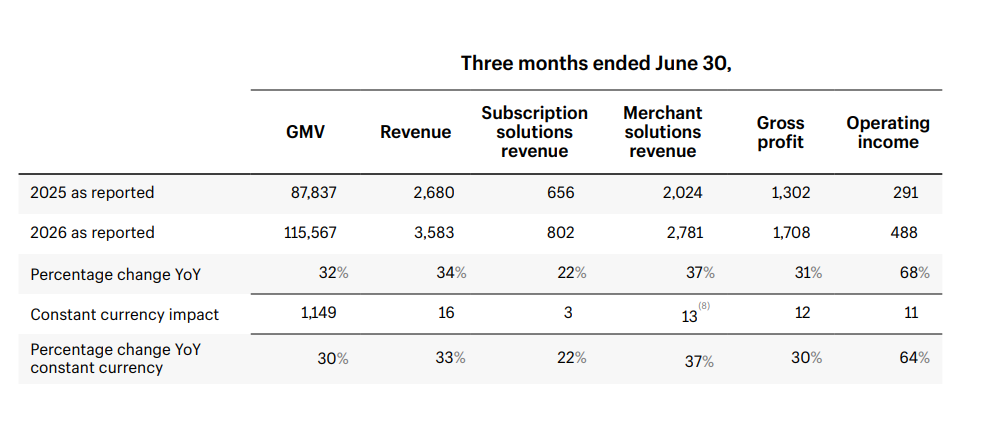
(Image Source: Shopify)
The transaction volume, revenue, and cash flow in the second quarter also support this judgment. The total value of goods transacted this quarter reached $115.567 billion, a year-on-year growth of 32%; total revenue grew by 34% to $3.583 billion; the free cash flow margin increased from about 16% year-on-year to 18%. Q3 guidance remains at a year-on-year growth just above 30%, with gross profit expected to grow 25% to 29%, and free cash flow margins anticipated to remain in the 17% to 21% range.
4.2 AI Order Growth 13 Times, But Entry Competition is Key
The impact of AI on Shopify has extended from enhancing merchant efficiency to order growth. In Q1 2026, the number of weekly active stores using Sidekick grew by about four times year-on-year; the addition of AI chat tools led to traffic growth of over eight times, and order growth approached 13 times. The conversion rate of visitors driven by AI is nearly 50% higher than that from natural searches, with an average transaction value 14% higher.
Shopify is integrating product catalogs, inventory, payment, and checkout capabilities into new AI shopping entries through Agentic Storefronts and Commerce for Agents. Consumers can complete searches and decisions in ChatGPT, Google, or other Agents; Shopify is striving to continue handling subsequent payments, orders, and fulfillment. As long as orders brought in by AI are completed through Shopify, the company can convert new traffic into gross merchandise volume and merchant solution revenue.
4.3 Whether AI Traffic Can Solidify into GMV is the Most Critical Observation Point for the Next Stage
Finance data indicates that the AI revenue path for Shopify is shorter than for most SaaS companies. On the first trading day following the earnings announcement, Shopify's pre-market gain expanded to 30%, reflecting the market's recognition of Shopify’s path to boost transaction growth through AI, while prior concerns about AI undermining its business model have also started to ease.
In the next quarter, we will focus on whether revenue can maintain growth just above 30%, while observing GMV, Shopify Payments penetration, AI-driven traffic, and conversion rates. If Agent shopping leads to new orders while continuing through Shopify for checkout, the platform's position will be further strengthened. However, if major model platforms dominate user entry and force Shopify to lower payment or transaction takings, the company may degrade into a backend infrastructure with weaker bargaining power.
Distill AI
免责声明:本文章仅代表作者个人观点,不代表本平台的立场和观点。本文章仅供信息分享,不构成对任何人的任何投资建议。用户与作者之间的任何争议,与本平台无关。如网页中刊载的文章或图片涉及侵权,请提供相关的权利证明和身份证明发送邮件到support@aicoin.com,本平台相关工作人员将会进行核查。


