The centralized AI platform has pain points such as quality black boxes; DGrid AI reconstructs decentralized AI infrastructure with on-chain verification.
Written by: Teacher Zhang's AI Diary
AI models are strong enough, but AI infrastructure is still not trustworthy enough.
When you invoke Claude Opus 5 or GPT-5.6 through a third-party platform, you cannot verify whether the platform really called these top models or silently switched to cheaper versions; you cannot confirm whether the returned results are original outputs or have undergone some processing; you also cannot know whether the platform's pricing is reasonable, as the entire supply chain is completely opaque to you.
This is not a trust problem, but a mechanism problem.
Today, as AI services have become critical infrastructure, the three issues of quality black boxes, vendor lock-in, and value closure remain fundamentally unresolved. Most developers and enterprises still rely on centralized platforms, making compromises between transparency, flexibility, and bargaining power.
DGrid AI's positioning is: to make AI services genuinely callable, verifiable, and settlement-ready through on-chain quality verification, an open model marketplace, and a token economy coordination.
As of the first half of 2026, DGrid has serviced over 15,000 paying users, generating $23M in verification revenue, and AI Arena has attracted over 500,000 users to participate in model evaluations. With the announcement of the $DGAI token economic model and the launch of TGE, DGrid is evolving from "AI service product" to "decentralized AI infrastructure protocol."
This article will break down DGrid's technical architecture, mechanism design, commercial validation, and market positioning starting from three fundamental problems.
1. Three Fundamental Problems of AI Infrastructure
Problem 1: Quality Black Box — You Cannot Verify Whether the Services Provided by the Platform Are Genuine
Scenario: A company calls Claude Opus 5 through a certain aggregation platform to process sensitive documents, paying according to top model prices. But in reality, did the platform really call Opus 5? Will it automatically downgrade to a cheaper model during peak times? Were the returned results processed or reviewed in some way?
Core of the Problem: Centralized platforms control the entire process of model invocation, placing users at a complete information disadvantage. The platform is both the service provider and the quality judge, leaving users to choose between "trusting" or "not using."
Why is this problem serious?
- For developers: cannot verify service quality, making it hard to optimize product experience
- For enterprises: trust costs are extremely high when dealing with sensitive data and core business
- For the industry: lack of quality standards leads to "bad money driving out good" — fraudulent platforms can have lower costs
Problem 2: Vendor Lock-In — You Are Trapped in a Few Centralized Entrances
Scenario: A SaaS product initially chooses a particular model vendor and deeply integrates their API into the business logic. Six months later, the vendor significantly raises prices or adjusts service terms, but the migration cost is extremely high — requiring code restructuring, retesting, and redeployment.
Core of the Problem: Each model vendor has its own API specifications, authentication methods, billing logic, and rate limiting strategies. Once developers choose a certain platform, the switching cost exponentially increases with the depth of integration.
Why is this problem serious?
- The platform has pricing power, leaving users with weak bargaining ability
- Single point of failure risk: platform service interruptions directly affect business
- Innovation is limited: unable to flexibly try new models or fine-tune models for vertical fields
Problem 3: Value Closure — You Cannot Participate in the Underlying Value Distribution of AI Services
Scenario: A medical AI team fine-tunes a model for clinical diagnosis scenarios, achieving results far beyond general large models. But they lack distribution channels and can only shelf it through centralized platforms, accepting the revenue-sharing ratios and traffic allocation rules set by the platform. The income generated from model invocation is mostly taken by the platform.
Core of the Problem: Centralized platforms hold model entry, pricing rights, and data control rights. Model providers, developers, and users cannot directly participate in value distribution or influence platform rules.
Why is this problem serious?
- High-quality vertical models have difficulty reaching actual demand parties
- Organizations and individuals with idle computing power cannot monetize their resources
- How much of the fees paid by users actually flows to the service providers? Cannot verify
The commonality of these three problems is that centralized platforms are both rule makers and stakeholders, placing both users and service providers in a passive position.
DGrid's answer is: to reconstruct AI infrastructure using decentralized mechanisms, making quality verifiable, supply open, and value traceable.
2. DGrid's Answer: Panorama of Technical Architecture
DGrid AI is not simply "putting AI on the chain," but building decentralized AI infrastructure around three core capabilities:
1. Unified Invocation Layer: AI Gateway
Problem Solved: Vendor Lock-In
DGrid AI Gateway provides OpenAI-compatible API interfaces, allowing developers to access 200+ models with just one API key, including mainstream commercial models such as Claude Opus 5, GPT-5.6, Gemini Pro, MiniMax, DeepSeek, Kimi, GLM, etc.
Core Mechanisms:
- Smart Routing: Automatically selects the optimal model based on task type, cost budget, and latency requirements
- Load Balancing: Automatically switches to a backup node when a certain upstream service provider fails
- Unified Billing: Standardizes pricing methods for different models through a Compute Unit mechanism
- Zero Migration Cost: Requires only modification of the base_url parameter, with no need to restructure existing code
Key Value: Developers are no longer locked by a single vendor and can switch models, compare performance, and optimize costs anytime, maintaining maximum flexibility.
2. Quality Verification Layer: Proof of Quality (PoQ)
Problem Solved: Quality Black Box
PoQ is DGrid's unique on-chain quality verification mechanism, and currently the only quality verification protocol practically deployed in AI infrastructure, supported by 5 professional technical papers.
Core Mechanisms:
- Random Blind Testing: DGrid maintains a question bank and randomly selects questions for blind testing the model services provided by nodes
- Multi-Dimensional Evaluation: Assesses multiple dimensions such as output quality, response speed, stability, and format compliance
- On-Chain Evidence: Verification results are stored on-chain as a basis for node reputation scoring and incentive distribution
- Penalty Mechanism: If a node cheats (claims to provide GPT-5.6 but actually calls a lower version), it will be detected and penalized
Key Design: PoQ only verifies the services that nodes claim to provide, without touching users' actual invocation data, thus protecting privacy while establishing quality standards.
This resolves the core issue of the open market: How to prevent "substandard goods" when anyone can shelf a model?
3. Open Market Layer: Model Marketplace
Problem Solved: Value Closure
DGrid Model Marketplace allows any model providers to shelf models, set prices independently, and directly receive invocation revenue, with settlement completed through on-chain smart contracts.
Core Mechanisms:
- Free Shelving: Any individual or organization with model resources or computing power can become a supplier
- Independent Pricing: Providers set prices based on costs, performance, and market demand
- PoQ Endorsement: Models shelved will be verified by PoQ, and quality signals will be public and transparent
- On-Chain Settlement: Invocation revenue is automatically distributed through smart contracts without platform custody
Key Value:
- Vertical fine-tuned models (medical, legal, financial) can directly reach paying users
- Organizations with idle GPUs can deploy computing power as inference services and monetize
- Users can filter the most suitable models based on performance, price, and usage
From an architectural perspective: DGrid is a three-layer protocol stack:
- Top Layer: Unified Invocation Interface (AI Gateway), solving developer experience issues
- Middle Layer: Quality Verification Mechanism (PoQ), solving trust issues in the open market
- Bottom Layer: Open Market Protocol (Marketplace + $DGAI), solving supply and value distribution issues
3. In-Depth Analysis of the PoQ Mechanism: How to Establish Quality Standards in an Open Network?
PoQ is DGrid's core technological innovation and the key to whether the entire open market can be established. This section is worth a deep dive.
Why is PoQ needed?
In centralized platforms, quality control is managed by the platform, and users can only choose to "trust the platform." But in the open market, anyone can shelf a model; without a verification mechanism, the market will rapidly degrade:
- Someone claims to provide Claude Opus 5, but actually calls a cheaper model
- Someone deliberately lowers service stability, dropping calls during peak times
- Someone returns results in non-compliant formats, increasing downstream processing costs
The core problem PoQ aims to solve: How to verify the service quality provided by nodes without touching user privacy?
How does PoQ work?
Step 1: Question Bank Construction
DGrid maintains a question bank covering multiple task types:
- Code generation
- Text understanding
- Reasoning analysis
- Format conversion
- Multi-language translation
Each question has a standard answer or scoring criteria.
Step 2: Random Sampling
The system regularly randomly selects questions from the question bank to initiate "blind test invocations" to nodes. The nodes do not know whether this is a test request or a real user request.
Step 3: Multi-Dimensional Evaluation
The returned results are scored from multiple dimensions:
- Quality Score: Accuracy, completeness, and logic of answers
- Speed Score: Response latency, time to first byte
- Stability Score: Success rate, error rate
- Compliance Score: Whether the output format complies with API specifications
Step 4: On-Chain Evidence
Evaluation results are stored on-chain, forming the reputation score of nodes. This score:
- Is public and transparent: Anyone can query
- Is tamper-proof: Historical records are permanently saved
- Affects incentives: High-quality nodes receive more $DGAI rewards
- Triggers penalties: Cheating nodes will have their stakes forfeited
Three Key Designs of PoQ
1. Privacy Protection: Only verify nodes, without touching user data
The verification requests of PoQ are initiated by the system, using question bank data and will not use users' real invocation data for verification or on-chain operations. This ensures user privacy.
2. Anti-Cheating: Randomness + Blind Testing
Nodes cannot know in advance which invocation is a test and cannot predict the content of the questions. If they want to achieve high pass rates, the only way is to continuously provide high-quality services.
3. Incentive Compatibility: Quality Linked to Gains
PoQ scoring is not a simple "pass/fail" but affects the incentive weight of nodes. Nodes with higher quality receive more $DGAI rewards, creating a positive cycle.
PoQ essentially combines "continuous random audits + on-chain reputation + economic incentives" to make service quality in the open market quantifiable, traceable, and punishable.
This also explains why DGrid has an essential difference from projects like OpenRouter and Infura at the technical level: the latter rely on platform credibility, while DGrid relies on verifiable mechanisms.
4. Product Matrix: A Complete Ecosystem Around Different Participants
DGrid’s products are not single-point tools but a complete ecosystem built around four types of participants:
1. For Developers: AI Gateway
Core Value: One API call for 200+ models, zero migration cost, smart routing
Applicable Scenarios:
- SaaS products need to flexibly switch models (use Claude Opus 5 for code generation, GPT-5.6 for dialogue, DeepSeek for cost optimization)
- AI agents need to dynamically select the best model based on tasks
- Enterprises want to avoid vendor lock-in and maintain flexibility in their tech stack
2. For Model Providers: Model Marketplace
Core Value: Free shelving, independent pricing, on-chain settlement, PoQ endorsement
Applicable Scenarios:
- Fine-tuning model teams in vertical fields such as medicine, law, finance
- Organizations or individuals with idle GPUs
- Suppliers with exclusive model resources or low-cost computing power
3. For Average Users: AI Arena
Core Value: Anonymous model battles, real preference data, earn by participating
Applicable Scenarios:
- Enterprises compare different models' performance in actual scenarios before purchasing AI services
- Ordinary users participate in model evaluations, contributing data to the ecosystem while earning incentives
- DGrid utilizes real user feedback to optimize routing strategies and quality standards
Current Data: Over 500,000 users have participated, generating a large amount of human preference annotation data.
4. For Agent Developers: DClaw
Core Value: One-click agent deployment, on-chain identity, independent service invocation
Applicable Scenarios:
- Individual creators deploy dedicated AI assistants
- Agents establish trust relationships through on-chain identities
- As a member of the BNB Chain AI Landscape, access to the on-chain agent ecosystem
DClaw accesses the BNB Chain's ERC-8004 Agent Identity standard, allowing agents to have on-chain identities, discoverability, and reputation accumulation capabilities.
From a product logic perspective:
- AI Gateway addresses invocation issues
- Model Marketplace addresses supply and distribution issues
- AI Arena addresses quality assessment and data feedback issues
- DClaw addresses agent deployment and on-chain identity issues
These four products build a closed loop around "allowing AI services to circulate in an open network."
5. $DGAI Token Economy: More than Just Incentives, but also a Coordination Layer
$DGAI is the native token of the DGrid AI network, with a total supply of 1 billion.
Token Distribution
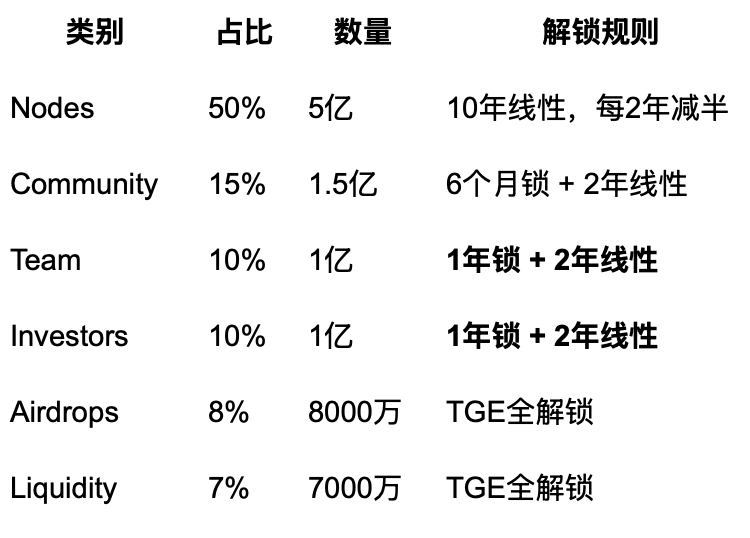
At TGE, only 15% is unlocked (Airdrops + Liquidity), with Team and Investor fully locked for one year.
Four Functions of $DGAI
1. Node Staking
Node operators stake $DGAI as service collateral, and PoQ scores affect incentive weights. Users can delegate $DGAI to high-quality nodes to share revenue.
2. Service Payment
When users invoke AI services, using $DGAI for payment can enjoy discounts. This creates real demand for the token.
3. Ecosystem Incentives
Nodes, model providers, agent developers, and arena participants earn $DGAI rewards based on contributions. Incentive distribution is not egalitarian but differentiated based on quality and invocation volume.
4. Protocol Governance
$DGAI holders can vote to decide: fee structure, PoQ rules, which new models to support, ecosystem incentive plans, and treasury usage.
Value Cycle
Users invoke services (paying with $DGAI)
↓
Nodes provide inference (receive $DGAI)
↓
PoQ verifies quality (affects incentive weights)
↓
High-quality nodes receive more incentives
↓
More nodes → Better services → More users
↓
Increased token demand → Ecosystem expansion
Key Question: Can $DGAI transition from being an "incentive asset" to a "utility asset"? That is, does the token's value come not only from incentive distribution but also from real AI service invocation payment demand?
6. Commercial Validation and Market Positioning: What Does $23M in Revenue Mean?
Verified Data
- Revenue for the first half of 2026: $23M
- Number of paying users: 15,000+
- Users participating in AI Arena: 500,000+
- Financing scale: $5M seed round
What do these numbers indicate?
1. Product demand has been validated
While most AI x Crypto projects are still telling stories, DGrid has proven paid demand through real revenue. AI Gateway and Premium services have been adopted by real users and enterprises.
2. Extremely high capital efficiency
Using $5M in financing to leverage $23M in revenue shows capital efficiency far exceeding the industry average. This indicates that the project has self-sustaining capabilities, not completely reliant on financing and token incentives to maintain operations.
3. High community engagement
With 500,000 users participating in AI Arena, it shows that DGrid has not only paying users but also active community participants contributing data to the ecosystem.
Key Turning Point
DGrid is currently at a critical juncture in transitioning from "centralized products" to "decentralized networks":
- On the product side: AI Gateway, Arena, and DClaw are online and have accumulated real users
- On the commercial side: $23M in revenue proves paid demand
- On the technical side: The PoQ mechanism has been implemented, with five papers supporting its credibility
- On the token side: The $DGAI economic model has been announced, and TGE is about to launch
The next challenge: whether to convert existing revenue and users into a sustained invocation volume within the decentralized network, the flow of supply and demand in the Marketplace, and the real application scenarios for $DGAI?
7. Competitive Product Comparison Matrix: Where is DGrid's Differentiation?
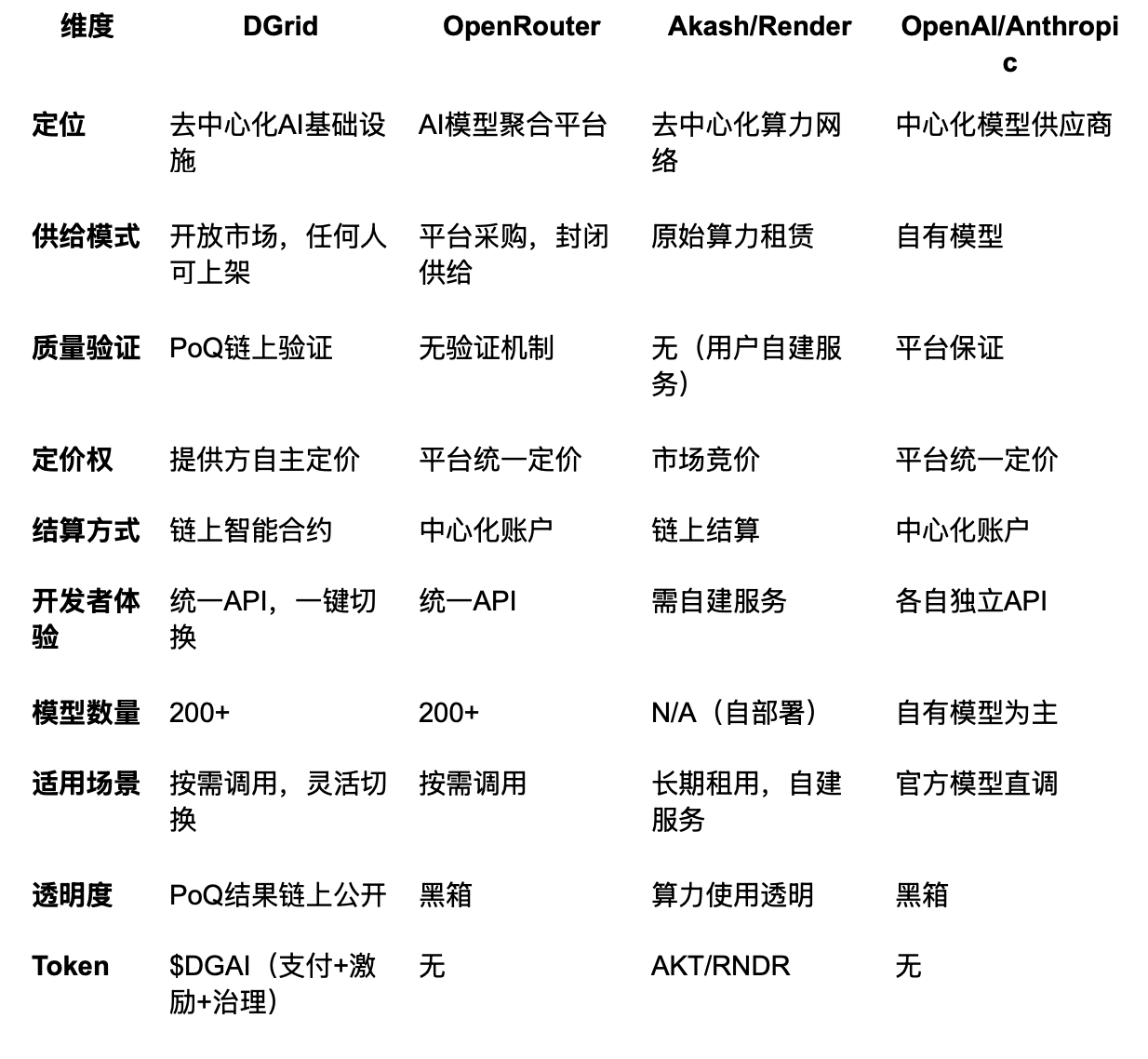
Core Differentiation
vs. OpenRouter
- OpenRouter was just acquired by Stripe for $7 billion, proving the market value of AI aggregation platforms
- However, OpenRouter is a closed transfer station, while DGrid is an open market
- OpenRouter has no quality verification, while DGrid has PoQ on-chain verification
vs. Akash/Render
- Akash provides raw computing power, DGrid provides packaged AI services
- Akash is suitable for teams building their own services, while DGrid is suitable for developers looking for rapid integration
- Akash is a generic computing power network, while DGrid is AI-specific infrastructure
vs. OpenAI/Anthropic
- Centralized platforms hold pricing power and quality interpretation authority
- DGrid makes quality verifiable through PoQ and restores pricing to the market through the Marketplace
- As AI models increase and vertical models become more important, the supply ceiling in the open market is far higher than that of a single supplier
8. Next Steps and Observation Metrics
Key Actions Ahead
- Launch Node Network: Open node staking and inference services
- Expand Model Marketplace: Attract more model providers to shelf models
- Governance Launch: Gradually open community governance rights
Three Core Metrics to Assess DGrid's Progress
1. Network Invocation Volume
Is the real AI service invocation continuing to grow? This determines whether there is genuine payment demand for $DGAI.
Observation Method: Focus on the monthly/quarterly invocation volume data disclosed by the official.
2. Diversity on the Marketplace Supply Side
How many model providers are shelving models? What proportion of vertical field models is there? This determines whether the open market is truly operating.
Observation Method: Focus on the number of models shelved in the Marketplace, the number of providers, and the distribution of invocation volume.
3. Token Usage Rate
Is $DGAI truly used for payments, staking, and governance, or just speculative assets?
Observation Method: Focus on on-chain data — number of payment transactions, staking rate, governance proposal participation rates.
Conclusion
AI infrastructure is undergoing a paradigm shift: evolving from centralized platform dominance to open protocols.
DGrid AI provides a complete specimen:
- Solving developers' invocation issues with AI Gateway
- Addressing quality verification in the open market with PoQ
- Solving supply openness and value distribution with Model Marketplace
- Connecting all participants with $DGAI, creating a coordination layer
It does not start with the token to revert back to scenarios, but originates from real product demand — $23M in revenue validates invocation demand; 500,000 Arena users demonstrate community involvement; five papers and actual deployment confirm the feasibility of PoQ.
The core question is: Can DGrid transform "callable, verifiable, settlement-ready" from product features into network protocols?
With the $DGAI launch and node network activation, this question is about to be validated.
免责声明:本文章仅代表作者个人观点,不代表本平台的立场和观点。本文章仅供信息分享,不构成对任何人的任何投资建议。用户与作者之间的任何争议,与本平台无关。如网页中刊载的文章或图片涉及侵权,请提供相关的权利证明和身份证明发送邮件到support@aicoin.com,本平台相关工作人员将会进行核查。


