The rise of API merchant endpoints: Low-value high-frequency payments may become the first sandbox for AI business.
Written by: @Jun__Yoo
Translated by: AididiaoJP, Foresight News
Imagine the following scenario: You plan to purchase an item worth $1,000, and you have two checkout options:
- Fully automated AI checkout: From product recommendations to payment completion, everything is handled independently by an AI agent.
- AI-assisted checkout: The AI is only responsible for information searching and product recommendations, while the final payment decision and execution are still confirmed by you.
How would you choose? I am optimistic about the prospects of agentic commerce, but at this stage, I would undoubtedly choose the latter. I believe most consumers would make the same judgment. What is the core reason behind this?
This article aims to first clarify the concepts of agentic commerce and API merchant endpoints, then analyze the "trust cost" that leads to consumers' concerns about fully automated checkouts, and finally explore the potential breakout point of this market and its future evolution path.
1. Concept Definition: Agentic Commerce and API Merchant Endpoints
Agentic Commerce refers to a business model in which an AI agent, after obtaining authorization from individuals or enterprises, autonomously executes searches and comparisons of products and services, partially or wholly completing the ordering and payment process. Major global consulting firms predict that by 2030, the scale of purchasing transactions in which agents are directly or indirectly involved will reach trillions of dollars.
According to the different levels of authority obtained by AI agents, their development can be divided into three stages:
- T1 Assisting Stage: AI is responsible for searching and recommending, while the final payment step is confirmed by humans.
- T2 Delegation Execution Stage: Humans preset budgets and purchasing conditions (such as spending limits), and the agent autonomously places orders and makes payments within these constraints.
- T3 Fully Autonomous Stage: The software autonomously selects and purchases external resources that can be called by machines (such as API interfaces, data, cloud services, etc.), without requiring manual approval for each transaction.
In the T3 stage, a new emerging business form is taking shape: API Merchant Endpoints. These merchants do not have traditional website interfaces and only accept payments and deliver services through API endpoints. It is seen as a potential new form for small and medium-sized enterprises following physical retail and traditional e-commerce.
An actual early market is already forming: AI agents purchasing software resources and services from other software. The new generation of developers, often called "Vibe Coders," is also beginning to build native agentic commerce businesses. In this context, stablecoin wallets, blockchain networks, discovery platforms, and facilitators are all entering the market, attempting to capture value at different levels.
2. Trust Cost: The Core Variable of Agentic Commerce
Before discussing the breakout path of agentic commerce, it is necessary to examine the market's general expectations regarding its evolutionary logic.
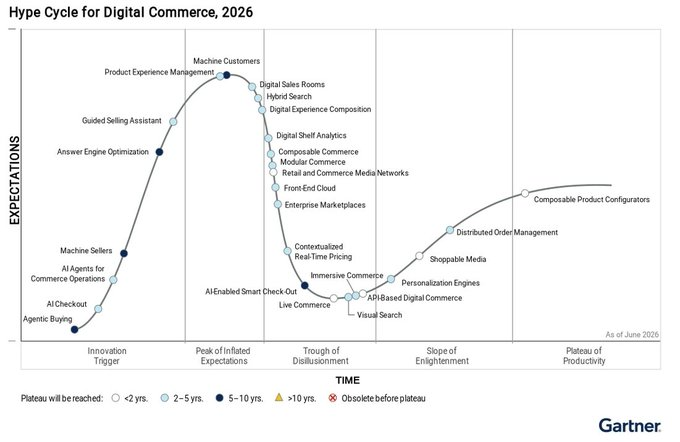
The mainstream view is that agentic commerce will follow a gradual development path from low authorization (T1) to high authorization (T3), accompanied by the gradual accumulation of trust. Many protocols and technologies follow this trajectory.
However, this article argues that the actual sequence of market formation may be exactly the opposite. Agentic commerce could achieve breakthroughs first at the highest authorization level, T3, especially concentrated in the niche market of API merchant endpoints.
Revisiting the initial case. When faced with a $1,000 item, the fully automated AI checkout option is hesitant. But if we change the scenario to purchasing data worth $10 from an API endpoint, would your choice change? What if you still preferred assisted checkout when the amount is reduced to $0.1 or even $0.01?
Why would the change in transaction amounts lead to differences in decision-making? The root cause lies in the fact that each choice comes with risks. When the expected risk of a decision exceeds the expected benefit, we tend to reject that option.
We define this risk and psychological burden as Trust Cost. Trust Cost is the sum of the risks and psychological burdens that users must bear when adopting a certain technology or service. It changes with the level of authorization and is also influenced by factors such as transaction amount, result verifiability, and recoverability.
3. Delegation Zone and Its Expansion Mechanism
Using the concept of Trust Cost, we can define the "Delegation Zone"—the scope within which users are willing to accept a technology or service at a specific level of authorization.
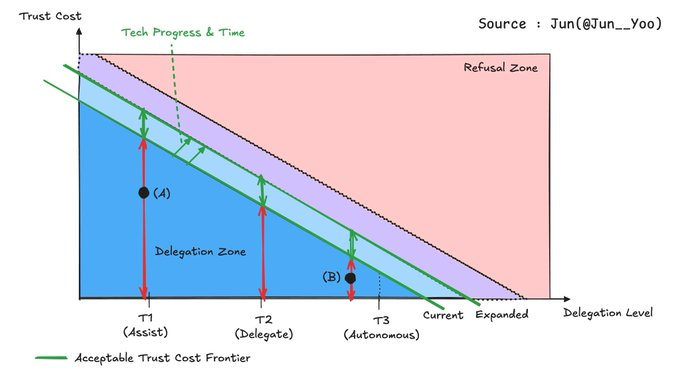
During the T1 stage, as users retain final approval rights, they can tolerate a higher Trust Cost, thus covering higher-value, higher-risk services. As the level of authorization progresses to T3, users are only willing to grant authority to those services that have reduced Trust Costs to very low levels. Therefore, the current Delegation Zone is broadest at the T1 stage and gradually narrows towards the T3 stage.
However, the Delegation Zone is not static. As technology advances and user experiences accumulate, the Delegation Zone can gradually expand. Looking back at the development history of e-commerce from the late 1990s to the early 21st century: early e-commerce focused on low-value, standardized products such as books and CDs, precisely due to consumers' concerns about the safety of online payments. With the improvement of payment systems and security mechanisms, as well as the habituation of consumers, purchasing high-priced home appliances and even cars online became the norm.
For a service to be adopted by users, it must first enter their Delegation Zone. There are mainly two paths for this:
- At a low authorization level (T1), the broader tolerance for Trust Cost makes it easier for services to enter;
- At a high authorization level (T3), service providers must compress Trust Costs to a sufficiently low level to cross the boundary of the Delegation Zone.
It should be emphasized that entering the Delegation Zone only represents "acceptable" from a risk perspective; actual adoption also requires the net benefit of the service to be positive.
4. Adoption Decision: Net Benefit Determinism
Whether users adopt a particular agentic service can be simplified to: Does the benefit brought by the agent exceed its Trust Cost (including supervision costs and potential risks)?
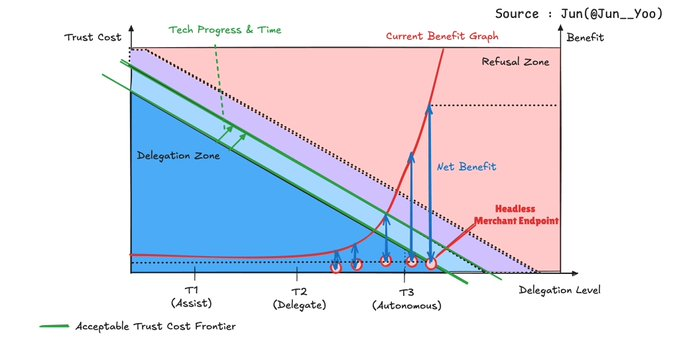
It is worth noting that increasing authorization does not necessarily lead to a proportional increase in benefits. If users still need to verify every action of the agent, their supervision costs will significantly offset the benefits brought by automation. More critically, human attention cannot achieve "partial recovery." A process handled 90% by an agent and 10% by a human differs significantly from one handled entirely by an agent; that remaining 10% human involvement can completely change the distribution of attention.
This explains why benefits may exhibit nonlinear leaps as they approach T3 authorization levels. Just as the difference between Level 2 and Level 3 autonomous driving is not about vehicle performance but whether the driver still needs to continuously monitor. Only when the obligation of supervision is completely lifted does the supervision cost tend toward zero. At this point, one person can manage multiple agents, and the benefits will show exponential growth.
From the perspective of net benefits, the value is the difference between "benefit" and "Trust Cost." The greater the gap, the higher the user's willingness to adopt. The real market opportunity lies in those fields that can reach T3 authorization levels while the benefits still significantly exceed Trust Costs. In such markets, the product-market fit is most easily formed.
API Merchant Endpoints fit all the above conditions.
5. Why Focus on API Merchant Endpoints?
The importance of this market is reflected in the following aspects:
- Limited downside risk: In high-frequency, low-value machine-to-machine (M2M) transactions, the loss from a single transaction failure is limited.
- Immediate automation benefits: The agent autonomously coordinates the procurement process according to preset strategies and budgets, significantly saving costs associated with manual searching, price comparison, and approval.
- Results are easy to verify: The final outputs (such as data, computation results) typically have clear verification standards, allowing for controlled user risk.
In this scenario, users are easily aware that "benefits exceed Trust Costs." Assume the end user requires an output worth about $10; the agent needs to combine multiple data and computation resources to complete it. A single output may involve multiple steps such as data retrieval, model inference, computation power purchasing, invoking specialized agents, and result verification. If done manually, searching for suppliers, comparing prices, and approving payments could far exceed the value of the task itself.
In this structure, a single user request will be broken down into multiple external calls (serial or parallel), each involving payment to different suppliers. As the complexity of tasks increases, the potential number of payment events will dramatically rise. In a multi-layer agent structure, payment events may exhibit nonlinear growth.
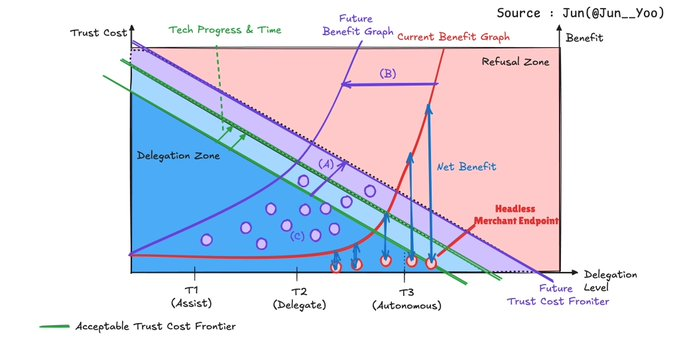
As payment data and transactions accumulate in this market, the trust mechanism will gradually mature. Measures such as delegation proofs, spending limit enforcements, result verification, and dispute arbitration, after repeated testing in low Trust Cost scenarios, will drive upward adjustments to the acceptable transaction amount thresholds at the same authorization level. This could trigger the following evolution:
- Expansion of the Delegation Zone: The boundaries of acceptable Trust Costs rise and shift rightward, expanding the range of tasks users are willing to delegate.
- Upward shift of the benefit curve: As services and ecosystems mature, the total benefits available to users increase.
- Expansion of the adoption zone: Services that previously did not meet adoption thresholds will gradually enter users' choice range.
This will form a self-reinforcing positive cycle that promotes the joint growth of markets at stages T1, T2, and T3.
Therefore, API Merchant Endpoints are very likely to become the first sandbox environment for fully testing agentic commerce processes with low Trust Cost digital resources. Although the transaction amounts may be small, the payment frequency is extremely high, providing dense testing and iterative opportunities for trust architecture and payment infrastructure.
6. Key Levels Worth Noting
If the API Merchant Endpoint market develops along the above path, the following five levels are worth focusing on:
- Stablecoin issuers: Earn income from reserve assets based on new net circulation balances.
- Blockchain networks: Charge network fees for on-chain settlement payment events.
- Facilitators: Charge validation and settlement fees for each managed payment event.
- Wallets: Control budget execution and asset flow before and after payments, and provide related financial services.
- Discovery platforms: Earn commissions from the routed payment amounts through supplier searches and order allocations.
The API Merchant Endpoint market has the potential for nonlinear growth. It seems to be at the forefront but may become the first area in agentic commerce to be understood by the market and implemented rapidly. This trend is worth continuous attention and deep tracking.
免责声明:本文章仅代表作者个人观点,不代表本平台的立场和观点。本文章仅供信息分享,不构成对任何人的任何投资建议。用户与作者之间的任何争议,与本平台无关。如网页中刊载的文章或图片涉及侵权,请提供相关的权利证明和身份证明发送邮件到support@aicoin.com,本平台相关工作人员将会进行核查。


