

This article is co-produced by PANews and BIT US Stocks, BIT US Stocks provides over 10,000 US-listed stocks and ETFs, supports stablecoin deposits and withdrawals as well as traditional US dollar wire transfers, enjoying complete shareholder rights and dividend voting rights.
Bitcoin On-chain Buying Recovers, Downward Risk Unabated
Bitcoin returned to above $65,000 yesterday, reaching this level for the first time since August 10. Meanwhile, US risk assets continue to be suppressed by soaring long-term US Treasury yields, with the 30-year Treasury yield briefly rising to a multi-year high of 5.34%, creating a temporary divergence between BTC and traditional risk assets.
Most traders focus on key support in the $62,000 to $63,000 range; if breached, it could test the $60,000 to $61,000 level to sweep liquidity. Resistance is concentrated near the 50-month index moving average around $65,400, as well as the potential neckline area of an inverse head-and-shoulders pattern. Analyst Aksel Kibar pointed out that if the inverse head-and-shoulders structure is confirmed, the rebound target is set at $76,000, but if it fails, it could drop to $53,000.
On-chain data research firm CryptoQuant noted that Bitcoin's 30-day apparent spot demand has greatly improved from a negative 206,000 BTC on July 23 to a current negative 5,000 BTC, on the cusp of turning positive for the first time since February 26. Historically, when spot demand turns from negative to positive, the median price increase for BTC over the next 60 days is 18.1%, with a win rate of 78%.
VanEck also believes Bitcoin may be nearing the end of its adjustment. Its model shows that 8 of the 12 “surrender indicators” have been triggered, and BTC has entered an 11-month adjustment period; the average length of cycles not including 2011 from peak to trough is about 12.7 months, so the period from September to November could become an important window for this round of accumulation. However, VanEck emphasizes that surrender signals do not show stable excess return advantages in the next 90 and 180 days, and what is truly worth waiting for is a renewed confirmation of funding demand.
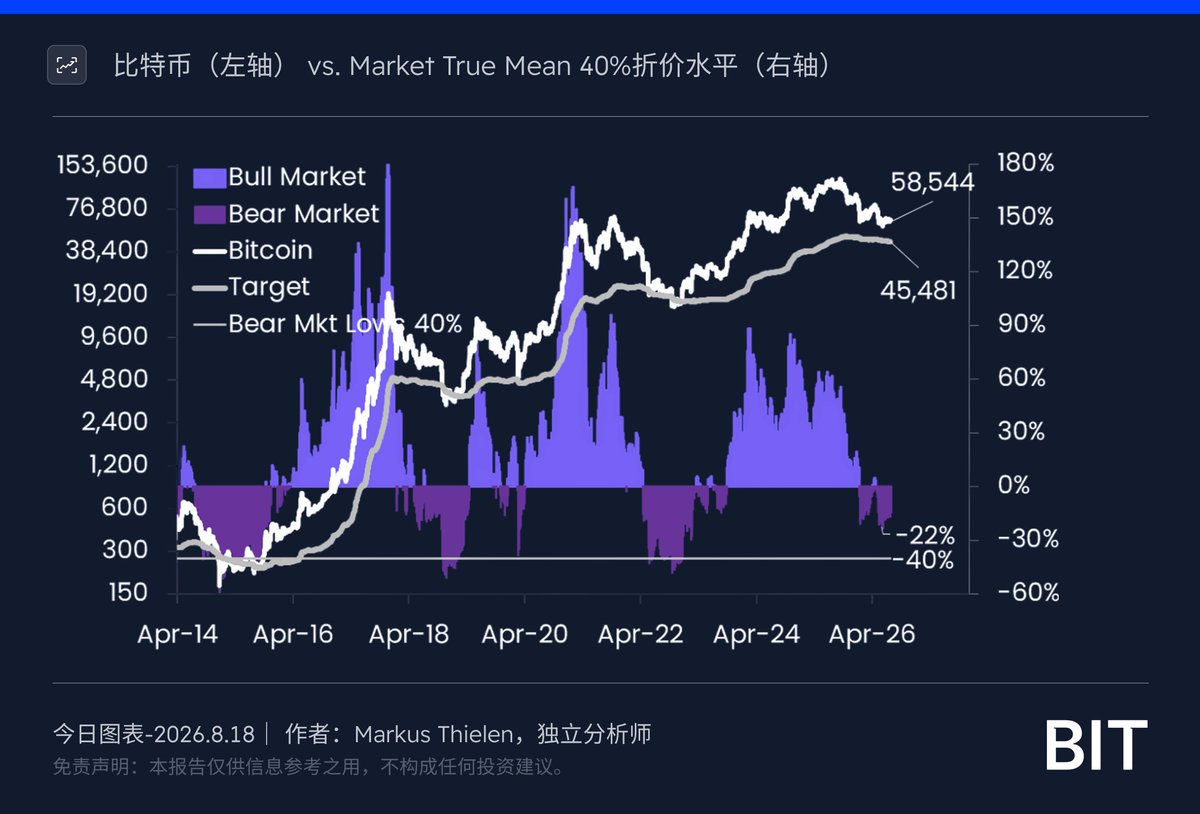
Bearish sentiment in the options market remains strong, with put option premiums significantly higher than call options, but open interest and funding rates show that leverage is gradually being cleared. BIT believes that based on historical data, Bitcoin has dropped about 40% below long-term market averages during bear markets, and if this pattern repeats, the price could fall to around $45,500. The current potential downside risk is about 20%, corresponding to an upside potential of about 60%, with the risk-reward ratio gradually improving, but macro risks may still push it down again; the real test is whether spot demand can continue to turn positive and hold firm on cost bases.
Next, BTC will focus on two key areas: whether the Fed's meeting minutes lean hawkish, and whether the auction of 20-year US Treasury bonds goes smoothly. If the bond market continues to be scary, BTC may retest around $63,000; if interest rate pressures ease, BTC may have a chance to challenge $66,000 to $70,000 again.
Today's Highlights:
Ethereum will undergo a Glamsterdam upgrade fork on the Platåberget testnet on August 20
KAITO (KAITO) unlocks approximately 32.6 million tokens, valued at about $11.5 million
LayerZero (ZRO) unlocks approximately 25.72 million tokens, valued at about $19.62 million
Upbit 24-hour trading volume ranking: BTC, XRP, ETH, LA, DOS
Bitcoin Spot ETF: +$189 million
Ethereum Spot ETF: +$71.468 million
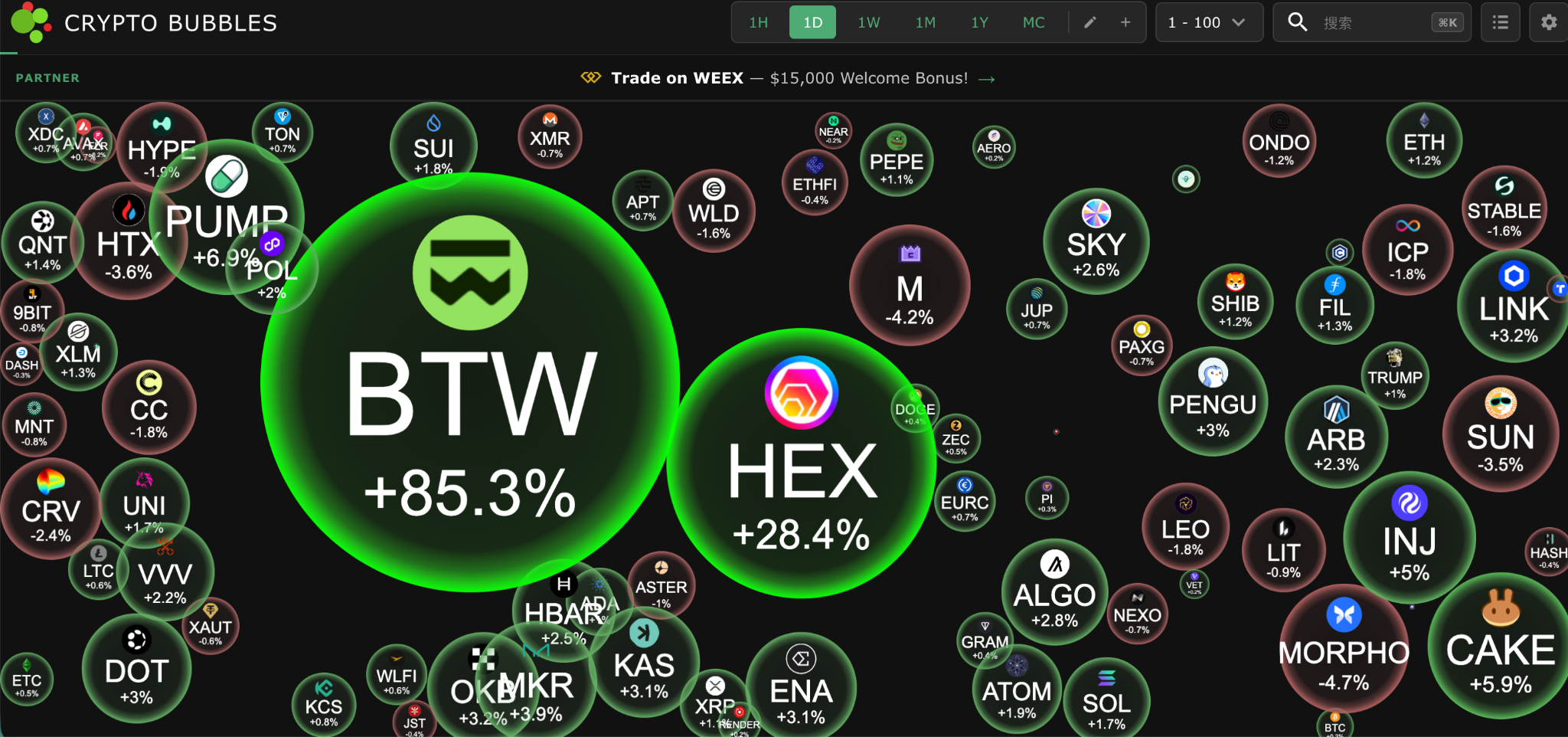
The largest gains today among the top 100 cryptocurrencies by market cap: BTW up 85.3%, HEX up 28.4%, PUMP up 6.9%, CAKE up 5.9%, INJ up 5%.
Stock Index Futures Test a Rebound, AI Sector is Still the Eye of the Storm

US stock index futures showed mixed performance, with Dow futures up 0.06%, Nasdaq 100 futures down 0.04%, and S&P 500 futures up 0.02%.
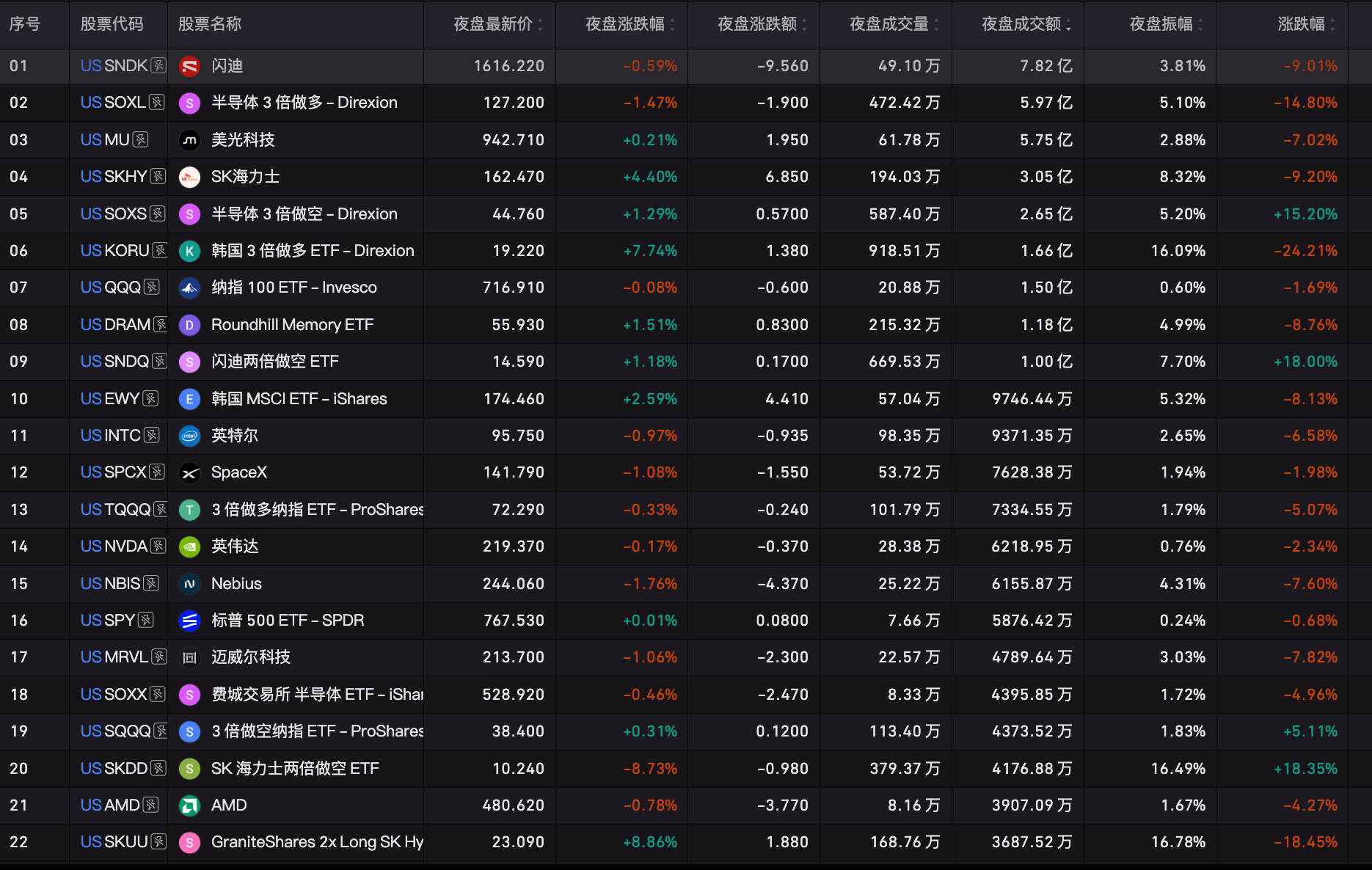
BIT night market data shows that the stock receiving the most attention in the night market is SK Hynix, which rose over 4% in after-hours trading. The company announced a buyback of stocks worth 40 trillion won to reduce shares and enhance shareholder returns. This action stabilized sentiment in the storage sector in the short term, with the storage ETF DRAM rising 1.51%, Micron Technology up 0.21%, and SanDisk down 0.59%.
However, most US stocks are still in a downward trend, with Nvidia down 0.17%, AMD down 0.78%, Nebius down 1.76%, and Marvell Technology down 1.06%.
Debt Market Storm Overwhelms AI Narrative, Funds Shift Towards Defense
Last night, the primary focus of US stocks was not on equities but on bonds. The 30-year US Treasury yield reached 5.338%, the highest since 2007, while the 10-year yield approached 4.75%; bond yields in France, Germany, the UK, and Japan also surged, raising global capital costs.
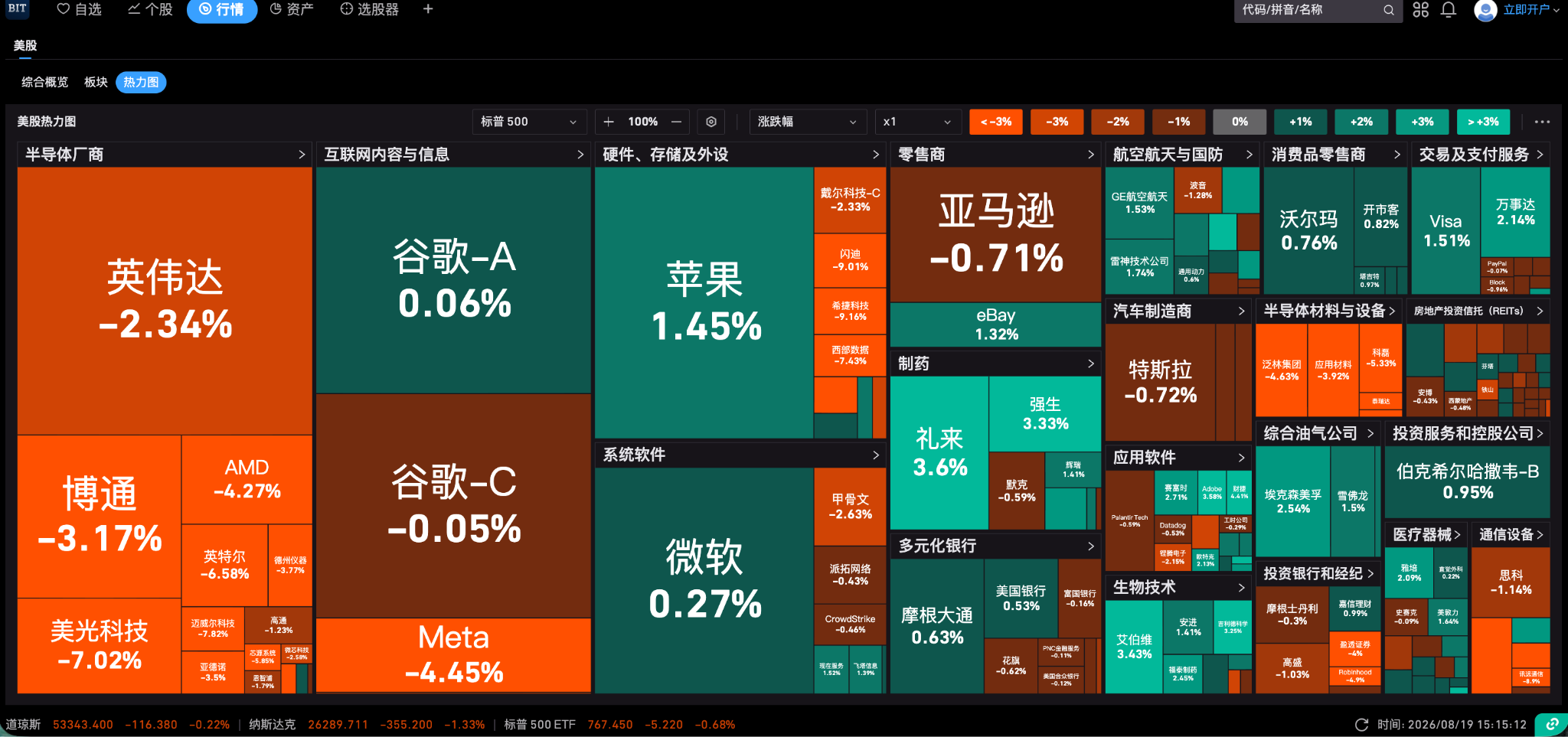
The AI sector has become the center of the sell-off, with the Philadelphia Semiconductor Index dropping about 5%, as the market's logic regarding AI capital expenditures wavers, fearing it is evolving from a "growth story" into a "debt story." Goldman Sachs data shows that issuance of AI-related bonds has reached $489 billion this year, far exceeding the total for 2025. At the same time, OpenAI's operating loss expanded to $12.3 billion in the second quarter, and Anthropic's annualized revenue run rate fell short of market expectations, further exacerbating investors' anxiety over the mismatch between hefty AI investments and return cycles.
As the most elastic link in the expansion of AI servers, storage stocks led the decline, with Micron Technology down about 7%, Seagate down over 9%, and SK Hynix ADR down over 9%. Optical communication and AI cloud service providers faced even more intense valuation reevaluation, with applied optics dropping about 15%, Coherent down over 12%, and CoreWeave down over 12%. BIT analysis points out that these companies, which heavily rely on continuous financing, may experience reverse amplifying effects on their valuations in an environment of soaring long-term rates.
Meta's stock price plummeted 4.45% due to a joint lawsuit from 29 states; whereas Apple was seen as a tech defensive stock due to its limited involvement in the capital expenditure "arms race" for AI data centers, rising against the trend by 1.45%. Microsoft, Google, and Amazon performed relatively steadily.
Analysts noted that the core of the current turmoil in the bond market lies in the US fiscal deficit outlook for the next decade, with nearly $1 out of every $5 in revenue going towards interest payments; this normalization is forcing the market to reassess the intrinsic value of overvalued tech stocks.
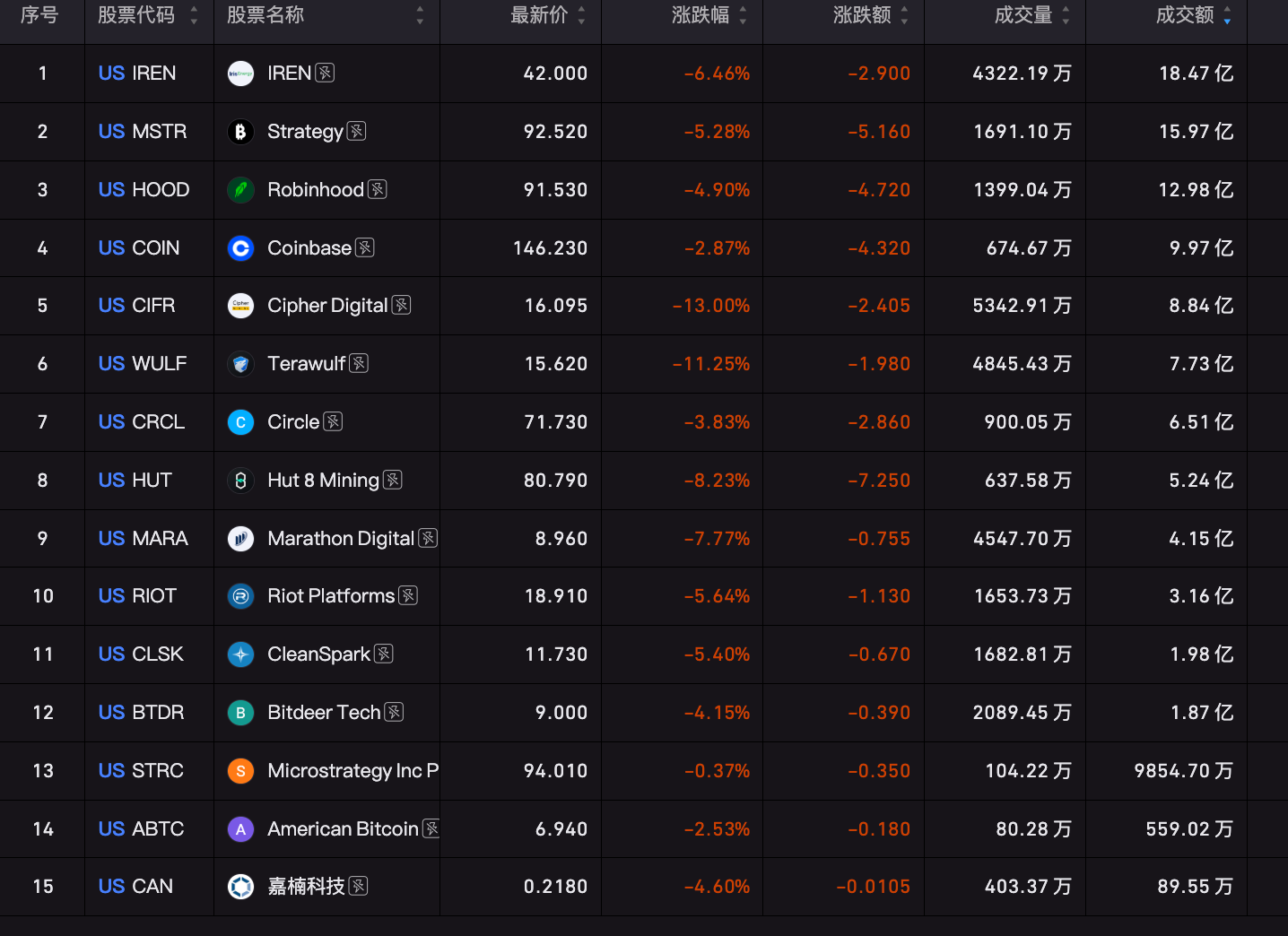
Cryptocurrency concept stocks fell sharply, according to BIT US Stocks data, with Coinbase down 2.87%, Robinhood down 4.9%, Strategy down 5.28%, and Circle down 3.83%.
In terms of mining companies, Cipher Digital plunged 13%, TeraWulf down 11.25%, Hut 8 down 8.23%, MARA down 7.77%, IREN down 6.46%; CleanSpark, Canaan, Rior, and Bitdeer fell by 5% to 5%. VanEck remains optimistic about the long-term value of certain mining firms transitioning to AI data centers, but short-term rate hikes, data center reviews, and AI capital expenditure concerns will suppress the sector.
Seoul and Tokyo Hit the Brakes, Chip Stocks Become the Core of the Asia-Pacific Sell-off, Yushu Technology's IPO Sets a New Benchmark for Humanoid Robot Valuation
High global bond yields and inflation worries over oil prices directly impacted Asian risk assets. The Korean KOSPI index closed down 5.80%, with chip stocks being a major drag; SK Hynix closed down about 10%, and Samsung Electronics fell nearly 8%. Despite significant revenue and net profits growth among South Korea's main board listed companies in the first half of the year (thanks to contributions from semiconductor leaders), short-term sentiment has been dominated by the sell-off in US bonds and stocks.
The Japanese market also opened low and went lower, with the Nikkei 225 index closing down 3.16%, and the TOPIX index also significantly dropped by 2%. Major tech giants like SoftBank Group, Tokyo Electron, and NAND flash memory manufacturer Kioxia faced intense profit-taking, with tech giants like SoftBank being doubly hit by valuation fluctuations and bond market volatility.
The A-shares opened low and trended down throughout the day, with the Shanghai Composite Index falling around 2.4%, the Shenzhen Component Index down about 5%, the ChiNext Price Index down more than 6%, and the Sci-Tech 50 Index at one point down nearly 7%, with more than 5,000 stocks across the board declining. Robotics, computing hardware, semiconductors, and MLCC concepts faced sharp declines, with many stocks hitting the daily limit down; coal and some shipping and banking sectors held up relatively well.
Yushu Technology became the strongest narrative and the largest source of volatility in A-shares, as the company's stock soared 629.44% on its first day of listing on the Sci-Tech Board to 1,100 yuan/share, with a total market value reaching up to 444.9 billion yuan before subsequently retreating to a 460% increase, approximately 845 yuan. Chairman Wang Xingxing's stake is worth over 100 billion yuan, making him the youngest billionaire born in the '90s. Lei Jun's Shunwei Capital, Liang Wenfeng's Depth Exploration, and Huanshan Quantitative also profited significantly. Nomura Securities gave it a "buy" rating, expecting a compound annual growth rate of 122% in revenue from 2026 to 2028. However, the robotics sector overall suffered a sharp downturn, with numerous stocks like Jiuqu Intelligent, Wuzhou Xingchun, and Qinchuan Machine Tools hitting the limit down, indicating that the market is rapidly switching between "leading excitement" and "sector retreat."
In the Hong Kong stock market, the Hang Seng Index rose slightly by 0.09%, while the Hang Seng Technology Index fell by 1.21%, with tech stocks broadly declining. MINIMAX fell about 8%, Baidu Group down about 11%, China Unicom, Hua Hong Semiconductor, and Cambridge Technology all seeing declines of around 12%. Kuaishou Technology released its second-quarter financial report for 2026, with revenue at 35.54 billion yuan and adjusted net profit at 3.91 billion yuan, both exceeding market expectations; the average monthly active users reached 800 million, significantly exceeding the estimated 740 million. Among them, Qiling AI performed remarkably well, with quarterly revenue exceeding 850 million yuan, growing over 200% year-on-year, leading the commercialization process of the global AI video generation industry. Despite stable performance, the internet sector in the Hong Kong stock market still faces significant selling pressure amid risk-averse sentiment.
Next Steps to Monitor:
August 19 (Wednesday)
The Seoul Artificial Intelligence Summit will be held from August 19 to 21: Tech leaders such as Google DeepMind, Google Cloud, Microsoft Research, NVIDIA, LG AI Research, and Hyundai Motor will attend. The market is focused on new collaborations in large models, AI clouds, autonomous driving, AI chips, and enterprise applications, with related signals possibly catalyzing the global AI software, cloud computing, chip, and robotics chains.
The World Robot Conference is being held in Beijing from August 19 to 23: Yushu, UBTECH, Siasun, Galaxy General, and Tian工 will showcase humanoid and industrial robot solutions. If production progress, order fulfillment, or cost declines exceed expectations, downstream manufacturers of decelerators, servos, motors, sensors, controllers, and whole machines in the A-share robotics chain may receive sentiment catalysis.
Hong Kong Stock Exchange, Kuaishou (19:00 conference call), Hengrui Medicine, ZTO Express, Kingsoft, Kingsoft Cloud, Weibo earnings: Focus on Kuaishou's e-commerce GMV, advertising recovery, profit margins, and AI video tools; Hong Kong Stock Exchange's focus is on trading volume, IPO reserves, and derivatives business; Hengrui Medicine verifies the overseas expansion and R&D realization of innovative drugs; Kingsoft Cloud serves as an elastic observation point for Chinese AI cloud demand.
August 20 (Thursday)
01:00 US Treasury 20-Year Bond Auction: Against the backdrop of soaring yields in last week's 10-year and 30-year bond auctions, the bid-to-cover ratio and overseas demand for this 20-year bond auction will serve as a "super stress test" for the bond market. If demand is weak, it may directly push the 30-year Treasury yield to exceed the 5.35% threshold, triggering severe chain reactions in the global fixed income market.
02:00 The Fed's July monetary policy meeting minutes: The market will carefully read the internal discussion details, especially regarding tolerance toward inflation (including energy-driven) and certain committee members' inclination to raise rates. If the wording is hawkish, long-term yields may rise further, increasing pressure on high-valuation assets like AI; if it shows growing concern over economic slowdown, it may ease the pace of rate hikes.
09:00 Announcement of China's one-year LPR: If previous July economic data is weak, whether or not the LPR is lowered will serve as a litmus test for policy attitude. A rate cut would benefit the real estate chain, consumption, Hong Kong stock internet, and high-dividend assets; if kept unchanged, the market may turn to wait for reserve requirement cuts, fiscal expansion, or further reinforcement of real estate policies.
20:30 US initial jobless claims: Employment data will affect Fed pricing together with previously weak non-farm payrolls. If initial claims rise, it will strengthen expectations for economic cooling and a pause in rate hikes in September; if employment remains strong, market confidence in "holding steady" may decrease.
Alibaba (20:00 conference call), Pop Mart, NetEase, Walmart, Ping An Insurance, China Telecom, AIA Insurance, Li Ning, Futu Holdings earnings: Alibaba is the number one focus among Chinese concept stocks, with attention on e-commerce GMV, cloud intelligence revenue, AI investment, and commercialization of Tongyi Qianwen; Pop Mart focuses on IP overseas, store expansion, and gross margin; NetEase verifies game revenue and AI tools; Walmart is a core barometer of US consumer resilience.
August 21 (Friday)
07:30 Japan's July Core CPI: If inflation exceeds expectations, expectations for the Bank of Japan's rate hike in September will rise, possibly leading to linkage volatility in the yen and global interest rate curves; if inflation retreats, it will alleviate the pressure to close out global carry trades and reduce upward pressure on global long-term rates.
08:00 South Korea's export data for the first 20 days of August: The previous value saw a year-on-year high of 52.3%, mainly driven by rising storage prices and AI chip exports. This data serves as a leading indicator for the continuation of the global semiconductor cycle and AI capital expenditures, directly affecting the sentiment of Samsung, SK Hynix, Micron, TSMC, AMD, NVIDIA, and the A-share semiconductor chain.
The second-quarter review results for the Hang Seng Index series will be announced: CICC predicts that Zijin Mining International, Zhizhi Technology, MINIMAX-W, and other targets are likely at the forefront of potential inclusion candidates. If the expectations for inclusion are met, it will bring passive capital allocation and short-term liquidity catalysis; if unmet, related targets may face profit-taking pressure.
NYMEX September crude oil futures will roll over: Against the backdrop of Hormuz risks and US sanctions expectations towards Iran, the rollover may amplify volatility in near-term contracts. If spot premiums widen, it will indicate tight physical supply; if price spreads converge, upward momentum in oil prices may weaken.
ZTE Corporation, Zijin Mining, Zhongji Xuchuang, Changfei Optical Fiber, Beike, and Sinopec earnings: Zhongji Xuchuang and Changfei Optical Fiber will verify demand for AI optical modules and optical fibers; ZTE focuses on computational networks and telecom capex; Zijin Mining is driven by gold and copper prices; Beike reflects recovery in China's real estate transaction chain; Sinopec is directly influenced by oil prices and refining margins.
免责声明:本文章仅代表作者个人观点,不代表本平台的立场和观点。本文章仅供信息分享,不构成对任何人的任何投资建议。用户与作者之间的任何争议,与本平台无关。如网页中刊载的文章或图片涉及侵权,请提供相关的权利证明和身份证明发送邮件到support@aicoin.com,本平台相关工作人员将会进行核查。


