
Author: Jim, MSX Maitong
Editor: Frank, MSX Maitong
The least valuable perspective in each quarter's 13F might be:
"Which stock did the big players buy again?"
Because the 13F is inherently a lagging snapshot of holdings.
According to SEC rules, institutional quarterly holdings can only be disclosed up to 45 days after the quarter ends. The latest round of 13F for the second quarter of 2026 reflects holdings as of June 30, while the deadline for concentrated disclosures has reached August 14. More importantly, the 13F primarily covers long positions in qualifying U.S. listed securities, and short positions in stocks may not be fully reflected.
Hence, it is not suitable for real-time "copying homework."
But from another perspective, the value of 13F is quite high—what are the truly large funds buying and selling in the past three months?
After sorting through, we discovered a key signal: AI is not fading away, but Wall Street is beginning to become "picky" about AI.
1. The AI consensus is still there, but the "herd consensus" is beginning to loosen
If you only look at a few star funds, it's easy to be misled by individual trades.
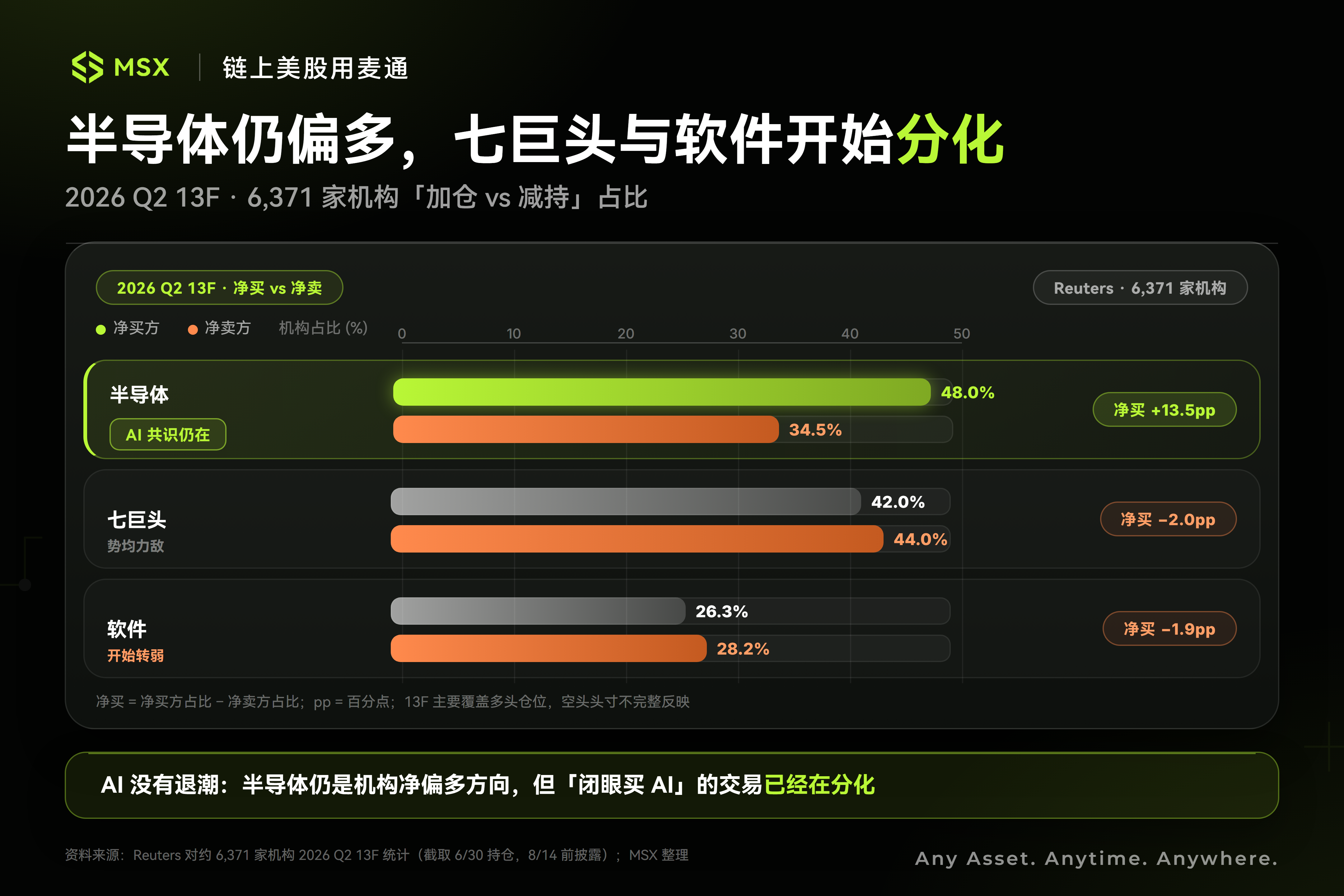
What truly deserves attention is the change in the entire institutional group; therefore, after Reuters analyzed the second quarter 13F submissions from 6,371 pension funds, hedge funds, wealth management institutions, etc., they found:
- Close to 44% of institutions reduced their holdings in the "Seven Giants," while about 42% of institutions chose to establish or increase positions, with both sides almost evenly matched;
- However, in semiconductors, the direction still appears significantly bullish: about 48% of institutions are net buyers, while net sellers only account for 34.5%;
- In contrast, software shows the opposite trend, with net sellers in a group of major software companies accounting for 28.2%, slightly higher than net buyers at 26.3%;
This indicates that the AI consensus still exists, but internal consensus is rapidly differentiating.
After all, if Wall Street truly starts to systematically deny AI, the first signs would be a consistent retreat in the semiconductor, computing power, and data center chains.
The reality is not the case.
Chips remain a clear preference for institutions, and AI infrastructure has not encountered systemic selling; large funds are merely starting to ask some questions that haven't been as crucial over the past two years:
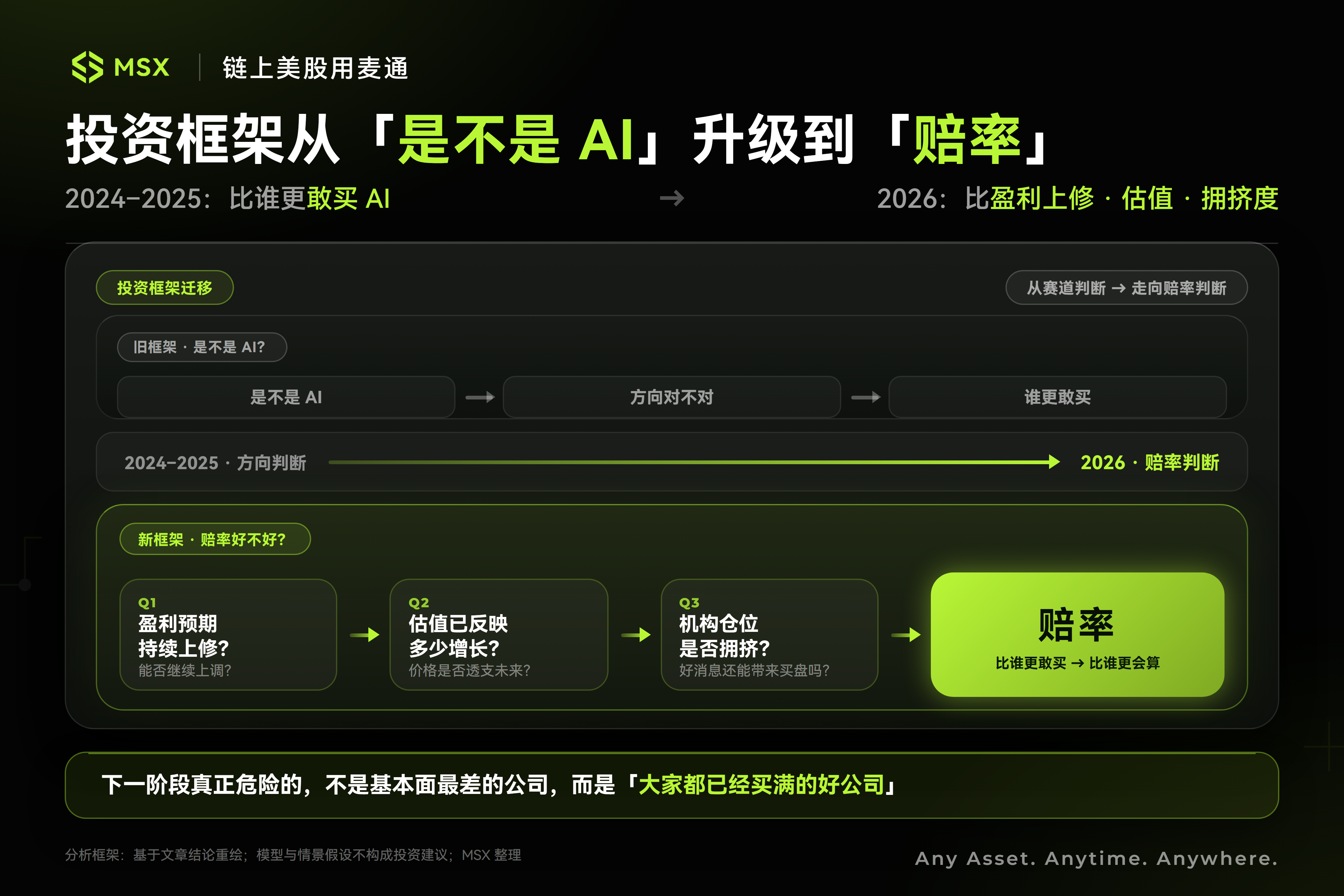
Is the growth of this company in the next two or three years already priced in? With continuing growth in AI CapEx, who can really convert capital expenditure into profit? If the market adjusts, which type of asset's institutional positions are the most crowded and most likely to be the first to be realized?
This is also the most significant change in the second quarter 13F; Wall Street is visibly starting to discuss "who has better odds within AI."
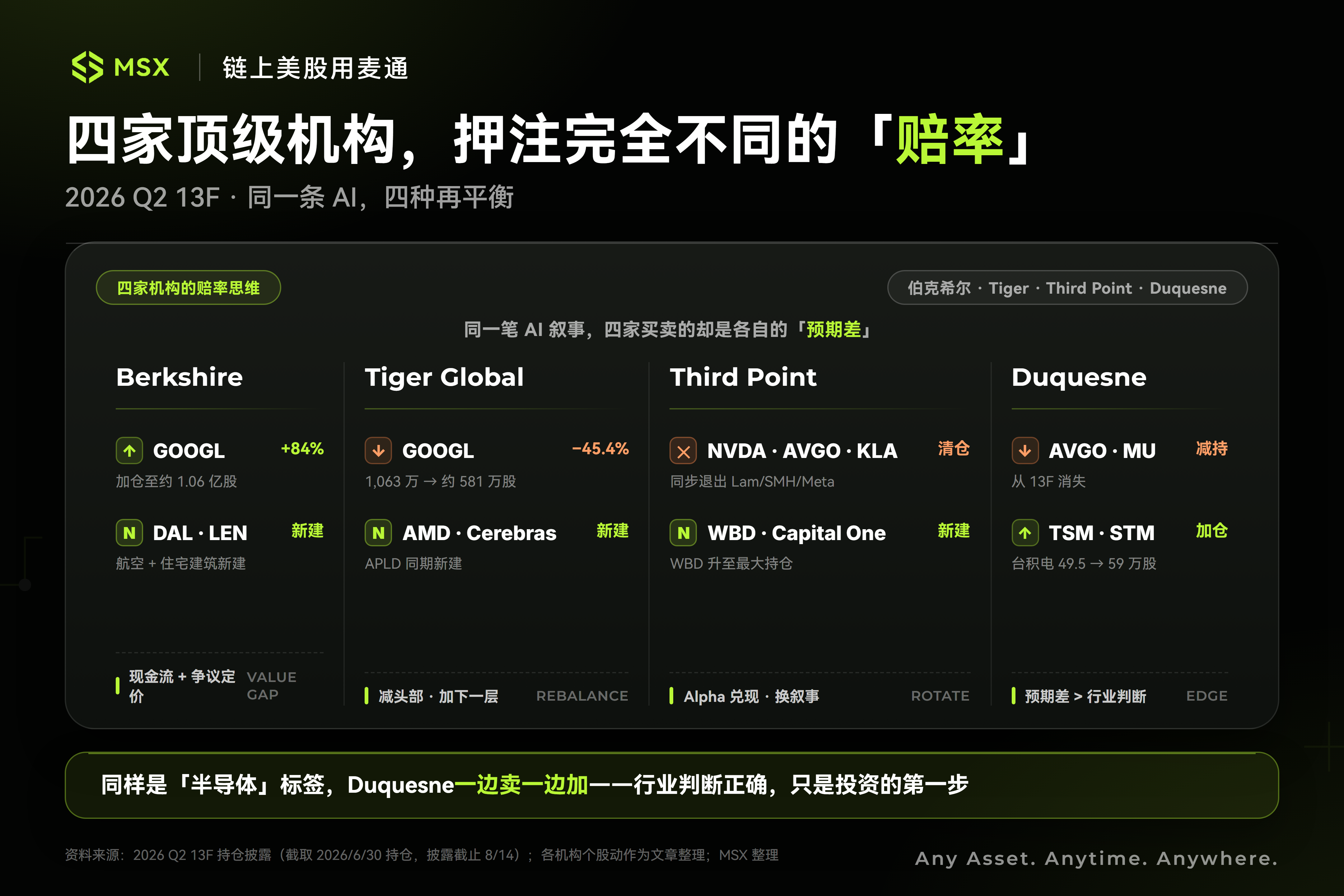
And Berkshire, Tiger Global, Third Point, and Druckenmiller's Duquesne just happened to provide four completely different answers.
2. Four institutions, four types of "odds thinking"
1. Berkshire: Starting to utilize cash, making a big bet on Google
Berkshire's actions concerning Alphabet in this 13F are particularly noteworthy.
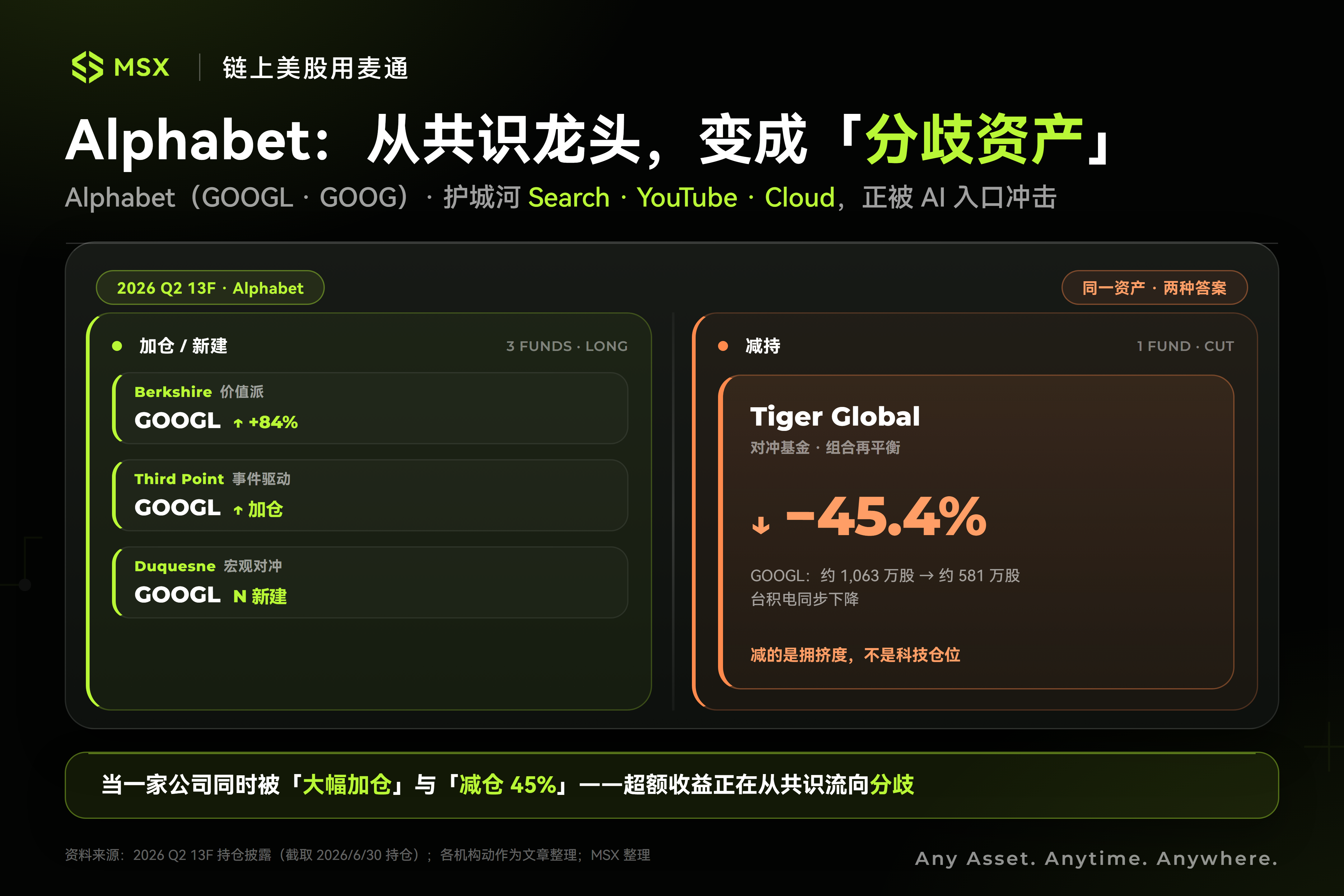
By the end of the first quarter, Berkshire reported holding about 57.84 million shares of both Alphabet Class A and Class C stocks; by the end of the second quarter, this number has risen to about 106 million shares, an increase of over 80%.
From the perspective of market capitalization at the end of the quarter, Alphabet has now risen to one of Berkshire’s most important publicly traded assets, and at the same time, Berkshire has also increased its exposure to aviation and residential construction, such as Delta Air Lines and Lennar.
It should be noted that Alphabet might be one of the companies among the Seven Giants that looks least like a "pure AI trade."
In recent years, one of the biggest concerns in the market regarding it has been whether generative AI will change the search entrance, even eroding the long-standing core business moat of Google Search.
On the other hand, Alphabet still possesses Search, YouTube, Google Cloud, advertising business, and a massive cash flow base.
Therefore, Berkshire's heavy bet is precisely whether a company with still strong cash flow, whose core business has not been invalidated, yet has faced ongoing disputes due to AI impacts, has a re-pricing potential?
This is entirely different from chasing the hottest AI winners.
2. Tiger Global: Reducing big tech, but still focusing on tech positions
Tiger Global’s portfolio offers another very typical sample.
In the second quarter, it reduced its Alphabet holdings from about 10.63 million shares to approximately 5.81 million shares, a decrease of 45.4%; its Broadcom holdings were also nearly halved, and Taiwan Semiconductor Manufacturing Company (TSMC) also saw a drop; along with Microsoft, Meta, and NVIDIA, which were all cut to varying degrees.
If you only look at this, it’s easy to conclude that "Tiger is starting to exit AI."
But looking at what it bought, the answer is almost completely the opposite.
Tiger established new positions in AMD, Applied Digital, Cerebras, etc., in the second quarter, while also adding assets related to AI computing power and data centers like Cipher Digital and Core Scientific; its Intel holdings increased from about 1.64 million shares to about 4.25 million shares.
So this resembles an internal rebalancing of AI positions—reducing extremely crowded top assets while reallocating some chips to the next layer of opportunities where market expectations are not yet so consistent.
NVIDIA serves as the most typical example. Just because a fund is bullish on AI computing power doesn't mean it must always increase its position in NVIDIA.
As long as the position weight is already sufficiently high, or stock price growth outpaces adjustments in profit expectations, reducing the position can simply be portfolio management rather than a reversal of industry logic.
This is also increasingly important for U.S. stocks; ongoing revenue growth does not necessarily mean stock prices will continue to rise in the same way as in the past two years.
Because what determines stock prices is not just "how good the results are," but also how much the market has anticipated beforehand.
3. Third Point: Starting to realize profits, searching for the next wave of AI opportunities
Daniel Loeb’s Third Point is even more distinct in its actions.
In the second quarter, it directly cleared NVIDIA, Broadcom, KLA, Lam Research, and the VanEck Semiconductor ETF (SMH), among other core benefiting assets in the AI capital expenditure cycle, while also exiting Meta.
If you only look at this set of trades, you might almost interpret it as a large-scale "AI reduction in holdings."
However, Third Point did not leave technology.
On the contrary, it clearly increased its holdings in Alphabet and TSMC, while establishing new positions in Keysight, Flex, etc.; at the same time, funds began to flow into media, finance, and industrial sectors such as Warner Bros. Discovery, Capital One, and Norfolk Southern. Warner Bros. Discovery directly became its largest publicly traded U.S. stock holding at the end of the second quarter.
So Third Point is actually realizing profits from the most easily understood winners of the first phase, while searching for opportunities in the next phase that are not yet fully priced by the market.
Why did NVIDIA, Broadcom, KLA, and Lam Research become the first-phase winners? Because their logic is too direct:
Scaling models requires GPUs; expanding advanced chip production needs semiconductor equipment; expanding AI clusters need networks, ASICs, and increasingly complex infrastructure.
These logics are not wrong.
The issue is, once all investors know these logics, what will determine the next phase returns is whether actual growth can continue to exceed already very high market expectations.
This also means that top investment institutions are beginning to believe that the most obvious alpha in the first phase of AI is becoming increasingly expensive.
4. Druckenmiller: Only trading expected differences
If you want to find a fund that most explains this round of institutional thinking, Stanley Druckenmiller's Duquesne might be the most typical example.
At the end of the first quarter, it still held Broadcom and Micron, but by the second quarter, both had disappeared from its 13F.
Yet, at the same time, Duquesne built positions in Alphabet, AMD, Palo Alto Networks, and continued to increase its holdings in TSMC and STMicroelectronics: TSMC from about 495,000 shares to about 590,000 shares, and STMicroelectronics from about 2.61 million shares to about 3.1 million shares.
At first glance, it might even seem contradictory; both are semiconductors, why sell one while buying another?
The answer might be precisely the most crucial keyword from this round of 13F: expected differences.
If a company rises too quickly, and the market has already factored in the growth for the next two or three years, even if the long-term industry logic remains correct, it can very much be realized in advance.
Conversely, if another company is undergoing a profit cycle improvement, while the market has yet to form a consensus expectation, then even if it is not the hottest AI leader, it may possess a better risk-reward ratio.
Judging the industry correctly is merely the first step in investment; determining valuation, location, and how much the market has already believed is what truly dictates the ultimate return.
3. From "buy AI" to "calculate odds," what is Wall Street trading?
Putting these four institutions together, the truly valuable signals begin to emerge.
First, Alphabet is transitioning from consensus leader to "discrepancy asset."
Alphabet might be the most interesting large tech stock in this round. Berkshire significantly increased its holdings, Third Point and Duquesne also chose to increase or re-establish positions, while on the other hand, Tiger Global directly reduced its holdings by almost half.
The same company received completely different answers from top funds.
The market is uncertain whether AI will ultimately weaken Google Search's moat or further unleash Alphabet's massive traffic, data, cloud computing, and computing power base.
Therefore, from this perspective, buyers see cash flow, valuation, and the potential increment brought by AI; sellers are concerned about changes in search entry, continually expanding capital expenditures, and the structural challenges that the old business model might face in the long term.
This type of asset is often more worth studying than companies that "everyone knows are good," because true excess returns fundamentally come from places where the market has discrepancies.
Secondly, the semiconductor consensus remains, but the phase of "blindly buying chips" has ended.
From the overall 13F perspective, chips are still a sector that institutions clearly prefer, with the net buyer ratio significantly higher than that of net sellers.
However, looking at a few star funds reveals tremendous internal differences. In Broadcom, some are reducing; in TSMC, some are increasing, and some are decreasing; in AMD, some institutions are re-establishing positions; NVIDIA has gradually shifted from being an almost uncontested AI core asset to a subject that now requires recalibrating position costs and crowding metrics.
This indicates that semiconductors can no longer be traded as a complete Beta.
GPUs, ASICs, wafer foundry, storage, semiconductor equipment, networks, and data center infrastructure all seem to belong to AI hardware, but their profit cycles, supply-demand positions, and valuation statuses are now completely different.
In other words, AI hardware is transitioning from "buying industry Beta" to truly competing in "individual stock Alpha."
Another easily overlooked change is that non-AI assets are re-entering the portfolio.
This is not to deny AI; rather, it appears to be a hedging operation to reduce correlation, such as residential construction, aviation, finance, healthcare, media, railroads, and industrial assets, which are reappearing in some top institutions' significant adjustments:
Berkshire increased its aviation and residential construction exposure; Third Point directed significant funds into media, finance, and railroads; and Duquesne's portfolio itself also extends well beyond just focusing on AI.
In a sense, precisely because AI has become the most conspicuous and easily understood mainline in the market, large funds increasingly need to seek revenue sources with lower correlations to AI.
In the past two years, getting the big direction of AI right has contributed a lot to returns, while moving forward, the importance of portfolio management will only increase.
This may be the most crucial point for ordinary investors to focus on in the latest round of 13F, helping us understand why this batch of the most intelligent and resource-rich funds begins to differ on certain issues when facing the same industry mainline.
In conclusion
In the past two years, the easiest transaction to understand in U.S. stocks was finding AI and then buying into it.
NVIDIA, Broadcom, Meta, Microsoft, TSMC, and the entire semiconductor industrial chain have all simultaneously enjoyed multiple dividends from industry growth, profit upgrades, and valuation expansion.
However, the latest round of 13F is sending an increasingly clear signal—AI is not over, but the phase of "as long as the direction is right, we can all rise together" is ending.
This is the most noteworthy change in the second quarter 13F of 2026:
AI is not retreating, but the herd is loosening.
The next phase will be about who is better at calculating odds, not who dares to chase more.
免责声明:本文章仅代表作者个人观点,不代表本平台的立场和观点。本文章仅供信息分享,不构成对任何人的任何投资建议。用户与作者之间的任何争议,与本平台无关。如网页中刊载的文章或图片涉及侵权,请提供相关的权利证明和身份证明发送邮件到support@aicoin.com,本平台相关工作人员将会进行核查。


