Author: Artemis Analytics
Translation: Deep Tide TechFlow
Deep Tide Introduction: The market views Circle merely as a stablecoin issuer, but the potential of its payment network and full-stack monetary platform has not yet been priced in. This article dissects Circle's moat and the $50 billion market capitalization scenario, serving as a key reference for investors focused on stablecoins and the payment sector.
Last week, we invited Lorenzo Valente from ARK Invest to our podcast to discuss why the market underestimates Circle. This week’s Thesis continues that line of thought.
Argument: The market perceives Circle's moat as weak, and views stablecoins as a commoditized product, believing that alliances like Open Standard will capture the majority share. We believe Circle's moat is deeper and harder to breach than the market perceives, and its first-mover advantage is underestimated.
Core driving factors:
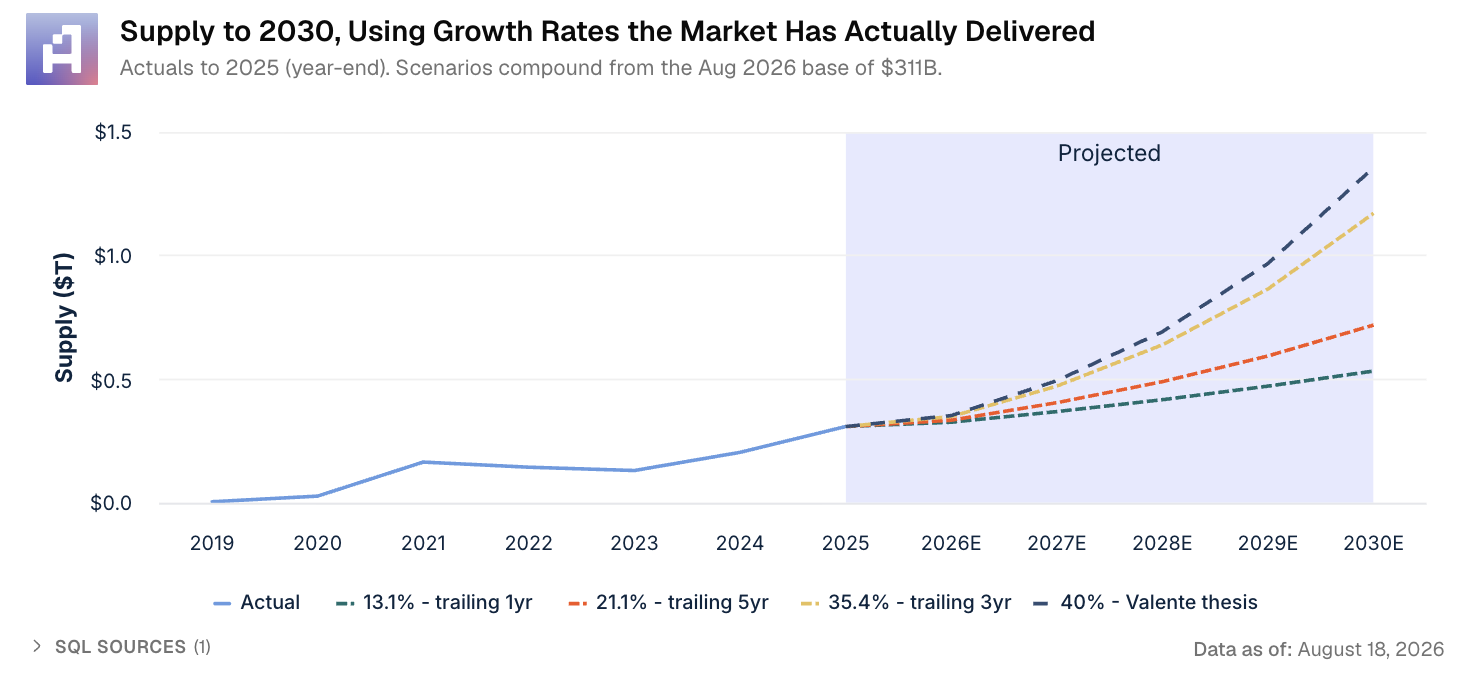
Stablecoins will grow at a 40% annual compound growth rate, exceeding $1 trillion by 2030.
The market shows a winner-takes-all dynamic in terms of liquidity and network effects, making it hard for alliances like OUSD to steal market share.
The market is pricing Circle as a stablecoin issuer rather than a full-stack monetary platform.
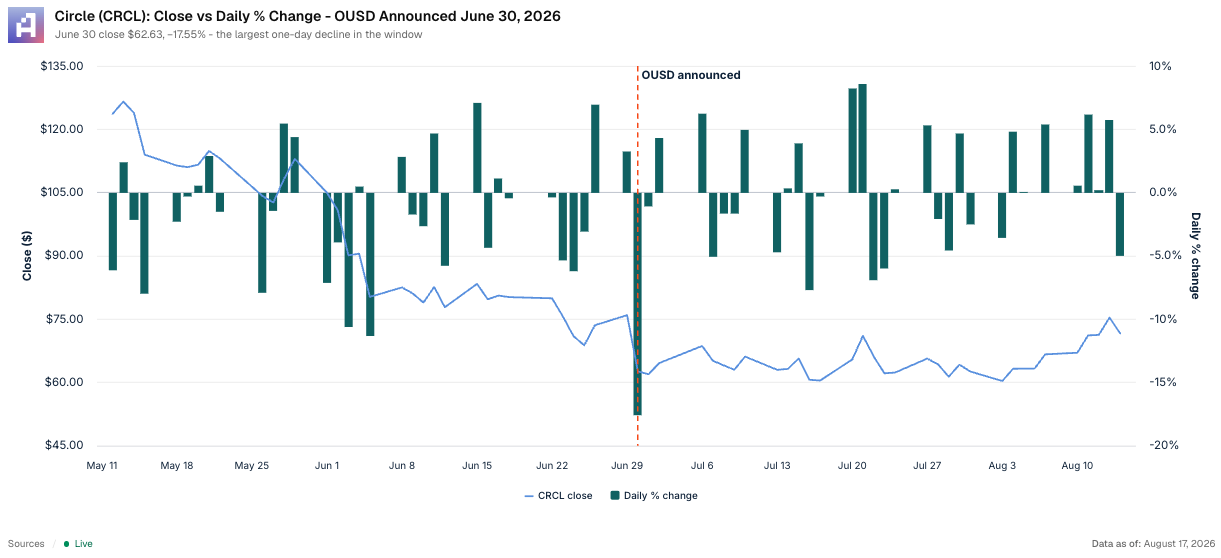
Circle's second-worst trading day in history occurred on the day Open Standard announced its formation. This is an alliance stablecoin backed by over 140 companies, including Stripe, Visa, MasterCard, and Google. After the news broke, Circle's stock price dropped 17%. The market's reaction is telling: Stripe will draw in various parties to overthrow the Circle/Tether duopoly and proportionally distribute stablecoin income among alliance members. This news drove the CRCL price close to its historical low.
Stablecoin Growth
We believe many investors do not think stablecoins can reach $1 trillion by 2030. They would point out the stagnation in stablecoin growth. However, stablecoin supply has decoupled from crypto prices for the first time in history. Despite a decline of 50-70% in crypto prices from recent peaks, stablecoin supply has remained stable, indicating that it has become a category on its own. If stablecoin supply continues to grow at the pace of the past three years, it will exceed $1 trillion globally by 2030.
The Stablecoin Market: Winner Takes All, Liquidity and Network Effects are Crucial
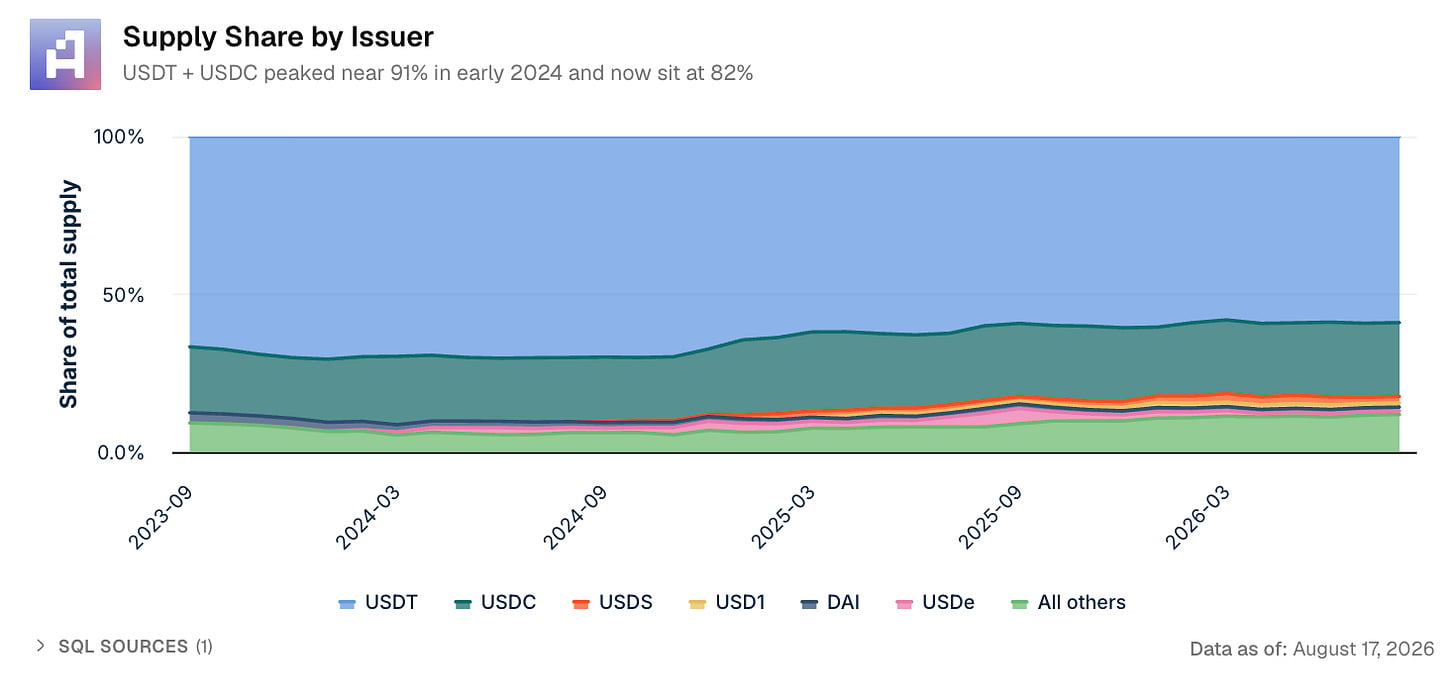
In recent years, dozens of issuers have tried to dismantle the Circle/Tether duopoly. Although hundreds of stablecoins have been issued now, these two giants still command over 80% of the supply share. The first-mover advantages obtained by these players are extremely difficult to surpass. The liquidity across chains, applications, and exchanges is hard to build from scratch, while Circle is already far ahead of challengers.
A Closer Look at OUSD
The market clearly considers OUSD to be a major threat to Circle's business. However, history shows that alliances are rarely successful. A successful alliance requires:
Alignment of incentives among members — OUSD has somewhat achieved this through interest income distribution.
Clear governance — Open Standard seems weak in this aspect, with several announced "partners" revealing they were not consulted and have not yet made commitments.
Survival pressure — I believe most institutions have not yet seen stablecoins as a matter of life and death, though Stripe may be an exception.
Therefore, based on the current information, Open Standard only meets about one-third of the necessary conditions.
Circle is Priced as a Stablecoin Issuer, Not a Full-Stack Monetary Platform
The market views Circle merely as the issuer of USDC. It underestimates Circle's revenue since that revenue is almost entirely interest income influenced by Federal Reserve policy.
In reality, Circle is building a full-stack monetary product for the future of the internet. At its core, it is a technology company.
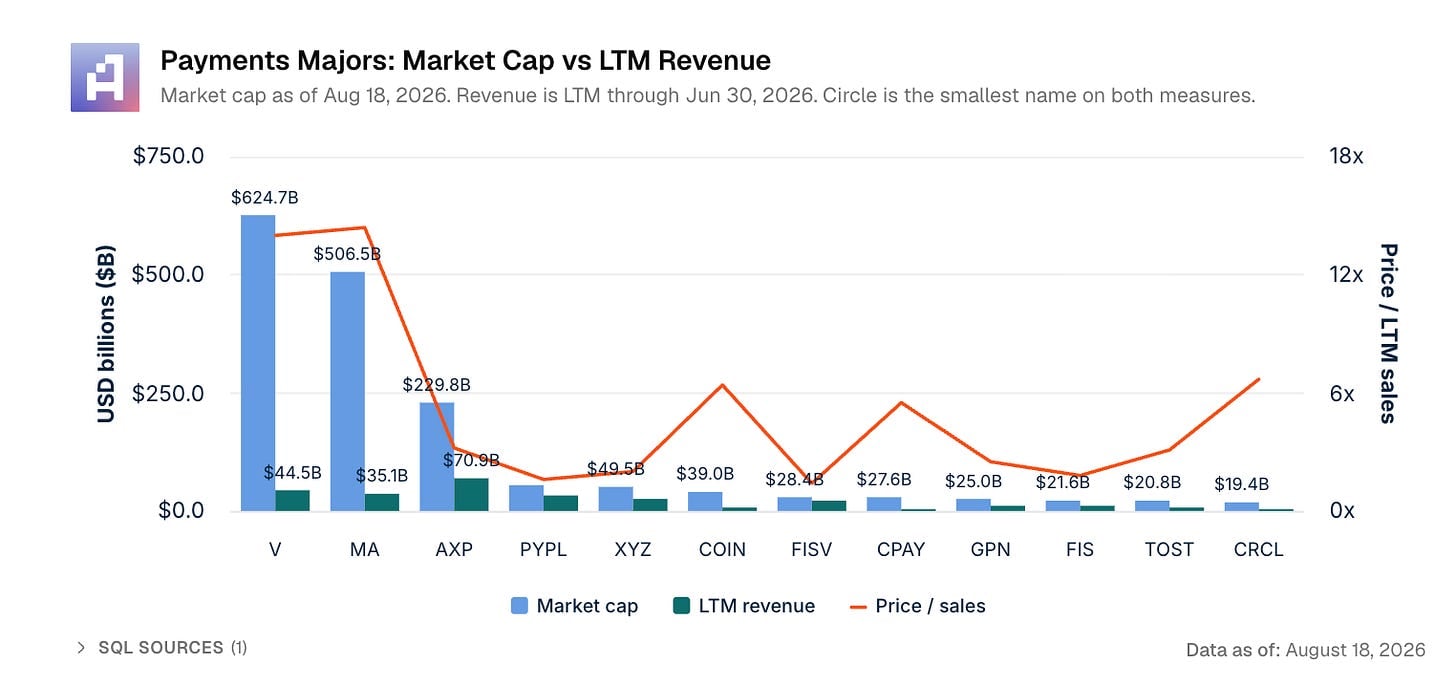
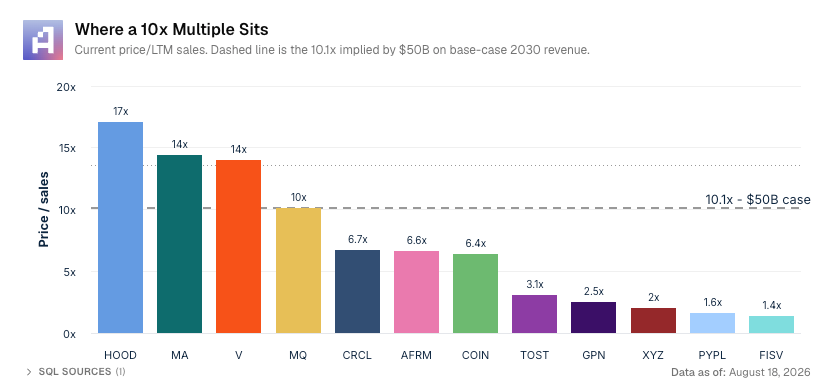
Circle’s valuation compared to other payment companies shows a significant gap. There is a clear disparity between credit card networks and other companies. If Circle builds the next generation of full-stack payment systems, its market cap and valuation will be closer to credit card networks, charging basis points on transaction amounts rather than relying on fund deposits.
Envision a $50 Billion Circle
Currently, Circle's annualized revenue is about $2.8 billion, with a valuation of $18 billion and a price-to-sales ratio of 6.7 times, far below payment networks (14 times) and high-growth fintech companies like HOOD (17 times). Its valuation multiple is nearly identical to that of COIN, which is primarily regarded as a cryptocurrency exchange.
The market sees Circle as a company that fluctuates with crypto cycles, with income sensitive to interest rates. Circle will shed this label and fragile income structure to achieve a higher valuation multiple — 10 times is conservative and reasonable.
If predictions hold true, and as we posit that liquidity and network effects form a strong moat, by 2030 stablecoin supply will reach $1 trillion with USDC holding 20% market share and interest rates at 2%, CRCL is expected to generate $4 billion in interest income.
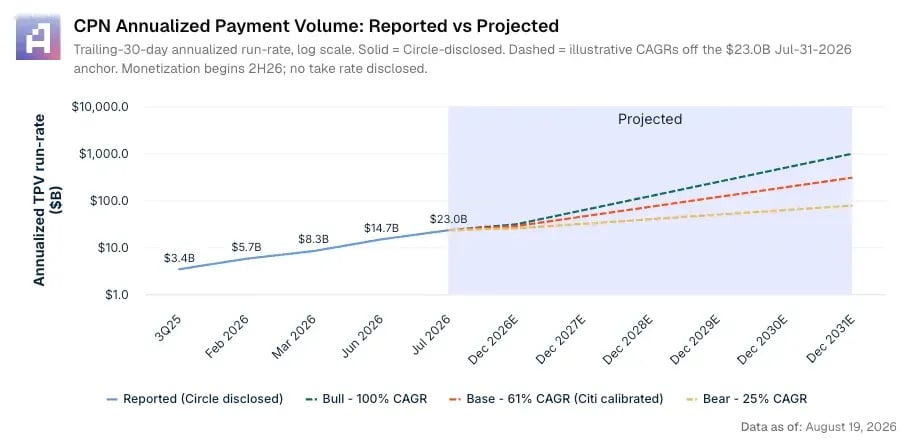
In terms of revenue diversification, Circle’s key growth products are beginning to show momentum, such as the Circle Payments Network. Despite ongoing declines in crypto prices and stablecoin supply leveling off, the transaction volume on Circle Payments Network is still growing explosively, with the latest disclosed annualized transaction volume reaching $23 billion by the end of July 2026 — a year-on-year increase of 6.8 times (the base is indeed quite small), with a quarter-on-quarter increase of 70%. If the growth rate maintains at 60-65% annual compound growth, by 2030, transaction volume will reach around $20 billion. At a 20 basis point fee rate, this will generate an additional $400 million in revenue.
Further looking at the Arc chain, if it reaches the scale of Tron (another chain focused on stablecoins), Arc will generate $500 million in fees.
The above estimates bring CRCL's revenue close to $5 billion, with 20% coming from the growing payment/settlement-related business lines, making such a combination reason enough for investors to assign a higher valuation multiple. Combining the above revenue growth and valuation multiple expansion, we get $5 billion multiplied by 10 equals $50 billion. A market cap of $50 billion for CRCL is not a far-fetched idea.
免责声明:本文章仅代表作者个人观点,不代表本平台的立场和观点。本文章仅供信息分享,不构成对任何人的任何投资建议。用户与作者之间的任何争议,与本平台无关。如网页中刊载的文章或图片涉及侵权,请提供相关的权利证明和身份证明发送邮件到support@aicoin.com,本平台相关工作人员将会进行核查。


