
Author: Jae, PANews
On August 19, during a press conference at the White House, a statement from Trump became a shot in the arm for the crypto derivatives market.
In a meeting with tech leaders and heads of regulatory agencies, U.S. President Trump stated that CFTC Chairman Michael Selig is advancing a special initiative aimed at bringing the Perp DEX Hyperliquid into the U.S. market in a "fully compliant and legal" manner.
After the news broke, the HYPE token surged by 20%, breaking through the $70 mark, with a market capitalization reaching $18 billion; its related U.S. stock DAT Hyperliquid Strategies (PURR) closed up over 30%, setting a record for the largest single-day increase since its listing.
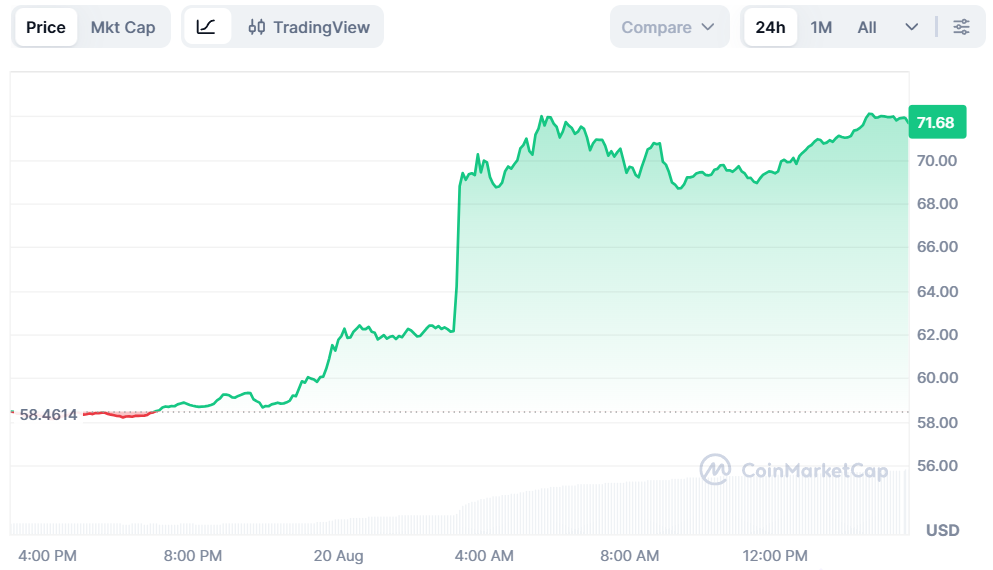
As a long-time leader in the on-chain derivatives market, Hyperliquid receiving public recognition from the White House signifies more than just a catalyst for market changes. If it is ultimately realized, it could mean that the U.S. regulatory system is beginning to attempt to incorporate the already scaled on-chain derivatives market into the domestic regulatory framework. In other words, the U.S. regulatory approach may be changing; rather than allowing offshore crypto derivatives giants to exist outside the regulatory boundaries, they might attempt to reintegrate their liquidity, trading activities, and pricing capabilities back into the U.S. market through rules and licenses.
Trump specifically names Hyperliquid, entering the White House "compilation list"
Trump's mentioning of Hyperliquid at a high-level political and business gathering was not casual; converting the offshore crypto derivatives giant into an onshore entity is a key approach for the White House to solidify global digital asset pricing power.
Hyperliquid has become a significantly important trading infrastructure. Last year, the protocol processed nearly $3 trillion in trading volume and has held a substantial market share in the Perp DEX space, already being a crucial player in the global derivatives trading market. The scale of Hyperliquid can no longer be regarded as simply a crypto project. From the perspective of regulators, allowing a derivatives market with such a trading volume and ongoing price discovery function to remain offshore and unregulated is not aligned with U.S. financial regulatory interests.
More critically, Hyperliquid's scope is no longer limited to crypto assets. In the second quarter of this year, trading volume for RWA (real-world assets) perpetual contracts on the platform reached $213 billion, with asset categories expanding from crypto assets to oil, gold, U.S. stocks, and even Pre-IPO items. This means that Hyperliquid's main business has surpassed the scope of a "crypto exchange" and has begun to penetrate the commodities and securities derivatives sectors, which is precisely where U.S. regulators are most concerned.
In fact, the U.S. has already started paving the way for the compliance of perpetual contracts. In May of this year, the CFTC approved the prediction market Kalshi to launch the first regulated Bitcoin perpetual contract in the U.S., while allowing Coinbase to connect American users to Deribit's crypto options and perpetual products.
This series of actions may have released a signal: Washington's positioning of perpetual contracts is shifting from "gray products outside the U.S." to "financial tools compatible within a regulatory framework." And Hyperliquid being named may just be a natural extension of this regulatory direction.
From a larger regulatory context, this also reflects a pragmatic choice from the executive branch. The comprehensive legislative push at the congressional level through the “Clarity Act” has been obstructed, prompting the Trump administration to rely on the SEC (U.S. Securities and Exchange Commission) and CFTC to fill regulatory gaps one by one through rule clarification and product approval. When the legislative path is blocked, the administrative regulatory path is accelerating.
On August 20, the CFTC will hold its first Innovation Advisory Committee meeting, covering topics related to crypto assets, artificial intelligence, and prediction markets. Trump’s connection of Hyperliquid with the CFTC at this time carries significant policy implications.
Top lobbyists move step by step, Hyperliquid knocks on the door of regulatory dialogue
Trump’s statement seemed sudden, but in reality, Hyperliquid has been in contact with the U.S. policy circle for several months.
A key player bridging Hyperliquid and Washington is the Hyperliquid Policy Center (HPC) and its Chief Policy Officer Adam Minehardt.
Minehardt’s background can be described as "top-notch Washington lobbying". He served nearly 17 years in the U.S. House of Representatives, worked for 3 years at the Federal Reserve Board, deeply understands the operational logic of bipartisan legislation and administrative regulation; after transitioning to the private sector, he became the Director of Federal Government Affairs at Citigroup, responsible for policy communication with banks and regulators; after crossing into the crypto field, he served at Stellar Development Foundation and Chainlink Labs, representing Chainlink at the White House's digital asset strategy meeting; in 2023, he officially became a member of the CFTC Global Markets Advisory Committee's digital assets subgroup, and has been named one of Washington's "top lobbyists" by The Hill for several consecutive years.
This high-level background explains why HPC was able to swiftly enter the U.S. crypto policy discussion circle just months after its establishment.
Founded in February of this year, HPC is not positioned as a traditional industry association but as a research and advocacy organization dedicated to promoting a regulatory framework for the on-chain derivatives market, focusing on perpetual contracts and on-chain financial infrastructure.
In terms of actual actions, HPC has been paving the way for Hyperliquid's entry into the U.S. market over the past six months:
In April, HPC submitted comments to the CFTC regarding prediction market rules;
In July, HPC co-operated with wallet Phantom to urge the CFTC to adjust regulatory rules for on-chain trading infrastructure;
In the same month, HPC collaborated with Multicoin Capital to submit comments to the CFTC, pushing for a clear regulatory framework for on-chain prediction markets;
In August, HPC submitted a statement to the CFTC’s Agricultural Advisory Committee advocating for clearer regulations on crypto derivatives.
Minehardt has also stated publicly several times that one of HPC's goals is to enable U.S. users to ultimately access on-chain markets such as Hyperliquid legally.
From a timeline perspective, Trump mentioning Hyperliquid this time isn't completely unexpected. The continuous communication between HPC and the CFTC, as well as the Washington policy circle over the past few months, likely laid the groundwork for this "naming."
"Naming" is easy, entering the U.S. requires overcoming "three hurdles"
It is worth noting that Trump’s mention is merely an expression of personal stance and not a final approval; the real implementation still requires the establishment of a new regulatory framework, which carries a high degree of uncertainty, and there is considerable opposition to Hyperliquid entering the U.S. market.
If Hyperliquid truly hopes to enter the U.S. market, it will have to face challenges from traditional financial interests, jurisdictional divisions, and decentralized models.
Pushback from traditional exchanges
At the forefront are the objections from traditional financial giants. In May, CME Group and ICE jointly expressed concerns to the CFTC and Congress regarding Hyperliquid. The two exchanges believe that Hyperliquid's offshore attributes and anonymous trading environment could foster risks such as price manipulation and evasion of sanctions, potentially impacting regulated markets. However, ICE CEO Jeffrey Sprecher revealed in May that the two parties had conducted multiple meetings to explore business overlaps and potential collaboration opportunities.
Essentially, this is a game of vested interests. Once on-chain perpetual contracts enter the U.S. with compliant status, leveraging the advantages of 24/7 trading, low barriers, and high flexibility, Hyperliquid could significantly divert trading volume from CME and ICE. The lobbying resistance from traditional giants will be a long-term variable on its path to "onshoring."
CFTC and SEC jurisdictional divisions
The internal division of responsibilities within the regulators represents another invisible barrier. More than 32% of Hyperliquid’s trading volume in the second quarter came from RWA perpetual contracts involving U.S. stocks, which are easily subject to SEC regulation. If classified as unregistered securities derivatives, this would face scrutiny or enforcement from the SEC, rather than being solely under CFTC jurisdiction.
The division of regulatory authority over crypto assets has long been a complex issue in the U.S., and the involvement of RWA perpetual contracts, which traverse between crypto and traditional assets, may further amplify regulatory ambiguities. The friction between different departments may also slow down the pace of Hyperliquid's compliance to enter the U.S.
The inherent contradiction between decentralization and compliance
The biggest challenge lies in the conflict of product DNA.
The CFTC's requirements for compliant trading platforms include strict identity verification (KYC/AML) and trading monitoring. Conversely, Hyperliquid's appeal is built on a decentralized foundation of self-custody, permissionless, and anonymous trading.
If Hyperliquid adopts KYC to enter the U.S. market, it would be equivalent to giving up one of its most important competitive advantages, potentially leading to significant loss of native crypto users. If it insists on the permissionless model, it will not be able to meet basic compliance requirements. This is a trade-off concerning product positioning and market expansion, and a soul-searching question all DeFi protocols will face on their journeys toward “onshoring.”
Regardless, for Hyperliquid, Trump’s statement is a significant political endorsement, but there remains a considerable compliance gap before it can truly enter the U.S. market.
What the U.S. wants may be more than just Hyperliquid
When viewed in a broader industry context, the U.S. may desire more than just Hyperliquid.
In recent years, more and more on-chain financial products have formed real trading scales, including perpetual contracts, prediction markets, RWAs, and on-chain derivatives, continually expanding market boundaries.
For the U.S., the question is shifting from "whether to allow innovative financial products to exist" to "how to incorporate new markets into the U.S. financial system." This involves not only regulation but also the future market liquidity, pricing power, and competition for financial infrastructure in the digital asset market. CFTC Chairman Michael Selig has also stated that the U.S. must actively lead the rule-making for the next generation of financial markets and crypto assets, or else the dominance of global financial innovation will be seized by other countries.
The real test facing the U.S. regulatory system is: can it attract back the on-chain financial infrastructure that has already been scaled overseas without sacrificing market stability and investor protection?
If this path is ultimately successful, Hyperliquid may be the first large on-chain derivatives platform to truly complete “onshoring.” However, from a longer-term perspective, what truly determines Hyperliquid's valuation and industry status will not be a statement from the White House, but whether it can find a compliance path that aligns with U.S. regulatory requirements without sacrificing its competitive advantages in the on-chain market.
免责声明:本文章仅代表作者个人观点,不代表本平台的立场和观点。本文章仅供信息分享,不构成对任何人的任何投资建议。用户与作者之间的任何争议,与本平台无关。如网页中刊载的文章或图片涉及侵权,请提供相关的权利证明和身份证明发送邮件到support@aicoin.com,本平台相关工作人员将会进行核查。


