Original|Odaily Planet Daily (@OdailyChina)
Author|Wenser (@wenser 2010)
Overnight, the entire crypto market rebounded, and HYPE became one of the brightest players among them.
As of the time of writing, the HYPE price is reported at $73.9, with a 24-hour increase of 26.86%. It is less than $3 away from its new high price of around $76.5, ending nearly two months of oscillating decline.
As for the positive factors behind it, aside from those mentioned in our previous articles such as "From Hedge Funds to Family Offices, Who is Quietly Increasing HYPE Exposure Through PURR?" and "The Eve of HYPE's Explosion: AQAv2 Starts Accrual This Month, HIP-4 Ready to Go", including factors like Wall Street’s entry and Hyperliquid's ecosystem growth, the most direct positive news is the statement made by Trump at a White House meeting last night: "The Chairman of the CFTC is pushing for Hyperliquid to enter the U.S. in a fully compliant and legal manner". Considering the earlier news about "Hyperliquid's Policy Center jointly proposing with trade.xyz for the SEC to introduce perpetual contracts prior to IPO," it seems the process for Hyperliquid to enter the U.S. market in a compliant way may be faster than the market anticipates.
A silent battle over "U.S. compliant on-chain Perp DEX" and "pre-listing pricing power in U.S. stocks" has quietly begun, and Hyperliquid is the "best driver of the industry".
Hyperliquid Becomes a Popular Option for U.S. Compliant On-Chain Trading Platform: Trump Affirms, CFTC Chairman Works Hard to Promote
For Hyperliquid and HYPE, the most immediate positive factor is undoubtedly Trump's endorsement.
As the midterm elections approach, Trump has started a new round of political campaigning and propaganda, positioning the crypto industry as a prime example of his "Make America Great Again" narrative. Importantly, he views various regulatory improvements in the crypto industry as a significant measure to "encourage innovation, compete for financial, crypto, and technological leadership".
As a trading platform currently under close attention from both the traditional finance sector and the crypto market, Hyperliquid's industry status and liquidity scale are undoubtedly the best cases. Hyperliquid, however, did not wait idly by; it has already started actively lobbying and pushing for compliance to enter the U.S. market.
Hyperliquid Policy Center and trade.xyz Actively Lobby the SEC: Opening Regulatory Doors for Pre-Listing Contracts
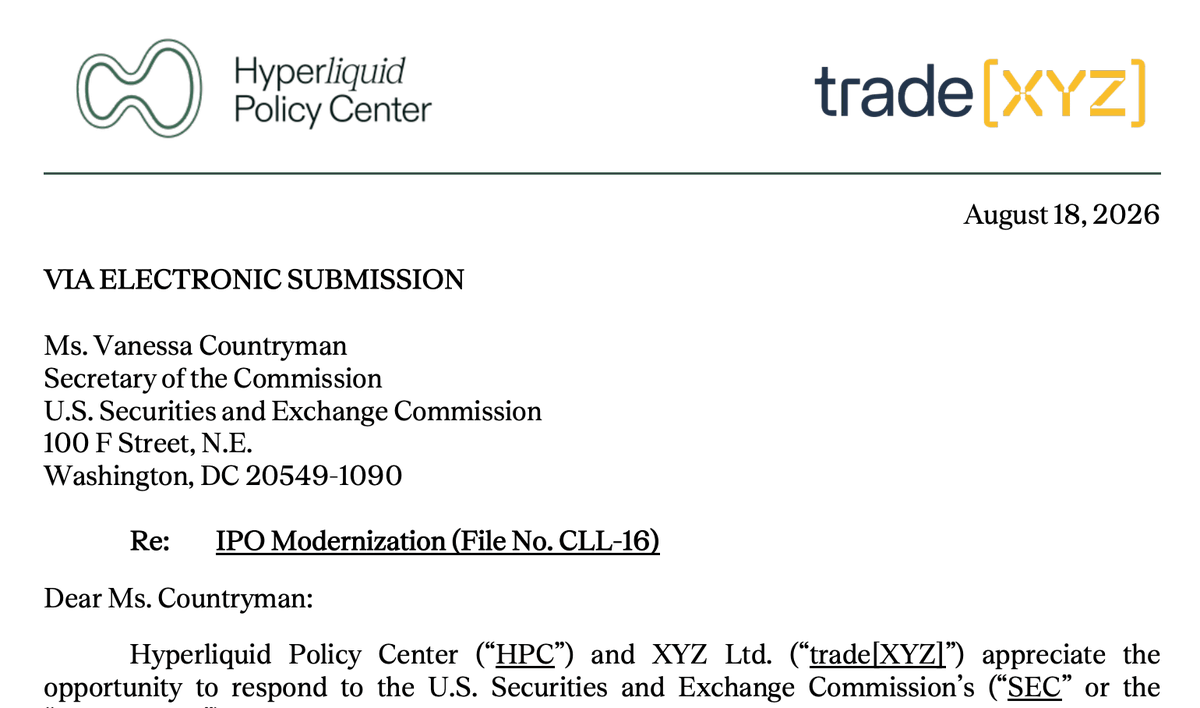
On August 18, Hyperliquid Policy Center and trade.xyz jointly released a letter of opinion submitted to the SEC, proposing to include the IPO pre-listing perpetual contract IPOP in the framework of IPO modernization reforms, allowing investors to trade their exposure to stock prices through perpetual contracts before the official listing of a company, thus forming a public and continuous market pricing.
Here, the "IPOP" does not represent company shares, nor does it grant holders voting rights or other shareholder rights; it only provides price exposure and will end its pre-IPO function after the related company officially lists.
Trade.xyz stated that it has completed 5 IPOP markets on Hyperliquid, including Cerebras, SpaceX, SK Hynix, and Changxin Memory; the pre-listing prices formed in some cases are quite close to the opening price after the stocks are listed, providing additional public price discovery signals for issuers and underwriters.
Both parties also suggested that the SEC and CFTC clarify the regulatory classification of equity perpetual contracts and establish rules on information disclosure, listing qualifications, market manipulation prevention, as well as leverage and position limits, with the ultimate goal of allowing U.S. investors, including retail investors, to participate in the IPO pre-listing perpetual contract market.
Earlier this year in March, S&P Dow Jones Indices officially authorized trade.xyz to use the S&P 500 Index to launch on-chain perpetual contracts for qualified non-U.S. investors; on May 26, SEC Chairman Paul Atkins initiated the CLL-16 proposal, inviting the market to discuss reforms to IPOs, direct listings, and other methods of going public.
On July 14, the Hyperliquid Policy Center, trade.xyz, and Sullivan & Cromwell officially met with the SEC's Crypto Task Force to introduce the Hyperliquid protocol, technology, and HIP-3 market.
In the struggle for pre-listing pricing power in the U.S. stock market, Hyperliquid's past performance and mature process systems provide ample evidence for the reliable price discovery mechanism that follows such lobbying.
Just as the former CEOs of Robinhood and founders of Uniswap have mentioned, "tokenization reshapes the global financial industry," regardless of the traditional finance sector's attitude, transforming traditional financial assets through on-chain trading platforms has become a reality; the only difference lies in whether regulators can take the initiative to intervene, clarify boundaries, and manage rules. This is the true historical trend.
The CFTC Chairman Becomes a Major Force in Promoting Hyperliquid's Compliance Entry into the U.S.: Hyperliquid’s "Invisible Connections in Washington"?
Apart from actively lobbying, Hyperliquid's other major "ally" is the current CFTC Chairman Michael Selig, who Trump mentioned as responsible for promoting Hyperliquid's compliance entry into the U.S.
On August 14, Michael Selig had announced in advance that the CFTC Innovation Advisory Committee's first meeting would be held on August 20 in Washington, focusing on discussions regarding the regulation of crypto assets, artificial intelligence, and prediction markets, which will be streamed live on the CFTC's official website.
This morning, at the White House cryptocurrency meeting, he reiterated that more details will be shared regarding the CFTC Innovation Advisory Committee's inaugural meeting tomorrow, which will provide greater certainty for innovators and boost confidence in the market for decades to come.
Selig added: "Innovation relies on regulatory clarity. Clear rules bring confidence, confidence attracts investment, investment creates jobs, strengthens our market, and attracts top global talent to stay in the U.S. to build."
Previously, platforms like Kalshi and Coinbase developed derivative contract trading also under the regulatory approval of the CFTC and Selig. It is not an exaggeration to say that Selig and SEC Chairman Paul Atkins can be considered as "two leading advocates for the Trump administration's crypto regulatory friendliness," particularly active in derivatives trading regulation.
Additionally, Selig has a considerable background with Hyperliquid.
According to Hyperliquid community member Dongdongfus, last year in May, Hyperliquid Labs submitted two opinions on the regulation of perpetual contracts to the CFTC, which were drafted with the assistance of former CFTC Chairman Giancarlo as a legal advisor; Giancarlo and Selig were in a mentor-mentee relationship at the CFTC in earlier years, and they also worked together at Willkie Law Firm for three years. Notably, Selig had just left that law firm two months prior to Hyperliquid Labs submitting the opinion letters. Coincidentally, before Selig took office as CFTC Chairman, Giancarlo had publicly supported his "apprentice" multiple times.
In this way, Hyperliquid successfully connected with the current CFTC Chairman through the legal advisor role of the former CFTC Chairman, potentially obtaining a "compliance entry into the U.S." regulatory ticket.
In this regard, Alex Thorn, head of Galaxy Research, also expressed keen interest, stating that he is very interested in the issue of "how Hyperliquid will achieve compliance". Comments suggested that it might adopt a HIP-3 whitelist or operation schemes similar to those of platforms like Kalshi and Coinbase, such as opening derivative trading functions after conducting KYC. Currently, the specific operational path still needs to be discussed.
Exploring the Operational Path for Hyperliquid's Compliance Entry into the U.S.: Clearing Cooperation, Asset Introduction, and Starting Anew
Having discussed the positive news, Odaily Planet Daily will now talk about the reference paths Hyperliquid might take to truly achieve compliance in entering the U.S. market.
The first option, in terms of operational difficulty and market efficiency, is undoubtedly more realistic to adopt a "clearing layer entry cooperation + back-end technical support" scheme.
In simple terms, Hyperliquid can cooperate with already licensed U.S. DCMs, FCMs, or clearing institutions, allowing the latter to access Hyperliquid's execution/clearing layer, with the partner responsible for KYC, client protection, and reporting, while Hyperliquid mainly handles the on-chain processing flow that aligns with settlement. This is also the path more publicly expressed by Hyperliquid Policy Center's CEO Jake Chervinsky, rather than building a new U.S. trading platform from scratch.
The second option, from the perspective of product realization and asset access, could involve "a regulated trading platform listing assets on the Hyperliquid platform."
In simple terms, the related assets and data of the Hyperliquid platform could be integrated with compliant trading platforms like Coinbase, Kraken, and Kalshi, bundling on-chain assets into compliant trading platform assets, similar to adding a front-end entry, transforming the HIP-3 and HIP-4 Builder mechanism into "compliant cooperation".
The third option, from the perspective of profit sharing and brand maintenance, is also the most challenging and least efficient scheme, which is for Hyperliquid to acquire or rebuild a new compliant trading platform aimed at the U.S. market. Similar to Polymarket's acquisition of QCX. This also means Hyperliquid needs to build KYC-compliant U.S. infrastructure or a complete DCM from scratch, sacrificing core advantages like permissionless and self-custody.
It’s worth mentioning that the CFTC cannot unilaterally bypass core domestic investment regulatory principles (such as customer protection, anti-theft, anti-money laundering) for Hyperliquid, but it can lower the compliance difficulty of on-chain models through interpretation of existing Commodity Exchange Act (CEA) core principles, no-action strategies, or rule-making.
Based on the available information, Hyperliquid still requires at least three to five months, or even longer up to a year, of preparation to achieve compliance in the U.S. However, regardless of the timeline, from the perspective of financial innovation and crypto regulation, "Hyperliquid's compliance entry into the U.S." has already entered a substantive promotion stage, and the price ceiling of HYPE has also gained more momentum, likely to once again set a historic high.
免责声明:本文章仅代表作者个人观点,不代表本平台的立场和观点。本文章仅供信息分享,不构成对任何人的任何投资建议。用户与作者之间的任何争议,与本平台无关。如网页中刊载的文章或图片涉及侵权,请提供相关的权利证明和身份证明发送邮件到support@aicoin.com,本平台相关工作人员将会进行核查。